

Alexander Grabovetskiy, woodcarver, School of Woodcarving · Published 2020
What does a wood carver mean by "not what I planned"?
Quick answer: In Venice Room 84.7 I said I had an eye on my piece, called it wrong and called it a mistake. Other lessons of mine say the same kind of thing about a bigger eye or a slope, and about a surface that looked better.
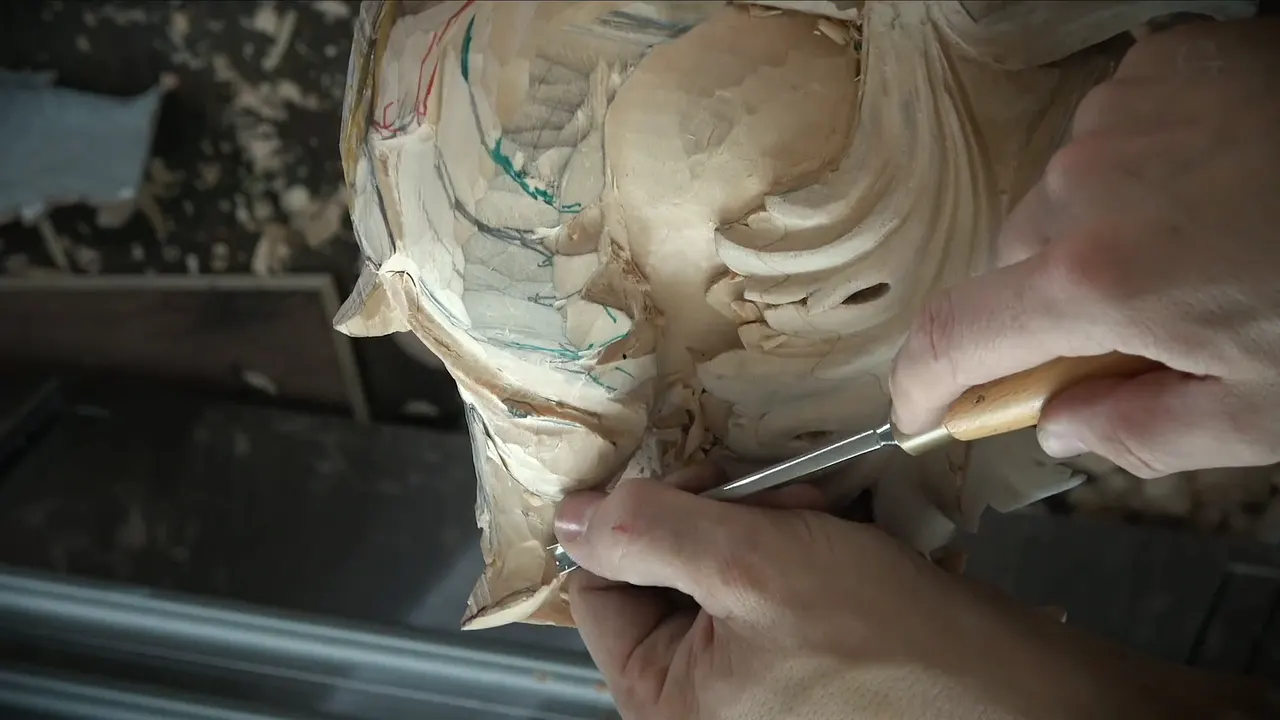

In workshop 84, part 7, I had an eye on the piece, called it wrong, and called it a mistake. Other lessons of mine say the same kind of thing about a slope or a notch, and about a surface that came out better.
Ever stood over a block and seen a cut that is not the one you drew? Does that sinking feeling make you want to put the tool down? Stay with this one part of workshop 84, where I say it out loud, and then walk with me through lessons from my other courses where I said it again.
How does part 7 begin?
Part 7 opens with a tool choice. "Probably clean it with the number seven," I said, then "Just one side of the number seven." The cut was "not final clean cut, but approximately." Next: "Here you go. So now I can remove a lot more material underneath right here."

You would see it "develop right before your eyes," I said, and "It's supposed to be beautiful."

Why was I so careful with a number nine?
"I'll take number nine." Then "And again, see? Have to be super careful how I do it." And: "Maybe I should use a smaller number nine, number nine or number eight will work." My plan was a number eight with a quarter inch (about 6 mm): "So let me do with the number eight and the quarter inch."

The grain comes into it. If you would ask why that is challenging, I said, the answer is "Because of the grain." And then a dare: "Just try to do something like that, and you will understand exactly what I mean by that."
It is "super easy to break while carving, of course. It's going to be strong once it's done, but while carving, it's easy to do some mistake and break it." And: "If I would just continue to carve, I would just lose that section right here." Then "Do I want to lose it? No, I'm not."

How thin did it get?
About "this side" I said it was going to be "also exactly the same, but got to be careful again." And "maybe the final shape I'll do a little later," I said, adding that I would leave it "somewhat rough for now."

Then a figure. "All right, so I've got approximately, what, about five millimeters thickness, about 3/16 of an inch thickness." Next: "Can't do anymore. Don't want to do anymore. Of course, I can do it, but I don't want to do it anymore because it would be a really bad idea."
I named "Number seven, 14 millimeters," about 0.55 in, and said "That's what I'm using." After "That is enough," I said "So now what I can do, I can start developing concaves and convexes."

What happened with the eye?
The part moves on with "Go in that direction." Then comes the line you came for: "I do have an eye, that's actually wrong, it's not what I planned, just made a mistake, there's not supposed to be any eyes." Next: "There should not be any eyes."

The reason was a movement. "Because that is a part of one movement, and it's going this way, and this repeats right here." And "this eye doesn't really make any sense."
Next came a plan, a gouge named out loud: "let me take number 11 and 3 millimeters and create a cut, hope I wouldn't lose it." That is 3 mm, about 1/8 in. A short verdict followed, "that was my mistake." Then another plan: "let me take number 11 and blend this ridge underneath."

Next, an apology for covering up. "I'm sorry if I'm covering up." "Let me show from the right position, but you can't really see." "I apologize, but if I'm going to do it where you see it, I'm going to cover it with my body." Then came "But I really need to carve it."

Then: "Okay, let me see. Yeah, that is much better." I added "I could actually do even more," and "there is no concaves and convexes yet."

What do parts 6 and 8 say about an eye?
Right before it sits part 6. There I said "Let me now create an eye. And where do I now do it? Probably somewhere right here." Another line from part 6 is "And let me make it deeper right away." I added "I usually am kind of afraid of doing deeper right away, but I think in this case I could do." The fear had a reason: "I'm afraid because if the eye position in the wrong place, it's always a chance."
Part 8 opens on a pencil mark. "I need to get rid of this pencil mark for the eye," I said, or it would confuse me. Mistakes were on my mind, and I did not want to make any more of them. "It's not a huge mistake, but it's a common thing." And: "if I have an eye, so both sides of the eye supposed to have concaves."
Later in part 8 the eye came up again. "I probably have to move this eye later also, which right now doesn't make any sense." It "was preliminary," I said, and "I didn't cut too deep, but just not in the right position."
The camera shows up in part 8 too. "I am doing upside down cut uphill, which is not the best. But in this case, the camera right on my way." Carving toward myself was the other choice, "which is not the safest way."

Where else did the wood disagree with my plan?
Lines like mine turn up across the Venice Room and in other courses of mine. I will say where each one comes from.
Workshop 26, part 10, comes first. "It's going to look absolutely gorgeous and beautiful, although, maybe not as I was planning, but it's okay." Then: "Let me create that S shape." For tools I planned "three millimeters, number 11" (0.12 in) and "four millimeters, number 11" (0.16 in). A correction followed: "Well, actually, this one is also three. I thought that's four."

Inside workshop 26, part 3, comes the reason I started two leaves before a shell: "because I want to make sure all the movements are done correctly." Of one I said "see this one goes inward like that, and originally I did not plan that." It would give me "beautiful detail," I thought. Two roads were open: "I could go this direction or I could just flip on inside."

Over in workshop 30, part 2, I said "So I just got a bigger eye," adding "I didn't plan to do that big, but it's okay." Next, "So I have to deal with the mistake I just created, and I think it looks good." Then a need: "I also need to use probably the back bend and excavate underneath of this side a little bit, just slightly, not much, but a little bit to create an extra shadow." I also said "wood carving is all about the lights and the shadow."

In workshop 87, part 8, I opened on mistakes: "I'm at the point where every mistake is going to make consequences." Then the slope. "Originally, I didn't plan to have that slope." It would give me "really nice movement, a really beautiful transition," I said, and the angle was "not exactly 45 degrees, but it's still angled." Then: "So I'll change that design a little bit."

The first Venice Room course, workshop 2, part 10, keeps it short: "Again, if it's not exactly how I planned, it is okay." Next: "I need to fix it right here because it doesn't look good."
Over in Carving Hashemi Flowers, lesson 39, part 3, I talked about "really tiny leaves." "Maybe it's a good idea to make some of them," I said, and for the way to do them I said I can use "just the one gouge pretty much, and do number five." Then: "I didn't plan at the beginning to do that." The rest was "we do have a lot of material anyway," and "every little detail like that creates even more 3D look, more shadows."

The lily box course has lines like it too. In lesson 8, part 7, I said "it's just one extra detail that I think is going to look nice," and "something what I did not plan at the beginning." The detail was "the extra notch I just created," an "extra separation point."

Lily lesson 12, part 4, was about a part that rose up. "This part is just raising up little bit. Did I plan for it? No, but it's naturally happened." "I kind of like that movement," I said, but "What I don't like, really sharp shadow on this side, and I need to take care of it." One way I named: "I could take number three and carefully blend." And: "I think it works just fine, number three."

The other side of the coin sits in part 3 of lesson 12. "Let me double-check. Yep, that is exactly the place." And then "I'm happy because it really goes underneath this one like I planned to, and this goes upward, and I'm really, really happy about it."
Lily lesson 6 shows a plan growing in part 12. "Originally, I was planning to do a small flip right here." Then "Here's my flip right here." And one more: "But I could do a small one right here, too." Then: "Okay, let me do that."
Carving Greek Acanthus Leaf, lesson 14, part 1, has a break. That section would stay alone, I said, until I fixed whatever I broke before that piece. Without it the piece would still look nice, I said, "but I kind of like it, the original design." I would fix it, and I hoped it would look like the plan.
Furniture panel work comes next, in lesson 19, part 10. I was not happy with a separation yet and planned just a micro tool for it. Looking at the result, I said "And now it looks better, in my opinion." It might not match my plan from the start, I said. "But still, nobody knows. Just you." I would leave it, and not spend too much time on it. Next I would clean a concave with, probably, "number seven and a quarter inch" (about 6 mm).

Greek acroterion work gives the final case. Lesson 3, part 6, has "A little too deep," then "I have to recreate on this side exactly the same." About the depth: "I'm not afraid if I'm going a little deeper than I was planning to, because like I said, it creates the shadow line, and this shadow line is a really important element."

What did each plan turn into?
| Place | Outcome |
|---|---|
| Eye on the leaf, Venice Room 84.7 | A mistake, and a number 11 named for the next cut. |
| S shape, Venice Room 26.10 | It's okay. |
| Inward turn, Venice Room 26.3 | Not planned, and I thought it would give beautiful detail. |
| Bigger eye, Venice Room 30.2 | A mistake I had to deal with, and I thought it looked good. |
| Slope, Venice Room 87.8 | It stayed, with a small design change to come. |
| Spot to fix, Venice Room 2.10 | It did not look good, and I needed to fix it. |
| Tiny leaves, Hashemi Flowers 39.3 | A lot of material, and details that make more shadows. |
| Notch, Lily Box 8.7 | One extra detail I had not planned, an extra separation point. |
| Raised part, Lily Box 12.4 | I liked the movement, but not the sharp shadow. |
| Underneath, Lily Box 12.3 | Right where I planned, and I was happy. |
| Break, Greek Acanthus 14.1 | A break to fix first, and a hope that it would look like the plan. |
| Separation, Furniture Panel 19.10 | Better in my opinion, and a plan to leave it. |
| Depth, Greek Acroterion 3.6 | A little deeper than planned, and a shadow line. |
| Flip, Lily Box 6.12 | A second small flip, and a plan to do it. |
Where can you watch all of this?
You can find workshop 84 in the Venice Room Part 7 course, on its own lesson page, and workshop 85 follows it. Workshops 26 and 30 are in the Venice Room Part 3 course, workshop 87 in Part 8, and workshop 2 in Part 1. The Hashemi flowers, lily box, Greek acanthus, furniture panel and Greek acroterion lessons each sit in their own course. A wood carving page on Wikipedia gives the long view, and the acanthus page covers the leaf form of the Venice Room. Sizes come as I said them, with the other unit in parentheses, and a millimeters page on Wikipedia has the metric side.
Does a cut that is not the one you drew still make you want to stop? Would you like to watch me work through one, a gouge in my hand? The whole Venice Room is open on one tuition plan, and this lesson is waiting in it.
How it's done
- Look at the eye. On my piece an eye looked wrong to me, and I said so.
- Name the slip. My words were "Just made a mistake."
- Give your reason. My reason was one movement, and I said the eye made no sense there.
- Pick a small tool. A small number 11 was my pick for the next cut, and I hoped I would not lose it.
- Plan the blend. Another number 11 was my plan, to blend the ridge underneath.
- Look again. My verdict was "that is much better," with room to do even more.
Frequently asked questions
What did I say about the grain in part 7?
The work was challenging "Because of the grain," I said. It is "super easy to break while carving," and strong once it is done. I told you to try it and you would understand. If I carried on, I said, I would "just lose that section right here."
Which thickness did I name in part 7 of workshop 84?
About five millimeters, about 3/16 of an inch (0.19 in). I could keep going, but I did not want to, because it would be "a really bad idea." In the same part I said "That is enough."
Which tools came up in part 7?
A number seven of 14 mm (about 0.55 in) was the one I said I was using. I said a number nine or number eight will work, the eight with the quarter inch (6 mm), and a number 11 of 3 mm (about 1/8 in) for the next cut.
What to carve next