

Alexander Grabovetskiy, woodcarver, School of Woodcarving · Published 2020
What does a wood carver mean by "why not"?
Quick answer: "Why not" is my two-word line when a small idea comes up in the middle of a carving. Venice Room workshop 84 has it in part 5, about a second separation I planned to carve. Other courses of mine put it beside a rasp, a few seconds of work, paint, or a lot of material.
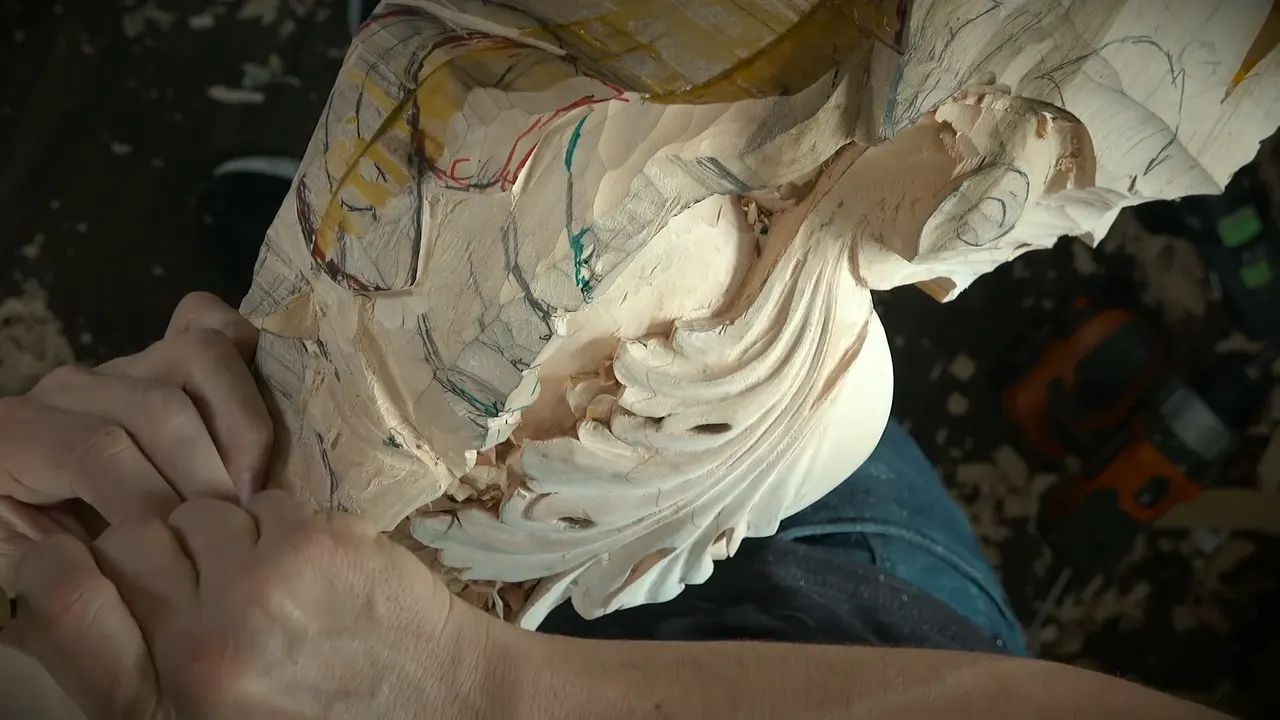

"Why not?" is my two-word line when a small idea comes up in the middle of a carving. In Venice Room workshop 84, part 5, I said it about a separation that could run "from above down, just like that, from the main body," and I planned to carve it. In other courses I say it over a tool already in my hand or a rasp, and over a few seconds of work or plenty of material.
Ever stopped mid-carve with an idea that was not in your drawing? The video for part 5 comes first on this page, and the other videos where I say it come after.
Where did the leaf land at the start of part 5?
The video opens on a leaf that, in my words, is "just laying right in the corner" and "touching right at the corner" of a rectangle. Happy with that, I said.
What choice came before the why not?
Next came a decision, and the section could go two different ways. One way was to lower this section so the flip reads "more pronounced," which would probably "make sense and create more beautiful movement." The other was to "repeat something what I have on this side."
Out loud I could not settle it ("I don't know if I should or not. Maybe I shouldn't."). My choice was to remove that side and probably lower this side right here, with a number seven at 14 millimeters (about 0.55 in). A "really good transition" would come out of it, "really nice and smooth to one side, to another side."

Why did I hold off on the undercut?
"I'm not going to undercut right away," I said, and added that I did not need to. First I wanted to "develop this movement" and "figure out where I want to end" it, because "logically, I do have a point right here."
A doubt followed ("maybe... It's not going to look good"), so I said I probably should roll it like that, and then "Yep. Rolls backward." In my words it would look "really more organic to the movement."
Time for a check: I would "double-check with the original what I had," and the original "wasn't as much rolling back, but I think it's going to look much better." Outlining came next, with "so let me outline it."

How did the second separation come up?
Earlier I had said I would leave some of the material below, so that "some kind of leaves" could sit there and make "really nice filler movements." Then my mind turned the other way: "But on the other hand, let me think."
What came to me was "Maybe one of the separations can go from above down, just like that, from the main body." My question went "Why not?" and I answered myself: "So we can do that." It would look good, I thought, and I could "have a second separation somewhere right there to repeat that idea." That would give me "even more beautiful look." My decision was short: "That's what I'm going to do."

Which tool came next in part 5?
Number three came again, with a hope that it would be "a really sufficient tool," because I had to be "careful how I'm approaching right now." For the below movement I meant to leave approximately a quarter inch (about 6 mm), on this side too. You do not see it, I said, "but that's my plan."

What was number five for on this leaf?
I asked next for "some kind of spoon," said I should probably take number three or number five, and settled on five. The job ahead was removing "some of the waste. But not much," since, I said, I wanted to keep some of it.
My verdict on the leaf came after: "that is actually wrapping really good." Even if it did not look good right then, "it will wrap really nicely," and I would try to show it "from different point of view."

For cleaning the movement itself I meant to use "just number five, the same tool what I have in my hands." The last words I have for this video: "Unfortunately, I made the previous cut a little too deep."

Where else do I say why not?
Other courses of mine carry the same two words, and in many of them a reason or a plan sits right beside them. I have grouped the passages by that reason. Each one names its course and its lesson.
What sits beside why not when a tool is in my hand?
A tool with a flute appears in Venice Room 89, part 9. I used it at about 9:00 o'clock, then planned to turn opposite, to 3:00 o'clock, and clean that background. "Almost like if I would use a small number three," I said, "but if I have the tool in my hands, why not use it?" Next on the list was "this wall of my volute."

Grape Onlay 13, part 1, gives me a tool of "probably two millimeters" (0.08 in). The size of the grape was changing completely, so I probably had to excavate an approximate shape, and I was "just outlining it." There was no rule for doing it this way, but "since I do have that tool in my hand, why not?" Then the shape would fall "somewhat like in a golden ratio," with "my 62" and "my 38." The golden ratio has a Wikipedia page.

The beginner course has it too, in Curly Kitchen Cutting Board 11, part 3. Turning the work came next, to look "from different perspectives" and "use different lights" to find ridges that are not visible from one side. Notice an area like that in your own work, I said, and "if you have knife in your hand, why not to clean it right away?"
Which jobs take only a few seconds?
Furniture Panel 15, part 12, is about a blade. Changing it was not even needed, and maybe I should use "a 1/16 of an inch" (near 1.6 mm) to get closer. The job takes "just pretty much a few seconds," I said, and added "why not?" Right after came "Beautiful tool" and "Get to the same depth." A bit later: "That is little too deep."

A measuring job starts in Floral and Molding for the Panel 14, part 2. One ridge had to come out ("take out one of the ridges") to "create the overall slope." Probably I needed to "measure first the highest spot, although I already know." Measuring was optional, I said, but it "takes only a couple seconds, so why not?" The amount to take off came to "maybe quarter inch," or "about six millimeters or so," I said.
When does paint settle it?
Paint shows up in Venice Room 82, part 6. One choice was to leave it like that, another to use rifflers "just to create nicer shape." The piece was a paint grade, and I said "why not?" The paint itself became a second reason. It would be "brushed on with a really thick paint," so there would be "brush marks" and "some texture anyway," and I wondered about leaving "some texture right here on the surface." "I guess I can do that," I said. Wikipedia covers chalk paint and paint.

Venice Room 14, part 10, brings a confession about rasps that I kept away from for many years. To be honest, I "just stayed for many years away from those rasps." I saw one woodcarver use them, with "some good results," and I told myself "Why not to try?" That was "a special project like that, which is going to be painted." It "doesn't look too bad at all," though "it leaves some fuzz, but that's okay." The rasp has its own page on Wikipedia.

Off camera, a rasp helped in Venice Room 112, part 1. A one millimeter number 11 was my tool to prolong a triangle edge slightly, which would give "a little more pop to that detail." Off camera I had used the rasp, just a little. "And I said to myself, Why not?" Painting was coming, since it was "going to be painted," and the rasp "saves me time." Then "Just rasp it and forget it."

How much wood lets me say it?
Over in Venice Room 20, part 8, I could "go around here too, deeper," and then, "like I said, I have plenty of material, so why not using it?" For that, a number 7 of 14 millimeters (0.55 in) came out. Losing wood was no fear: "I'm not afraid of losing anything" because "I have a lot of material right here."

A number 11 of two millimeters (0.08 in) shows up in Grape Onlay 5, part 1, after one of two and a half (0.1 in). I would keep "somewhere connecting point" and make the excavation deep. "Maybe I'll go all the way and make it airborne," I said, followed by "why not?" with a limit on it: "If I have enough material, if I don't have enough material, then that's a problem." And right after, "Carefully, carefully."

Five divisions appear in Venice Room 32, part 10. Maybe I could actually add "just a small, just a really small..." The reason was "just to give even more detailed look." That "why not?" had a way out: "If I don't like it, I can always chop it out." And a warning to myself: "got to be kind of careful going underneath."
In Grape Onlay 1, part 1, I call that project "not necessarily for the beginner" and "somewhat advanced." Then: "if you wanna challenge yourself, why not?" Next I asked what you will need. A "24 inches long board, and that would be about 61 centimeters," and one "about six inches wide," which is "about 15 and a quarter centimeters."
Which shape or detail did I try?
A shell turns up in Venice Room 56, part 2. I was going to create "a little bigger opening for the shell," and then I said "Maybe shell, maybe I'm going to stick something else there. I don't know yet." I asked "why not?" twice. The answer stayed "maybe shell," with "a lot of empty space" around it.

In the Hashemi course, lesson 41, part 2, I said "Turn this upside down," and I did like it, "except this piece needs to be taken care of also." Should I "create a detail like that or not?" My answers ran "Maybe," then "maybe it's a good idea," and last "why not?"
A question comes in Byzantine Acanthus 10, part 1: would I put an eye where a black marker was on the largest leaf? My answer was "We can do a micro eye right there," yes, and "why not?" Another could go "right here," and "then it's going to become another pipe inside of that big movement."

The Floral course has a slip in lesson 2, part 1. I had forgotten to scroll a couple of sections, "not like big mistake," and one needed to be "pierced," as did a small section beside it. A drill could go all the way through, which I "probably should" do, and "why not?" closed the thought. For one side, that was my plan, and then came "One. Two. Three."

Where does a saw or a line come in?
Part 2 of Venice Room 77 has a stage where I could take the piece "right now to a scroll saw" and take out "whatever the waste" there, and a "why not?" came with it. The line did not need to be straight: "I really don't want to do a straight line." A spiral blade is usually not my favorite, but "in this case, I did use the spiral blade," and "it's a lot easier to create the movements without changing the position." Wikipedia covers the scroll saw.

Another stop is Venice Room 79, part 7, where "this section is really important for me" and "I don't really worry about removing..." Then "Well, actually, I could," and "why not?" Out would come "a little bit to more or less like a final form right here," not the final form but "the final height." The tool was "just the number seven and 14 millimeters" (a bit over half an inch), with "let me remove to the line." Later: "I'm right on the line at this point."
For Chamomile and Bow Rosette 3, part 2: "let me think how extreme I want to do it," I said. My wish was to go "extremely closer to my border," and a "why not?" followed. Then a word for number 11s: "you can get right underneath," with the tool "positioned on the side," for "a really clean cut on inside."

Floral and Molding for the Panel, lesson 5, part 2, has a spot where I could "still see the mark from a drill," which was my height, so nothing else was needed there. Measuring another part was on my list. "Maybe it's a good idea," I said, and "why not?" came twice. Sloping came next ("start sloping everything"), and it "has to be really nice and smooth transition."
Every why not, side by side
| Where I said it and what lay in front of me | A few of my words |
|---|---|
| A second separation in workshop 84 | "repeat that idea" |
| A shell for an empty space, Venice Room 56 | "a lot of empty space" |
| A rasp on a painted piece in Venice Room 112 | "saves me time" |
| Leftover texture under chalk paint, Venice Room 82 | "brush marks" |
| The tool I already held, Venice Room 89 | "a small number three" |
| A two millimeter tool on a grape, Grape Onlay 13 | "just outlining it" |
| An airborne cut, Grape Onlay 5 | "enough material" |
| A quick measure, panel course lesson 14 | "only a couple seconds" |
| A thinner blade for Furniture Panel 15 | "a few seconds" |
| A drill through a scroll, panel lesson 2 | "drill a few spots" |
Where can you watch part 5?
You can find part 5 in workshop 84, with 83 before it and 85 after it, all in the Part 7 course. Wikipedia has pages on wood carving, woodworking and hand tools. The chisel and the gouge have short ones too, and so do the vise and the workbench. What small idea would you try today?
How it's done
- Make the decision. Part 5 starts with a choice: lower the section so the flip is more pronounced, or repeat what I had on the other side. I leaned toward lowering this side.
- Check the original. Before outlining I wanted to double-check against the original. It rolled back less, and I expected the new version to look better.
- Keep some material below. I meant to leave a quarter inch (6 mm) for the below movement, so leaves could sit there as filler movements.
- Ask why not. A separation could come off the main body, running down. My question was why not, and then a second one could repeat the idea.
- Take the spoon. A spoon came after that. I chose number five and meant to remove some waste, but not much. The leaf, I said, would wrap really nicely.
Frequently asked questions
Which tools did I name in part 5?
A number seven at 14 millimeters (a little over half an inch) came first. After it, "Again, number three," which I hoped was a really sufficient tool. For the spoon, number five was the choice I named.
How much wood did I mean to keep for the below movement?
Approximately a quarter inch, which is close to 6 mm, for the below movement and for this side too. You do not see it, I said, but that was my plan. A share of the material was staying.
Did I undercut right away in part 5?
My words were that I would hold off on the undercut and had no need to do it yet. First came the movement, then finding where it ends.
What to carve next