

Alexander Grabovetskiy, woodcarver, School of Woodcarving · Published 2020
What does a wood carver mean by "Byzantine style"?
Quick answer: In Venice Room 84.8 I said I needed a second concave and a convex middle part, then said there is also Byzantine style, more convex in the middle. Elsewhere I tie that style to gold leaf, smooth transitions, big pipes and a second layer.
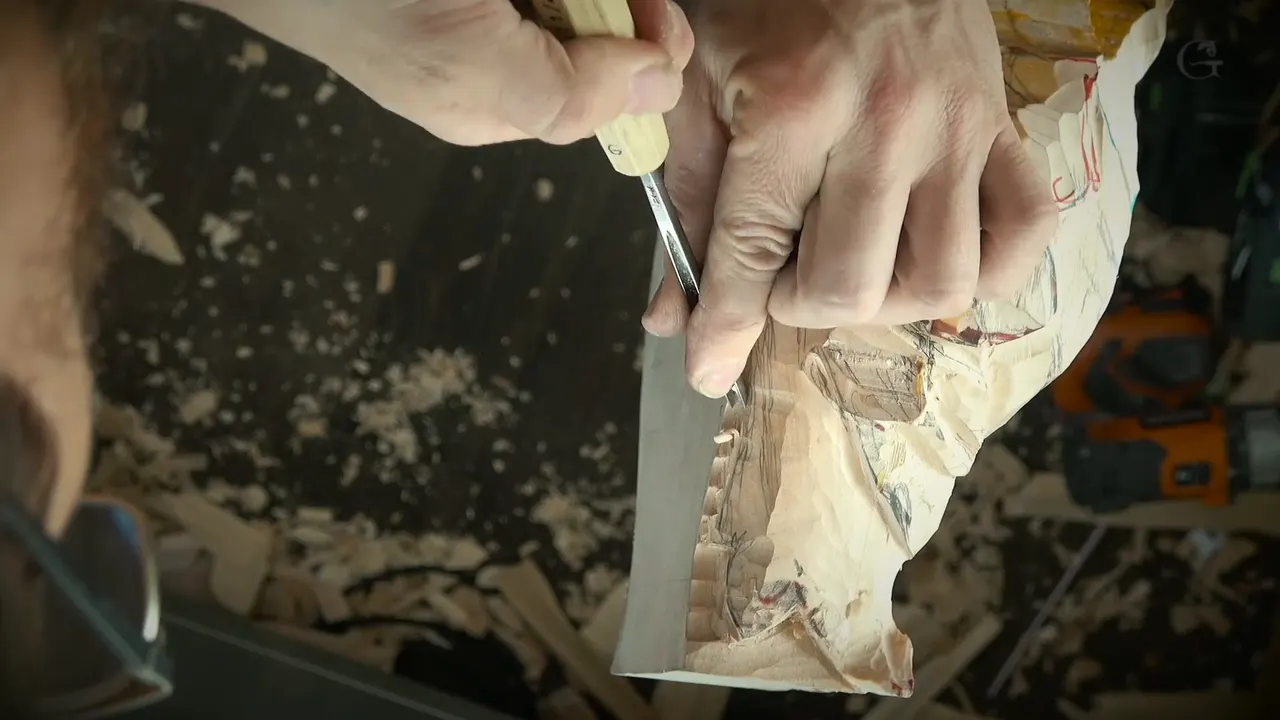

In workshop 84, part 8, I said there is also a Byzantine style, with a more convex middle. My other lessons link it to gold leaf, to smooth transitions inside a leaf, to big pipes, and to a second layer of wood.
Ever looked at an acanthus leaf and wondered why the middle swells while the sides dip? Does the word Byzantine mean anything at the bench? Stay with this one part of workshop 84, then walk with me through the lessons where I used that word again.
What does part 8 say about Byzantine style?
The part ends on it. A few lines before, I said "I need to make that middle part of acanthus convex." A caution followed, "it's not always the case," and then "It's just particular Venetian style." The last cue of the part reads "There's also Byzantine style, it's exactly the same thing, actually, it's more convex inside of the middle part."

Before that I had asked for a second concave, "I need second concave," one that would go to a point and "blend in."
How does part 8 begin?
With a pencil mark for the eye. It had to go, because otherwise, I said, it would "confuse me." Next: "I really don't want to make any more mistakes." The next thought, still on the subject of mistakes: "It's not a huge mistake, but it's a common thing."
The eye belonged to the movement. I said it would be "part of this movement," and that there would be an eye.

A question came next: "how am I going to show to you what am I going to do?" My reason was "I really need to start developing concaves and convexes." I needed to "reposition somehow" without making it problematic for me, and I settled on the "best position for now."
Where does the main movement run?
The main movement runs all the way in one direction, I said, and that meant I could "easily outline it." Then a warning, "got to be super careful how I do it." One more spot I planned to round a little, "otherwise, it just doesn't look too good."

With the main movement settled I had my eye, and the eye had to follow "the main idea." The pipe was meant to reach a point. I probably had to move the eye later, I said, and right now it "doesn't make any sense." The eye "was preliminary," I said, "I didn't cut too deep, but just not in the right position." After that came "That's okay."
How did I plan the concaves?
Both sides of an eye should have concaves, I said, so I wanted the outline a little better first. To begin: "I'm going to start right there." The concave would begin at one point, "really nicely, nicely, nicely," and run all the way to the point, so that I could reach "that future pipe."

An upside down cut uphill was what I was doing, "which is not the best." The camera was right on my way, and the other choice was to carve toward myself, "not the safest way."
Which tool sizes came up in part 8?
As I worked I named a size, "I'm using 3 millimeters," which is 3 millimeters, about 0.12 in, and I called it "just preliminary." Then came a change of tool: I said I would use 7 millimeters (0.28 in) to continue the concave, and I needed a deeper concave there.

After that I said "It's good for now." The second concave needed a color, "for you would understand," and I asked for blue, "if I'll find it." Then: "Got the blue color."

How do my other lessons describe Byzantine style?
In Byzantine Acanthus lesson 3 I compared three kinds of leaf. Greek acanthus has "a sharp V cut on inside," and Roman acanthus has "a concave on inside." For Byzantine acanthus it was "a raised up convex," I said, and we were working with Byzantine style, so the middle part would become convex.

My aim was to be "authentic to the true Byzantine." A Roman style with that twist, I said, "it's not going to look as nice." It would have "too many lines," it would be less soft, and it would not be good for gold leafing. My summary: "concave, concave, and convex right in the middle." I called that "the big difference."
On curvature I said Byzantine style "took it to extreme," and called it "a really big, big improvement."
Why does gold leaf keep coming up?
Lesson 5 of that course has "Byzantine acanthus leaf never left as a bare wood or finished wood or stained wood or whatever, shellacked wood. It was always gold leaf." The channels in the carving made "the big problem for the gold leafing back then."
clay came up too. "What they've done before the gesso, Italian gesso, they used just the red clay." The clay was "the first form of application of the gold leafing," I said, and "really thick." The carving was done "without too many details, but a really beautiful shape."
Then I tied it to the leaf with "It's what we did," and went on about the convex in the middle and the concaves beside it, which are "really easy for the gold leaf, even thicker gold leaf." Inside the leaf I planned "a dome effect."
If gold leaf is new to you, gold leaf, gilding and gesso are outside pages that explain them, in other people's words.

Lily Box lesson 10, part 9, has a line about the carvers. The ones I meant were "AD wood carvers, like Byzantine wood carvers," who "achieved really nice results with the design and so on, especially with acanthus leaf." And: "the Byzantine wood carvers, they never used any V tools. They used only gouges and chisels."
A bit later in that part: "It's all gold leafed. All the carving is just covered with the gold." The line after: "that was one of the main reasons why they did not use any sharp lines. They used really smooth transitions on inside and out." An undercut shaped like a V "would be really hard to get gold leaf on inside, and nice and smooth."
Where else did I talk about smooth transitions?
Part 3 of Venice Room workshop 28 has "they did not have those sharp transitions on inside." You do not see them "on a Byzantine style acanthus," I said. And "if you're doing a gold leafing, it makes all the sense not to do the sharp transition," because gold sticks a lot better on a smooth one.
Why are the pipes on a Venetian leaf so big?
Workshop 65, part 6, has my answer. The Venetian pipes were "really exaggerated," I said, and inherited "from Byzantine style." Byzantine carvers "developed those really big movements for the gold leafing." The gold is "a yellow-brownish color," I said, and they "needed to get those shades, those shadows."

"That's why they've got exaggerated eyes, they've got exaggerated pipes, and developed its own beauty." Then: "It's a beautiful style."
The bench version is in the Byzantine course. As I looked at a pipe in lesson 4, I said "See the pipe? It's already convex. And yes, you can take it to the perfection." Digging a little deeper was "absolutely okay," because "we are after really good shadow effect." Then: "in Byzantine style acanthus, pipes, really important."

Lesson 8 has a deep cut about which I said "now it's actually created the beautiful pipe," and "it's what I was talking about on Byzantine style and also Italian style." Then: "that's what they did, big pipe, over-exaggerated pipe, if you wish to call that name." It had to be "really smooth and nice," and for the eyes: "We're going to have huge pipe like that, okay?"

Lesson 5 has the eyes. "The difference also in the Byzantine acanthus, they used huge eyes."
What about the second layer?
Part 3 of Venice Room workshop 48 brings up a double layer as one approach for "a smaller scale acanthus." Then I said "The true Byzantine, not just like what people think is Byzantine, the true Byzantine. Early Byzantine style, which designed for the gold leaf." And: "the true Byzantine acanthus not done in one piece. They are actually a double layer."

Workshop 18, part 5, matches it. A double layer is used to "glue that upper part on top of the lower." That is "used in Byzantine-style carving," I said, and "someday I'm going to do that just to show it to you." I also said "It's not like late Byzantine, but we're talking about early Byzantine style." Of churches: "You can still see it in some of the Orthodox carvings, which is made for the gold leafing, by the way."
Over in Byzantine lesson 1, part 3, the second layer comes up. My plan there was "a concave on inside, like a bowl almost, but still leave some surface to glue on the second layer."

Then: "like I said, in Byzantine, they were able to replace that upper piece if something happened to that piece, somebody knocked that or broke that, and so on. So you could use just the pegs, like a few pegs, and stick that piece. You could use screws, or you could just glue. And in my case, I'm just going to glue it, okay? I'm not going to take it apart."
Part 1 of that lesson has "they didn't glue on, they used tacks." On screws: "not in Byzantine, of course, they didn't have screws, but later on, Orthodox Churches, they used screws from the backside." Part 2 of lesson 5 adds "like I mentioned before, Byzantine used dowels."
Did the style come from one place?
In the April 2020 livestream I said "If you look on Byzantine, it's supposed to have a concave, convex, concave." Of Roman acanthus I said there that it should have a concave on the inside.
I showed a movement there and said "It was inherited from Byzantine." A Byzantine leaf is "supposed to have a gold leaf, and they have really deep excavations on inside." Then a turn: "Byzantine, on another hand, adapted from Greek empire the movement like that. Okay, so it wasn't Byzantine invention." And: "So they all adapted from each other."

Workshop 55, part 12: "Concave idea was first developed actually in Byzantine, and then it was widely adapted."
Over in Greek acanthus lesson 8, part 2, I said "Even in the Byzantine style, there was some more development, but still the main idea was based actually on the same." Lesson 7 of that course, part 3, says "Like Byzantine style, they still had some of the V cuts, but later on in the history of acanthus leaf, they stopped doing the V cuts." Set that beside my Lily Box line about V tools. Both lines are mine, and I let both stand.
At Roman acanthus lesson 6, part 1, I said "later also Byzantine acanthus leaf also utilized that. Which is a Byzantine, I should say, also semi-Greek Roman style."
Where did I put the history?
Workshop 162, part 3: "Byzantine is the eastern part of Roman Empire, pretty much when they divided, it was a Christian nation, pretty much, Christian country." The Romans "did not use gold leaf," I said. "But Byzantine Empire, they used acanthus leaves in churches."

Workshop 163, part 1, goes on about the gold, which I called "really hard" to get "right on the side of the undercut if it's too deep," so that "they wanted to make it a simplified version to get the gold leaf underneath." And: "Before the gold, they applied clay, red clay, just normal earth red clay."
Outside pages on the Byzantine Empire and on Byzantine art sit beside my lines, and the words there are not mine. The same goes for chisels, dowels and Orthodox churches.
Is a Byzantine acanthus hard to carve?
Also in part 2 of lesson 5, I said "I could go on and on about acanthus leaves, and about Byzantine especially, because it's one of the most complicated acanthus you can find. And if you master Byzantine acanthus, all acanthuses besides that, it's going to be easy. Just like a piece of cake."
In Floral and Molding lesson 12, part 1, I said "Right in the middle of that acanthus, it's going to be a convex and two concaves." Then "exactly the same what I've done on the previous pieces." Next, a plan: 7 millimeters (0.28 in).

Which lesson says what about Byzantine style?
| Lesson | My words on Byzantine |
|---|---|
| 84.8 in the Venice Room | A convex middle between concaves, and a note on a more convex Byzantine middle. |
| Lesson 3, Byzantine Acanthus | Greek has a sharp V inside, Roman a concave, Byzantine a raised convex. |
| Lesson 5, Byzantine Acanthus | Always gold leaf, red clay under it, huge eyes, dowels. |
| Lesson 1, Byzantine Acanthus | A second layer that was tacked on, not glued, and could be replaced. |
| Lessons 4 and 8, Byzantine Acanthus | Pipes really important, a big pipe, an over-exaggerated pipe. |
| Lily Box part 10.9 | Gouges and chisels only, and smooth transitions inside and out. |
| 28.3 of the Venice Room | No sharp transitions inside, because gold sticks better on a smooth one. |
| 65.6 of the Venice Room | Exaggerated pipes and eyes, and shadows for the gold. |
| Parts 48.3 and 18.5, Venice Room | The true, early Byzantine acanthus is a double layer. |
| Part 55.12 of Venice Room | A concave idea first developed in Byzantine, then widely adapted. |
| Lessons 7 and 8 of Greek Acanthus | Some V cuts stayed in Byzantine style, and some more development. |
| Lesson 6 on Roman Acanthus | A Byzantine leaf also used the concave, a semi-Greek Roman style. |
| Livestream, April 2020 | Concave, convex, concave, and a line that they all adapted from each other. |
Where can you watch all of this?
You can find workshop 84 in the Venice Room Part 7 course, on its own lesson page. Find the Byzantine lessons in the Carving Byzantine Acanthus course. The other lessons I quoted are in the Venice Room courses for Part 3, Part 5, Part 6, Part 14 and Part 2, and in the Lily Box, Floral and Molding, Greek acanthus and Roman acanthus courses.
Does a convex middle make more sense to you now? Would you like to watch me carve one, a gouge in my hand? The whole Venice Room is open on one tuition plan, and this lesson is waiting in it.
How it's done
- Clear the pencil mark. The mark drawn for the eye had to go, so that it would not confuse me.
- Find the main movement. The main movement had one direction, and I could outline it.
- Plan the first concave. The concave would start right there and run to the point, with 3 millimeters (0.12 in), just preliminary.
- Plan a deeper tool. A change of tool was coming, to 7 millimeters, to continue the concave.
- Mark the second concave. A second concave was needed, and then "Got the blue color."
- Keep the middle convex. The middle of the acanthus needed to be convex.
Frequently asked questions
Which middle part did I mean in part 8?
The middle of an acanthus leaf, which I said I needed to make convex. I also said it is not always the case, and that this is the particular Venetian style.
Which tool sizes came up in part 8?
A tool of 3 millimeters (about 1/8 in), which I called "just preliminary," and a change to 7 millimeters (about 0.28 inches), because I needed a deeper one.
Why did I want a pencil mark gone in part 8?
A pencil mark on the eye could confuse me, I said, and I did not want to make any more mistakes.
How are Greek, Roman and Byzantine leaves different?
What to carve next