

Alexander Grabovetskiy, woodcarver, School of Woodcarving · Published 2020
What does a wood carver mean by "new addition"?
Quick answer: In Venice Room 84.9 I said "new addition" right after I said I could clean up an area with a rasp, then "a really good addition." Several of my lessons say the same words about rasps, and once about a number 9 of 4 mm (about 0.16 in).
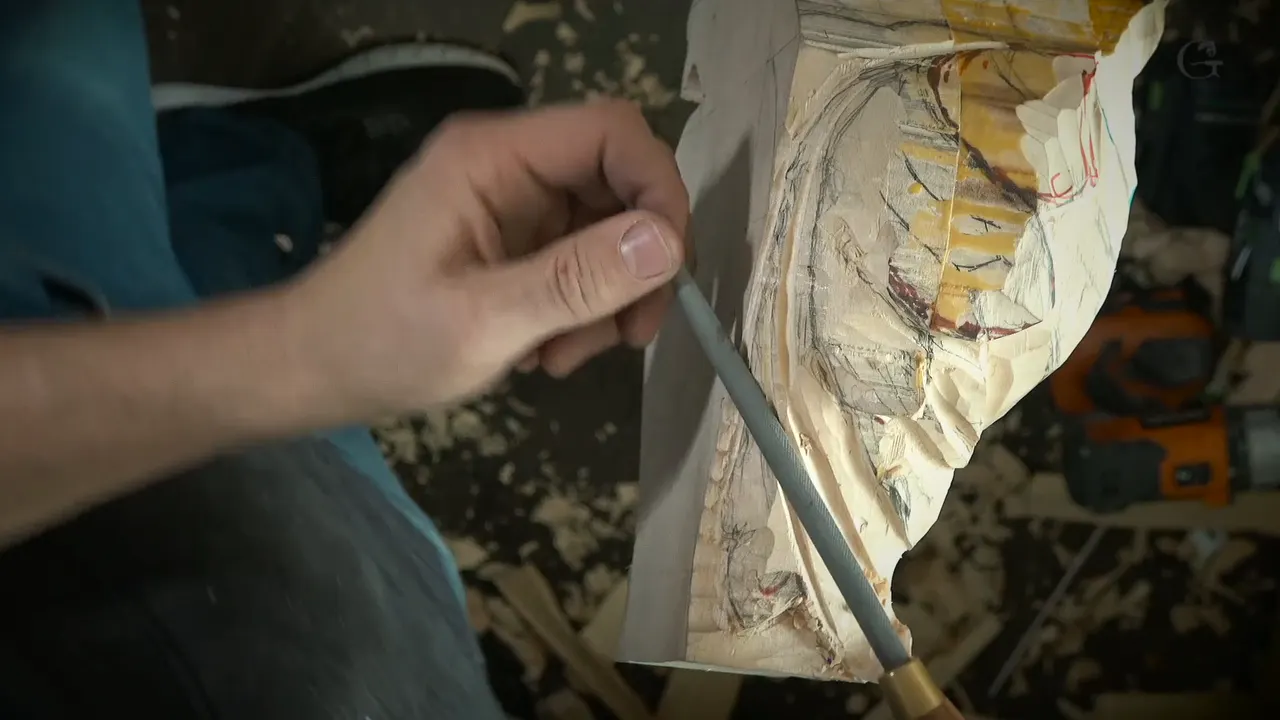

In workshop 84, part 9, I said "new addition" about a rasp. Other lessons of mine use the same two words about rasps, and once about a tiny spoon.
Ever picked up a tool you rarely touch and wondered if it belongs on your bench? Does a rough spot keep bugging you after the gouge is done? Part 9 of workshop 84 has the rasp in it. Come along for the whole part, and then follow those two words through eight other lessons of mine.
How does part 9 begin?
It opens with "Do it" and "just like that." Next, "like I said, it's going to blend." My line about the clean-up was "I'll take care of it little later."
"I need to clean up this area because right now it doesn't flow," I said, and the way to do it was "I actually can do it with a rasp." In my own words: "My new addition. I think it's a really good addition." And right after that line, still in the same part, I said "I'm happy now with that."

What could the rasp do?
Smooth, beautiful movement, by my account: "I can always create smooth, beautiful, free-flowing movements." Then: "Of course, nothing prevents me from doing it by using just the gouges." And: "But this is also kind of fast. It's not a big deal at all, except this part is not so good."

Okay, good. "And going to go all the way," I said, and after that "I think I can leave it for now like this."

How deep could the concave go?
A little deeper is fine, I said, though the outline of the main body sets the limit on how far I go. "So let me blend those cuts. I'm not sure how deep I can get. I can actually get a little deeper concave right here, and I cannot go deeper than my outline of the main body."
Seeing and feeling come into it. "Logically, you're not going to be able to see, but still feel it." Next, "You're going to feel that there's something wrong. Just too deep. But little deeper I can do."
My reason for the extra depth followed: "And why I want to get deeper, because I want to raise this part going up." "That's what I want to do," I added, and then "I really want to do the right movement."

Which gouge raised the part?
A number three, held upside down, did the raising. I said "All right. So now nothing prevents me of raising up this part." The gouge came with the words "And yes, I'm using number three upside down. So it is going up."
"Maybe deeper cut," I said, "and make it even more pronounced." Another: "I need to start all the way right here." Later, "Okay, wonderful. So it's smoothly going from this point." Then, "Sorry."

When did the rasp come back?
Near the end of the part I said "And let me get this little more." Then: "Right now it's not so good." My plan was "Maybe I can hit that again with the rasp a little bit, this section, just to get really smooth transition."
Afterward I said "So now it's a lot smoother." Next, "Okay, that is good. So it's raised." I gave myself one more job: "So of course, this needs to be also chopped out. I don't need those ridges."

The part ends on an apology: "I apologize if I'm covering that with my head." Next, "I don't know what can I do." One last line: "I just move it slightly."
What came in part 10?
Part 10 is the next video of workshop 84. Early on I said "Yes, I need to smooth this out, but for now it's good," and I also said I wanted to "do a little movement like this, just the separation going underneath." And "Indicate that separation."
A line about shape came after that: "Otherwise, if you look at that section and that section, it has the same distance, so it's almost like rectangle, which is not good." And right behind it, "So it has to have some taper."

A small tool comes up as well. "I'm not too happy about how smooth on inside, just because I used too small of a tool. It wasn't mistake by the way, it's just by choice." Of the small tool I said it is "a small tool that I don't like usually to use" in sections like that.
My plan was "7 millimeters, maybe I'll just use 10 millimeters" (0.28 in and 0.39 in). Then "We'll see. Try 7 first." Later, "7 is much better than what it was before." Soon I said "it's still not pronounced pipe," and "So pipe has to be more pronounced." One more: "I need to create much deeper cut right here."
Near the end I said "So I've got really pronounced pipe now." Right after, "That is good." About one side I said "I'll take care of it little later." Later: "So it's pretty much repeating the movement, what I have right here."

Where else did I say "new addition"?
The same two words turn up across the Venice Room, and once in a floral course. Here is where each one comes from.
Workshop 9, part 3, comes first, in my first Venice Room course. Junk was in my way: "I can't even see what is going on right there." Then "Let me brush it," and "maybe it's a good idea for me to try again to use" the "new addition," "which I didn't use too much before." Another line: "Just make it little, but smoother transition right here."
Then came "Maybe it's a little too aggressive there, so I got to say they're grabbing a lot. Okay, got a different one." Next, "It's not that convenient," and "Can't even get it. Okay. Can't do that." One more: "Okay, let me use just the back bent again, the old way."

Over in workshop 14, part 8, I said "And maybe even an extra one right here. Just a little bit." Then "And you know what? I could use my beautiful new addition rasp and just create a really nice, smooth transition to it." Next, "Beautiful. Oh, actually, this one's not working out. This one will." And "let me do exactly the same right here. Really nice and smooth transition downhill."

In workshop 26, part 6, I said "What I'm not happy, I want to see a little more subdivisions because I think it would look even nicer if I would give even more movement." A doubt follows: "I'm not sure. Maybe I shouldn't even bother." Next: "Maybe I just should leave it like that for now, okay? And later on, I can see what I can do."
"But what I could do, I could actually give a nice rasp work, my new addition to the overall shape." And "after that, I'll decide what kind of details I going to put."

Over in workshop 27, part 10, I named a tool and a size: "I'm using number 7, by the way, 10 millimeters. It's actually a little bigger than 10, maybe about 11." Those are 10 mm (0.39 in) and about 11 mm (0.43 in).
"But overall, I'm not too happy about how it shapes right here, well, first of all, I need to make sure this reach is perfect," I said. I would "just shape that" with the "new addition." Then: "And that way I know it is perfect."

Then: "Second, I have to place my final line, how it's going to look." And later: "Again, same number 7, and I gradually going to go to that line."
Workshop 28, part 6, has "Number 11 and 1 millimeter. That's what I'm using." Written in inches, 1 mm is 0.04 in. After that, "I am kind of happy with the overall movement."
Then came "And yes, usually I just take it to the perfection with just the gouges and blend everything and just work my way in. But now, with the new addition of my new tools, rasps, I can probably use shortcut and kind of create semi-final shape with that."

"And I like it. I like it a lot." In the same stretch: "I'm sorry that I'm trying to apologize all the time." Then a confession: "I'm still feeling guilty every time when I'm grabbing those rasps or sandpaper. I feel guilty of not utilizing the true woodcarver's approach."
A moment later I said "Maybe I shouldn't feel guilty." One thing I knew: "Some furniture makers, even in the past, they used some kind of techniques like that. Either scraping or something else, but they did it."
Then a tip about scraping: "Just use a razor blade. Okay. Just a normal razor blade." And "You don't have to buy specialty tools for this. It also going to give you really nice results, okay?" Later still: "Every time, I feel guilty. Maybe at some point I won't." Also "I would like to find out if you feel guilty if you would use it." Next, a word about people at my school: "they are professional woodworkers and professional furniture makers, and they're trying to be really authentic to the original work."
Part 12 of workshop 59 has "I do not want to make it too fragile yet." After that, "maybe I'm going to be able to use some of" the "new addition, my riffles or rasps, and try to figure out if my overall shape is good or not."

Get rid of some of the marks, that way, I said, and "like I said, it's not the final form." "I can always hit that again with the gouge," I added. One limit on the rasp: "But not everywhere I'm able to use it because, again, I'm limited with the ceiling and also other parts."
The plan in workshop 90, part 10, is plain. "It is simple," I said, and "I don't want to make it overwhelming." Next, "Maybe I just overcomplicate it. Which sometimes happens. Okay. Well, actually, you know what I can do?" My idea was to try the "new addition," and "get those ridges out and see if I'm going to like it or not with the rasp." "I want to see it a little more smoother. And rasp will help me a little bit," I said.

The Floral and Molding for the Panel course, lesson 9, part 1, gives the odd one. "Obviously, I still have to clean little bit this section, and I can probably do it with the same small tool. Or let me get, actually," the "new addition." The tool was "like a four millimeters number nine. A really tiny, small spoon." In inches, four millimeters is 0.16 in.
Then: "I could just do some kind of separation, but I don't think it's necessary." And: "But I will still establish micro pipe, so I really want to raise slightly this ridge." Of that ridge: "It's not big." The work would "help for the light and the shadow."
Which tool did each lesson name?
| Place | What it named |
|---|---|
| Workshop 84, part 9 | A rasp, for an area that did not flow. |
| Workshop 9, part 3 | Something I had not used much before. |
| Workshop 14, part 8 | A beautiful rasp for a smooth transition. |
| Workshop 26, part 6 | Rasp work, added to the overall shape. |
| Workshop 27, part 10 | A way to shape a reach and know it is perfect. |
| Workshop 28, part 6 | New tools, rasps, to reach a semi-final shape with a shortcut. |
| Workshop 59, part 12 | My riffles or rasps, to see if the overall shape is good. |
| Workshop 90, part 10 | Rasp work, to get the ridges out. |
| Floral lesson 9, part 1 | A 4 mm number 9, a tiny spoon. |
Where can you watch all of this?
You can find workshop 84 in the Venice Room Part 7 course, on its own lesson page, and workshop 85 follows it. The second Venice Room course holds workshop 14, and Part 3 holds workshops 26 to 28. Part 5 has workshop 59, Part 8 has workshop 90, and the floral lesson sits in the floral course.
The rasp page on Wikipedia explains the tool. A wood carving page gives the long view, and for gouge work, chisel work, sandpaper, furniture makers and the hand tool in general, Wikipedia has a page each. Sizes come as I said them, with the other unit in parentheses, and a millimeter page plus an inch page cover both.
Does a rough spot still bother you after your last pass? Would you like to watch me pick up a rasp, a mallet or a gouge and say what I think out loud? The whole Venice Room is open on one tuition plan, and this lesson is waiting in it, set in Venice style.
How it's done
- Clean the area. A spot that does not flow needed cleaning up, I said.
- Reach for the rasp. Using a rasp was my way to do it.
- Blend the cuts. Blending the cuts came next, and how deep I could get was still an open question for me at that point.
- Know the limit. A hollow stops at my main outline, though you will not see it.
- Raise the part. Lifting the part was the job after that, and in my words the part was going up.
- Come back to the rasp. Maybe a second pass of rasp work on that section, I said.
Frequently asked questions
What did I say after I reached for the rasp in part 9?
"New addition" came first. Then "I'm happy now with that," and after it "I can always create smooth, beautiful, free-flowing movements."
How deep could a concave go in part 9?
Deeper by a little, I said, but not past my outline, and you will not see the extra depth, but "still feel it." Then: "But little deeper I can do."
Which gouge did I hold upside down in part 9?
Number three, upside down. Its job was "So it is going up," and next came "Maybe deeper cut," followed by "make it even more pronounced."
How would the rasp help the transition in part 9?
What to carve next