

Alexander Grabovetskiy, woodcarver, School of Woodcarving · Published 2020
What does a wood carver mean by a "good detail"?
Quick answer: Workshop 84 has me calling something "a really good detail," right after talking about an eye underneath and one movement for this and that. In other courses I use "good detail" for a bead, a volute, ribs on a corbel and a small shape that adds movement.
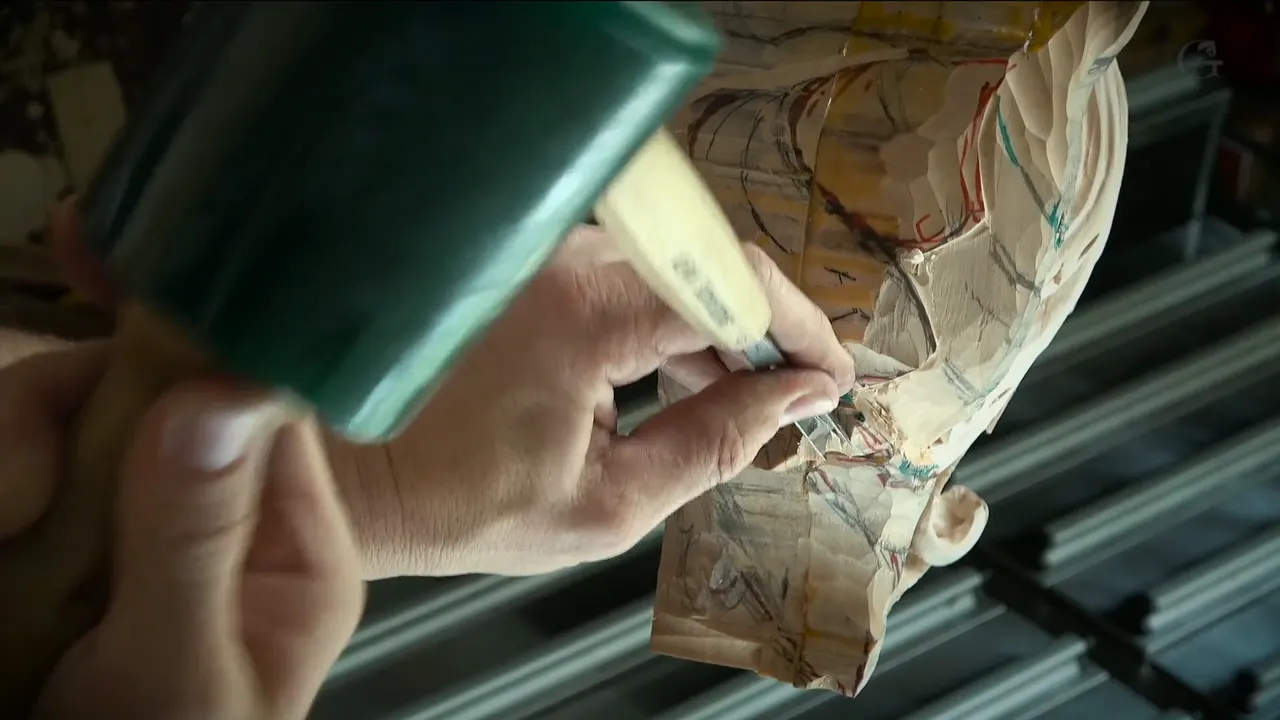

In workshop 84, part 2, I planned an eye underneath and said I really wanted to keep a detail. My other courses use the phrase "a good detail" for a bead, a volute, ribs on a corbel and a small shape that adds movement.
Have you ever looked at one small shape in your carving and wondered if it earns its place? Workshop 84 comes first on this page, and the other videos with the phrase follow it.
What was I carving in part 2 of workshop 84?
The video opens on the main body. A movement goes underneath it, and I had to decide where the eyes would sit, which was "not as critical in this case, but I still like to see some eyes." One word needed a fix in part 1, where I said "Not the corbel, but to that main body." Wikipedia has a short page on the corbel.

"Let me reestablish the main movement," I said. Some stuff goes in another direction too, "which, unfortunately, you don't see." My idea was "Maybe I'll just change the position of the camera." Then "Hopefully, you see it okay."
Why was it a slow process for me?
"For me, it's a really slow process because I have to change the positions of the camera and so on, and I start losing so much time." "Losing so much time," I said again, and then "But let me start."

The grain came next. "Got to be careful because the grain direction goes in," I said, so "I have to attack that from the right position." I would probably cover the camera, "which I don't want to do, but please forgive me for that." Strength comes up in part 3, where I say it will be strong "because the grain goes that direction," and that it is "just inconvenient to carve." Wikipedia explains wood grain.
Where did the wobble and the glue show up?
"Let me take this other tool," I said. "Clean a little bit, and that way I will see much better what is going on." "A part of this movement, which is wrapping this way," I said. Wobble gets a mention: "I still have a lot of wobble." Later I said "And that's going to go all the way this way," and "Really smooth transition."

An "Oops" came next, and then the words "that is glue." After it I noted a separation: "I can right away indicate that with the number 11 and 10 millimeters" (about 0.4 in). A gouge like that has its own page on Wikipedia.
How did I plan to fill out the space?
"I'm not going to go all the way," I said, and probably some stuff "like what I've done on a previous one." That one had "some small pieces, like it's sticking from underneath. It makes it more richer and fills the space."

"So like those two guys. Okay? So maybe some spots, I'll leave it like that. We'll see." I wanted "a little deeper cut in this section." Then came "That is good. Maybe a little deeper. About six millimeters or so, about quarter inch. That way."

Which leaf would grow from underneath?
"I also have to figure out what am I going to do with this leaf." This part would be "a part of the main movement," I said, and the leaf would be "growing from underneath." Then I said "I think it's going to make more sense."

A correction followed: "I have to really-- Well, actually, you know what? I don't have to. I can actually make part of it be as a movement like that." "A really interesting movement" is how I put it, and "that's what I want to do." A "double separation right here" might come too.

When in this video did I call it a good detail?
"I need to make an eye somewhere underneath," I said. "If I want to make this and that as a part of one movement. So I need to make the eye. I hope it makes sense, even if it doesn't at the beginning. But it will. I really don't want to lose that detail. So it's a really good detail."

What follows are plans for the next eye, with a size. "So now I'm going to also need another eye in this section. And I'll use the seven millimeters again" (0.28 in). The video ends on "Got to be careful how I attack it." One more figure for this piece sits in part 1, "about quarter inch above that line because I'm going to undercut that" (about 6 mm).
Where else do I say a good detail?
Those words turn up in many of my lessons. The passages sit in three groups below: what I had just carved, what was still ahead of me, and the details I said you could use again.
Which cuts came just before I said it?
Workshop 63, part 11, has "That is wonderful. Get that corner out." The tool was a number six, "about three-eighths of an inch, about 10 millimeters." Of the result I said "That is much, much better," and "every detail you add gives somewhat final look what you're after." "That's exactly what I'm after," I said, and I called the detail really good. Next on my list: "I need to fix this section right here too, because it doesn't make too much sense now also." One more line: "I still kind of don't like what I see right here, but that's okay."

In workshop 43, part 2, I said I could probably use a number seven, since "I really want to see maybe concave right here." Something would go underneath, I said, which "I can plan right away before the confusion." "Again, let's go deeper. A little deeper down inside," I said. The result "just gave me" detail I called really good. "This is raised up, and I think it's beautiful." After it came "I could go with the smaller number 11, and I could excavate deeper even. This is a 1.5 millimeters, one and a half millimeters, 1/16 of an inch."

Further back, in workshop 11, part 12, I said "that is actually really good and deep," and "I don't probably want to go too deep." After that I said I just did detail that was really good, followed by the correction "Not the detail, but movement. Okay? It's still not the detail. It is detail, big detail, but it's not the final detail, okay?" Next on my list was "I need to clean up upward," with a smaller tool, "two millimeters or so" (0.08 in).

Extra movement comes up in workshop 17, part 9. I planned a number 11 at 3 millimeters (0.12 in) to "clean a little bit better right there," and said "I need to give a shape to that little thing, whatever you call it." Then came "This gives a little extra movement. I think it's a good detail. Yes, I still need to clean it a little bit and clean underneath of that detail." The size changed: "3 millimeters was too big, but 2 millimeters is fine" (0.08 in).

One part in workshop 32, part 8, "doesn't look too good." "I could take just a straight number one tool and clean it," I said. "I also noticed on some of the original work, they used a small concave almost cut." For a tool: "Number three will work really good." The verdict was "And that is a good detail," with "in my opinion, again" after it. Last lines: "I can spend a little more time off camera a little later," and "for now, it looks really good."

What did I say when the detail was still ahead?
Hashemi Flowers 23, part 1, has a plan to make "those two berries lower than the volute." "I'll take probably just number five, and quarter inch" (about 6 mm), I said, "and I'll just remove right away excess material." I think it is going to give a detail that is really good, I said, and "pop to this volute." On the name I said "in architectural world, it's called a volute. But sometimes I call it myself just a curl," and you can read about the volute on Wikipedia.

A hidden spot sits in workshop 39, part 6. "Don't really need to go too deep. Just deep enough, and much deeper, of course, right here." Most of it will be hidden "underneath of the flowers we're going to do." This detail, I think, is going to be really good, and "This overall movement is going to be beautiful." "I could leave it like that," I said, but maybe I would create something more interesting.

Part 11 of workshop 32 has "About 20 millimeters, three-quarter of an inch in" (0.8 in), and "enough for now." Another line: "I can always able to make it deeper later with no problem." Then "Now let me draw the movement what I want to see right here." The plan, I said, would be "good detail, just go like that," with a move to "lower down this reach and create a movement like that."

One side could roll a little more in workshop 82, part 3: "I also could actually roll this side a little bit more, and that's probably going to look really good." It will look really good, I said, "just because" it will be visible from the bottom from this position, so you can see that. After that I called it really, really good.

Which details can you use again?
A bead gets its turn in workshop 6, part 7. "Get really nice and round here." The shape, I said, is really good "to use that anywhere pretty much you can use it." And "that is one of the details I really like, the bead." Then "Okay, let me get a little deeper right here." Then: "That is enough because sometimes I do have a tendency of overdoing stuff which I shouldn't."

Moldings come into workshop 149, part 1: "don't undercut if you're working with moldings. So that would be a big mistake." The tool "should be 90 degrees," and "if it gives you trouble because it's end grain, so just cut one more time with number 11." Then "like I said, that detail is more architectural. You could use that in furniture too. If you're building furniture, that is a good detail to have sometimes." "Approximately three millimeters to go, about eighth of an inch later on for cleanup," I said. Wikipedia covers architecture and furniture.

Chamomile and Bow Rosette, lesson 1, part 1, opens with "It's time to move on to the next detail." I wanted "to include that detail in my main project, which is part of Venetian room, and I also do as a separate course." My verdict was "a good detail." This piece, I think, is "small, doable, and you could utilize some elements in furniture. So you can do some kind of rosette and some kind of leaves and so on." And "it's not complicated piece." A plan from that video: "I will provide some drawings."
Ribs in a corbel get a question in workshop 102, part 8, from people who ask "why would I do that movement, those ribs right in the middle of that corbel." People looking close see everything, I said: "you're looking at really close, that's why you see everything." My answer was "I really want to be authentic to Venetian times, and that's what they've done on some of the corbels, and I researched what they've done." Then "And yes, I could probably do without them, without those ribs, but I think it's a good detail. Why not use it? It gives extra dimension." And I planned "right again, right on top."

The details side by side
| The detail and the video it came from | Lines from the video |
|---|---|
| An eye underneath for one movement, in workshop 84 | "lose that detail" |
| Two berries to go lower than the volute, in Hashemi Flowers 23 | "pop to this volute" |
| A cut with a number six, from Venice Room 63 | "exactly what I'm after" |
| A spot taken a little deeper, in Venice Room 43 | "it's beautiful" |
| Part of a big movement, but not yet final, in Venice Room 11 | "a big movement" |
| That little thing, with extra movement, in Venice Room 17 | "a good detail" |
| Ribs in the middle of a corbel, in workshop 102 | "extra dimension" |
| The bead, a detail I really like, in Venice Room 6 | "details I really like" |
| A molding detail with the tool at 90 degrees, in workshop 149 | "to have sometimes" |
Where can you watch every video on this page?
You can find part 2 in workshop 84, with 83 before it and 85 after it. All twelve are in the Part 7 course. Is there one small shape in your own carving that you do not want to lose? Pages worth a look: wood carving, woodworking, hand tools, chisel, sculpture, relief and Venice.
How it's done
- Say what the detail belongs to. My plan was an eye underneath, for one movement.
- Name the part you want to keep. I really wanted to keep that part, and it counted as a good detail.
- Plan the next eye. The plan was another eye in this section with the seven millimeters again.
- Say what is not final yet. A big movement was not yet the final detail, I said, and I planned a smaller tool, roughly two millimeters.
- Give the reason you keep it. Doing without the ribs was possible, and then I asked why not use them.
Frequently asked questions
Which words came right before "a good detail" in part 2?
The line before it was about an eye somewhere underneath. Then I added "I hope it makes sense, even if it doesn't at the beginning. But it will."
Was a movement the final detail in workshop 11?
I first called it really good, then took it back and called it movement. It was big detail, I said, but not the final one, and I planned to clean upward with a smaller tool, roughly two millimeters.
Why keep ribs in the middle of a corbel?
Doing without them was possible, I said in workshop 102. Another line was that I want to be authentic to Venetian times, that I researched what they did on some corbels, and that the ribs give extra dimension.
What to carve next