

Alexander Grabovetskiy, woodcarver, School of Woodcarving · Published 2020
What does a wood carver mean by "separation"?
Quick answer: In Venice Room workshop 84.10 I said "I can create some kind of separation," and then "Indicate that separation." Other lessons of mine use the word about volutes, petals, grapes, a molding and a hazelnut husk, with sizes in both units.
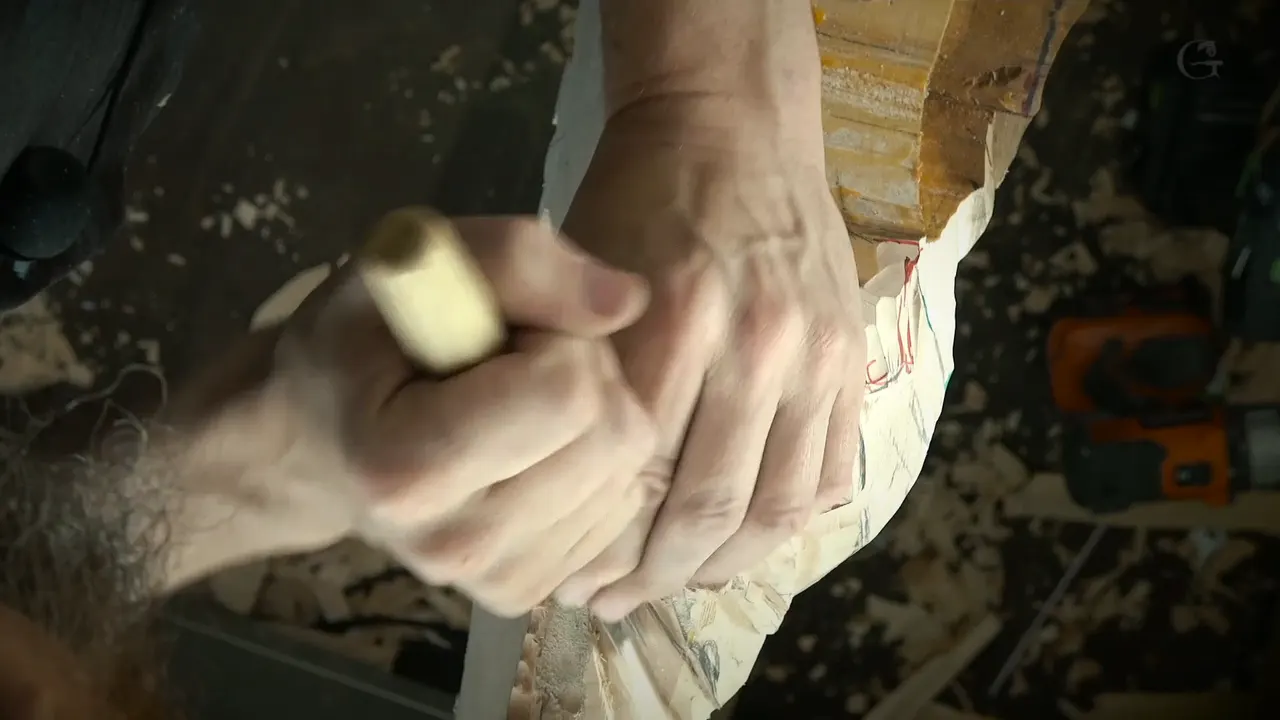

In workshop 84, part 10, I said "just the separation going underneath," and left one side for "little later." My other lessons use the word about volutes, petals, grapes, a molding and a hazelnut husk.
Ever looked at two parts of a carving that sit side by side and seem to run into each other? Do two sections of a leaf run side by side and look alike, so the shape reads like a rectangle? Part 10 of workshop 84 has my gouge on that kind of spot. Stay with the whole part, and then follow one word through my other courses.
The main lines of part 10
- Two sections with "the same distance" looked "almost like rectangle."
- Next, the shape needed some taper.
- A tool "just a little bigger" was for a "little smoother transition."
- The pipe was "still not pronounced" and needed a "much deeper cut right here."
- One side was left for later.
What did I say about the separation in part 10?
"I guess I have to stay from the wrong position because I'm covering with my head, the camera." That is how the part opens. Further on came "So that is good." And: "Yes, I need to smooth this out, but for now it's good."
"But I also want to do a little movement like this, just the separation going underneath," I said. Then: "Otherwise, if you look at that section and that section, it has the same distance, so it's almost like rectangle, which is not good."

Of the shape I said "it has to have some taper," and then "in this case, the only way I can do it, I can create some kind of separation." Next: "Indicate that separation."
The final detail waited. I was "going to take care of the final detail of that separation little later," in my words.
What tool did I try next, and why?
"I'm not too happy about how smooth on inside," I said, "just because I used too small of a tool." Then: "It wasn't mistake by the way, it's just by choice."
And: "I used a small tool that I don't like usually to use a small tool in sections like that. So this is just a little bigger and make little smoother transition."

I named two sizes, 7 millimeters (0.28 in) and a maybe for 10 millimeters (0.39 in). "We'll see. Try 7 first." Then: "7 is much better than what it was before." And "Also go opposite direction."
How did I deepen the pipe beside it?
"Okay, wonderful. But it's still not pronounced pipe. So pipe has to be more pronounced. So which means I need to create much deeper cut right here." A check came next. "Yeah, I think it makes more sense right now."

Next: "And I need to do another concave cut on another side of that pipe. So which is going to go also all the way, just like that. And let me do with the 7 millimeters right away." Those are plans in my words. After them: "And it has to go all the way to that point somewhere, okay?" And "But be careful. I have to be careful, okay?"

Near the end I said "So I've got really pronounced pipe now. That is good." Then: "Except this side is not so good," and "I'll take care of it little later." After that: "So now start creating some shape right here. So it's pretty much repeating the movement, what I have right here. Which you don't see, sorry."

Where else do I say separation?
The word turns up in my other courses too. The table below lists where, and each row comes from a different video. The paragraphs after it quote my words, so read the table first if you only want the list. Read the table first if you only want the list, or go on for the lines themselves.
| Lesson | Sentence |
|---|---|
| Venice Room 84.10 | Going underneath a leaf, a separation with a taper to go with it. |
| Lily Box 6.4 | A wall between two volutes, with an undercut planned underneath. |
| Lily Box 6.2 | An upper volute given a separation from a lower volute. |
| Lily Flower 11.5 | My separation line, with material to remove and an inward pass. |
| Flower Rosette 2.3 | Petals with one going underneath another, so the separation is not open. |
| Flower Rosette 6.1 | Room left between two moldings for a small undercut. |
| Hashemi Flowers 12.2 | Separation cut with the V tool, beside a round detail. |
| Hashemi Flowers 12.8 | My separation inside, shown from different points of view. |
| Lily Filler 12.5 | A natural separation between petals, then one more spot. |
| Gibbons Maine 4.3 | Petals going underneath another petal, not just a separation. |
| Gibbons Maine 3.3 | Flowers I wanted to connect, with no big separation in the way. |
| Furniture Panel 19.1 | Separation needed between two parts, one a little lower. |
| Furniture Panel 29.2 | Separation cut, not too deep, with a number 11. |
| Floral Molding 3.3 | A plan to lower an acanthus slightly so it separates from a volute. |
| Floral Molding 11.3 | Two separations, easy to do in that spot. |
| Grape Onlay 9.3 | Extra separations inside those separations, and a warning about fragile ones. |
| Carving Hazelnuts 3.3 | Bigger separations on a husk, and quite distinct ones on some nuts. |
| Byzantine Acanthus 9.2 | The separation between the leaves, where a relief cut comes first. |
| Vase lesson 3.1 | A separation like a triangle, with a micro vein going in. |
| Acanthus Moldings 8.3 | Separations I can exaggerate later to make them look nicer. |
| Butterflies Plate 7.3 | Knife so tiny and small that I could do my separation. |

How do I start a separation?
The Lily Box course has two lines. "We are talking about just a 1-millimeter space between right here, this ridge, and the other ridge right here," I said in lesson 6, part 4. That space is 1 mm (0.04 in). Next: "I'm creating a wall first," and "Later on, it's going to be undercut underneath." And "But for now, I need clear separation between those two volutes."
"Just a straight-down cut, like 90 degrees." I would not force it, I said, because the grain right there "has a lot of cracks." A different tool was my plan, "probably 2 millimeters" (0.08 in).

That lesson's part 2 put the word on two volutes. About them: "I need to give a separation upper volute from a lower volute because this part is a part of this lower one." Next, about a relief cut, "lower this down just little by little." And: "Straight down cut, but carefully."
The Byzantine acanthus course says it in lesson 9, part 2: "wherever you see the separation between the leaves, you really have to do a relief cuts." And: "You have to relief first."

Floral and Molding for the Panel has a plan in lesson 3: "I need to lower down slightly this part, for I can separate my acanthus from my volute," and then "All I need is just pretty much separation."
Why does a petal go underneath its neighbor?
The Venetian Flowers Rosette course puts it in my words. Rosette 2.3 has "When you work on separations between those two petals, let's say, or this one, it's never an open separation. It's not going to look as nice if you just create a V cut or just whatever the cut."
About one petal and the next I said "So one of the petals, one of them supposed to go underneath of another one."

A shadow entered the talk too. Keep in mind where a composition will be positioned on the wall, I said, and then "If I would like to exaggerate and play with the shadows, most logically, I would like to create a lot deeper shadow on this side." Then: "That way, it's going to be casted really nice shadow."
Lesson 12 of that same set has petals too, in part 5. "I'll use a number 11," I said, and "for now, it's two millimeters" (about 5/64 in). Then: "But I really want to see it's like a natural separation."
The Gibbons class in Maine says it in class 4. "I can show you Both ways," I said, and "If those petals going to go underneath of another petal." About creating "just separation between them," I said "they will not look natural."

Rosette lesson 6 has a small undercut in it. The line there is "I'm going to leave a little bit space between my molding and this molding." Then: "That way, I'm going to create a separation."

The Hashemi Flowers course has two, both in lesson 12. In part 2 I said "except I don't want to touch my detail, the round detail right here. So let me make a separation cut with the V tool." Part 8 has a line about a separation on the inside. The words were "again, that is not my clean cut yet, how I call it, because I do have to make a separation, okay? I have to make my separation on the inside, and hopefully, you understand what I mean." About a V cut I said "that is just preliminary V cut," and "Well, I could actually use a spoon V tool and work with the grain."
A size came with it. "That's a number 12, and that's eight millimeters" (0.31 in), I said. Near the end of that part I said "Hopefully, you see my separation from different points of view."

How many separations can one spot take?
More than one, in the Grape Onlay course. Onlay 9.3 has "inside of those separations you can create even extra separations. Like so with the relief cut first with the grapes, you can do as many separations as you wish."

About the tiny small tools I was using I said "it's number three and one eighth of an inch, three millimeters." And: "You could fix your separations, but I wouldn't," and "I wouldn't do all of them right now if I would be you because it becomes fragile."
The Hazelnuts course holds a plan. Hazelnuts 3.3 has me saying "maybe I can start probably even bigger separations because each of those are going to subdivide in three main motions." And: "in this case, I really want to do extreme subdivisions."

Later in that part, about the nuts themselves, I said "some of the types of hazelnuts, they do have quite distinct separations." And "kind of just have indication of it, but not really separation." My next line was a need: "I think I need to get that little bigger number seven." And "we'll use 14 millimeters number seven" (0.55 in).
Floral and Molding has a number of its own. In Floral lesson 11 I said "I could do two separations easily. Yeah, why not?" Next: "Just because I created separation on that side, so now I have to really just blend that really carefully right underneath."
The Acanthus over Moldings course points ahead. In Moldings 8.3 I said "I can just give preliminary shape," and then "later on I can just exaggerate those separations make them look nicer."
What other lines have a separation in them?
The Furniture Panel course has a line in lesson 19, part 1. I said one of the parts would be "little lower than the second part," and "But I need that separation right here." The next Furniture Panel course has lesson 29, part 2: "let me create a separation cut," and "I can't do it too deep of a cut." On the tool: "doesn't have to be two millimeters" (0.08 in), and "Three millimeters will do also" (0.12 in).
The Vase with Grape Leaves course gives a reason in lesson 3. Here is the line: "The reason why, because every time when you see a separation like this or triangle," I said, and a micro vein goes in there. Also: "you can always use micro tools for this operation. You can use maybe even a number eight, or a quarter-inch." A quarter-inch is about 6.4 mm.

Maine class 3 has a separation I did not want. The line is "I want to make sure I don't have like a big separation between those flowers," and then "I want to connect them all." And "I want to create like a triangle see this cut."
A tiny knife comes up in the Plate with Butterflies course. Butterflies 7.3 has "Probably in this case I could do my separation because the knife is so tiny and small."

One more sits beside a saw, back in the Lily Box lessons. The part is 11.5, in lesson 11. "This is my separation line, so I have to kind of remove that material and also cut inward just like that," is how I put it. Next I said "I'll take it to scroll saw," and then "I just scrolled this out." A scroll saw page on Wikipedia shows the machine.
Wikipedia has pages on volute, petal, vein, grape, hazelnut and wood carving for background, and on gouge, chisel and mallet for tools. Sizes come as I said them, with the other unit in parentheses, and a millimeter page plus an inch page cover both.
Does one of your own pieces have two parts that run into each other? Would you like to watch a gouge settle it, with my voice saying each doubt? The whole Venice Room Part 7 sits on one tuition plan, and workshop 84 is waiting in it.
How it's done
- Look at the two sections. Both sections kept "the same distance," and I called the look "not good."
- Give the shape a taper. A taper was what I said the shape needed.
- Indicate the separation. The separation came right after the taper line, and I wanted it indicated, as I put it.
- Try a little bigger tool. A small tool had left the inside less smooth than I liked. I said a little bigger one would make a smoother transition, and then I called the result "much better."
- Leave the last details. Taking care of the separation's last details waited for "little later."
Frequently asked questions
How did the word taper come up?
Sections with "the same distance" looked "not good" to me, and I said "it has to have some taper." My next point was that the only way I could do that, in this case, was a separation, and the words after it were about indicating that one.
Which tool sizes did I name in this part?
Seven millimeters (0.28 in) came up with a maybe for 10 millimeters (0.39 in). Then came "Try 7 first." Next: "7 is much better than what it was before." Later, for another hollow, I said "let me do with the 7 millimeters right away."
Did I finish the separation in this video?
The part ends on "Here you go." Before that, the final detail of the separation waited, in my words, until "little later," and about a side I called "not so good," I said it would wait too. On the pipe I said "really pronounced pipe now."
What to carve next