

Alexander Grabovetskiy, woodcarver, School of Woodcarving · Published 2020
What does a wood carver mean by "good position"?
Quick answer: In Venice Room 84.6 I said "good position" about a spot I picked for an eye, and I said it's going to feel like that little piece going underneath. Other lessons of mine use the same words for a pipe, subdivision points, a nut, a piece in my vise and the camera.
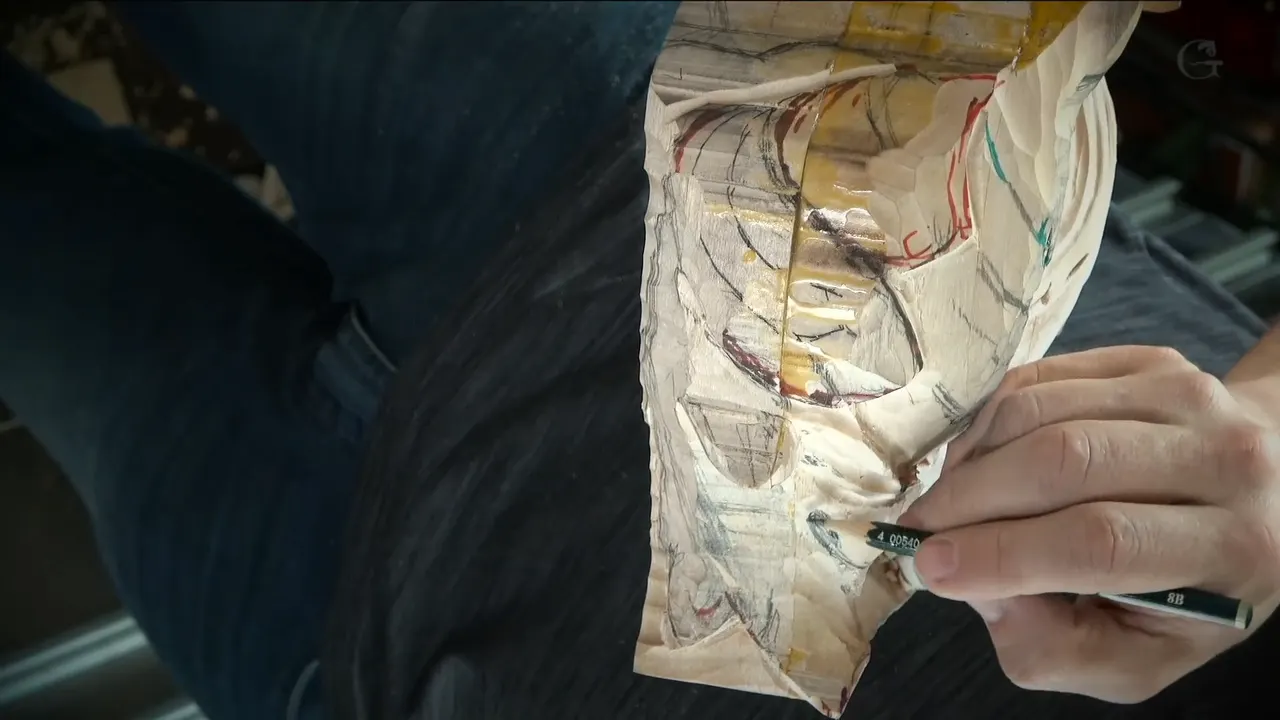

In part 6 of workshop 84 I mark an eye in pencil and call the spot "good position." Other lessons of mine use the same two words for a pipe, a nut and my own place at a grinder.
Ever hold a pencil over a block and wonder whether the eye belongs there? Does one wrong spot stop you before the first cut? Come along while I name spots out loud, a gouge and a pencil in my hands, and listen for what I say next each time.
How does part 6 begin?
With a plan for a separation cut. "So that is good. So now I need to create a separation cut." It was "not a separation cut like in other cases, but that still has to be separated," I said. The tool I named was a 2 mm (0.08 in) number 11, "Let me use 2 millimeters, number 11," along with "probably just a small mallet, brass mallet."

Mallets fill this stretch. My warning for the cut was "I got to be really careful." One mallet fell, "That's my mallet falling down," and I told you "I have multiple mallets close by."

My verdict on the movement came in pieces. "A little bit, even more," I said, and it would give me a "really nice feel," "like it's a really three-dimensional movement." Then: "it feels like this part is really going from underneath." The limit I put on it: everything would be "smoothed down and refined later, but for now, it will do."

Why did I reach for a skew?
The side was too bumpy for me. "I need to just knock down a little bit this side because it's just too bumpy," I said. I weighed two tools out loud before I settled on a skew: "I'll use just a skew." It was for "a little more smoother movement." And a warning: "Always possibility to overdo it, and I do not want to overdo it."
Where did the eye go?
"There you go, let me now create an eye. And where do I now do it? Probably somewhere right here." That was followed by "Somewhere right there." A pencil is in my hand in the frames from those moments.

Then: "Okay, it's a good position, and it's going to feel like that little piece going underneath."
The good position came with a plan for more. "But I also want to make sure I've got the second eye also. So if I've got that, so that is going to be my middle line. And I'm going to need an eye somewhere right here, too."

Doubt followed: "Maybe yes, maybe no, maybe I have to just move a little bit," I said, and I thought it would be "a little more logical." I added "I want more."
Why was I afraid to dig deeper at once?
For the eye I planned a 7 mm (0.28 in) number 11, "So again, to create the eye, I'm going to take 7 millimeters, number 11, and create an eye." I offered myself a deeper start, "And let me make it deeper right away." I usually am kind of afraid of doing that, I said, "but I think in this case I could do."
My fear has a reason. "I'm afraid because if the eye position in the wrong place, it's always a chance." One word came after it, "Blend." Then: "So it goes like this. So that movement is going to be above that little thing what we just created."

What was my plan after the eye?
An outline, as a plan. "What I have to do, I need to outline it better. So I'll take 3 millimeters and I'll just create preliminary cut like this." That is 3 mm (0.12 in). Tools "should be super sharp," I said, "Because of the grain directions. It's all over right now."
Then: "Okay, good, so now I'm happy, let me kind of also remove some of the stuff I don't need, and now I can just clean up a little bit this side."

What do the parts on either side say?
Part 5 of this workshop ends on this line, "Unfortunately, I made the previous cut a little too deep." The next part starts with "That is okay."

Another position shows up in part 5. Something is "just laying right in the corner," touching "right at the corner" on a rectangle. "I'm happy with that," I said there.
Part 7 shows a different case. "I do have an eye," I said, and then "That's actually wrong. It's not what I planned. Just made a mistake." My reason was "Because that is a part of one movement," and "this eye doesn't really make any sense." I did not say in that part which eye it was.

Where else does it turn up for an eye?
These two words appear in my other Venice Room lessons, and I will say where each one comes from.
Workshop 13, part 3, has "I want to make sure I'm placing an eye in the right position right here." Then: "Good position," "I can go around this eye." For the details my plan was "I need to create a big concave first right here," plus "I want to raise it up."

Over in workshop 19, part 5, "Another eye right here" was my phrase, and I thought it would be "a good position for it." I planned "exactly the same number nine, which I used already a lot in this project," and to go in a little bit first: "That way, I know exactly what I'm dealing with." "Another one, separation, probably, because I really like those" was a plan too.

For an eye in workshop 31, part 5, I said "maybe just straight down cut," named a "really good position," and added "I can actually do right there an extra one."
Back in workshop 52, part 1, I talked about the "main divisions" repeating "on inside," which would be "invisible," a "common way to create acanthus movement." I did not think I would do "a little more of eye," I said, and the spot was "probably a good position." A new question followed: "how do I attack those triangles?"
Workshop 68, part 5, ties the spot to a line. "If you logically continue this line underneath," I said, the place will be an intersection. I rated it a very good spot for the eye, and I planned "another eye in this area" and one "applied to another side also." I also planned "another small division" and said I could do "exactly the same on that side, just a small detail to fill that space."

Is it only about an eye?
In workshop 15, part 2, the words went with a pipe, "all the way this way," and then "a good position for the pipe. I really like it." My thought about the tool was "something more extreme for this pipe" because it will be "on the bottom" and "seen a lot, actually." I could even start "probably even with the number eight."
Subdivision points came up in workshop 25, part 12. "Why I didn't cut that deeper, because I still have to bring it all the way down, and I need that extra material," I said. And "I need to find the right subdivision points." Of two spots I said "that is a good position right there" and "a good position right here."
In Carving Hazelnuts, lesson 4, part 3, the spot was a hazelnut, and the words were "So which means you really have to find that position." The husk matters here: "it's not going to look parallel with the background." The nut got "probably good position," then numbers: "About maybe three-quarters of an inch from this point down. About 19 millimeters down, something like that. But still has to be logical." Both of my figures match, since 19 mm is 0.75 in.

The husk got a limit as well: "I'm not going to do too much to this husk because I still did not establish my main shape of it."
The Furniture Panel design course, lesson 14, part 4, has me deciding "I think I could actually make this one even bigger." That spot was "a good position" because, I said, "take a look. I've got the point right here, and there is a line." "I hit my point on that diagonal, so really good," I said, and "So far, I'm happy."

Measuring is the topic in Carving Floral and Molding for the Panel, lesson 1, part 2. "I cannot reference from the bench, I have to reference from plywood." "Let me find a good position," I said. I warned that you probably could not see the whole thing. And: "I made a mistake. Not a mistake, but some stuff is in my way, and I have to just change the position how I measure it."
My vice shows up in workshop 85, part 3. I called it a "really good position" to show how I'm holding my piece. I use a "carver's vice and a plate three inch," which is 76 mm, and "you can use multiple sizes of plates, two inches, three inches," which is 51 mm and 76 mm. The screws are "long screws, like about two and a half inch screws," about 64 mm, "since I do have a really big chunk of wood."

"I like the idea I can just position that to different positions," I said, though I know it is "little flimsy" and "really hard sometimes to watch how I'm carving." I asked you to forgive me. That was "the only way as of now," I said, "I can attack all three sides."
My back bent gouge sharpening lesson puts the position at the grinder. "In this case, this bar goes below the wheel, and that's really important." The bar needs to be "somewhat away from the machine." I said I had to "find the right position and try to hold that distance without wiggling that too much back and forth." I would "find also the right position on my bar" and "try not to move too much toward myself," and I thought it was probably a very good place for me. "Let's start grinding."

The same lesson has "I think my bevel is actually excellent right now."
In Grinling Gibbons, Maine class 16, part 1, the words went with the camera. "Really careful. It's an extreme undercutting." Then: "Sure, you see that or not?" and "Unfortunately," with "no good position" where it could show. "I apologize," I added.
Which spots got the words, and what did I do next?
| Video and spot | What went with it |
|---|---|
| Where an eye goes, Venice Room 84.6 | A plan for the second eye, with a doubt about moving it a little bit. |
| An eye beside a concave, Venice Room 13.3 | A big concave first. |
| A pipe, Venice Room 15.2 | I liked it, and a more extreme tool crossed my mind. |
| Another eye, Venice Room 19.5 | Number nine again, used a lot in that project, and a likely separation too. |
| Subdivision points, Venice Room 25.12 | Finding the right ones. |
| A straight down cut, then the eye spot, Venice Room 31.5 | An extra one right there. |
| Where I stop adding eye, Venice Room 52.1 | A question about the triangles. |
| An intersection, Venice Room 68.5 | Another eye planned for the other side, and a small division to fill the space. |
| The work in my vise, Venice Room 85.3 | A three inch (76 mm) plate and long screws. |
| A nut, Carving Hazelnuts 4-3 | 19 mm (0.75 in). |
| A spot on a line, Furniture Panel design 14, part 4 | My point hit a diagonal. |
| A place to measure, Floral and Molding for the Panel 1, part 2 | Stuff in my way made me change the position. |
| My place at the bar, back bent gouge sharpening | Grinding was the plan. |
| The camera, Maine class 16, part 1 | An apology. |
Where can you watch all of this?
Workshop 84 sits in the Venice Room Part 7 course, on its own lesson page, between workshop 83 and workshop 85. Workshops 13, 15, 19 and 25 are in the Venice Room Part 2 course, and workshop 31 is in Part 3. Workshop 52 is in Part 5, and workshop 68 is in Part 6. The hazelnuts, furniture panel, floral panel, tool sharpening and Grinling Gibbons Maine class lessons each sit in their own course. A wood carving page on Wikipedia gives the long view.
Does the spot for one eye still make you hold your breath? Would you like to watch me hold a pencil over a block and say "Maybe yes. Maybe no." out loud? The whole Venice Room is open on one tuition plan, and this lesson is waiting in it.
How it's done
- Name the spot out loud. In 84.6 the question was "And where do I now do it?" and my answer was a "Probably."
- Say what the spot will do. The spot would read as a piece going under another one.
- Think of the second eye. A second eye was on my mind, and I wanted to make sure I had it also.
- Leave room to move it. A small move in one direction was possible.
- Know what you fear. Going deeper that fast scared me, with a reason: the eye might sit in the wrong place.
- Plan the outline. The outline needed to be better, and a preliminary cut was the plan.
Frequently asked questions
What came right before "good position" in part 6?
I asked where the eye should go and answered with a first guess, then "Somewhere right there." After that came the words about the position.
Why was I afraid to dig deeper at once?
My words were "I'm afraid because if the eye position in the wrong place, it's always a chance." I usually am kind of afraid of doing it, I said, but I thought I could here.
Which gouge did I name for the eye in part 6?
A number 11 of 7 mm (0.28 in), and I planned 3 mm (0.12 in) for the outline.
Which other lessons use "good position"?
What to carve next