

Alexander Grabovetskiy, woodcarver, School of Woodcarving · Published 2020
If you start a concave the quick way and see it is wrong, should you stop and redo it from almost nothing?
Quick answer: Redoing a concave from a shallow start is what I do in the third part of Venice room workshop 17. I weigh a pass that goes downhill, doubt it out loud, and then work along my line with a shallow start, leaving the edge alone while the hollow gets deeper.
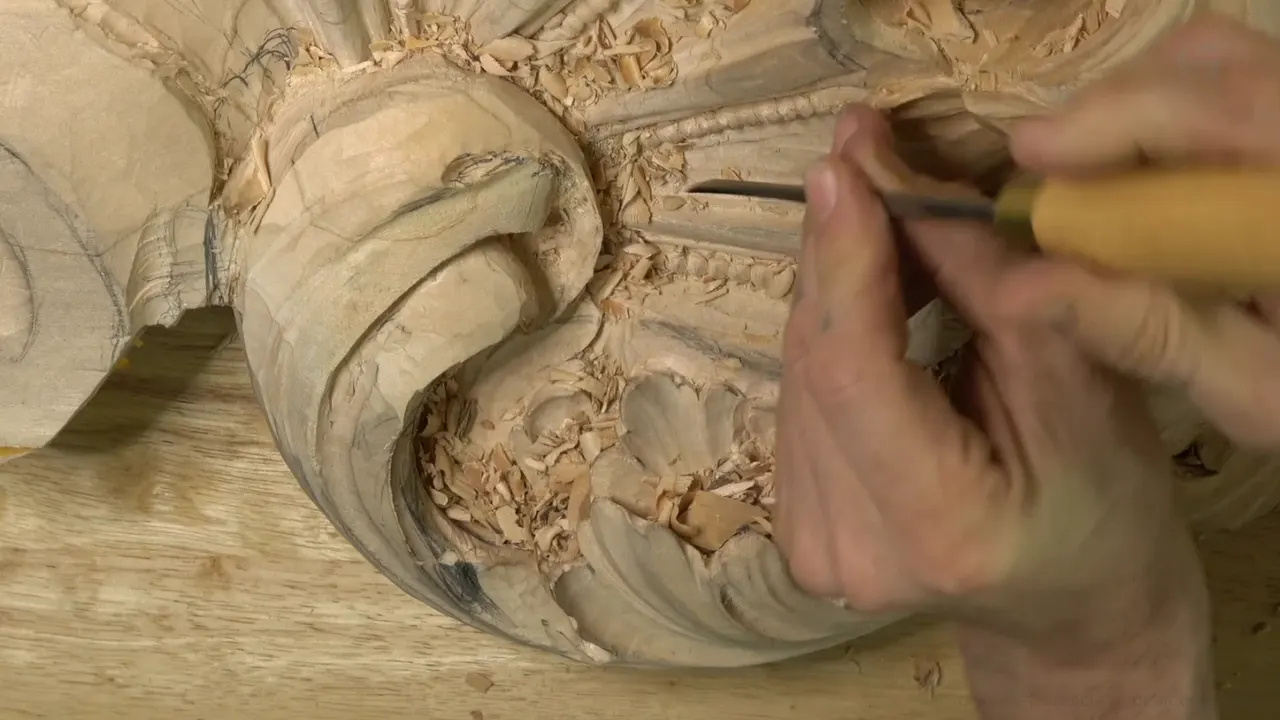
Redoing a concave from a shallow start is what I do when I catch myself on the wrong pass, and in Venice room workshop 17, part 3, I say so in plain words: "I think it's not the right way." That line comes at 01:25, just after I weigh a pass that goes downhill.
Have you ever set a gouge, a curved chisel, on a spot and felt, before it bit, that the pass would come out wrong? Would you push on and fix it later? In this video I take the slower road, and I give my reason in one short line. Part 3 is a short video, and its captions end at 08:34. I went through my other lessons for the places where I turn around mid-pass, and I link each one by its lesson.

What did I say right before I changed the pass?
Part 3 opens on an effect I wanted. "So now I get the effect I wanted to," I tell you, and "this flips a little bit above that one, and this goes all around" (00:14). Next comes "now I am somewhat happy" (00:25). A division follows, and I name the tool for it: "let me use just a number five" (00:34). "Carefully got to remove it," I add.

One division is not enough. "I need to create another division because it does not make sense to have only one" (01:10). Next I weigh how to carve the second. "And the way I can do it, this way. Go a little bit downhill" (01:21). Four seconds later I turn on it, with "I should do the right way" and then "Shouldn't rush it and do the right way, which is authentic to the period" (01:32). The captions don't say whether the downhill pass touched the wood, so I print only what I say.

What does authentic to the period mean in that line?
On this panel I mean one thing, and I name it myself: "create the concave starting from almost nothing and gradually go inward on this side" (01:44). My reason comes right away. "That way it's going to be more accurate" (01:53). In these captions that is all I say about the period. The course is named for 15th century Venice, which sat inside the Italian Renaissance, though I don't use that name in these captions.
How does a hollow that starts shallow go in?
With the edge left alone. In wood carving a concave is a hollow, and this one grows along my line. "Carefully going to just follow my line without touching the edge" (01:58). I stay on my line.

I count the depth out loud, in steps. "Go in, in, and even deeper in" (02:10), and a few seconds later "Go all the way in" (02:14). A look follows, and I say it twice: "That looks much better, in my opinion, of course" at 02:26, and "Looks much better" at 02:38.

No gouge is named for the hollow itself in those captions. A number five is named for the next job: "Now I can take number five and shape a little bit like that" (02:41), and "remove some of the waste" (02:55). So the slow hollow comes first, and the shaping and the waste come after it, each in its own step.

What came after the redo in part 3?
A new problem comes up. "I also need to fix overall movement right here, because right now, also doesn't make too much sense how it looks" (03:00). Two gaps get my eye next, and I say they are "just a little too close. It should not be like that" (03:43). I reach for "a little concave right here", and at 04:20 I say "Okay, it's good."
Later I look again. "It has to look like a leaf, not like something else" (05:01), and it has to be "gradually moving like that". The concave is needed again. I can "probably start from all the way right here and create long cut like this" (05:25), and "otherwise, it just doesn't look right". One side stays untouched for now: "I did not touch this side yet because I don't know, maybe I'm going to add something else" (06:12). "As far as this movement goes, I think I am happy with that".

When else have I turned around mid-pass?
It comes up in other lessons too. In Venice room 23.4 I'm rounding a pipe when I stop myself: "But no, that is not the right way to do that" (01:34). "Okay, I'm sorry." My middle line is the trouble, since I'm "kind of losing it at this point" (01:47), so I say I need a micro concave inside it. I think out loud: maybe use 2 mm (about 5/64 in), a number 11, going "a little by little uphill" (02:01). I print it as a plan, and it stays one.
Venice room 45.1 shows the same turn. "Actually, this needs to be going down" (04:30). What I've just done has to go down like this, I tell you. The eye comes up next, and I say I probably have to do it right away (04:54).

Part 3 of workshop 84 has a bigger change. I could do the opposite direction, I say, and "lower down that side instead" so that the part flips a little above (02:34). Then comes my verdict on the first try: "but it's okay. I still have plenty of material" (02:49). At 03:28 I say "That is wonderful." Over in Venice room 68.1 I can't put a hand underneath. "I probably should switch to a spoon," I say, and then "that's what I'm going to do" (05:10).
The happy side of it is in workshop 17 too. In part 9 I say I can take 1 mm (about 0.04 in) and connect the concaves underneath, where the eye can't see them. "But I know what it is, and where is it," I say, and "that makes me happy when I'm doing it the right way" (03:37).
What does rushing cost me?
A mistake I have to hide, a tool I could break, or an undercut I can't undo. Each of them is on camera, in different lessons, and the table lists where.
| Where | What I said |
|---|---|
| Part 2 of workshop 144 | Sometimes I rush an undercut, and then it is too late to change my mind. |
| Workshop 100, first video | The key at that point is to hold the pace down, because rushing makes mistakes. |
| Part 3 of workshop 126 | The words are plain: I'm rushing. |
| Lily Box 7 | I skip a relief cut, and I go back and make it. |
| Flower rosette 6 | I probably rushed, and now I hide a mistake. |
| Part 12 of workshop 56 | A rush makes me aggressive, and that can break a tool. |
The clearest one is workshop 144, part 2, where I say I can always undercut a little later. Then "that is also one of the lessons for myself. Sometimes I'm rushing and create undercuts right away, and later on, I see I want to change something, but it's already too late because I already undercut" (04:03).

In the first video of workshop 100 I say "I guess the key for me at this point, not to rush it. Because when I'm rushing, I make mistakes" (01:04). Undercutting to the edge gets some thinking out loud. "Maybe yes, maybe no. Let me think. Maybe I shouldn't do it yet" (01:49). It stays a maybe.
In workshop 126, part 3, I dig underneath and say "So again, not too good" (02:07). "I'm rushing too much." I can't go lower than that, I tell you, although "I could always lower this side. That's also a possibility" (02:46).

Lily Box 7 holds a smaller slip. "I should create that relief cut, but I didn't do that. I need to" (13:19). Then comes "Sometimes, rushing things is not the best idea. Okay, let me relieve it" (13:30). A relief cut means placing the tool and going straight down, I explain, and then I can use a number five.

What do I do when I catch it late?
I fix it where it sits. On the olives in Lily Box 13 I wonder if I'm hurrying too much, and then I say it is not the end of the world: "It's just a really tiny spot, and I'll be able to fix it" (16:38).

The flower rosette in lesson 6 has a similar slip. I have to hide the mistake I made, I say, and my guess is that I was probably just rushing (07:13). My plan is to lower the ring a little more on that spot and reestablish it (07:23), with just a small knife. The word is "probably," and I keep it that way.
Rushing can cost more than a spot. Part 12 of workshop 56 tells you why I watch myself: "when I feel that I'm rushing something and I'm becoming a little more aggressive," I can break a tool (04:37). I broke tools before, I add.
What do I hold off on when I go slow?
Undercuts and deep digging, mostly. Part 9 of workshop 47 has me saying I won't rush, I won't undercut yet, and I won't excavate inside yet (05:21). My reason is in the next breath: "right now I need to establish and create the movements right here before I do farther" (05:32).
Workshop 59, part 7, sounds alike. Not undercutting yet, I say, because I still have to develop this section down to the smaller divisions (04:03). "So I don't want to rush it too early," I add, and straight after that I say I'll excavate underneath (04:16). "Same number 11, by the way," I say.
My tools are the next place a rush shows up. Part 9 of workshop 24 brings an extra notch, and I call it "indication I have to be really careful what I'm doing" (06:13). "Which means I'm probably rushing too much when I'm grabbing my tools," I say. "I have to slow down a little bit" (06:30).
Does going slower ever win?
In workshop 70 I correct myself in the middle of a sentence: it is better sometimes, and then, "Well, actually, it's always better not to rush it" (00:53). Then my result: "I found that when I'm not rushing, I'm getting much better results" (01:02). I'm in the middle of excavating little by little when I say it.
Floral and Molding lesson 2, part 2, brings in a deadline. "Even if there is a deadline, rushing is not really a good thing" (12:34). Then I say "once you take too much, you can't put it back" (12:57).
The scroll saw video makes the same case with a blade. "Don't rush it, please" (27:16). With a rush, I say, "you could break a blade, and you're not saving your time," and you can make mistakes and get off the lines (27:24). Rushing doesn't mean it will be quicker, I say, and I add that at least I don't think it will be (27:52). The saw is a different tool from a gouge, so I count this one as a side note.
Is the quick way ever the right way?
Sometimes, and I tell you what it costs. Workshop 20, part 6, has me say "I know there is much quicker ways to do all that stuff, but if you want to do a quick way, you're losing a lot of details" (02:43). I tried it, I say. My verdict is "It's acceptable, but it's not an art" (03:01).

Big tools bring another cost in workshop 34, part 5, where I talk about the fibers. "Always when you're using big tools like that and you're just trying to do a quick way, just like this, you're always creating pressure on both sides of the fibers, which is not the best, not always the best" (05:52).

Part 11 of workshop 72 goes the other direction. "That's a really quick way for me" (07:00), I say, and it is not the safest way. A knife could do it too, I say, but "knife doesn't have that sweep," and I like that a number five has one (07:11).

Part 1 of workshop 34 shows a slow start on another hollow. I begin excavating with a long bend number 11 of about 10 mm (about 0.39 in). "So it's not going to be as deep at the beginning" (01:32), I say, and then "deeper and deeper and deeper" (01:40). Different hollow, same shallow start.
What should you listen for in your own pass?
Listen for that line in part 3. After it I start with next to no depth, and I leave the edge alone. Workshop 17 holds all twelve parts of this panel, in the tuition with the rest of the room, and workshop 18 follows it in the Venice room, part 2 course.
How it's done
- Name the doubt. At 01:25 I say I doubt the downhill way I just weighed.
- Set the pace. At 01:32 I give the pace and the method in one line: no rush, and the way that fits the period.
- Start shallow. At 01:42 I create the concave shallow and gradually go inward on that side.
- Follow the line. At 01:58 I follow my line, and I leave the edge untouched.
- Go in, then deeper. At 02:06 I go in, in, and even deeper in.
- Shape and clear the waste. At 02:41 I pick up a number five, and at 02:55 the waste comes off.
- Check the movement. At 03:00 I say I also need to fix the overall movement right there.
Frequently asked questions
Is it okay to say a carving pass was wrong?
In my lessons I say it plainly. Workshop 84, part 3, has me weigh a first try and say "but it's okay." I still have plenty of material, I add. Part 2 of workshop 144 calls a rushed undercut one of the lessons for myself.
What happens when you rush a carving pass?
Rushing an undercut leaves me wanting to change something when it is already too late, I say in workshop 144, part 2. I make mistakes when I rush, I say in the first video of workshop 100. Tools can break when a rush makes me aggressive, I say in workshop 56, part 12.
Is the quick way always wrong?
Part 11 of workshop 72 calls one pass a really quick way for me, though not the safest. Part 6 of workshop 20 says a quick way loses a lot of details. My verdict there is "acceptable," and I leave the rest of that line to the video.
What to carve next