

Alexander Grabovetskiy, woodcarver, School of Woodcarving · Published 2020
Should you add an extra eye or carve one long concave when a line on a leaf runs almost straight?
Quick answer: A long concave is the fix I chose in Venice Room workshop 17, part 11, for a line that ran almost straight. I called an extra eye nice, but the flow of the whole leaf came first. I judged both options from below, where people will look.
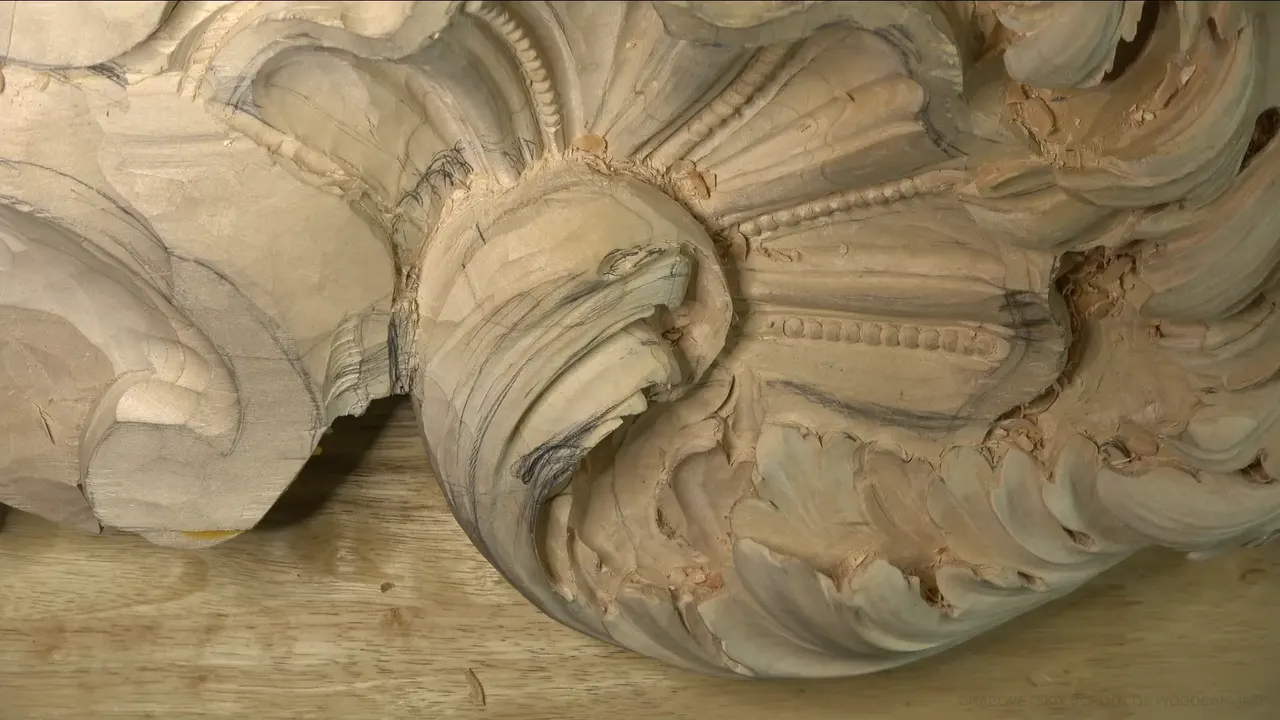
A line that runs almost straight on a carved leaf is a line I fix with one long concave when an extra eye would break the flow, and in part 11 of workshop 17 I weigh both while the gouge is in my hand. My words at 00:44 were "see this line right here, it's almost straight line, so that's not good." Right after came "Of course, I didn't finish it yet."
This video is short. I went through my other courses and pulled in places where I stood in front of the same choice, an extra eye on one side and a longer hollow on the other. Each of those sits in a lesson page that you can open.
Ever looked at a line in your own carving and felt it was dead? Did you reach for a new detail to cover it? I looked at that very option here, so read on.

What did I decide in part 11?
- The line was nearly straight, and I was judging it from below.
- Another eye would have given me one more separation, but the overall flow came first.
- I picked a long concave and started it really far out.
- The tool was probably a number six, and then maybe a number eight to go a little deeper.
- I lost some detail I had carved before, and I called that absolutely okay.
- A small tool, a blending cut and a big skew left me happy with the movement.
Why is a straight line a problem on a leaf?
My goal at 00:21 was to see the piece "from the bottom, from this position." Ten seconds later I was working out what would show, which parts would hide, and where a shadow would fall.
My first words in the video were a plan. I wanted to change one area, add a subdivision on the inside, and create some kind of concave right there. Then, at 00:37: "now I clearly see what I don't like about it."
A quick fix was one option. "I could just chop and just create beautiful movement right there," I said at 00:50. Before touching the wood, I looked at my other options.

Which fix suits a flat line, an eye or a hollow?
I explored a couple of options. The first was an extra eye right there, which would get me an extra separation, and I said "that would be nice." "But I don't want to lose the overall flow," I said at 01:07.
So a long cut it was, a concave going along like that. My reason came in the next breath: "Because it's going to be seen from the bottom. I think it's going to look much better that way."
Look at how I put it. I did not call the eye a bad idea. I said it was nice, set it beside the flow of the whole leaf, and the flow won.

How do you start a long concave far out?
For the tool I said "I will take probably number six," and then, "maybe about a quarter inch" (6 mm). Both are maybes, and I started the hollow by saying "really far," twice, the second one ending "like that."
At 01:58 I said it would still give me "some ridge, this ridge right here." I moved toward the inside, and the reason came at 02:11, "because right now it just doesn't look too good to me." A moment later I added "maybe actually even more downhill."

The second pass wanted a little deeper hollow, so I said maybe number eight, and again a quarter inch (6 mm). I began from the same far spot. "Carefully go out and go all the way," I said at 03:01, and finished with "and give that concave look." My verdict at 03:32 was "So I think that makes more sense to me."

Is it okay to lose details you already carved?
I said yes while I was doing it. My words at 02:33 were "I am losing some of the details because I already chopped from inside, and that is absolutely okay." The reason sat in the sentence. I had carved from the inside first, and the long hollow took some of that away.
Then, at 03:41, came a line I want you to hear. "Please understand, I'm not trying to confuse anybody." All I was doing, I said, was developing an idea that pleases the eye and is also logically accurate, because "you have to look at that from different points of view."

What does a small tool do for the ridge?
Inside the new hollow I wanted a deeper concave, "just give that extra line look." For that I would use "maybe even a micro tool," and I added, "I think it should be a good spot to use it." The job was to bring out that ridge.
Then the tool needed help. "I think I need to sharpen it," I said at 04:46, and once I went back in I told myself, "Carefully," because I did not want to destroy the line.

Near 05:25 I stopped short. "That's enough," I said, because I was creating an extra ridge that I did not want. Next I would return to my number eight for a "little blending cut."
Next the overall picture needed fixing, since it did not look too appealing yet. I needed to sharpen my pencil too. A skew would do, or a knife, "or pretty much any tool will do the trick."

My pick was the big skew. "It has a leverage point, so one of the parts rising on the edge, and it creates a lot smoother cut for me." "So creates beautiful curvature," I said at 07:00.
One last check: could I clean a little on the bottom, and bring it to the edge "without making it too weak"? I looked, and at 07:29 said "that's not too weak. It's actually really good." The video ends with me "really, really happy right now with this movement."

When have I said yes to an extra eye or an extra separation?
The clearest yes sits in workshop 38, part 4. Around 02:11 I looked at one movement and said "I kind of don't like what I see." That day I would change it, "because it's not too appealing to me," and "give an extra eye right there." I also said this concave was "a little too deep to my taste."
Smaller steps fill workshop 76, part 2. I was "really not too happy with this movement," so I needed "maybe an extra separation right here," since it did not look good and did not make too much sense. My tool was a number three, 3 mm (1/8 in), a "micro tool pretty much."

"It just created an extra separation," I said at 01:50 in workshop 67, part 4. Maybe a smaller number three, 3 mm (1/8 in), came next, to get "that detail a little nicer."
The words in workshop 66, part 10, were plain: "I just added extra separations, what I did." I had excavated an eye and excavated the inside. "Nothing that special," I said, and then, "now it's all about the detailing."

When have I said no, or maybe?
Back in lesson 38, part 9, the same question got the other answer. Near 04:02 I was "not sure if I could just give extra eye, if I should or not." Then came the line I come back to most: "Sometimes those extra details, they make sense. But in this case, it doesn't make too much sense."
The eye stayed out. My plan was to take a little off that section and make it narrower. I weighed the same two things as in part 11 of workshop 17, and the answer came out the other way.

Between those two sits part 6 of lesson 38. By 04:07 I said "maybe I have to just recreate my eye in this location," then that I "could give extra separation, I'd say." And right after, "on the other hand, let me keep it like that. But I'm still going to give a little detail right here."
Workshop 163, part 1, holds another maybe. Around 06:46 I was not sure about the eye "right here, so maybe I really don't need to. Just keep it smooth."

Does the viewer's position change the choice?
It does for me. Over in workshop 69, part 4, I had to consider the position that would be visible, and for me that was the bottom, mostly.
The other side came next. "On the other hand, when you're going to stay really far in another point and look at that detail, you're still going to detect that movement also." Same leaf, two places to stand, one movement that has to hold up for both.
Another video of that lesson, part 3, adds a twist. A smaller tool could go inside, maybe one millimeter, number 11, to "just create extra depth, which in my case, it's again, not going to be really visible. But create extra separation."
How did I begin a long concave in other lessons?
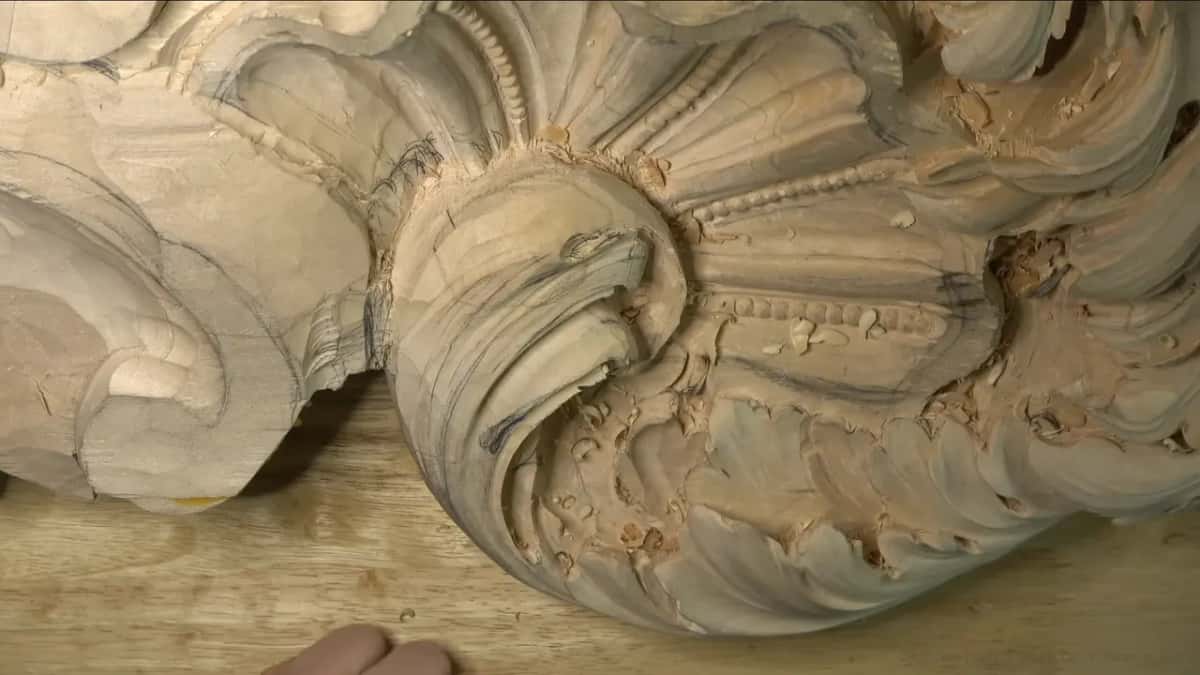
That same video goes on, and the plainest line comes at 07:09: "I need to make a long concave again to raise up the middle part of that main movement." Then, "long and big." The size I gave was 15 mm (about 0.6 in).
In workshop 80, part 1, the order is the point. "I'm not creating concave pronounced right away," I said at 05:02, and "it's better just to create straight line first, almost straight line, and then create a final movement."
Put that next to part 11 and the two look opposed. In workshop 17 the line was "not good," and in workshop 80 it was a first stage. In 17.11 I said I didn't finish it yet, and in 80.1 I said I was not creating a finished look yet.

Furniture panel lesson 20, part 9, shows a far start on a molding. That hollow would not be really deep, because it "still has to be on top of that molding." I began it "from all the way here," from "almost nothing, barely, less than 64th of an inch deep" (under 0.4 mm).
The hollow still had to read as a concave, and my words were "from almost nothing, deeper, and even more deeper." Then came a warning: "make sure you've got the really sharp tools."

Hashemi lesson 13, part 1, asks the question out loud: "But how do I start my concave cut?" A spoon gouge came out, and I would start probably with a half-an-inch number eight (about 13 mm). Next came a number seven, half an inch: "I don't want to overdo it."
One more sits in workshop 46, part 11. I needed to "establish boundary of this concave on this side, because it's really important not to mess up." Then, "carefully going to start my concave," and "does not have to be that extreme."
The next video of workshop 17 picks up the thread. In part 12 I said "maybe even I could take number 11 and create a good-looking concave right there," then said I had to work out where to start, so that I would not overdo it. Near 04:33 the verdict was "nice and long movement."
A short record of what I chose and where
Here are five. Read the choice column first, because each row answers the same question in its own way.
| Where | Problem | Choice | Detail |
|---|---|---|---|
| This video, part 11 | A nearly flat line seen from below | Long concave | Probably number six, maybe number eight |
| Lesson 38, part 4 | One movement that was not too appealing | Extra eye | Tool not clear in that cue |
| Workshop 38, part 9 | Another eye that might not make sense | Skipped it | Tool unnamed in that part's cue |
| Venice 76, part 2 | A movement I was not happy with | Extra separation | Number three micro tool, 3 mm |
| Venice 163, part 1 | The middle part of that main movement | Long concave | Long, big, 15 mm (0.6 in) |
What should you do with a line like that?
Where will people stand when they look at it? Is there a spot where a new eye would break the flow? Then hold the eye back, and try one long hollow that starts far out.
The video I described is one part of the lesson. Workshop 17 holds the rest, and the course page is Advanced Carving: Venice Room, Part 2. The craft is wood carving, a branch of woodworking. A gouge belongs to the chisel family, and a strop keeps its edge sharp. A relief is carved on a flat background, and an acanthus leaf has deep spots that hold shadow. My sizes are in millimeters and inches, and I sharpened my pencil too, since the line it draws follows a curvature. The room is in the style of Venice.

Which curve in your work looks dead from where you stand?
How it's done
- Stand where people will. My goal was to see the piece from below and think about what shows, which parts hide, and where a shadow falls.
- Name what bugs you. At 00:44 I said the line was nearly straight, which was not good, and that I had not finished it yet.
- Weigh an extra eye. An eye was nice, I said, so I weighed it against the whole leaf's flow.
- Begin the hollow far out. A gouge near number six went first, and the hollow began really far.
- Go deeper and blend. A slightly deeper pass came next, then a blending pass.
- Finish with a skew. A big skew on its leverage point gave a smoother pass, and the edge held up.
Frequently asked questions
Is an extra eye the right fix for a flat-looking line?
In part 11 I called the eye nice, but the leaf as a whole came first, so a long hollow won. The person looking from below will see that flow, and that is where I judged both options. In another lesson I did choose the eye.
Where does a long hollow begin?
Really far out. My tool was probably a number six, maybe a quarter of an inch, which is 6 mm, and the hollow still left me some ridge as I moved inward. A second pass with maybe an eight went a little deeper, from the same far spot.
Is it okay to lose detail I already carved?
Yes, at 02:33. Some detail went because I had carved from the inside earlier, and I called that absolutely okay. My aim was an idea that pleases the eye and holds up logically from different points of view.
What to carve next