
Alexander Grabovetskiy, woodcarver, School of Woodcarving · Published 2021
What does a wood carver mean by "this corner"?
Quick answer: Part 11 of workshop 101 is where I expose only a slight corner. Other lessons of mine bring up a corner to chop off, clean, excavate, break or lower, and in the Lily Box I say it should be an arc. Each one comes with its own tool and plan.
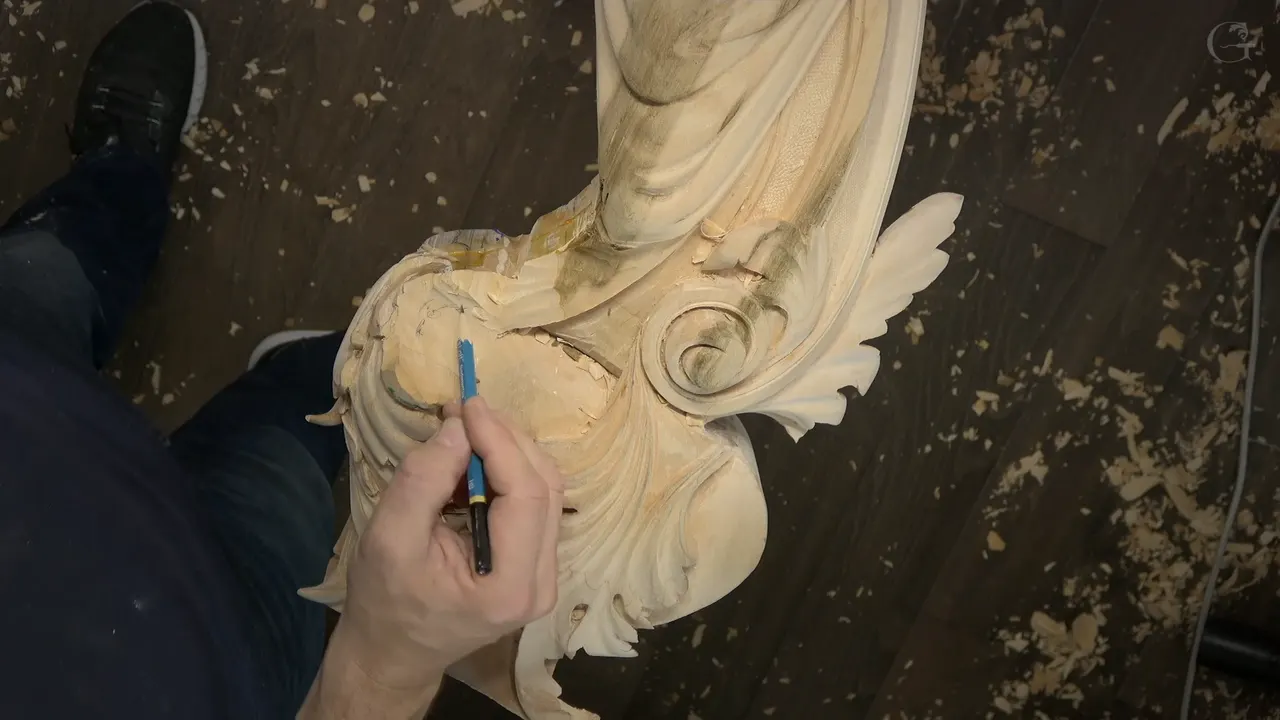

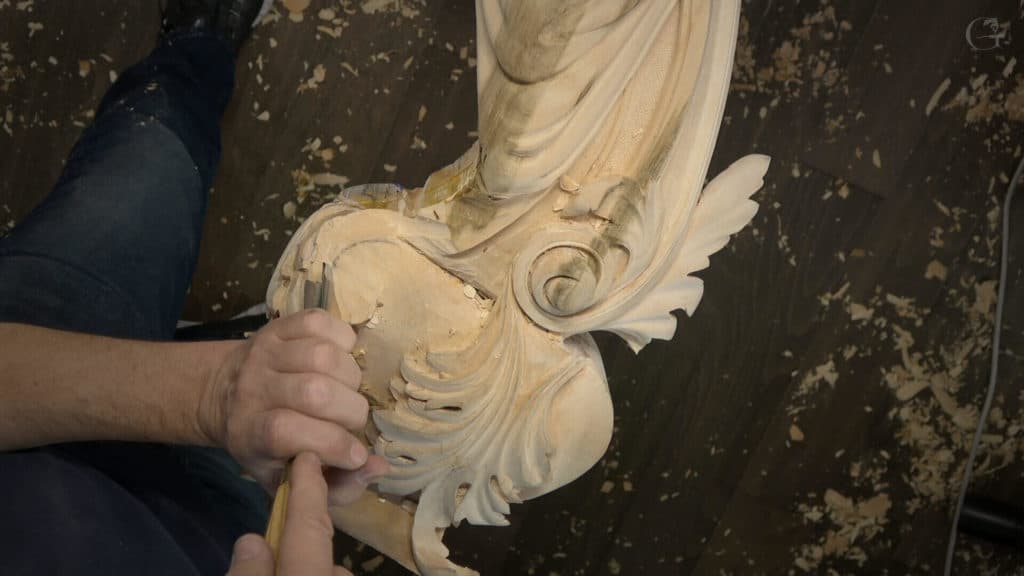
In workshop 101, part 11, I say "So I expose just a slight corner of it." Other lessons of mine bring up a corner too, and each one comes with its own tool and its own plan. I read them next to this one.
Ever looked at the edge of a carved shape and wondered how much of its corner to leave? This video is short, so I put it beside the places in my other courses where a corner comes up. Each place links to its public lesson. Workshop 101 belongs to my Venice Room Part 9 course, it is wood carving, and every size is in millimeters and inches, my own figure first.
What did I want from the corner in part 11?
The part opens with two lines: "I'm pretty sure I'm close" and "I'm pretty sure I'm really close." Then comes "So that would be exposed part."

Two jobs come next. One is to "repeat the curvature, how it's supposed to look" with "those leaves going to just flip above that." The other is the spot itself: "this part is going to be exposed." I end on "So I'm happy with that."
My tool is a number 11 of 10 millimeters (0.39 in). The plan is to "work my way in around this area" and then "create the beautiful transition." The word "curvature" has its own page, about curvature.
How did I get in to the corner?
A warning comes first: "Okay, so I've got at the same level, so I have to be careful not to overdo it." I also float a bigger move, saying I could "chop out completely this section and then recreate my line" and I think of "the bigger number nine."

After "Here you go," I say I can "redraw that line and also move it this way." The placement is by eye. "I'm just eyeballing it," I say, and "I know sometimes it's scary to eyeball, but I feel safe."
The knife is next in my plan: "my knife I love. It's number 12." A cut like this is planned for the knife, "pulling it over myself" and then I plan "another side" with a V cut.

Why did I stop at a slight corner?
Next comes the edge. "The edge will be exposed," I say, and "this edge line will be exposed." The hard part gets its own line: "I still have to do somehow really good and nice corner."
Then the limit, in my own words: "I can't do too much." That side "has to bend in" and I add "a continuation of design." And the amount: "All I need is just a little bit of exposure of this corner, then it's going to look architectural."

Next on my list is a number three, to "create cut straight down." It stays a plan here.
Which passes finished off the corner in part 11?
A clean-up follows. I say I can "just probably take number 7 and 14 millimeters" (0.55 in), and "create my clean-up cut all the way like this."

Then comes my verdict, and it is short. "There you go. That's what I'm after. So I expose just a slight corner of it." It "looks really good in my personal opinion, of course" and "now it's more looking like architectural carving." The word "architectural" has a page about architecture of its own.
I use a number 11, 10 millimeters (0.39 in), to clean up. Last, "just a little bit of cleaning" with "number three upside down" and I "need to make sure the surface is actually really nice and clean and smooth."

What does part 10 say about the edge?
Workshop 101, part 10, sits right before this one. There I say I need to "get that edge translated right here" and that it will be an "exposed edge," "looking really good."

What came right after the corner?
Part 12 starts with "I think I'm happy." Next I say I "have to jump on a side and continue development of my acanthus," but I plan "a cleanup job to this section" with a number three.
Where else in the Venice Room does a corner come up?
Workshop 85 comes first, in Venice Room 85. Part 12 names "three-quarter of an inch, 20 millimeters, and number nine," that is 3/4 in (19 mm) and 20 mm (0.79 in), and I add "Let me get this corner first."

Part 11 of that workshop has me saying "I can chop off this corner right away pretty much." After it: "I don't need that anymore." A few lines on, I say "a more smooth transition."

A slip of the tongue sits in workshop 74, part 2. I call a spot "this corner, or whatever that subdivision" and then I stop: "What am I talking about? It is not corner." The gouge was a number five of about 12 millimeters (0.47 in), about half an inch.
Workshop 4, part 5, pairs a number three, "just straight down cut" with a plan to "clean that little bit, that corner."
Workshop 24, part 11, has "Chop a little bit this corner." A "preliminary mark about 10 millimeters away" (about 3/8 in) is next in my plan, and "I'm just eyeballing it."
In workshop 37, part 1, I say maybe I have to give "straight down cuts, a couple of them" and then "excavate that corner." Just before, I note that I "need to clean this side a lot better."
Workshop 29, part 10, has a plan: "clean that corner right away." Excavating inside waits, and I say so: "Yeah, later on, I'm going to excavate inside of those. But for now, at least for now, it is good."

The line in workshop 60, part 10, comes after I call a spot waste and say it will be deeper. And: "I need to clean little bit that corner, too."
"Which means this corner needs to be lower." That is workshop 123, part 3, and what I want is to "make it feel like it is going right underneath." A number two is the plan, leaned for an undercut "a little bit underneath."

Workshop 153, part 1, shows the corner after a number 1 goes straight down. The tool I plan is "big 3 inches and 1/8 to be exact, like 80 millimeters" (about 3.1 in), placed "right on the line." Then: "There is a corner. There's the edge." A smaller option: I can take "even smaller number 11, maybe about 3 millimeters" (0.12 in) "and excavate even deeper."

What do I do with a corner in the Furniture Panel?
A drawn corner comes first, in the design lesson of the Furniture Panel course, lesson 4. I want to "repeat this corner" with a "90 degrees angle" and then my plan is to "break that corner" and "create something else."

Panel 15, part 5, hands a corner to a V tool: "Get that corner with the number 12 V tool." Next, a number four, "Carefully," to "remove my waste." The size I name is "3/32 of an inch on this side" (2.4 mm).
In lesson 18, part 5, I plan a number one of 5/8 of an inch (16 mm) and "place it right on the line." Then I plan "Let me chop this corner also." I tell you "Make sure you're holding that straight down."

Part 6 of that lesson says "get really close to the final destination," "But carefully." The corner itself gets a number three, planned "to chop this corner out." After it I plan a number 11 at one millimeter (0.04 in) to "clean inside" and the warning "keep an eye how deep you go."
In Furniture Panel 19, part 15, I do not want to spend too much time cleaning "that all the way right now," because later on I plan to look at it and see what needs to be changed. A "tiny number one" is my plan for "this corner." And I add one more thing about it, a suggestion: "you could use a small knife right away."
What about a sharp corner, or a corner I keep?
Sharp ones are the other side, in workshop 12, part 10: "I don't really want to see any sharp corners like that." I plan my number 11 for it, and "I think it's going to look better without those sharp corners."
Workshop 113, part 2, has "keep a little bit this corner" plus a "smaller gouge" to "outline the rest of leaves."
The Lily Box has two more. Lesson 2, part 3: "I am happy with overall blending in this corner." Lesson 5, part 2, has "this corner, this part is still a little too high" and "this ridge" has to "match the same height right here."
Do corners ever come in the plural?
Workshop 6, part 12, plans a number seven for the corners: "Let me get inside of those corners and kind of remove." Then a warning, "be careful" and "I'm using only edge of my tool."
A small tool is planned "in all of those corners" in workshop 58, part 2: "I could use a really small number six and go in," attacking "from that side" and "blend that concave to it."
Chamomile and Bow Rosette 3, part 1, calls one side "my high spot" going "downhill." The next line: "I need to knock those corners." And "Since we took the corners out, makes it much easier," I say in Flower Rosette 3, part 4.
In Greek Acroterion 4, part 5, my knife works "to find my one-eighth of an inch" (3.2 mm) "in those corners" with "a really low angle."
Is the corner of a tool the same thing?
Panel 15, part 12, says "I'm using number seven, and I'm using just the corner of the tool." That corner belongs to the tool, not to the carving.
Which corners show up in the Lily Box and the Grape Onlay?
"Let me chop out this corner. Straight down cut." That is Lily Box 6, part 11, and I call the next ones "just relief cuts." On this corner I want "a relief first with the 1 millimeter" (0.04 in).

Lily Box 3, part 6, turns the word around, and the shape I want is an arc: "it should not be a corner, by the way. It should be, again, like an arc transition. Curvature, if you wish."
The Onlay with grapes has its own. Grape Onlay 1, part 2: "Let me actually excavate this corner." After that, "every cut I am still slicing and attacking that from different positions. None of my cuts are 90 degrees down."

Which lesson says what about a corner?
| Where it comes up | What I plan or say about the corner |
|---|---|
| Part 11 here | A slight exposure, and a little cleaning follows |
| Venice Room 85, part 12 | Get this one first, using a number nine, is my plan |
| Its part 11 | It can come off right away, since I do not need that anymore |
| Workshop 74, part 2 | Slip of the tongue: a subdivision, then not a corner |
| Venice Room 4, fifth video | Clean that little bit once a number three has gone straight down |
| Workshop 24, part 11 | A mark about 10 millimeters away is planned, after a little chop |
| Workshop 37, part 1 | Maybe a couple of straight down cuts, then excavate it |
| Workshop 29, part 10 | Cleaning it right away is the plan, and excavating inside waits for later |
| Workshop 12, part 10 | Sharp ones are unwelcome, and a number 11 is my plan for them |
| Workshop 113, part 2 | Plan to keep some of it, and outline the rest of the leaves with a smaller gouge |
| Workshop 60, part 10 | One more to clean, a little bit, right after the waste |
| Workshop 123, part 3 | Lower, so the shape feels like it goes right underneath |
| Workshop 153, part 1 | There is a corner, and there is the edge |
| Panel 4, design | A drawn one to break, to create something else, is the plan |
| Lesson 15, part 5 | Number 12 V tool first, and a number four to remove my waste |
| Lesson 18, part 5 | On the line sits a number one, and I plan to chop it |
| Its part 6 | Number three to chop it out, and a number 11 to clean inside |
| Panel 19, part 15 | A tiny number one is planned for it, and a small knife could do it |
| Box 6, part 11 | Plan to chop it out, with a relief first, using one millimeter |
| Box 2, part 3 | Happy with the overall blending in it |
| Box lesson 5, part 2 | Still a little too high, and the ridge has to match |
| Lily Box 3, part 6 | An arc transition, a curvature, not a corner |
| Onlay 1, part 2 | Excavate it, and slice and attack from different positions |
| Workshop 6, part 12 | The plural: a number seven for the corners, using only its edge |
How do these passages line up with part 11?
- Part 11 leaves a corner slightly exposed, and a little cleaning follows.
- Other corners get chopped, chopped out, excavated or lowered.
- One corner is broken, and one gets a V tool.
- Some corners wait for a cleaning, a little bit at a time, and sharp ones get a number 11.
- In that Lily Box lesson the shape I want is an arc transition.
Here the corner stays and shows, just slightly. Which corner on your own carving would you leave exposed, and which one would you chop off first?
How it's done
- Work in around the area. A number 11 at 10 mm (about 0.4 in) was planned for working in around the area.
- Mind the level. I said I had to be careful not to overdo it, and that I could actually chop out the section and recreate my line.
- Plan the knife and the V cut. Next on the list: my number 12 knife for a line, pulling it over myself, then a V cut from another side.
- Plan the straight down pass and the clean-up. I planned a number three straight down, then probably a number 7 at 14 mm (0.55 in) for a clean-up cut.
- Leave a slight corner. I said "That's what I'm after." For the last cleaning I planned a number 11 and a number three upside down.
Frequently asked questions
What was my word on the corner here?
That I still had to do a really good and nice corner. I could not do too much, because that side has to bend in, and all I needed was a little exposure of it.
Which tools did I name there?
I named a number 11 with 10 mm (about 0.4 in) for the area around it, a number 12 knife, a number three, a number 7, 14 mm (about 9/16 in), for a clean-up cut, and number 11 again for cleaning. I also thought of a bigger number nine.
How much of the corner did I show?
A slight one, I said, and it looked really good in my personal opinion.
Where else does a corner come up?
What to carve next