

Alexander Grabovetskiy, woodcarver, School of Woodcarving · Published 2021
What does a wood carver mean by "lean a little bit"?
Quick answer: Workshop 101, part 8, has me say "lean little bit my flute" about a number 11 as I plan a wall of almost 90 degrees. Other lessons of mine use the same word for an undercut, a shadow or a ridge, and I warn of an edge.
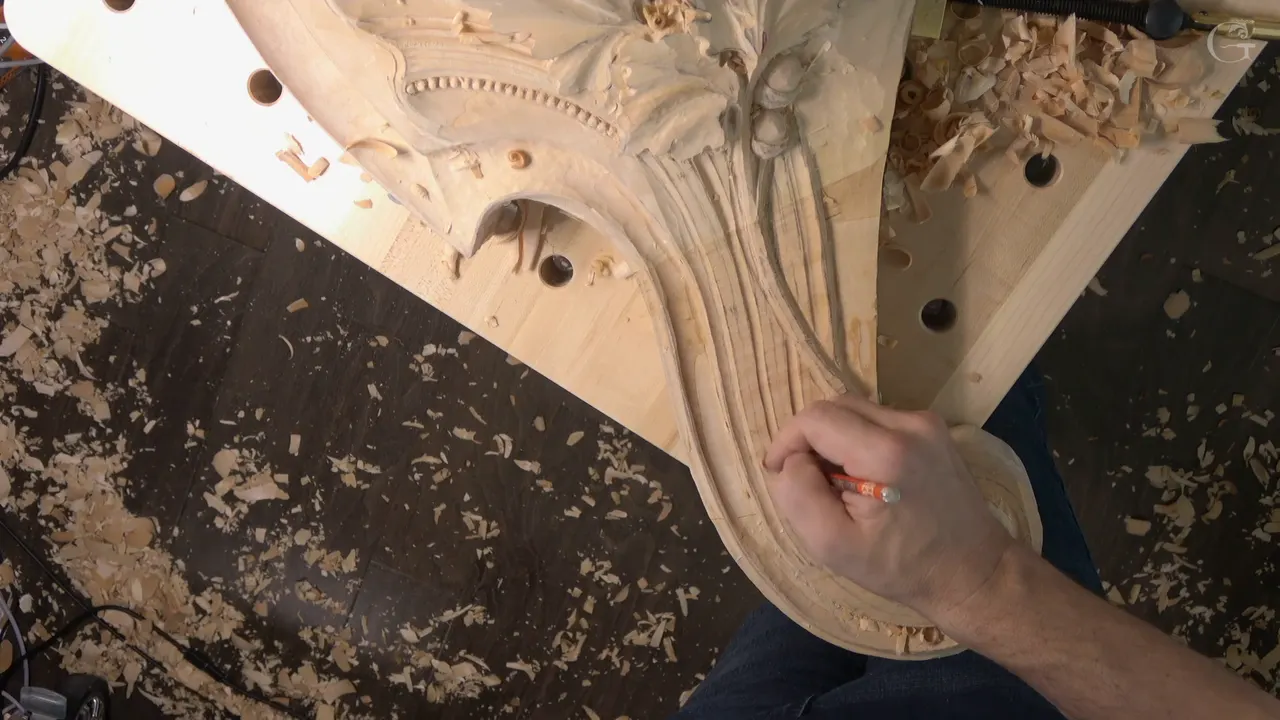

In workshop 101, part 8, I plan a lean "to about 11 o'clock" and talk about tipping a number 11 flute over an edge. Other lessons of mine use the same word to undercut, to keep a wall, to cast a shadow and to warn about an edge.
Ever picked up a gouge and wondered whether to hold it straight or tip it a little? The video is short, so I read it beside the places in my other courses where I say that word out loud, and each one links to its public lesson. It belongs to my Venice Room Part 9 course, it is wood carving, and every size is in millimeters and inches, my own figure first.
How does the video open?
The part opens with a warning: "It is a little challenging." Then "I'm not going to lie." Straight after that: "But it's not impossible." And then "still possible."

My tool is "I guess 2 millimeters" (0.08 in), on a number 11. I plan to run a first cut.
Only one side is on the video. The rest, I say, I will do "just off-camera," because I want my magnifier glass "closer to my face." I also plan to "cover the camera."

Then: "I can probably get a little deeper cut." The size stays "just using 2 millimeters" and it is still a number 11. What it gives me is "beautiful shadow, isn't it?"
What do I say about the flute?
"couple ways I could approach the side of it," I say. One way is a number 11 of 5 millimeters (0.2 in), and I say sorry for naming number five. Then: "lean little bit my flute over the edge and knock the side of it."

A doubt follows: a cut like that "becomes kind of weak, I would say." Once painted, it will be less weak. My other idea is to "penetrate it with the glue at the edge." And of going "too close to this," I say "that would be a little too weak."

A new tool is a plan: "I can switch to number seven." I plan to "use number seven and skew," a "Skew gauge" that gives "much cleaner cut." One more line: "I should use also skew right here too," meaning "on that side."

My point comes in plain words: "to prove the point, it is possible to do really tiny, small beads." Right before it, a plan: "later on, I'll just blend this side also."
What happens at 11 o'clock in part 8?

Another slip on a number, "number two again," gets fixed on the spot: "number 11 and 2 millimeters" (5/64 in). The plan with the lean is "to about 11 o'clock my tool, for I would create a wall, like almost 90 degrees."
A limit goes with it: "I don't want to undercut it, but I kind of need the wall."
The next cut moves over: "my cut will be on this side of the line." Then comes a stress, "So really important. On the bead side." The side I name is "my convex" and it is "my bead." Back to the size, 2 millimeters again (0.08 in), and "I could actually take 1 millimeter" (0.04 in). The last words of the part are "carefully, I'm going to ride along."

When do I lean a veiner to undercut?
In Lily Box 2, part 13, I tell you to place a number 11 "on one of the sides, okay." Then: "Don't cut just straight down like a groove." The picture is on a board: "if that is your top of the leaf, and you're trying to undercut underneath this direction."

Straight down, I say, will do no good. Leaned, the result changes: "when you lean your tool this way, so it's going to create that movement on inside."
The gains, in my words, are "a lot easier for you to flatten that background" and "any grooves like that" gone. Add "much cleaner that way." Then the light: "the light going to travel on inside, reflect and cast the shadow," so the shadow is "much deeper that way." To close: "if you can get on the side. Hope it makes sense."
Back in that lily box, a number 11 returns: "I almost going to undercut. So I'm actually leaning toward the right side of the tool" with a move "a little bit inward underneath of that main upper part." After it comes "blend that with number four."
Furniture Panel 20, part 7, has "gradually start from not undercutting to full undercut." Next: "I could use about the same tool" and "not straight down, but lean it." Does it matter? "if it makes a difference, it absolutely does."

A line from part 5 of that lesson: "I cannot do really shallow background because we are leaning little bit and I need a little depth." Right after, "I really need that little depth."
Venice Room 94, part 11: "about the quarter inch, create the wall, but quarter inch, about six millimeters" (0.24 in). A number 11 "for undercutting" is the tool. The lean: "lean in little inward" and "about a 4 mm cut" (0.16 in). A blend then gives "full Three-eighths of an inch 10mm" (0.39 in).

How does a lean change the shadow?
In Venice Room 55, part 2, I have "I am leaning toward left side right now." Next: "I'm not using tool straight, but I'm leaning like this." Then: "see how deep shadow it creates? It just creates that effect, just rolling effect." And "Extra dimension" plus "I still did not lose my convex." Later in that workshop, part 11 has "Deep concave. And I'm leaning to the left to that side a little bit."

Roman Acanthus 15 is a course on a Roman acanthus leaf. With a number 11, part 1 gives "an inside spoon, and it casts even more shadow" and I say "that's what I like about the number 11." Further on, I lean to one side so my U cut sits "on inside," "closer to this edge" and makes "some shadow movement."

Elsewhere, Venice Room 53, part 9: the lean is to "the left-hand side" and I "start my concave." Then "It creates a movement like that. Okay? Like a U shape, but it goes on in."
The tool on the April 2020 livestream is "four millimeters number 11" (0.16 in), and I lean "a little bit to the left, okay, with my tool." The rule: "with the gouge, it wouldn't make any sense to lean, but with the veiner, it does make sense." The feel I want is "the left side, going right underneath."

Butterflies 13, part 1, has "If I need to clean up, I can go back, create secondary cut and remove it." I say "that is the effect I'm after, leaning a little bit on inside." And I plan "another cut around this area, around that bigger element with the same angle."

When do I say don't lean?
For Furniture Panel 16, part 5: "And now I can take number two and half an inch" (12.7 mm). The next line: "It's not really half an inch, but pretty close. Okay, 12 millimeters" (0.47 in). It goes "straight down."

The warning: "Make sure you don't undercut, okay? So it's better to lean away a little bit." The reason, in my words: "if you're going to lean toward inside, you can create a big problem, which you don't really want." And "I want to keep the wall."
In part 12 of that lesson I say "I'll get quarter-inch number one" (6.4 mm), with "make sure you don't undercut" again. The line: "don't lean inward." That, I say, would be a mistake.
Over in part 6 of Venice Room 54, I rule out an undercut right there. "I don't want to lean it. I want to make sure my cut is straight down like this, because I still have to create a really nice concave on inside." All I need is "just outline" and "That is really important for me not to make mistake."

On Furniture Panel 22, part 10, I name a number 11 with "three millimeters, one-eighth of an inch" (0.12 in). I will not "lean on the side at the first cut." In part 11 of that lesson: "My first cut was straight, just like that, but I can lean it on one of the sides and try to blend it with that side, okay?" And "if you have a bigger tool, that would help even more."
What does lean against an edge mean?
In other lessons the word comes with an edge, a wall or a part I just carved. Hashemi Flowers 3, part 4: "don't lean your tool against the edge because your edge becoming really weak." Here, part 8 has its own line: "a little too weak."

From part 1 of Venice Room 21: "I have to be careful not to lean against any part I just carved." Over in Venice Room 29, part 7: "go closer to the future pipe and almost lean on the side." My reason is an eye that I do not want to lose.
At Furniture Panel 38, part 3, I read "Be careful when you are cranking like this." Then: "you have to lean on this edge," but "just lean too much" and "you're going to break it." I add "I'm using just that straight chisel." Another warning: "You have to lean, be careful with that."
How else do I use a lean?
In Venice Room 57, part 2, I plan "three-quarter of an inch, 18 millimeters, number 11" (0.71 in), still a veiner, only bigger. I will not cut straight down: "lean it to the right." It will "create this ridge higher" with "a lot less concave on the right-hand side."

A reminder follows: a gouge or veiner leaves a single side clean. The other is not clean cut, because I work one side "with the grain."
Grape Onlay 4, part 2, has a short run of words: "straight down, cut, lean, cut to my previous cut, straight down, cut toward my previous cut until I'm happy how it actually dies in."
A knife leans in Butterflies 11, part 1: "slightly bend toward the inner part." The knife goes "straight down" and I also plan to "lean it toward myself slightly." That makes it "a lot easier." Next comes "the cut on the pull with the slight angle."
For Venice Room 145, part 3: "So I'm going to lean it." The look is "a somewhat effect of folding." The size: "10 millimeters" (0.39 in), "of course, that's number 11." The plan: "probably going to do it right on the line, but lean it toward the left."
Which lesson says what about a lean?
| Where I say it | What I say or do right after that |
|---|---|
| Here, in this part | A flute over an edge, and a plan for 11 o'clock beside a wall |
| Lily Box lesson 2, part 13 | A chalk line on a board, and a background that is easier to flatten |
| Lily Box lesson 2, part 8 | Leaning to the right, under the main upper part |
| Lesson 20 of Furniture Panel, parts 5 and 7 | Lean it, don't go straight down, and a shallow background that must go a little deeper |
| Part 11 of workshop 94 | A wall about a quarter inch deep, and a lean inward for about a 4 mm cut |
| Venice Room 55, part 2 | Not using the tool straight, a deep shadow and a rolling effect |
| Roman Acanthus 15, part 1 | An inside spoon that casts more shadow, and a U cut near the edge |
| The April 2020 livestream | Lean to the left: sense with a veiner, none with a gouge |
| Furniture Panel 16, parts 5 and 12 | Better to lean away, and not inward |
| Workshop 54, part 6 | I rule out a lean there, and only outline |
| Hashemi Flowers 3, part 4 | A warning on an edge that gets weak |
| Panel 38, part 3 | Lean on this edge, but not too much |
| Lesson 57, part 2 | A ridge higher with a lean to the right, then a reminder about the clean side |
| Part 3 of workshop 145 | Probably right on the line, with a lean toward the left, for a folding effect |
What do these passages share with part 8?
- Here I talk of leaning a number 11 at the edge, and I plan a lean toward 11 on the clock.
- One lesson has the lean undercut, and another has it cast a deeper shadow.
- One of them has a lean that makes a ridge higher, and I also remind you that a gouge or veiner leaves a single side clean.
- Some lessons say don't lean inward.
- The word weak is in 101-8, and it turns up in Hashemi 3 too.
Here the word comes with a wall and no undercut. Have you tipped one tool on your own carving, and which side told you what it did?

How it's done
- Take the small tool. A 2 mm (5/64 in) number 11 was my pick, and a first cut was my plan.
- Say what the video will show. Just one side goes on the video. The rest I planned to do off-camera, near a magnifier glass.
- Look at the side. One way in was a number 11, I said. Near the edge it gets weak, I said.
- Think of a skew. A skew on number seven was the next plan for that side.
- Plan the wall. Lean it to an 11 o'clock angle, with a 2 mm number 11 (about 0.079 in), and keep the wall almost square with no undercut.
Frequently asked questions
How far did I plan to lean the tool in part 8?
Roughly 11 o'clock, I said, with a 2 mm (about 0.079 in) number 11. The wall I planned is almost square, I did not want to undercut it, and I kind of need the wall.
Which tool did I talk about tipping in part 8?
The 5 mm (0.2 in) number 11, as one way to approach the side. Close to the edge the cut gets weak, I said, and too close to it would be too weak.
What did I say about a skew in part 8?
That I can switch to number seven and use a skew. It would give me a much cleaner cut, and I should use a skew on that side too.
What to carve next