

Alexander Grabovetskiy, woodcarver, School of Woodcarving · Published 2021
What does a wood carver mean by "you already see"?
Quick answer: In workshop 101, part 3, a cove I had wanted deeper ends in a line about its shadow. The same words show up in other lessons of mine, in a few forms, beside a shadow, a shape, or a problem.
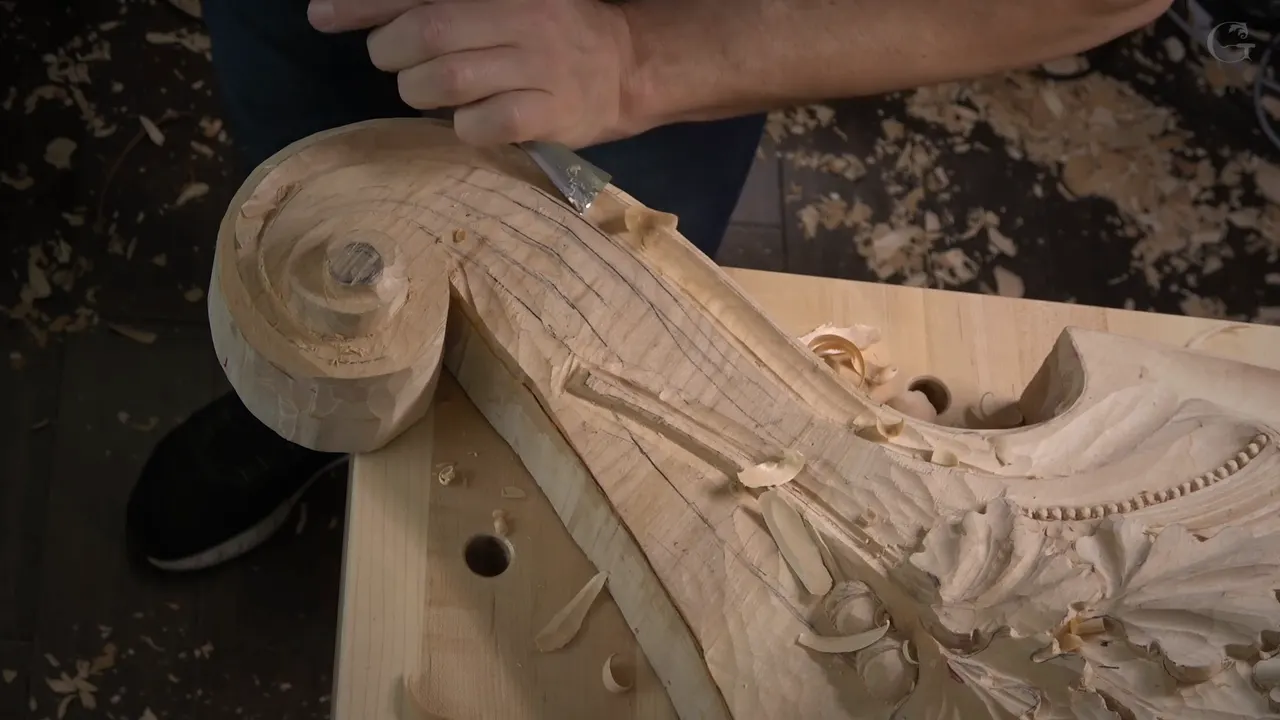

In part 3 of workshop 101, near the end, I said "And you already see how beautiful shadow it creates." The same words, in a few forms, come back in other lessons of mine. Each passage is read here with the lines around it, so every tool and size sits next to its phrase.
Ever held a hand over a carving, or turned a lamp, and watched a shadow fall into a hollow? That moment sits in workshop 101 and in the lessons below. Anyone new to the craft can start with the Wikipedia page on wood carving. Sizes come in millimeters and inches, my own figure first, the conversion beside it.
What came before the phrase in part 3?
The part opens on the cove: "And I've got the cove, but I'm not too happy about how deep that is." Next, "I think I want to get it deeper." The reason follows: "I want to get that deeper for the shadow's sake, because the light going to hit from this position, and it's going to create beautiful shadow cast."
My gouge is a plan: "So take again number 11 and 5 millimeters and get even deeper cut." That is 0.2 in. Afterward, "Yeah. It doesn't go as smooth as I wish. But it's okay."

How did I describe day and night?
A stretch about light comes next. "So essentially, what I'm doing, it's a light and shadow game or light and shadow play." I had mentioned before that "during the day, source of light is going to be windows and open areas." And "at night, it would be just the light source from our ceiling."
That part "is going to play big role during the night because light going to shoot from this side, and that's going to cast a really beautiful dark shadow in this area." By day the light would "hit straight little bit from the bottom" and the shadow would be "not as deep as at night." Then "At night, it should be more dramatic, I should say."

What was left to do when the words came?
Two plans stand between. "I also have to blend this cove with that one" and "it has to be like a gradual blending. Really gradual." Then came "Carefully going to approach this section."
Next comes the line from the top of this page, with "All right" before it. Behind it I said "At least right now, the light source is hitting from this side, and I have a really nice deep shadow."

Which plans in parts 2 and 4 led up to it?
The plans that lead here sit in part 2. First, "Probably what I can do, I can run my knife first" and "Number 12 Swiss made knife, one of my favorite knives." Soon come a 5 millimeter size (0.20 in) and a bigger one, "like number 11 and 10 millimeters, three-eighths of an inch," which is 9.5 mm.
On depth I said "Okay, so I've got about, five millimeters deep." Later, "maybe about a quarter inch in some areas," roughly 6 mm, and "So I've got to be consistent, like six millimeters everywhere." For the cove, a number 7 of "about 20 millimeters, about three-quarters of an inch" is planned, and 20 mm is 0.79 in.

Part 4 starts with "So each pass gives me cleaner and cleaner look." Soon, "what I want to do, I want to create the feel like that is some kind of miter." A smaller tool is a need, "a smaller, number seven" and then "And blend them." One more pass in that section would overdo it, which I did not "want to kill that feel." As the part closes, about the miter: "Not really miter, but the idea of miter."

Where else does the phrase come with a shadow?
Near the start of workshop 130, part 3, "30 millimeters" (about 1.2 in) is a size I could use, with "the goal for me, to make some concave look." Its line is "You can already see it casts some shadow on inside." After it, "So that's why I exaggerate." The middle part would be "lower than those two."

Workshop 131 comes next and runs "You should be able already see how it deepens that shadow." I called it "a really good area to just learn about the shadows, so how important they are." Soon after, "Can get really deep shadow right here."
The third part of workshop 108 begins with "But I still need shadow." Right after, "it casts a really sharp and beautiful shadow. But on another hand, I can also see some waviness, which I am not biggest fan." Of the waviness, "this line is not really flowing" and "little by little, I'll fix whatever I think needs to be fixed."

Over in workshop 145, part 2, I said "But I already see a deep shadow." And "I actually like it." Soon comes a plan, "I'll take 5 millimeters, number 11" (0.2 in), then "marry those two cuts." After that, "it looks really awesome, actually" and "But it's okay. That wasn't that critical."

A dig is held back in workshop 97, part 7. "And I don't want to go too deep," I said, since the spot would be "visible from bottom." Then "But just a little bit" and "how deep shadow it casts. It's just perfect."

In the Greek Acanthus course, lesson 10 I said "you can see it's created a beautiful shadow" and then "later on, like I said, we're going to remove even lower." The plan is "Take number seven and get even deeper underneath." Its closing line is "even deeper shadow. You can already see."
Lesson 11 of that course, Greek Acanthus 11, has "how the shadow is forming" in the same sentence. I name "number 3, just about half an inch, about 13 millimeters, I'd say" and the aim is "just to start digging deeper."
In Plate with Butterflies, lesson 13, part 2, a rough area waits: "if you do have a rough area like this, like a marriage line, you can always come back and clean it." My worry was how it would look overall, and the line lands on "how it's just casting some lights and shadows."

A spot in Lily Box, lesson 4, is "just concave" and the line ends "it's getting shadow, this part." A plan for "three millimeters" (0.12 in) follows.
In Corinthian Acanthus, lesson 5, "how beautiful the shadow" comes "and we didn't even remove the background yet." I added "we're going to remove the background deeper, but it's already visible, the shadow."
A hand goes into Panel lesson 21. "Just try to get some shadows and see how it looks." Then comes "once I place my hand over, so it just creates beautiful shadow" and "Gorgeous shadow."

Do problems ever sit beside the phrase?
Glued templates sit in workshop 79, part 7, and then "I already see the problem." The next line takes it back: "All right. No, there's no problem. I'm sorry." The reason follows, "Because it's a 3D, so that's why it's a little longer." Then "it has to be really 90 degrees toward that surface."
A part 5 line in workshop 24 reads "Not too deep." Then a note on "a little problem right here, but I can fix it."
In Roman Acanthus, lesson 8, part 2, "it's going to create a really nice shadow" is followed by "You can see already." A flaw comes next: "this is a little higher than that side, and it's too early to establish undercuts."
On a drawing, workshop 126, part 3, goes "check with my iPad drawing and see if I'm not making mistake how I want to do it." It lands on "I could make a mistake" and later "Not a mistake, but it's a good idea to double-check."

Panel lesson 22, has two. Part 1 has "3 millimeters first" (0.12 in) and then "some imperfection," where "What I could do, I could actually exaggerate that shadow." That is an offer, followed by "much better result."
Further on in that lesson, part 9, the line sits by "a problem that I need to take care of." My checks go "Let me see if my number seven would be probably too big." Then "Number five and one inch," which is 25 mm. "It's too big" and "Number six works perfectly." Then, "So I want to see perfect roundness on this side."

Which shapes come with the phrase?
Workshop 76, part 3, has "Again, 10 millimeters, number 11" (0.4 in) and "And it does give me much better transition." Then "it created convex going underneath of this part."

I asked, in part 8 of workshop 62, "Can you see that? Can you see it" and said "a lot of stuff I'm going to do probably off-camera." The line ends "the development." Then "The goal is to create that movement upward." My tool stays "just the number 11 pretty much all the time" at "12 millimeters right now" (0.47 in).

Hashemi Flowers, lesson 13, names "number five, half an inch" (about 13 mm), and the line lands on "that is actually a piercing." A line later, "I have to be really patient with this, not to overdo it." And "it is possible to overdo it, make a big mistake."
Down in workshop 120, part 3, I say "logically, I could go almost as deep in this case right here." Next comes "it's already popping, this detail." And "It was dull before but looks much better now."

A plan in workshop 115, part 2, is "a small plug" at "7 millimeters" (0.28 in) that would "just indicate, just for the shadow's sake." It finishes with "it is pointing the direction I want to see."
On extreme concaves, Lily Box, lesson 11, has "how it makes it even more three-dimensional just by creating those really extreme concaves." Behind that, "So we try to exaggerate the real life."
Workshop 87, part 10, puts them on a direction: "or detect I should say, the movement" and "It's going this direction versus that direction." Next is a plan, "I'll use number nine."
The Floral and Molding course, lesson 14, part 2, has "you get an idea of overall movement, how it's supposed to look." It closes on "how it's established." Right after, "I'm not going to change the shape of it."
My own eye gets the words in the Grape Leaves Vase course, lesson 1, part 5: "just eyeball it, but if you're going to measure it, I know I'm right on the money because my eye already sees that. I know exactly where it's supposed to be."
The rasps in workshop 161, part 2, are a plan "just to hit the high spots, just to create that really nice movement." Then "almost perfect" and "Even if it doesn't look perfect on the camera."

In workshop 33, part 8, there is "how clean the cut is because I'm using bigger tool." Next, "I don't have to use a bigger tool, by the way. It's not the only way. I could get exactly the same result with the much smaller tools."
The Grape Onlay course, lesson 9, starts with "Number 11" then "probably two millimeters" (0.08 in), and a "relieving cut." It stops at "how it looks already."
In Roman Acanthus, lesson 11 I hoped for "some shadows and the 3D development." Later, "I already see some shadow lines and so on." Then, "And I'm going to leave some material." After it, "I'm not going to hit all the way to the top yet because I need to check if the height is the same and the movements are the same."
Lesson by lesson, side by side
| Lesson and part (Venice Room unless named) | Beside the phrase |
|---|---|
| 101.3 | A deeper cove, with the number 11 again |
| 76.3 | A convex under the part |
| 62.8 | One tool as before, for a movement upward |
| 130.3 | A concave look |
| 131.2 | Shadows, and how important they are |
| 108.3 | A sharp shadow, and a line that is not really flowing |
| 145.2 | A deep shadow, and two cuts to marry |
| 97.7 | A shallow dig, because that spot is visible from the bottom |
| Greek 10.3 | Deeper underneath, and then a deeper shadow |
| Butterflies 13-2 | A rough marriage line, with cleaning a little later |
| Lily Box 4.5 | A spot called just concave, now getting shadow |
| Corinthian 5.4 | The shadow, with the background still in place |
| 79.7 | A problem seen, then taken back |
| Furniture Panel 22.9 | Number 5 at one inch (25 mm) too big, then a 6 that fits |
Is there a hollow on your own carving that wants a little more light before the next tool goes in? Everything in this lesson sits inside one tuition plan. The rest of workshop 101 is on its lesson page, and workshops 100 and 102 sit on either side of it. The whole run is on the Part 9 course page.
How it's done
- Find the line. Open workshop 101, part 3, and listen near the end for the line about the shadow in the cove.
- Read what comes before. The words before it are a plan to deepen the cove with a number 11, plus a plan to blend it into the next one.
- Check the light. I name windows and open areas by day, and the ceiling at night, with the shadow "more dramatic" at night.
- Compare the other lessons. Workshops 130, 131, 108 and 97 carry a shadow, and workshops 79 and 24 carry a problem.
- Read the plans as plans. A line that starts with "I could" or "let me" is a plan, so the page keeps it a plan.
Frequently asked questions
Which tool did I plan for the deeper cove?
Number 11 again, in the 5 millimeter size (0.20 in), to get an even deeper cut. In the same part I said it did not go as smooth as I wished, but it was okay.
Which forms do the words take?
Workshop 76 has "You can probably already see it," and workshop 131 has "You should be able already see." Workshop 145 has "already see a deep shadow."
Where do the words come with a mistake or a flaw?
Workshop 79 takes it back a line later. Workshop 24 has "a little problem," and Furniture Panel 22 has "some imperfection" and "a problem."
What to carve next