

Alexander Grabovetskiy, woodcarver, School of Woodcarving · Published 2021
What does a wood carver mean by "study"?
Quick answer: In workshop 101, part 6, I say old pictures show a bunch of small strokes that were then connected, and anyone who studies those works can see it. Other lessons use the word for Venetian leaves, old books, a museum, a teacher and a livestream.
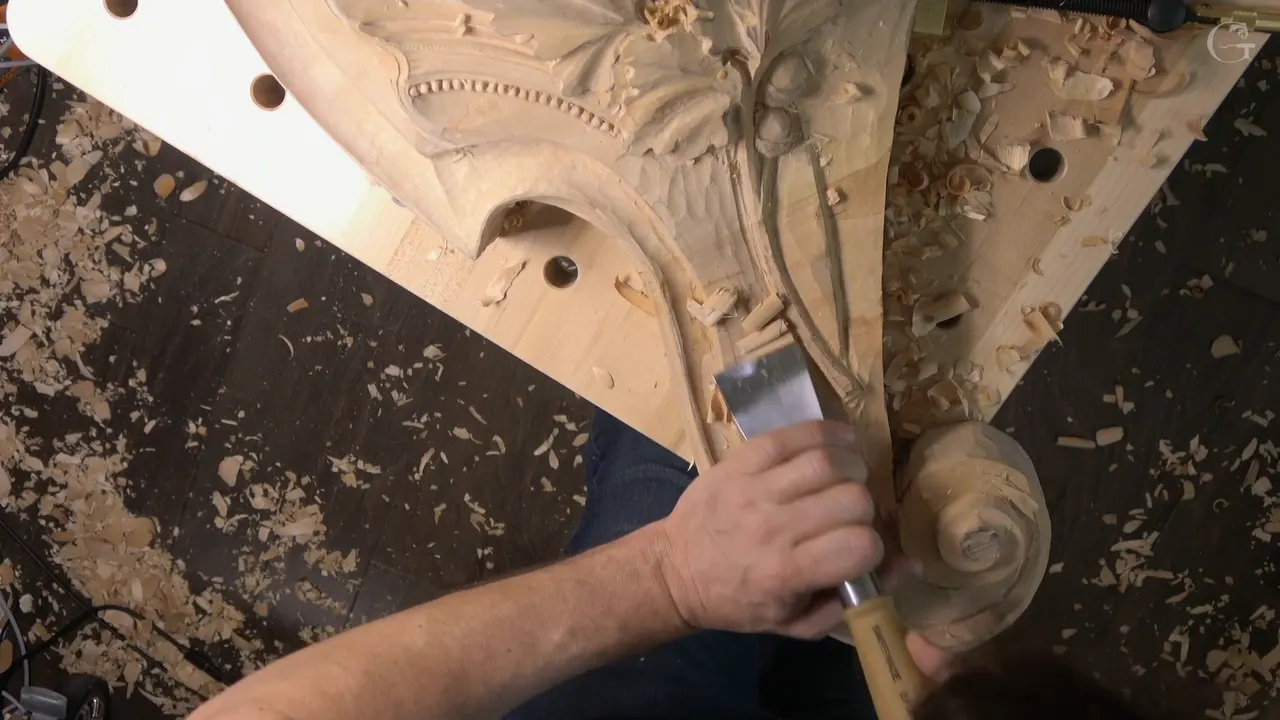

In workshop 101, part 6, I tell you that old pictures were drawn in small strokes joined up, and "that's visible if you're going to study those works." Other lessons of mine use the word for old Venetian leaves, old books, a museum and a teacher.
Ever tried to draw one long, smooth line and felt it wobble in the middle? The video is short, so I read it beside the places in my other courses where I say study out loud, and each one links to its public lesson. It belongs to my Venice Room Part 9 course, my other wood carving lessons carry the rest, and every size is in millimeters and inches, my own figure first.
What does "study" mean in part 6 of workshop 101?
An artist from the 2D world would tell me, I say, "you're supposed to have just one stroke like that, okay, with the pencil." My answer is "On the paper, it's a lot more forgiving." And "I can actually just continue that line with no problem."
But "I feel like I have a lot more control if I'm doing a lot shorter strokes when I'm drawing like this." On the older pictures, I say, "they would just use a bunch of small strokes like that and then they would connect that."

"That's exactly what I'm doing, just much quicker." Then the last lines of my part: "they just create few strokes and then they would connect them. And that's visible if you're going to study those works. So you'll see it. So I'm not making this stuff up."
What sizes do I give in part 6?
Let's say, I tell you, a section of the carving will be "no more, I would say, than six millimeters, quarter of an inch, something like that." In that section I have "about 16 millimeters, about five-eighths of an inch right here, and I've got a quarter inch right here."

Between the two, "if we're going to divide that in three parts," I get "about half an inch" (12.7 mm). I add that I'm "really just eyeballing it, okay?" A little further on I give "about three-eighths of an inch" (9.5 mm), and I read the row off in millimeters: six, then 10 (0.39 in), then about 14 (0.55 in), then about 16 (0.63 in). After that, "I'll do on all of them. I'm going to connect those lines." Later in the part, one section is about three-eighths of an inch, "so which means three-sixteenths and three-sixteenths, five millimeters both sides."
How does my hand check the wood?
Early in the part there is a check. "I'm checking with my hand because the hand is a really good device to use. It's not really a device, but you can feel by your hand much better than even by human eye or anything else. You can detect 1/1000 of an inch movement" (0.025 mm).

Next: "And now it is gradual movement all the way, and I'm happy." And "Now I need to get those movements just right here. But how am I going to do it?" My plan is "only four of those going to go that direction. Okay? So it's easy to divide."

"I have to just get right in the center, and I'm keeping an eye on my right side line and left side line, and I will just eyeball the movement." That makes convex number one, number two and number three, and in my count there are "four concaves and three convexes."

Of course it will be "much smaller at the beginning," I say, and by the time it gets to my volute it is "really tiny." It will go all the way this way, and "That is going to be invisible."
What did I study before I drew the first Venetian leaves?
Venice Room 9 begins with a look at my own leaf. In part 1 I say, "I looked at this part of my acanthus, and I also studied little more authentic 15th century acanthus from Italy, Venice to be exact." That section "just doesn't look the way it's supposed to look, I would say," so I tell you "I have to create a lot deeper concave on inside."

Four parts later the same lesson says it again. Like I said, "I studied little more the original design of this period, 15th century, and I really want to be authentic to the design." In my case it is going to have "a little convex" and my plan is "just a quarter inch" (6.4 mm), number nine.

Workshop 23, part 5, goes to the Venetians themselves. "That's what I studied when I tried to prepare myself for this project," I say. They started the concave at the separation, and a convex follows, in my words "a convex right in the middle."

A look at pairs comes in workshop 25, part 6. "Also when I was studying how they've done those concaves and convexes, and it looks like sometimes they just made the alternative approach." One idea is "If this is a convex, then make this one as a concave." I leave it open with "Maybe I'm going to do it. We'll see."

An eye I'm not afraid of shows up in part 7 of Venice Room 53. "Let me excavate deeper. 5 millimeters" (0.2 in), I say, and then why: "I'm not afraid of those big eyes on this particular acanthus movement, Venetian acanthus, because I studied original what they did, and they created those big, really deep eyes, really big eyes." The makers were "Venice craftsmen, people from Venice."

Which old work do I tell you to study?
My teacher told me first. In the April 2020 livestream I say he told me "You really have to study old work, especially if you really want to work in a Baroque style and Rococo style. So you really have to look at that work."
The country was locked down when he taught me, I add, "we grew up in Soviet Union. The whole country was on lockdown." We couldn't travel, and "all we could, just study some pictures in some of the books." I add, "if you're able to spend some money, go to St. Petersburg and just go to Hermitage and study the work." My words for what it holds are "ancient work and Middle Ages."
His advice was three verbs. "Study, draw, and carve." Then comes the next line, "Repeat what you already studied, draw it, and carve." I close it with "That my teacher would say to me."
The old work is in a museum, I say in part 1 of Furniture Panel 27. Look online, I say. Go to a museum and look at old work. What you will see is "Italian also, they're gonna have that middle part raised up." After that I plan on "maybe about five millimeters" (0.2 in), "probably number eight."
Furniture Panel 20, part 2, is about Grinling Gibbons. "If you study his work, you will find a really interesting fact. Later works, they are more complicated ones than the early works." His collection of tools, I believe, "expanded a lot, okay, the older he would get."

Gibbons class 12 in Maine has it in part 1. "I also had a chance to study a little deeper what Gibbons did."

Why are books not enough?
I correct myself in part 8 of workshop 28, "I studied a lot, not studied, but I should say, researched a lot about those acanthus leaves." Of the books I have, "there's not too many books about it." Even old ones show "just a certain type of acanthus, which is related to the time when the book was written."

"The best material you can find, it's not the books. That's what I think." What I send you to is "the old European books, which is not even in English, most of them. Some of them just in French and other languages." Such a book is "not about wood carving or about acanthus, it's about ornaments." And "you can see some architectural books, and you can get an idea what they built back then."
One old book I name in the April livestream is "How to Draw Acanthus," a university book. Its limit is "time period." I ask "What type acanthus this book is talking about" and say "There is hundreds and hundreds of different acanthuses." My best place to look is "those palaces and to those ancient places and study." Failing that, "just go online" and "you can find all of the ancient pictures."
A Florida student is in the October 2020 livestream. "He studied acanthus leaves for over 10 years, and he still didn't get it, okay? He still didn't get it until he tried himself in person, actually, to carve together with me." Books are good, I say. And "sometimes you really don't get it because it's three-dimensional."

That livestream has one more line, about what I had to look up for a carving "authentic to Italian style, and that's 15th, 16th century Italian style." "I had to study what they used back then, and I'm trying to use the tools, what they used. And they used a lot of gouges and veiners."

What do I say about acanthus from other lands and other times?
Where the leaf sits in time is the subject of part 4 of Venice Room 58, "second part of 15th century and beginning of 16th century." Next I say "when you study the movements of acanthus, and that is acanthus movements. Okay? It's the common name for it. But different regions, they do different development of acanthus."

People who "do understand the development of acanthus and studied that," I say in part 7 of Venice Room 52, "they can see." Also "really important to understand concaves and the convexes. In different cultures, there's a different concaves and different convexes."

A sculptor and a huge piece of marble come up in part 4 of Venice Room 55, and "if you study little deeper that period, what he did with the marble, with the stone, with the lime stone also, it wasn't always that way." I bring up my lion heads, "Huge, like 48 inches lion heads on lay" (1.2 m). I "started from a clay modeling" and "it was just the plastilina."
Egypt gets a few words in part 6 of Venice Room 50, "I studied ancient Egypt machinery. Of course, it's not really machinery because it's little different. They did not have any electricity and so on, but still machinery." The result, I say, "it's just amazing." I also say go to Machu Picchu, "just to see how they worked with the stone."
What else do I study before I carve?
The April 2020 questions livestream has me saying I highly believe "wood carving is about the shadows and the lights and how it's going to hit the light." Before I develop my design, I say, "I have to study where that piece is going to be located, installed, if you wish. The light source, position of the eye."
Shadow gets its own line in workshop 30, part 2. "There's five levels of shadow, by the way." It is "a complicated subject on its own, shadow, and worth to study, actually." Next, "Shadows and lights and how it affects and how deep you're supposed to cut."
The oak leaf is next, and in Venice Room 96, part 11, I say "I spent a little time studying a little bit what they carved, how they imagined the oak leaves and so on." The oaks I had seen in Russia, Michigan and Florida "pushed me to study pretty much what it's supposed to look like."

Which lesson says what about study?
| Where I say it | What I look at, or tell you to look at |
|---|---|
| This part, 101-6 | Old pictures drawn in many small strokes, then connected |
| Early lesson 9, parts 1 and 5 | A more authentic 15th century acanthus from Italy, Venice to be exact |
| Workshops 23 and 25 | How the Venetians placed a concave, and how they paired concaves with convexes |
| Lesson 53, part 7 | The big, really deep eyes that people from Venice made |
| Furniture Panel 20 and 27 | Later works that grow more complicated, and a museum visit for old work |
| April 14 livestream | My teacher's three verbs, and the limits of one book |
| Old books in workshop 28 | European books that are about ornaments, not wood carving |
| Livestream in October 2020 | The tools they used back then, and a student who read for ten years |
| Regions in 52, 55 and 58 | Different regions, different acanthus, and a deeper look at an old period |
| Egypt in workshop 50 | A little about Egyptian work and machinery |
| Questions livestream, workshop 30 | Where a piece will hang, where the light comes from, and shadow |
| Gibbons class in Maine | A chance to study a little deeper what Gibbons did |
What do these passages share with part 6?
- In 101-6 I draw in small strokes, as old pictures do, and I say it shows in the old work.
- Four Venice Room lessons cover old leaves, concaves, convexes and eyes.
- My teacher gave me three verbs, and other lessons name a museum, a university book and books from Europe.
- A student read for ten years and still missed it before carving with me.
- Light, shadow and where a piece will hang come before my design.
In 101-6 my hand does the checking, and I divide by eye, "just eyeballing it." As for the old pictures, "you'll see it," I say.

How it's done
- Check by hand. I checked with my hand, and I said it beats the eye.
- Count the parts. I said only four of those go that direction, so it is easy to divide, and I counted four concaves and three convexes.
- Eyeball the sizes. Six millimeters (0.24 in) in one section, and about 16 millimeters (0.63 in) in that section too.
- Draw short strokes. Shorter strokes gave me more control, and I planned to connect the lines.
- Check old pictures. Old pictures used small strokes, and I said it shows in the old work.
Frequently asked questions
What can my hand check that my eye cannot?
By hand, I said, you can feel much better than by eye or anything else, though the hand is not really a device. The number I gave was 1/1000 of an inch (0.025 mm) of movement. Then I called the movement gradual, and I was happy.
How wide did I say that section would be?
Six millimeters (0.24 in) at most, a quarter of an inch, I said, something like that. By the volute it is really tiny. Another section got five millimeters (3/16 in) on both sides.
Why draw short strokes when one long line would do?
On paper a line is a lot more forgiving, I said, and I can carry one with no problem. Shorter strokes give me a lot more control. Older pictures were drawn in small strokes joined up afterward, and I do the same, only much quicker.
What to carve next