

Alexander Grabovetskiy, woodcarver, School of Woodcarving · Published 2021
What does a wood carver mean by "an interesting area"?
Quick answer: In workshop 101, part 7, I call one spot a very interesting area and say I will undercut a stem later on. Other lessons of mine use the same words for pipes, grain, deep shadows, a slip and a spot that needs a smaller tool.
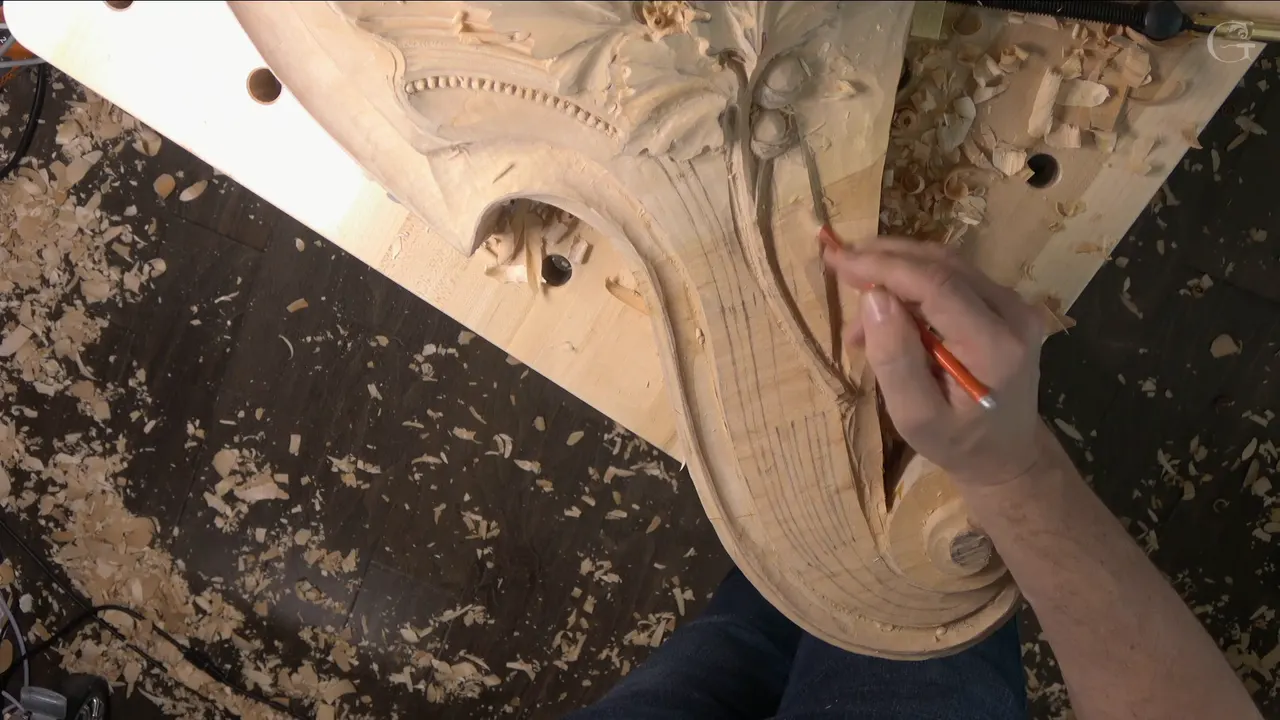

In workshop 101, part 7, I say "Very interesting area right here" and plan to undercut a stem later on. Other lessons of mine use the same words for a pipe, loose paper, a grain that changes direction and a spot that is hard to work.
Ever stood over one spot on a carving and known it would take more care than the rest? The video is short, so I read it beside the places in my other courses where I say those words out loud, and each one links to its public lesson. It belongs to my Venice Room Part 9 course, it is wood carving, and every size is in millimeters and inches, my own figure first.
What do I say in part 7 of workshop 101?
The part opens on a plan: "I will continue to work right here, but little later." For now, I say, "I've got my middle and I've got about half an inch" (12.7 mm). Next line: "I know. Lots of lines."

"And now I do not want to lose what is going on. So that would be my concave." The sides get one as well, I say: "of course, on sides, it's also going to be a concave. And that's also going to give me extra shadow." And "Same pretty much idea as what we've got on this side."

Tool next: "Okay, let me take 10 millimeters" (0.39 in). I give the number, "Ten millimeters and number 11, of course" and then say "My apologies, I forgot to tell you what tool I'm using. Veiner." Carving goes on, with "Okay, and also right on the side of it" and "And this way, too."
After "So that is good," I say "Let me actually do some cleanup this way, cleaning a little bit, it's about 11 o'clock, and get my blending cut." A further line is "I can probably do it the same way right here, too."

Straight after those words, a plan for that spot comes: "Later on, I'll undercut underneath of this stem" and it will be "like an airborne in one of the sections" and "it's going to create beautiful look."

How small are the beads I plan in part 7?
"So now let me think about how I'm going to do some of those guys because I don't have too much space," I say, and some of it, I add, I will still be able to create. It will not be "exactly like the true beads." My line is "But I'll try my best to figure out what I can do."

Depth is another plan of mine: "But I also have to excavate slightly deeper right here." Then, "It is not like I have to do it." It will give "a really nice touch," I think. Of those guys I say "a little smaller and the really tiny ones we're going to get to this point." The size is "no more than a couple of millimeters" (two would be 5/64 in), and "maybe I have to do it in all of those areas."
The next part, 101-8, opens with "It is a little challenging. So I'm not going to lie. But it's not impossible." The first cut gets "I guess 2 millimeters, number 11" (0.08 in). The rest, I say, I will do off-camera, because I want to "bring my magnifier glass closer to my face." My point is "it is possible to do really tiny, small beads."
When could an interesting area go wrong?
In part 6 of Venice Room 11 I ask "At which number 11 should I use" and guess "Maybe five millimeters" (0.2 in). The same words about an area come with "I don't want to mess up." Then: "All I need is just to create the shadow." That one looks "a little too big" and my next pick is "probably just the two millimeters" (0.08 in).

Of areas like that, I say "it's always tricky." The hard part is the cleaning: "it's tricky to clean because it's almost impossible to see what is going on inside." And I add "But I really need to see it."
A slower case sits in part 5 of Lily Box 6: "I know it's slow." I'd rather spend more time on developing, I say. Then comes "Little by little, almost like a turtle. Really slow." Next, "Because I really don't want to make any mistakes right here" and "I can clearly see now two different volutes."
A slip sits in Furniture Panel 38. I got "some kinda little too deep cut in this section, but it's all right." Of that spot: "Interesting because it's just, I don't know what I was thinking, so I should admit that is the mistake, mistake of the design." Next: "you're the only one who knows that nobody's gonna catch it." Later: "Maybe it was on purpose, it's a really good transition" and "Kind of like it actually."

Where does the grain come into it?
A first line in Lily Box 8, part 6, is "Need to change the position and attack that from this side." Next: "This is a really interesting area. I have to keep an eye grain of the wood, what it does." Later in the same part, I say "I'll leave it for now like that, and I'll take care of this roughness a little later" and "I like that flip I just created."

The next part of that lily box has "a really nice interesting area" with "a curly grain on inside." Next: "Again, change the position and blend that marriage line where my grain changes direction."
A marriage line comes up in Acanthus over Moldings 5, part 1: "And that is a marriage line." Calling it normal, I say "Which is okay. It's always like that. It's a normal thing."
Where do I want a deeper shadow?
Grape Onlay 3 has the plainest case. Just before it, in part 2, I say "make sure when you are creating the cut, you stop before you hit too hard." Then comes "I can create really deep, really deep shadow right here." The grape should not get too big, I say, and my plan is "I'll undercut it slightly both directions." My choice is "maybe number nine in this case, and quarter inch" (6.4 mm). The area itself is "a really good area to create the shadow, even if you don't see that."

Over in part 1 of Butterflies 8, on a butterfly, I say "So now we have to excavate around this." Then: "we really need to connect from all the way. From this line all the way to the undercut." The part I outline, I would say, "looks exactly the same as a Volute," but "it's not of course. But the idea is the same."

Butterflies 5, part 2, sets the words beside a blend: "see that super clean" and "I'm kind of blending my previous cut."
A warning sits in Venice Room 21, in part 6: "I shouldn't push too much because I just created too deep of a cut, and I sliced a little bit inside." I plan a mallet, which will give me "much more control."

When does a part have to go lower or move?
Which part goes above? That question sits in Venice Room 60, part 6, and I think it is "wiser to flip this part above outer one." Next comes "But I need to fix the look of it." My plan is to do it just like that, and "if I don't like it, I'll fix it." Another line is about the camera: "I know on a camera it probably doesn't look too good, but it makes sense, actually, because visually, this piece is going to go underneath."

Workshop 82, part 9, calls the spot "a really good area" with "maybe just cleaning little bit between those two guys." Later in the part I want to "lower down this triangle," a "high spot" where "I don't think it looks organic."

A short note sits in workshop 81, part 8: "Not too convenient." In Gibbons class 13 in Maine I say "I also can see an opportunity that you create some kind of opening and create the darker spot."
Tight spots, loose paper and small tools
Workshop 60, part 5, has "there is a pipe and there is going to be a micro pipe". I plan "number 11, and that's 4 millimeters" (0.16 in). I could use "actual 3 millimeters" (0.12 in) "or even 2 millimeters, I would say." Then: "Maybe 2 millimeters. Because I don't have too much space."

In Furniture Panel 39 I say "Number 11 again" and "two and a half millimeters" (0.1 in). The paper is "just kinda loose," I say, and so "I have to be careful how I go around that."
A smaller tool turns up in Lily Box 2, part 1: "Here's an interesting area. I'm going to need a smaller tool just to make sure." The stems, I say, are "only about one millimeter wide" (0.04 in).

Rosette 3 has "I'll excavate much deeper" and "Probably going to need the smaller one." Further on: "I really want to make sure my middle part is raised exactly the same idea what I've got on another petals." And it goes on: "I can't do that normal way. So I'll use just a small spoon gouge."

Part 4 of Lily Box 7 has "It's hard to work with. The camera's pointing different directions, but it's hard to find the right convenient angle for me to shoot the video."

Is it an area, a spot or a section?
Workshop 84, part 11, has "Really interesting transition" and next "Kind of really like it." A fix follows: "Or I shouldn't say transition, I should say section. Really interesting section." The detail will probably go "off camera" and I add "it's really inconvenient for me to stick my head in the camera all the time."

Hashemi Flowers 9 has "a kind of interesting spot." My words are "I have to control my tool," because a hit would destroy my edge.

Workshop 44 has "I know it's kind of interesting spot." To "move this underneath of this line" is "more logical," I think.
Olives come up in Lily Box 13, part 4, where I call a spot interesting and say "this one I can probably lower a little bit right away."
Another one, in Lily Box 9, part 1, starts with "Really interesting space. I should say interesting spot." The detail gets "I could make it absolutely separate from upper part and make it like it's growing from underneath." I follow with "I could do that, but I probably will not."
In Lily Box 11 I say "Really, really interesting section. At least for me." The carving there is "I'm just using side of my tool and carefully remove it" with "almost absolutely no pressure whatsoever." And the note in Lily Box 10 is "Interesting spot. Kind of hard spot" with "much lower than that one and that one."
A section I call really interesting sits in Furniture Panel 32, with "Don't wanna lose it." Workshop 19, part 6, has one too, with "There's a couple ways I could develop it."
Which lesson says what about interesting areas?
| Where I say it | What I say or do next |
|---|---|
| Here, in 101-7 | I flag a spot, and a stem gets an undercut later on |
| Workshop 60, part 5 | A pipe, a micro pipe, and not much space |
| Part 6 of workshop 60 | Wiser, I think, to flip one part above another |
| Venice Room 11, part 6 | I do not want to mess up, and I only need the shadow |
| Furniture Panel 38 | A cut too deep, and maybe on purpose |
| Over in Furniture Panel 39 | Paper that is kind of loose, so I go around it with care |
| Lily Box 6, part 5 | Little by little, almost like a turtle, really slow |
| Parts 6 and 7 of Lily Box 8 | Curly grain, a marriage line, and a change of position to attack it from the side |
| Grape Onlay 3 | A really deep shadow, and a grape that must not get too big |
| Butterflies 8, part 1 | Excavate around a shape, then connect it to the undercut |
| Rosette 3 | A spoon gouge after I say I cannot go the normal way |
| Workshop 84, part 11 | I fix a word and call the spot a section |
What do these passages share with part 7?
- In 101-7 I name the spot, then plan an undercut for a stem.
- A tight one has a pipe, a micro pipe or stems only about 1 mm (0.04 in) wide.
- Wood decides in another.
- A slip starts a third, and I say maybe it was on purpose.
- Shadow, tools, paper and a camera angle fill in the rest.
In 101-7 the words come with a stem and an undercut I will make later. Have you picked the spot on your own carving that gets the most care, and do you know what tool it needs?

How it's done
- Take the veiner. My words were let me take 10 millimeters (0.39 in), then number 11, then the word veiner after my apology.
- Clean a little. Some cleanup came as a plan, along with my blending cut.
- Name the spot. Right here was the spot, and the undercut beneath the stem was set for later on.
- Think about the small ones. How to do some of those guys needed thought, because room was short.
- Mind the depth. Slightly deeper was on my list right there, and I said maybe in all of those areas.
Frequently asked questions
Which tool did I name before the words in part 7?
A 10 millimeter (0.4 in) number 11. I forgot to name it, said sorry for that, and then gave the word veiner. After it I said and also right on the side of it, and this way, too.
How big are the beads I planned in part 7?
The really tiny ones would be no more than a couple of millimeters, I said. They would be a little smaller than the others and not quite the same as the true beads. I said I would try my best.
Which cut did I plan for the stem in part 7?
Right after calling the spot interesting, I said later on I will undercut under the stem. I said it out loud in the part, and the cut itself is a plan for later.
What to carve next