

Alexander Grabovetskiy, woodcarver, School of Woodcarving · Published 2021
When is one more pass too many in wood carving?
Quick answer: The next pass is a decision I weigh before I make it. In 101-4, one extra stroke in that section would overdo it, I said, and I wanted to keep the feel. Other lessons show the passes I did make.
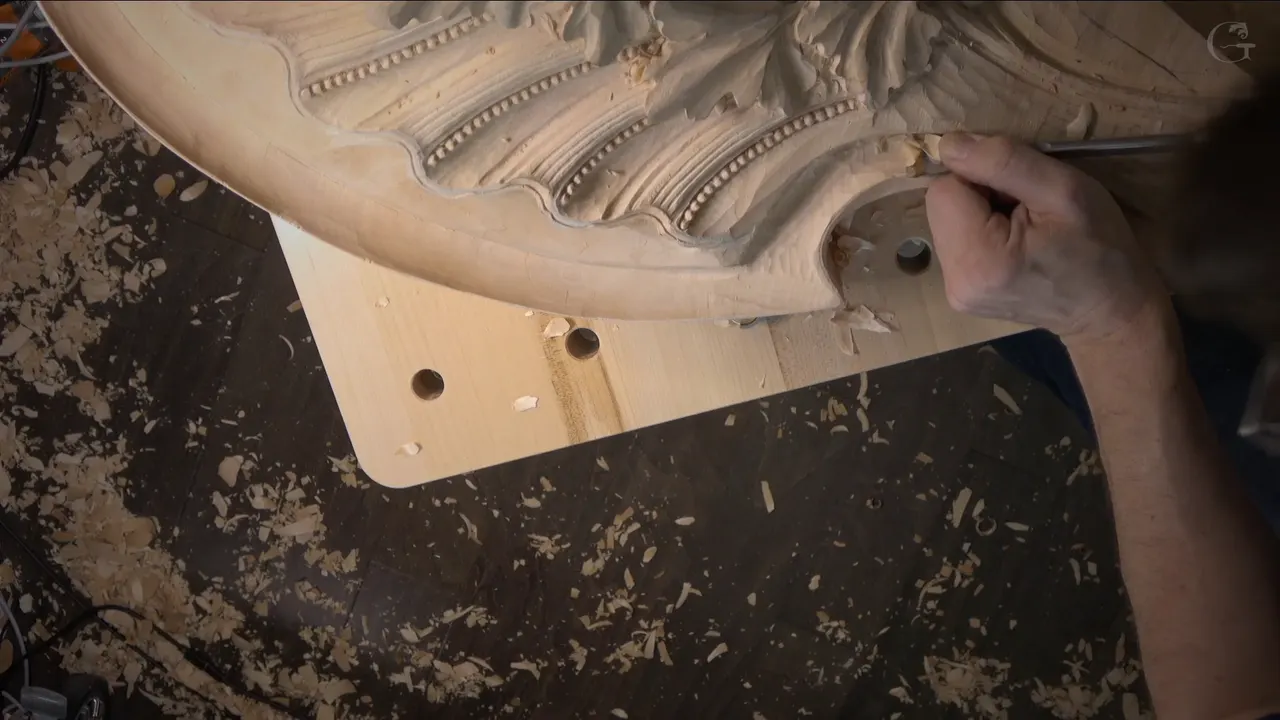

An extra pass is a decision I weigh before I make it. In workshop 101, part 4, I say that another stroke with the smaller seven would overdo a section of my wood carving that already looks good.
Ever stood over a hollow that finally feels smooth and asked yourself if one more stroke would help? I did that on camera, and I gave my answer in plain words. This part sits in my Venice Room Part 9 course. It is short, so I read it next to passages from other lessons where I say a single extra pass out loud, and each one links to its public lesson. Every size here is in millimeters and inches, my own figure first.
Which words in this part cover the next pass?
It opens on a plain line, "So each pass gives me cleaner and cleaner look." Next comes "And yes, again, against the grain." My aim takes a longer breath than the rest. "I want to create the feel like that is some kind of miter joint."

Here is how I describe the plan. "So which means my concave can start somewhere right here, and they're going to just get together." And "you're not going to see the line right there, but it's still going to create that feel like those two parts, this part and that part, is mitered together."
"I need a smaller, number seven," I say. Two short words follow, "And blend them." Next is the line that gave this page its question, "Well, I can overdo it, of course."

The line keeps going. "And that's the problem sometimes," I say, and it is not mine alone, "I guess with everyone." The habit comes next. "When you concentrate too long on one area, you have a tendency to overdo it."
The sentence I read out most follows. "If I would create just one more cut in this section with a smaller number seven, I would overdo this section, and then I had to fix it somehow." After that I add "It's not unfixable, but it's really nice and smooth, and I don't really want to kill that feel."

Other tools come next. "Number five, that what I was using." Right after that, "And now number 11 again, and clean all that fuss." "Here you go," I say a little later, and then "I'll use number five again."
The extra passes are put off. "Okay. Later on, I'll get extra passes, and it's going to be good." A short hold closes that thought, "Although right here..."

How subtle should the miter feel be?
Workshop 101 has an answer to that, and it fits in a few lines. "Like I said, I really want to make it subtle, but still detectable, like a miter feel." Later in the same part I say "And here you go, I've got it." Then "So I kind of exaggerated intersection."
A clean pass is next, said as a need, "And now, again, I have to create a clean pass this way." The end of the part is a hope and a limit. "I hope you can detect that miter. Not really miter, but the idea of miter." My last words are "Don't worry about how it looks right now."

A miter joint is two pieces sawn at an angle and closed tight, and a coving is a long hollow. Mine is carved with a gouge, and I say it is "not really miter," only "the idea of miter." An architect would call the hollow shape a cavetto.
What came right before and right after it in parts 3 and 5?
The cove comes first in part 3. "And I've got the cove, but I'm not too happy about how deep that is." My words are "I think I want to get it deeper" and the reason is "for the shadow's sake." The tool is "number 11 and 5 millimeters" (0.2 in), and I want "even deeper cut." Then comes "It doesn't go as smooth as I wish. But it's okay."

Further on, I call the job a game. "So essentially, what I'm doing, it's a light and shadow game or light and shadow play." A blend is on my list, "I also have to blend this cove with that one." It has to be gradual, I say, "Really gradual." And near the close, "you already see how beautiful shadow it creates."
Cleaning comes first in part 5, though not yet. "I will clean it. But it's not going to happen right away." A shell is the next job. "Okay, so that shell going to go all the way like this," I say, and the size is "10 millimeters, three-eighths of an inch" (0.39 in) with a number 11. Then "I'll create initial pass."

A limit comes with it, "no more than about three-sixteenths of an inch, five millimeters" (about 4.8 mm). One reason is the wood itself. "I also laminated together some pieces, and I've got a layer of wood, and that's going to give me the boundary pretty much how deep I should go."
A moment later I show it. "You can see that is another layer, lighter wood. So that is my boundary." And near the end of part 5 comes a bump. "I need to take care of this bump." For it I name "just number two and two inches" and then "About 50 millimeters" (2 in is 50.8 mm).
Where else do I say it, and what do I do next?
One of the clearest lines about a pass is in Venice Room 15, part 3. "Now I see the movement. Maybe just one more pass, just a clean pass." I follow with "And yes, I need to take care of this ridge." Then "I'm going to use a back bend again" and "Make it a little smoother."

In Venice Room 58, part 1, I tell you that "I had to cut a little deeper right here because there was a bump, which you don't see, but I could feel it." Then "That, I'll just do one more cut" and "I can blend together those two cuts." My verdict is plain. "It's really good almost, but it's not too good." The taper needs work. "It has to taper a little nicer right here."
The extra pass has a reason in part 7 of that same lesson. Again, I plan another pass, because "left side this line, really important for me." Of the tool I say "Have to lay down." I clarify, "I mean, the tool, not me." It is deeper this time, so "I'm able to go even higher this time." My check follows, "It's supposed to be really a consistent cut."

Lesson 7, part 3, shows the other side. I name an extra pass "with the number eight back bent, which I don't think I actually even needed." Right before that I weighed an undercut. "I'm not sure should I or not." And "for now, I'm going to leave it like that."

Over in Venice Room 10, part 7, I say "I'm always finding something else to do." Next comes "Now it looks good, except I need to make" a pass "on inside corner maybe with the 2 millimeters" (0.08 in). A look from the side shows "some unevenness" and I say "I want to take just a knife." "In this case, I just took skew chisel number one," I add. Then comes "And now it's good. I think it's good."

Does the last pass go to a smaller tool?
Only sometimes. The Floral and Molding course, lesson 13, opens its part 2 with "Again, I'm not taking a lots of material at once." Then "I have to be patient because sometimes it just takes a little longer than what you expect, but I'm okay with that."
Next I say "I probably going to use a little smaller. Maybe yes, maybe no. I don't know." And I plan a single extra pass. Right after, "I'm not sure if I need to use a smaller tool because it's already kind of really good. I do like how it looks." The tool I name is "a smaller number nine" at "two millimeters" (about 5/64 in).

Roman Acanthus 11, part 2, starts with a doubt. "Maybe I have to take a really small gouge, like eighth of an inch" (about 3 mm). The plan is to "make my concave cut right on the side of the pipe" then say "one more concave cut. I think that's good." Later there, "at this stage, I am trying to make my cuts as long as possible because some of them are already going to be final."
In part 5 of Roman Acanthus 16 the veiner is a number 11 at "1 millimeter" (0.04 in). Maybe just a single extra stroke, I say, and then "Okay, and that's good." A cleaning job comes next. I left a pencil mark "for the video sake, for the lesson sake" and "usually, I try not to use a pencil, especially at the stage at the end, because it does create a lot of mess."

When does the extra pass protect an edge?
Rosette workshop 3 gives the plainest reason. I plan to "make my cuts over the edge" and I say "be really careful, almost not to touch the edge, because you can really easy snap it." The choice is "It's better to take a knife and just make" an extra stroke "and easily to remove it than to make a mistake and snap that line."

In Rosette workshop 1 the pass is about a clean edge. I name another pass, "Really important for me that this edge is clean without my chisel poking in." Then a check. "You can see right now it's exactly one-eighth of an inch deep" (3.2 mm), and "Perfect. Right on the mark."
Hashemi 14, part 5, has a gentler version. "I'll just undercut it, just like that, and remove it," I say, and then "Don't force it." I could use "really small, tiny number three," I say, and I plan another stroke. After it, "Maybe I can start even closer." And "I'm happy with this cut."

Greek Acroterion 1, part 5, brings in a plane. "I'll take again my shoulder plane, and make more passes," I say, and after another pass is named come the words "and I try to make it cleaner. Just reduce my depth of cut slightly." The surface gets a little sandpaper, "a little bit later on."

Furniture Panel 21, part 7, is the shortest version of the lot. "I'm really actually happy how it's developing." Then "Let's see how crisp it gives me the result" and "It's just really crisp and nice." A few words follow about one more stroke, then "Just a little bit raising up" and "Okay. Wonderful."

The same quick form turns up in Venice Room 94, part 10. "Let me use again number 11 Veiner and five millimeters and create" another stroke. "And that is good. That is good." In Venice Room 50, part 9, I say I have a movement in hand. "I've got that movement except one more little thing. That's good. And I am ready to carve."

Which lesson says what about the extra pass?
| Where I say it | What the pass was and what I did next |
|---|---|
| Workshop 101, part 4 | A section I like that another stroke would overdo, and I want to keep its feel |
| Parts 3 and 5 of the same workshop | A deeper cove with a 5 mm (about 3/16 in) number 11, then a boundary I can see in the wood |
| Venice Room 15, part 3 | A clean pass once the movement shows, then a back bend for the bump |
| Venice 58, parts 1 and 7 | A line I try to ride all the way down, and a tool that has to lay down |
| Lessons 7 and 10, one part each | A pass I don't think I even needed, and a 2 mm (0.08 in) pass for an inside corner |
| Floral course, lesson 13 | A smaller number nine at 2 mm (about 5/64 in), after I say the surface is already good |
| Roman Acanthus 11 and 16 | One concave pass, and a 1 mm (0.04 in) number 11 that ends on good |
| Workshops 94 and 50 | A number 11 at 5 mm (0.2 in), and a movement with a little thing left |
| Rosette workshops 1 and 3 | An edge kept clean at an eighth of an inch (3.2 mm), and a knife that keeps a line safe |
| Hashemi 14, Acroterion 1, Panel 21 | A tiny number three, a shoulder plane, and a result that is really crisp and nice |
What do these passages share with part 4?
- In 101-4 the next pass is named, and I say it would overdo that section.
- After the movement shows or a bump is felt, 15 and 58 put the extra pass.
- Lesson 7 has an extra pass I doubt I needed.
- The Floral course has a surface that is already good before I change tools, and I say so.
- Both Rosette lessons keep an edge clean or safe with the pass.
- Roman 11, Hashemi 14 and lesson 94 end on a plain word, good or happy.
Extra passes wait for later in 101-4, and I say so. In 101-5, a laminated layer gives me a boundary for depth. The shadow in 101-3 is why I want the cove deeper, with the light hitting from one side.

A bump waited for a number two.
How it's done
- Say the feel you want. I said I wanted to create the feel of some kind of miter, with the concave starting somewhere and the two coves getting together.
- Reach for a smaller tool. I said I needed a smaller gouge, a number seven, then talked about blending the two coves together.
- Weigh the next pass. With another stroke there, I said, I would overdo that section, and the feel was what I was protecting.
- Change tools and clean. A number five was the tool I had been using, I said, then number 11 again to clean all that fuss, and number five again after it.
- Keep the extra passes for later. Later on I would get extra passes, I said, and I called the intersection exaggerated, with a clean pass still to make.
Frequently asked questions
What did I say would overdo the section in part 4 of that workshop?
Another stroke in that section, with a smaller gouge, would overdo it, I said. Then I would have to fix it somehow. I added that it was not unfixable, but the section was really nice and smooth and I meant to keep that feel.
Is a smaller tool the answer for the last pass?
In part 4 I said I needed a smaller seven, then judged another stroke with it too much. Over in the Floral course I said I wasn't sure a smaller tool was needed because the surface was already really good. Both lines are on camera, in different lessons.
What does an extra pass protect in the Rosette lessons?
Workshop 3 has an extra stroke with a knife that protects an edge that could snap, and I say it beats making a mistake. Workshop 1 has a pass that keeps an edge clean without my chisel poking in, then a depth check at one-eighth of an inch (about 3 mm).
What to carve next