

Alexander Grabovetskiy, woodcarver, School of Woodcarving · Published 2021
What does a wood carver mean by "a smooth cut"?
Quick answer: In workshop 101, part 2, I said a knife could go along the line before any veiner. A 5 millimeter (0.2 in) number 11 comes next. In other lessons it comes with a spoon or a big skew, and with talk of position and slicing.
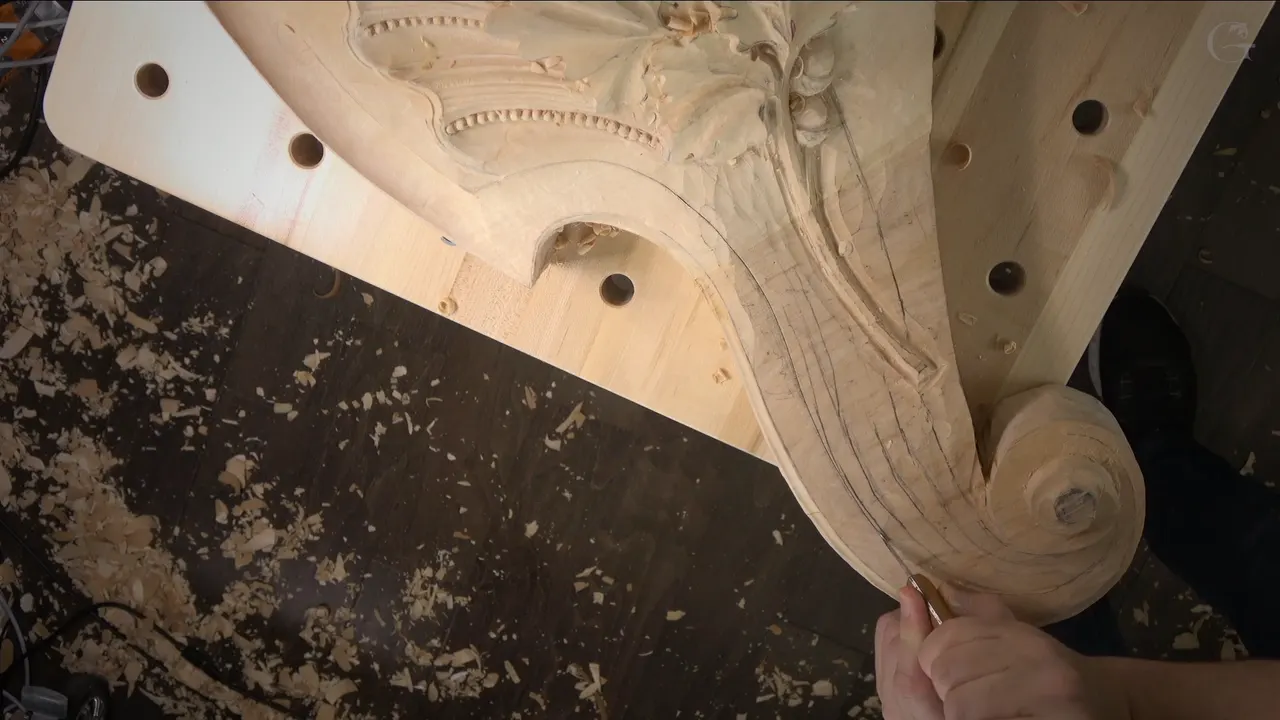

In part 2 of workshop 101, I said "probably what I can do, I can run my knife first. That way I'll know it's going to be really nice and smooth cut." The same words turn up in other lessons of mine. Each passage is read here with the lines around it, so every tool and size sits next to its phrase.
Ever stood at a line you did not want to wreck and wondered which tool should touch it first? That moment sits in workshop 101 and in the lessons below. Anyone new to the craft can start with the Wikipedia page on wood carving. Sizes come in millimeters and inches, my own figure first, the conversion beside it.
What surrounds the phrase in part 2?
The part opens on a note to myself, "Have to be careful." Then it places the cove: "So obviously it has to be on this side of the line because my cove going to go to that line."
The knife stays a plan. Next comes a Swiss made number 12, "one of my favorite knives" and a word about the path, "all the way around."

Which veiner follows the knife?
At 5 millimeters (about 3/16 in) a number 11 follows, and I put it this way: "And now I can take number 11 and 5 millimeters, and right on the side of the line, create my cut."
Another plan is a bigger one: "And I'll probably take an even bigger one, like number 11 and 10 millimeters, three-eighths of an inch. I think I'm safe to use a bigger one." Three-eighths of an inch is 9.5 mm.

A change of position is next, with the words "Okay. Got to change my position and attack that from this side." Then, "And maybe even deeper."
How deep does the work get in part 2?
A depth comes next: "Okay, so I've got about, five millimeters deep." That is 0.2 in. Then, "Maybe a little more than five. Like three-sixteenths of an inch," which is about 4.8 mm.
More follows, "Or maybe actually more, maybe about a quarter inch in some areas." A quarter inch is about 6 mm. And a note to myself: "So I've got to be consistent, like six millimeters everywhere." Six millimeters is about 0.24 in.

What does the cove need after the veiners?
A wider tool comes next, and a number 7 is a gouge like the 11 before it. "And now the next step would be, I would take probably number seven and probably about 20 millimeters, about three-quarters of an inch." Twenty millimeters is 0.79 in. Last in that plan, "and I'll create my cove."
Position comes up again: "Although, I have to just choose the right position." The captions close on the grain: "And yes, I'm doing that against the grain just because I don't want to change the camera position."

What did the other parts of workshop 101 say about it?
Part 1 opens on a corner: "So right now, it's just a 90 degrees cut" and then "And that is not what I want to see." Step one is a plan, a number 7 at 14 millimeters (0.55 in), with the words "I'll just knock down this corner first." Of that pass I said "And again, that is just the preliminary knockdown." Further on comes a slip, "I'm actually carving in the wrong side. I made a mistake, and I'm glad I just thought about it before too far." Then "So let me clean it. I still have plenty of the material."

Part 3 starts on the cove: "And I've got the cove, but I'm not too happy about how deep that is." On depth, "I want to get that deeper for the shadow's sake, because the light going to hit from this position, and it's going to create beautiful shadow cast." The tool is the 5 millimeter (0.20 in) number 11 again, to "get even deeper cut." Then, "Yeah. It doesn't go as smooth as I wish. But it's okay." Further on, "So essentially, what I'm doing, it's a light and shadow game or light and shadow play." Then, "I also have to blend this cove with that one" and "it has to be like a gradual blending." Later, "you already see how beautiful shadow it creates."

The fourth part begins with "So each pass gives me cleaner and cleaner look." Later it holds a limit: "If I would create just one more cut in this section with a smaller number seven, I would overdo this section, and then I had to fix it somehow. It's not unfixable." And: "I don't really want to kill that feel." A bump is in part 5: "I still have to make it smoother. So there is a bump, and I don't want to see that bump."

Over in part 11 the knife is back. Before it comes "I'm just eyeballing it" and then the lines "So let me take knife," "I'll take just my knife I love" and "It's number 12" then "create just a cut like this with the knife, pulling it over myself." For the cleanup I name a 10 millimeter (3/8 in) number 11, "to clean up."

Where does the phrase turn up in other Venice Room workshops?
Back in workshop 20 I named a spoon first, "I'm going to use just a spoon" and then "Let me think which one." A bigger one is next, with the number and size of my bigger veiner in part 2, a 10 millimeter (0.39 in) number 11. The line ends on "smooth cut" with a warning, "Although, I need to sharpen it." A doubt follows: "Maybe this one is a little too big, but I don't know. We'll see." The sharpening page on Wikipedia is a place to start for that word.
Workshop 17 puts the line on a skew: "For that, I could use just probably even skew or knife will work, or pretty much any tool will do the trick." My choice is "this big skew because it has a leverage point, so one of the parts rising on the edge, and it creates a lot smoother cut for me." A result is named, "Okay, so creates beautiful curvature." And a plan follows, "let me check if I'll be able to clean a little bit on the bottom." A skew is a kind of chisel.

Over in workshop 30 I was working underneath, with "Let me kind of remove all that junk underneath" and "And yes, I am wiggling, and I'm okay with that wiggle." Of the wiggle, in my words: "Wherever I wiggled, it creates a really rough cut. But I can go from the right position and create really smooth cut." Then, "You don't see it" and "it's really smooth and nice" then "it is really smooth, and it is really nice." A brush is the plan after that, "let me use a brush and just brush out some of that stuff."

A shape carries it in part 6 of workshop 102, "I am working around my convex, creating a really smooth cut right on the side" and adds "It also has to flow."

A word about the camera comes first in workshop 105, part 3, "I know on the camera, it really doesn't show how nicely just going down." Then sizes, "This is only 10 millimeters deep from high spot, and that is about 30 millimeters, three times more," which are 0.39 in and 1.18 in. The tool is a number 2 at 50 millimeters (1.97 in). My words are "So the next tool for me is going to be number two and 50 millimeters." And about it, "really smooth cuts, and I can just smooth it really nicely." I add "I could use something different, but I kind of like that tool" and also "I really like what I can accomplish with this big tool." The size is plain, "it's a big tool, two inches or so" and the mallet is on its way out, "Maybe get rid of this mallet."

Workshop 117 names the tool, then a bigger one: "I take 20 millimeters again. I could take actually even bigger, maybe about 30 millimeters. Thirty millimeters, number 11, of course." The sizes are 0.79 in and 1.18 in, and what I name is "a really beautiful smooth cut." And later, "I don't have to clean as much."

A dig carries it in part 1 of workshop 127, "There's almost no concave, and I'm going to dig little deeper." Then comes "And that's a really nice and smooth cut. Beautiful cut." A repeat is planned, "Almost no concave. And blend it this way."

The other side is where workshop 142 goes in part 2, "I'll walk around and attack from the opposite side." Then: "But the way to make it smooth, so I really have to slice, even if it's against the grain." "Smooth cut" closes that sentence. Then, "exactly the same on this side with the same tool" then "I'll just go all the way to the marriage line," "take my time" and "not to push too hard."

Which other courses have the phrase?
The Hashemi Flowers course, lesson 15 has it after the words "And just cleaning," "I could definitely use just a number seven, and I would take probably just one inch." One inch is 25 mm. The words that come next are the phrase itself, "smooth cut." Behind it, "And that's going to take care of all of those ridges" and soon after, "And I have absolutely almost no ridges left whatsoever." Then a thought about excavating: "Logically, I could actually just excavate from the backside. That would be much easier."

In the Grape Leaves Vase course, lesson 1 I was on an outline, "And I can probably do a little deeper in this case." It goes on, "Now let me do this movement. Again, that doesn't have to be too perfect. I can make it perfect little later, but at least just to try to keep it nice" and its end is "smooth cut, and flowing cut." Next, "All right. Get this side" and then "just outline yet."

The Grape Onlay course, lesson 5 has it in a blending stretch: "But anyway, even if you don't see it, please try to understand what I'm doing." Then, "Just blend my cuts, okay? That's what I'm after, just the cleansing, maybe slightly bigger tool." The size is stated, "the big one, like one inch," which is 25 mm. What I expect from it is "much better, you know, smoother cut, better blending" and then "So that's, that's the shape I'm after."

Grape Onlay lesson 9 has a big tool again: "I'll use a huge number" comes first, and the size beside it is 30 millimeters. Next comes the phrase, with "So it's a inch and three 16th approximately," which is about 1.19 in. A motion is named, "I'm still doing that slicing motion and I'm doing that rotation."

The Plate with Butterflies course, lesson 6 puts it on a separation: "you can see I do have some kind of Separation. I can do it right away." Then, "Although I don't have to but let me actually do right away. Why not?" The steps are named, "Create the first cut" first, then "second cut gonna be toward this section" and "another cut and I'm gonna follow my line." Of that line, "if I need to change slightly align" and then "I just look for the really really nice smooth cut." Next, "Okay. So the next cut would be this line." Behind that comes "let me take that from the right position."

Lesson by lesson, side by side
| Lesson and part (Venice Room unless named) | Beside the phrase |
|---|---|
| 101.2 | A knife first, then a small veiner |
| 20.1 | A spoon, then a 10 mm (about 0.4 in) veiner that needs sharpening |
| 17.11 | The big skew, for its leverage |
| 30.8 | A rough spot where it wiggled, then a smoother one from a better position |
| 102.6 | A convex, worked around |
| 105.3 | A big number 2, about 2 in (50 mm), and a mallet that may go |
| 117.1 | A larger number 11, maybe bigger still, and less cleaning later |
| 127.1 | A deeper dig, then a blend |
| 142.2 | A slice, then the same on the opposite side |
| Hashemi 15.4 | Number 7, one inch (25 mm), and the ridges to remove |
| Vase 1.9 | A movement with the perfect version left for later |
| Onlay 5-1 | The big number 5, one inch (25 mm), to blend |
| Onlay 9-2 | A huge tool of 30 mm (1.2 in) and a slicing motion |
| Butterflies 6-1 | A separation, pass by pass, along my own line |
Is there a pass on your own carving that wants a cleaner edge before the next tool goes in? Everything in this lesson sits inside one tuition plan. The rest of workshop 101 is on its lesson page, and workshops 100 and 102 sit on either side of it. The whole run is on the Part 9 course page.
How it's done
- Find the line. Open workshop 101, part 2, and listen for the words "smooth cut."
- Read what comes before. The words just before it are a plan for a knife, and none of them is a finished pass.
- Check the tools. Part 2 names a number 12 knife, two number 11 tools of 5 millimeters (about 3/16 in) and 10 millimeters (3/8 in), and a number 7 of about 20 millimeters (3/4 in) for the cove.
- Compare the other lessons. Workshop 117 and Grape Onlay 5 put the phrase beside a big tool, and workshop 30 puts it beside the right position.
- Read the plans as plans. A line that starts with "I can" or "I'll probably" is a plan, so the page keeps it a plan.
Frequently asked questions
Which tool did I say could go along the line first?
A knife, and the one I named is a number 12. The veiner after it is a number 11 at 5 millimeters (0.20 in), set beside the line. Both of those are plans in part 2, said before any pass.
What is the bigger veiner in part 2 of workshop 101?
At 10 millimeters (about 0.4 in), a number 11, which I named as "an even bigger one." That plan has "probably" in front of it. Workshop 20 names a 10 millimeter size too, with a note to sharpen it.
Which lessons put a big tool beside the phrase?
Workshop 117 names 20 millimeters (0.8 in), then maybe 30 (about 1.2 in). Workshop 105 names 50 millimeters (1.97 in). Grape Onlay lesson 5 has "like one inch" (about 25 mm), and lesson 9 has a huge tool of 30 millimeters (about 1.19 in).
What to carve next