
Alexander Grabovetskiy, woodcarver, School of Woodcarving · Published 2021
What does it mean when a wood carver says a spot is "going to be covered"?
Quick answer: In workshop 99, part 1, I say the main stem goes somewhere underneath, and the leaf will cover it very much. Other lessons of mine say it about flowers, an upper layer, a knot, one inside surface, and paint. Each passage is read with the lines around it.
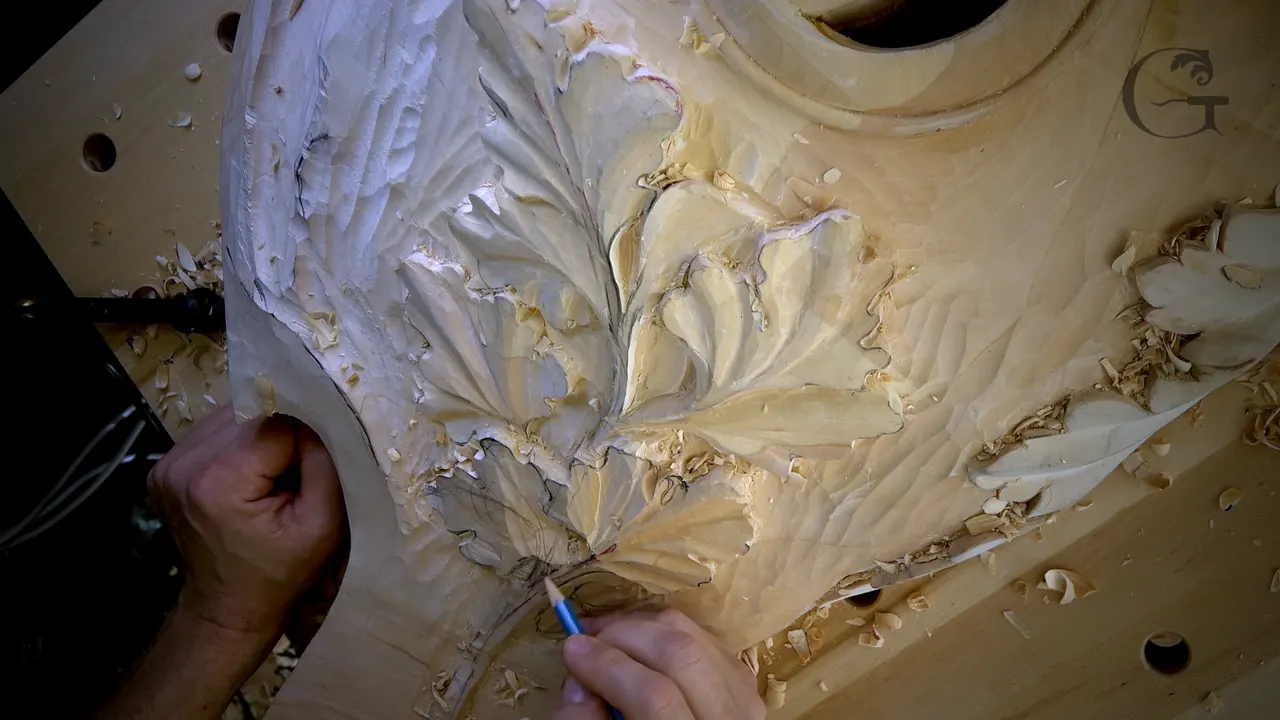

In part 1 of workshop 99, the main stem "goes somewhere underneath right there," and the leaf will cover that stem "very much." The video is short, so the rest of this page follows one word, covered, through my other lessons. Every link below opens for everyone.
Ever carved a spot you knew a flower would cover? Did you wonder how much work that spot deserves? Here are my answers.
How does part 1 talk about the stem?
Two more lines follow. One calls something "all waste." The next says the stem is going to go "all the way here."

My plan for the stem is a number 11, at 10 mm (about 3/8 in). "Let me actually take number 11 and just establish that stem first." A number 5 was on my list before that, at "a quarter inch" (about 6 mm). I also named "Five millimeters, number 11" (about 0.2 in).
The middle is a need, "now I need to get that convex right in the middle." About the grain: "Carefully, carefully." Then "It's a really interesting position for the grain because I have to work just like a curve. And so I need to attack from different positions."

Next I say "going to take number seven and work upside down just like that." After it comes a plan for number 11 again, at 10 millimeters (about 3/8 in), to "kind of fix overall movement right here." The part ends on "And I think I like it."

Do I stop carving once a flower will sit over the spot?
Part 2 of Venice Room 19 has doubts about the position of an eye, but "I really like the idea." The question is "do I have to do it or not?" My answer is "of course, not," since a flower will be over that spot.

Part 6 of that workshop floats the idea of one more section. Flowers are to cover the rest of it, and "I think I can create beautiful movement." Part 11 has "most likely" and "but still" around an upper layer. A plan follows: "Let me make the subdivision."

The reason comes with a limit in Venice Room 42, part 10. "I do not want to develop too much details right here." Flowers will cover the majority of it. A cleaning goes with it, "Let me clean little bit that mess because it just bugs my eyes."
Later in that part, one piece will be visible, but most of it will be under the flowers. "I could, but I really don't need to."

Out of view is the next spot, in Venice Room 62, part 8. It is "off camera." A flower will cover it mostly, and "I don't really need to get too much details." The last words there are "covered forever."

Did I carve it anyway?
Workshop 43 goes the other way in part 6. Most of that spot sits under leafage and flowers, and still, "I'm not going to leave it rough. I'm going to clean it." The tool: "a straight tool is not the best tool for the job. So I need to use a spoon."

Part 5 of Venice Room 65 has this. Some of one section will sit under flowers, so "I really don't have to worry about too much." Then the turn: "But still, it has to be nice. Somewhat nice." The reason is "sticking from underneath."

Push pins are the subject in Venice Room 1, part 4. Two plans come first, "let me use a couple more push pins," then "I'll actually be smart and place them in the eye." Then: "Of course, it doesn't really matter" since most of it will be covered, "but still, just in case."
A line inside comes up in Venice Room 3, part 7: "I still don't have any idea what is this line inside." It gets covered anyway.
A cluster of flowers sits in my plan for part 8 of workshop 43, with petals that "stick down." That spot gets covered. Still, "But I would love to develop this movement."

In Chamomile and Bow Rosette 2, part 1, there is a choice. "obviously there's no rule what I can do." An open element with a small stem is one way, and "partially covered with the leaf" is another. My plan is "I'm going to partially cover it probably."
Where did the lily box say it?
Among the lily lessons, Lily Box 3 has the word in several parts. My second layer is near in part 2, "really close to my second layer in this section." "I don't want to remove too much" because most of that area gets covered, "and I don't want to overdo it."
Later in that part, a side is "not as important," and it gets covered. My thought is "Maybe I'll just get bigger gouge and make this side a really nice curvature."
A flower will sit above a leaf in part 10, so I do not want to spend too much time on it, and "All I worry about is just my middle line." A second spot there is to be covered by the flower too. "But still, the idea is the shadows and the light. So that is the main idea."

Most of a spike will lie under the upper layer in part 8. The visible part will run to a point, and I will not shorten it. "I kind of like how it's going all the way."

A knot sits in Lily Box 4, in its first part. A "bad knot right on the inside" gets a flower over it, so "I don't worry about it." Further on: "I do have a knot in this area," and "the main flower completely" goes over it. Then: "I'm not going to do too much to that as of now. Just maybe cleaning."

Lily workshop 7, part 12, names the flower, a lily. A lot of it goes under the flower, and the flower will reach "almost to this point right here." My clarifier is "I'm talking about the lily flower, okay?"

Doubt shows up in Lily Box 6, part 11: "Maybe I have to redesign something in this area, because for now it doesn't look too good." I know lots of it will sit under the flower.
The seventh workshop has a line in part 11 that is "going to go to the same point," and the flower sits over that region. "But I want to make sure overall movements are correct."
Two lines in the lily course are short. One, in Lily Box 8, part 2: "Although it could be covered, but still, I just want to make sure it's nice and smooth." In Lily Box 10, part 7, the bulk of it is to be covered anyway, "and I should not be afraid." The inner part of a bunch of details goes over it. Then: "let me use a knife."

Last in the lily course is an inside surface, in Lily Box 13, part 10. "if the inside surface is semi-rough, don't really worry." Glue and flakes go over it, and "it's not really big issue."

How did paint change what I said?
Here paint gets plain words, in Venice Room 74, part 12. "I know that is a paint grade," I say, and everything will be "pretty much hidden," "but like in other cases, it would be a big mistake." The piece is "a somewhat forgiving project," and the paint will cover mistakes. "At least I'm telling you honestly."
Then comes "smaller number 11, and clean it on inside." After that: "I still have to clean, clean, clean, clean, and clean again."

The rasp shows up in Venice Room 90, part 3, and the finish "is a little different." Verdict: "In this case, it's okay. I have absolutely no problem with that." The piece is paint grade, and all of it gets paint on top.

The next one gives the project a color: "this particular project will be painted with the white paint." That is Venice Room 103, part 1. Lots of details will probably sit under the paint, so some of that stuff needs no worry from me. Just before that comes "there's no limit." And "you can just get that as detailed as you wish."

Sandpaper or small rasps can "make it to the perfection," I say in Floral and Molding 6, part 1. Then: "I don't need to." The line ends "all that going to be covered with paint."
Lesson 13 of that course names the kind of paint, "chalk paint." A lot of the facets "will be completely covered." I plan primer, "maybe even two times," and "a really thick primer." Houses come up in the same part: "The whole houses were covered pretty much with the chalk."

What about work that nobody paints?
Lesson 14 answers it in part 3. "Some of the stuff what you saw in this course, I left somewhat rough." Paint is the reason I give. Taking it "to extreme" is not needed.
Furniture without paint is the flip side: "I would suggest to spend a little longer and just clean it."
Acanthus over Moldings 9, part 2, brings up sandpaper. "Not much, but still I used some of the Sandpaper," I say, because paint covers it. "I didn't want to spend too much time to clean my facets." My caution is "don't get an idea that I'm using some paper all the time."

Two short lines belong to Hashemi Flowers 31, part 2. "This is a tricky spot." The bulk of that spot gets covered anyway, and "I could use a kind of spoon gouge to refine that." Further on, "I don't worry about how it looks on inside." All of the inside gets covered. "But let's refine this one."

Paint covers a fix in Venetian Flowers Rosette 2, part 3. I use super glue. The part is "still really fragile, but still solid." "if I would leave it just raw without any finish, I wouldn't use that glue." With paint over it, "there's absolutely no problem." For a shellac or lacquer finish, I say you can "also probably stabilize it with that thin super glue."

What else covers a carving?
Putty is one. In Venice Room 5, part 1, you mix sawdust "and use it as a putty." Hide glue is "absolutely fine" there, because "you're still able to stain it." That way "you can actually hide some cracks," and "some mistakes you actually made could be covered."
Gold is another cover, in Lily Box 10, part 9, where I talk about Byzantine churches and say "It's all gold leafed. All the carving is just covered with the gold." That was "one of the main reasons why they did not use any sharp lines." They used "really smooth transitions on inside and out."
In Venice Room 162, part 3, I name a temple and a tabernacle. "Seem like long time ago when Solomon built a temple, and even when Moses built tabernacle and Ark of the Covenant, it was covered with carving. And all of it was covered with gold."
Tool marks can cover a surface too. Grape Onlay 12, part 2, has "it's all covered with those facets," and I call that "pretty much mark of a hand done." Then, "but not every client likes that." My tool for it will probably be a number seven.
Which lessons say it?
The table lists the spot, what covers it, and my words. Each row is a lesson you can watch.
| Lesson and part | What covers it, in a few words | My words |
|---|---|---|
| Eye, Venice Room 19, part 2 | Flower | Do I have to do it or not? |
| Venice 62.8 | Mostly a flower, over that whole spot | Covered forever |
| Venice Room 42, part 10, a spot with flowers over the majority | Flowers | I could |
| Surface inside, Lily Box 13, part 10 | Glue and flakes | It's not really big issue |
| Venice Room 74, part 12, a paint grade piece | Paint | A somewhat forgiving project |
| Furniture, lesson 14 of the panel course, part 3 | Nothing, since no paint is planned for it | More time, and clean it |
| Sandpaper, Acanthus over Moldings 9, part 2, paint over it | Paint | Not much, but still |
Where can you watch these lessons?
The video for this page belongs to Venice Room 99, among the twelve workshops, 98 through 109, in the Part 9 course. Workshop 103 is in the same course.
The first Venice Room course, Part 3, Part 6, Part 7 and Part 8 are linked, and so are the lily box course, the panel course and the moldings course.
If a word here is new, a plain definition is one click away: wood carving, gouge, mallet, leaf, inch, millimeter and workbench.
Want to hear all of this in my own voice? Start here.
How it's done
- Find the stem. Part 1 puts the main stem underneath a leaf.
- Hear the plan. The plan for the stem names a number 11.
- Watch the flowers. The lessons in that room say a flower will cover an eye, part of a section and a spot I do not develop much.
- See what comes next. One lesson says I will clean a spot, and another says I do not need to develop it much.
- Compare the paint lessons. Paint lessons say much of the work is hidden, and one says furniture without paint gets a little longer.
Frequently asked questions
What sits over the stem in part 1?
A leaf. I say the stem goes underneath it, and the leaf is set to cover it very much. A line after that calls something all waste.
Which lesson says to clean a spot a flower covers?
Workshop 43, in part 6. I say I will not leave it rough and I will clean it. A spoon is the tool I say I need.
Where does a knot hide beneath a flower in the lily course?
In the fourth lily workshop, part 1. The knot is on the inside and a flower is to cover it, so I do not worry.
What about furniture with no paint?
What to carve next