

Alexander Grabovetskiy, woodcarver, School of Woodcarving · Published 2021
What does a wood carver mean by "preliminary shape"?
Quick answer: Workshop 99, part 5, holds the words just after I hold the undercut back, with a shell on the way. Parts 4, 6, 8 and 10 hold lines close to it. My other lessons put the same words beside a tool size, a skew or a later cleanup.
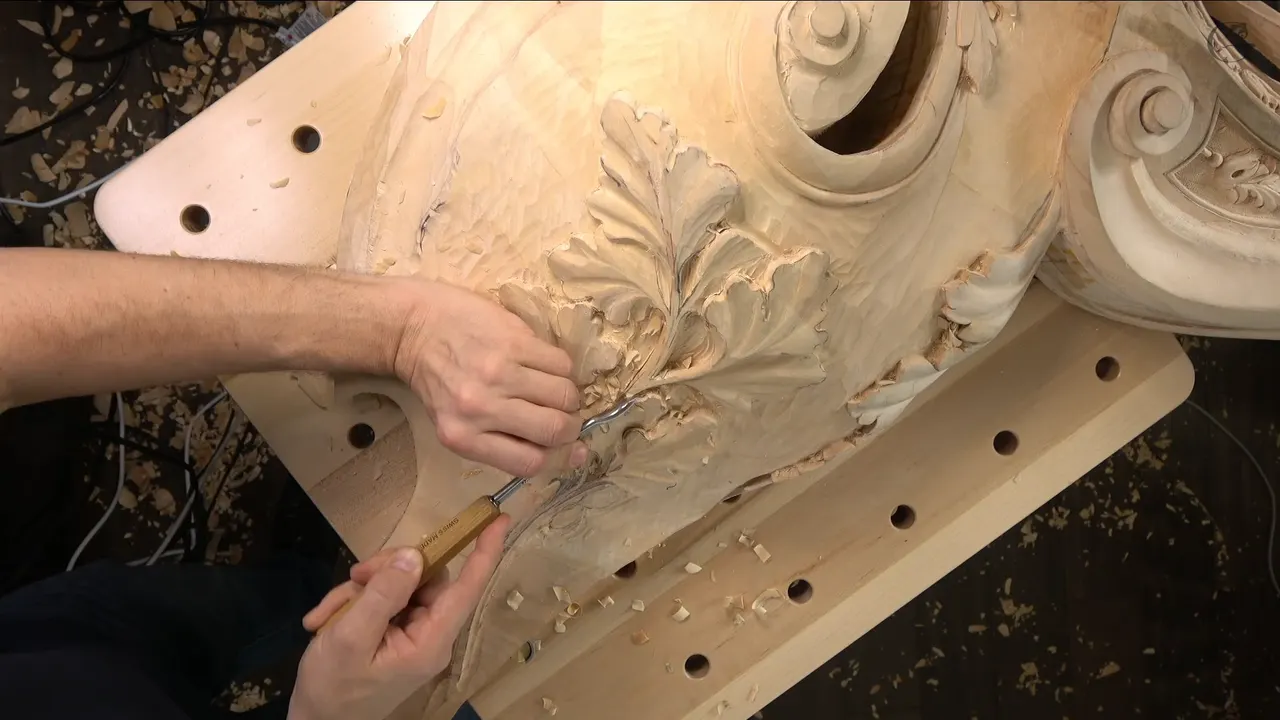

Part 5 of workshop 99 gives this page its words: preliminary shape. The video is short, so I follow the words through my other lessons, one passage at a time. Where a lesson below has a link, the link goes to a page that is open to everyone. A name like 18-2 means part 2 of that lesson.
Ever started a leaf and wanted to see where it was going before you cut deep? Did you hold back one move because something still had to go in beside it? Here is where I said it.
What did I say about the preliminary shape in part 5?
The part opens with a tool. "I need to use number 11 and 10 millimeters to get this point and that point right here." The ten millimeters come to 0.39 in. Then "probably a good idea for me to use a back bend."
I hold something back first. No undercut yet, I say. A shell is coming, and "for me, it would be a mistake if I start undercutting too early." Right after that line come the words of this page. "But preliminary shape I'll be able to do."

The line comes round again. Next comes "Again, that is just preliminary." A short one follows, "So I need to keep it somewhat rough yet." After that, a leaf: "I also need to attack this leaf. I never done it." Also: "Although originally I didn't want to do this one."
Now I count. "So I've got nine, which is not Fibonacci." One idea is to "just eliminate that completely and just leave those two," which would make it "more or less like Fibonacci." Then "Let me think." And "I'll just get rid of it."
A comment on the back and forth: "I added this one, and now I am removing it. That's called just a process." My next words are "Just to create some open spot, open space." And "Otherwise, it just doesn't look too good."

Next comes a spot. "That's the area I was talking about. See, it's not too stable," and I call that okay. For the mallet, I say "I'll use mallet," and a little later "I think it's going to help me." Then "Okay, let me see," and "I think now I like it much better."
The part ends on plans. "I need to use some kind of spoon. A small spoon." I plan to get my skew and clean up my wall. I say again that I will not undercut anything in this section yet, and "Once I'm going to get my shelves in place, then I'll finalize my undercutting."

Do the parts around it say the same thing?
Part 4 sits just before it. There I say "I don't need to do it super clean yet because like I said many times, there's going to be a shell going that direction right here." For a tool I plan "probably just number five and a quarter inch, six millimeters or so."
Near its end the stems come up. "I think it's time for me to just to get to the final shape. Not final, final, but somewhat final." A skew is my plan, and my words on it are "I can just ride right on top, and I can actually create my cut really flowing."

Part 6 turns to the acorns, and its closing lines are plans. "And now I need to give some roundness to my acorn." Then, "And give an overall shape."
Part 8 has a skew as my plan for "my preliminary cut." Later in that part: "So that is preliminary form, although I still want to make sure it's just growing from somewhere."
Part 10 says it this way. "And I can give somewhat like undercut, not really undercut yet because, like I said, we still have to do a shell. But preliminary idea."

Did other Venice Room workshops say preliminary shape?
Lesson 15 of the Venice Room series has it in part 4, and I say "Yes, I will undercut later on." Then "Again, it's just a preliminary shape. It's what I want to see." Before it I say I do not want too much stress "on the wood I'm talking about." Afterward I say "maybe I can just do S shape right here. Maybe a bigger one."

In Venice Room 18, part 2, a mallet comes first: "maybe I have to use a help of a mallet to create the right shape." Later on I plan the number 11, "but now just preliminary shape. That's what I'm doing, okay?"
Then comes "Really interesting, beautiful detail." For tools I say "Let me use some kind of spoon gouge. Or even I could just probably do it straight for now and start cleaning a little bit."

Part 6 of workshop 31 gives a check, and I say "That is just the preliminary shape, and I need to check from all the positions, from all the sides, even from the bottom, because it has to look really nice and smooth." Also, "And it has to make sense."
A reason sits in the next lines: "that's going to be visible from the bottom, so I have to make sure it looks really good." For it I name "number seven probably."

In Venice Room 33, part 6, the words are "beautiful preliminary shape." I could leave it like that, I say, "without extra separations and so on, but I will do extra separations."
A size comes after it, "Three millimeters is what I'm using right now, number 11" (0.12 in). Then "I can go as deep as I wish and create beautiful shadow." Last: "I'll make the decision how deep I'll go a little later."

Workshop 43 names the tool first, "just my skew chisel," and adds that it is a "big one, one inch" (25 mm). Then my plan is to "give a preliminary shape." Soon after, "Just preliminary cuts is what I'm doing."
Also in that part I say "maybe I'm going to hide partially with the leaf or something like that right there." It stays a plan.

Workshop 44, part 5, puts the words after a skew plan. "Probably use just a skew. And I could probably just give a really nice preliminary shape." A need follows, for the separations: "I need to undercut underneath."
One more plan sits there, "I think I should give an eye, and get that piece go down all the way underneath." Also this: "I know it sounds funny, give an eye."

Workshop 55, part 8, has a skew in it: "Again, I'm using just the skew, okay, to clean and get that roundness. It's not the final form, but it's a preliminary shape."
A section, I say, is "kind of not good." Of its tool I say it "is not going to fly," and "We're going to need number seven right now," with a width of "maybe about half an inch" (13 mm).

In workshop 89, part 8, I name a small size: "Looks like even two millimeters is a little too big for that section" (0.08 in). Then "Okay, so that is preliminary shape." Next, a plan: "let me use actually two millimeters right here."

Venice Room 92 has a back bend in part 6, next to "But now just a preliminary shape. And this needs to be rounded a little bit, and I'll use a back bend for that." After that I change my mind: "Or actually, you know what? I can just use a upside-down number seven."

Workshops 120, 125 and 137 come after 99, in Parts 10, 11 and 12 of the Venice Room, and each has the words. In 120, part 2: "I've got the preliminary shape. But my problem is, before I can just roll it this way, I really need to establish surrounding area." Next, "I want to create really deep shadow this way."
In workshop 125 I guess I will need a "much smaller tool now" to "get the outline the right way." Then "get number two and get preliminary shape."
Workshop 137, part 2, has "Okay, so I've got a preliminary shape." Then "it looks like mess." And "now it's time to clean everything and just give the final shape and separations."
Which Furniture Panel lessons say it?
Furniture Panel 18, part 8, is about leaving room around a detail. It has "a preliminary shape of those leaves," and then "let me work around that curly detail." I plan to stay away "approximately, I would say, a millimeter on both sides. Maybe less" (0.04 in).

The next lines say I need the extra material for now. Then "I don't want to cut that on the line right away. I can always make it smaller," and if I cut too much, "I can't make it bigger."
A loop comes up in part 1 of Furniture Panel 29. "It's not the final loop there, okay? So we're gonna introduce some concaves, some convexes, otherwise it's not gonna look nice. But, you know, just preliminary shape if you wish. That was just a shaping stage."
Soon after: "It's not really undercutting, but you know, somewhat undercutting. I don't wanna go too much."

In Furniture Panel 32, part 1, the words are "kinda pre-established preliminary shape." My tool there: "the flatter tool I'm using is just on number three. Straight down, cut and clean it." Then "you can obviously see the shape is not really really there yet, but it will be."

Where did I say it on the grape onlay?
In Grape Onlay 3, part 2, I say "Later on I'll clean it," and then "preliminary shape, but it does look like a grape." My count comes next: "1, 2, 3 layers almost."

Grape Onlay 5, part 2, has an offer: I could use "just my skew to get, you know, just those preliminary shapes of the grapes like blocking in." A size follows, "not gonna be bigger than three quarters of an inch" (19 mm).

Grape Onlay 7, part 1, has a depth. "I don't worry about the leaves yet," I say, and then "I've got preliminary shape of the leaves. What I did, I excavated about a half an inch deeper" (13 mm).
Next: "So pretty much from this point all the way down, I've got one inch" (about 25 mm). Before it I say "I have almost like two inches" (51 mm), and "There's no reason to keep some of the spots too high."

Does the same idea show up on acanthus and rosettes?
Acanthus over Moldings 6, part 3, says "Again, those are just the preliminary shapes." Then "I've got too much mess going on," and "how it looks that's what I'm after." Later: "But overall I'm gonna try to stick with the same idea."

In Moldings 7, part 1, I talk about nature: "I can just play and some of them gonna be the same some of them gonna be different seem like in nature."
Part 2 of that lesson has "Just preliminary you can see I'm developing." For a tool, number 11 at "seven millimeters" (0.28 in). I add "It's a good idea to have. You know, bigger tools first."
Moldings 8, part 3: "I can just give preliminary shape." Later: "I can just exaggerate those separations make them look nicer." My plan is "Let me get the number 11 again and I'll clean it."
Venetian Flowers Rosette 4, part 1, has "So I don't want to put too many details in it." Next: "Let me also make right away preliminary shape," using "number seven" as the tool. And "If you have big tools, it's always helpful."

In Chamomile and Bow Rosette 2, part 3, I say I can give preliminary shape with a tool, and then "that is the idea what I want to do."

Which lessons say it, and what was nearby?
The table lists the lesson, the tool or the plan nearby, and a few of my own lines. Each row is a lesson you can watch.
| Lesson and part | The tool or plan nearby | My words |
|---|---|---|
| 99-5, Venice | Number 11 first, then a back bend | Undercutting too early |
| 99-4, Venice | Number five, with a shell planned | Not final, final |
| 15-4, Venice | An undercut that waits, and maybe an S shape | Maybe a bigger one |
| 18-2, Venice | Mallet first, the number 11 later on | Really interesting, beautiful detail |
| 31-6, Venice | Checking from the sides and from below | It has to make sense |
| 33-6, Venice | Depth decided a little later | As deep as I wish |
| 43-8, Venice | Skew chisel first, then a plan to hide a part | Hide partially with the leaf |
| 55-8, Venice | Skew again, then a number seven | Get that roundness |
| 89-8, Venice | Number 11 tried, then judged a little too big | Really nice area to use it |
| 92-6, Venice | Back bend, or an upside-down number seven | Rounded a little bit |
| 18-8, panel | Room left beside a curly detail | Maybe less |
| 32-1, panel | Straight down with number three, then clean | It will be |
| 5-2, grape onlay | Skew offered for blocking in the grapes | Like blocking in |
| 7-1, grape onlay | Digging deeper, leaves left for later | I have almost like two inches |
| 8-3, moldings | Number 11 planned again, then a cleanup | Exaggerate those separations |
Where can you watch these lessons?
The video for this page belongs to Venice Room 99, among the twelve workshops, 98 through 109, in the Part 9 course. Workshop 98 is in the same course, and its page is open to everyone.
The other Venice Room lessons sit in Part 2, Part 3 and Part 5. Panel lessons belong to the Furniture Panel course, while grapes have the Grape Onlay course for a home.
Leaf passages come from the Acanthus over Moldings course. The two flowers live in the Venetian Flowers Rosette course and in the Chamomile and Bow Rosette course.
Plain definitions of a few words here are one click away: wood carving, gouge, mallet, skew chisel, grain, relief, oak, acorn, grape, acanthus, rosette, molding, millimeter and inch.
Want to hear all of this in my own voice? Start here.
How it's done
- Find the words. Part 5 puts them right after a plan not to undercut yet.
- Read the lines after. A line about keeping it rough and a plan for the cleanup follow.
- Check the parts around it. Parts 4, 6, 8 and 10 each hold a nearby line, about a shell, a skew or a shape.
- Compare the other lessons. Venice Room, panel, grape and acanthus lessons put the words beside a tool, a size or a later cleanup.
Frequently asked questions
Where do I say it in part 5?
Right after I say I will hold the undercut back, and my line about the shell.
Which tool did I name in part 5?
A number 11 at 10 mm (0.39 in), with a back bend named as a good idea.
Which tool came first in Venice Room 43, part 8?
A skew chisel, "big one, one inch" in my words (25 mm), with a preliminary shape as my plan.