

Alexander Grabovetskiy, woodcarver, School of Woodcarving · Published 2021
What does a wood carver mean by "maybe even"?
Quick answer: Workshop 99, part 7, holds the words right after I name a bigger tool for a shape: a back bend, then a skew. My other lessons put the same two words before a tool number, a size in millimeters or in inches, a smaller one, or a deeper pass.
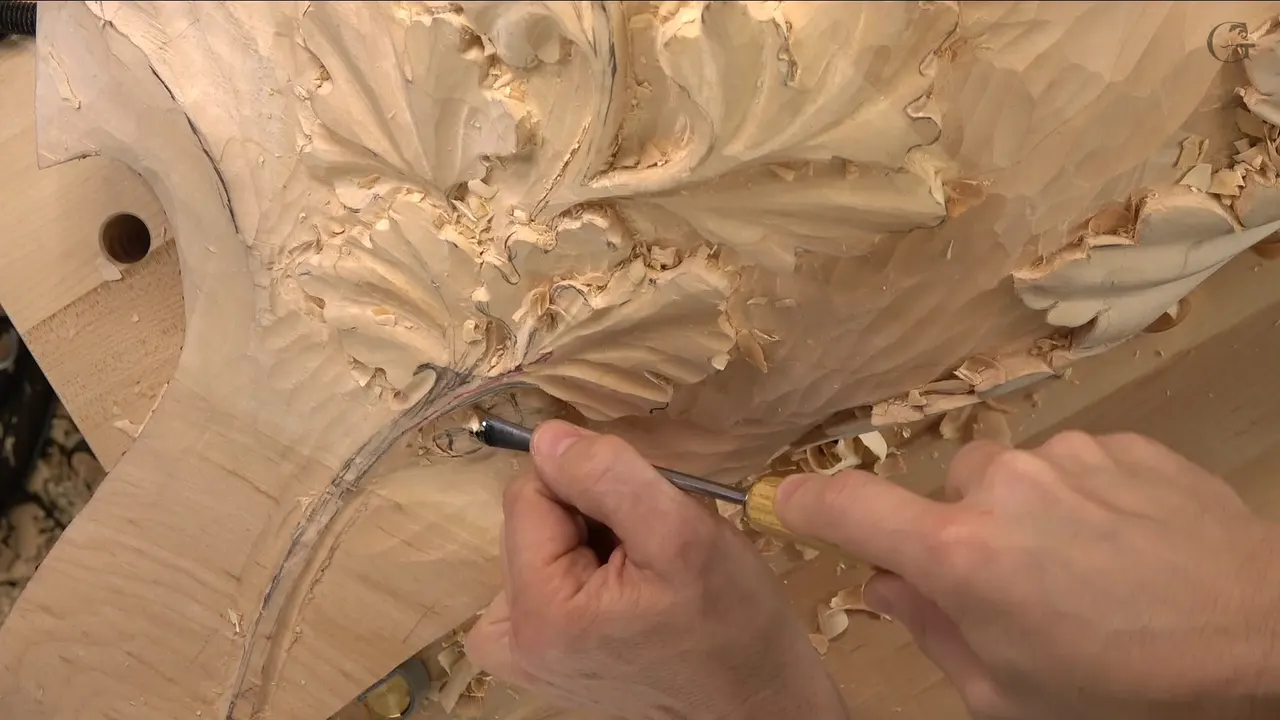

"Maybe even" is what I said in part 7 of workshop 99 when I said I needed something bigger: "maybe even a back bend." It shows up in other lessons too, and each place is below. A lesson with a link is open to everyone. A name like 118-1 means part 1 of lesson 118.
Ever stood at your bench with a gouge that is a little off? Did you wonder whether one size up, or one size down, would do better? Here is how I said it, and what I picked.
What did I say in part 7 of workshop 99?
Part 7 opens with "Attacking from two sides," and a triangle I plan to remove. Next I need to establish overall roundness. My warning is "Got to be careful when I'm working against the grain."

Next comes the line this page is named for. "And now I need to use some little bigger tool, maybe even a back bend," I say, and again, "Maybe even back bend just to give a shape." A moment later I take it back. "It doesn't have to be a back bend." A skew could do the job too: "I could actually use just a skew and just establish my shape, whatever shape I'm after."
The inside of that triangle is my next job. "And I will need to lower down the stem itself." My reason is "because it's too high," and I do not want to get through to the other side. Then "Maybe yes, maybe no, I don't know." To me it feels as if the stem has to go lower.
"It's got to be attacked from the right position," I say. A second reason is "I don't want to undercut too much underneath of here, and it going to give me also really nice movement feel of it." Then "So now I have to be a little more careful how I'm doing it."

My next tool is a number three, and my aim is to "try to get my shape of acorn of a oak nut."
Later my plan is the back bend once more, "and this one is a skewed one." Ask me where to get it, and my answer is "it's actually a normal back bent. I made my skew myself. Okay? I reshaped it myself."

Further on: "it looks like I have plenty of material. I was worried a little bit." One more line follows, "that is a main form of those two acorns."
A plan for the head ends the part. It will sit "approximately on a golden ratio point," which is "about six parts out of 10, or 60/40 rule." Sixty percent goes on one side, forty on the other. The head plan closes on "I need to make sure my movement is correct."
How do parts 6 and 8 of workshop 99 sit around it?
Part 6 turns to the acorns first, "just work on those acorns or oak nuts, whatever you call them." Their size comes as a maybe, "about an inch long and about three-quarter of an inch wide" (25 mm by 19 mm). Number three chips around them, number seven comes next, and "Maybe use number 11" is my plan for the excavating. Later in that part I name number seven or number five for the area around them, and "same number seven, half an inch" (13 mm) for their roundness.
Part 8 plans a skew. "I'd say let's use just a skew and get my preliminary cut." Number three follows it. "And maybe I can clean this up with number 11," I say, and right after, "Maybe or not maybe. Maybe it's just for sure." Its size is 2 millimeters (0.08 in). Near the end I plan "number 7 or even number 5" to clean "this area."
What comes after them when I want a bigger tool?
Part 6 of Lily Box 5 asks for a bigger gouge. Five comes up first. Seven follows "or even." I try number seven and an inch (25 mm), and the area gives me "kind of a worry" because of how the grain behaves.

Venice Room 20, part 1, plans a spoon. My bigger maybe is number 11 at 10 millimeters (0.39 in), for a pass that is "really nice and smooth." Along the way I say "Maybe this one is a little too big, but I don't know. We'll see."

Part 3 of that lesson goes to a number five, and to a bigger number five as the maybe. Next come "start my cutting like that" and "my preliminary convex." Workshop 33, part 9, wants a bigger number 11 and "maybe even one inch" (25 mm). It needs sharpening, I say.
Workshop 141, part 2, names "an even bigger tool in this case." The maybe is 7 millimeters (0.28 in), and I add "Get that much deeper."

Over in workshop 118, part 1, I begin with 10 millimeters. Then I name 12, and "maybe even 15 millimeters, like 5/8 of an inch" (0.59 in). I try 15. The pass "worked really good, except I have to attack that from two sides."

Workshop 125, part 2, names "a little bigger number two, maybe even 50 millimeters or so" (about 2 in), "to get that cut clean." The next thing I say is "Going to need the mallet."

Grape Onlay 5, part 2, comes with a reason. A bigger tool is the plan, and my last word on size is "like three quarters of an inch" (19 mm). "You would ask me why," I say. "I wanna see this ridge raised up and I don't wanna see too many cuts. And the bigger tool you use, less clean up you have to do."
What follows when I go smaller?
In part 1 of Lily Box 11 I say "I really want to exaggerate this area." I name a smaller gouge, maybe a 3/32 of an inch, "a couple millimeters" (about 2.4 mm).

In workshop 152, part 2, I plan a smaller 11 of two millimeters (0.08 in), to "attack that little by little." A bit later I say "I know it's only two millimeters. I probably could get by with a bigger one," and I add that overdoing it is not what I want.

Workshop 158, part 3, wants a smaller number two. Five millimeters (0.20 in) is the size, "right on the line." The next line is "I don't want to go too deep because logically, it's supposed to be part of this movement."

Venice Room 22, part 1, goes the same way. A little smaller 11 is the plan for an even deeper pass on one side, and I say "maybe even smaller. Let's see. Maybe 2 millimeters" (5/64 in). Workshop 23, part 2, has an 11 at 2 millimeters, "or maybe even one," and I plan to see whether 2 works first.
Workshop 27, part 12, calls for a smaller 11, maybe about five millimeters (0.20 in). I name something smaller than that, and I add "let me try five millimeters first." My next plan is to excavate even deeper. Workshop 30, part 11, goes from "2 millimeters or 3 millimeters" to a 1.5 millimeter (0.06 in) maybe, "We'll see." Next comes "Try 2 millimeters first."
In part 9 of the same Lily Box lesson I say I could use a small mallet, and then a tool smaller than that, "talking about the tool." I say I will use an 11 at 3 millimeters (0.12 in). In Lily Box 7, part 12, I think about an 11 at 5 millimeters, and later I name 4 millimeters "for now" (0.16 in).
In Furniture Panel 15, part 7, I warn "please don't fool yourself." A tool will not go in some spots, I say. A smaller blade is what I need. I put it as "maybe even just 1/16 of an inch" (1.6 mm), to establish my depth.
For Grape Onlay 3, part 3, I say "not number three, because number three is gonna give me too much sweep." A number two "will do really good and maybe even smaller because I've got some of the sections right here."
Which number do I name next?
Lily Box 4, part 11, names number five and is not sure about a quarter inch. Then "maybe even number six," with a quarter inch (6.4 mm), and "number six is actually doing a really excellent job."

Part 10 of Lily Box 5 tries number seven, and then an eight at about half an inch (13 mm). It is "catching grain." Afterward comes a verdict, "number eight worked really good," and one more maybe, a nine. Refining this movement is my plan.
Over in Lily Box 7, part 6, I pick a five, with a three as the other maybe. The five goes first, at a quarter inch (about 6 mm). The place is the area with the knot.
Workshop 148, part 3, takes a bigger tool of probably 20 millimeters (0.79 in), or a nine. I will attack "just across the grain."

Furniture Panel 17, part 9, names a number seven, a bigger one, or a six, because I really do not want to dig too deep.
Part 3 of Venice Room 16 has me say I need to sharpen this one, "and maybe even number 8 to create that depth on its side, which I'm after."

Workshop 14, part 9, wants "a different tool for that," and a number nine is my maybe. Then comes a plan, an 11 at 3 millimeters (0.12 in), to "exaggerate that a little."

Acanthus over Moldings 6, part 2, wants a flatter tool, a number three at a quarter inch (6 mm). Part 2 of Floral and Molding 6 finds number five "probably not the best tool for this operation," so I name a number one. Floral and Molding 10, part 3, goes right underneath with a nine and a quarter of an inch, "six millimeters," for "preliminary cuts."
Do they ever point at a kind of tool, or a deeper pass?
Part 9 of Venice Room 18 says I could use a back bend again, a small one, "maybe even," to excavate. I keep an eye "from the bottom how clean my dome is."

Workshop 17, part 11, wants a deeper concave to "give that extra line look." A micro tool is my plan. It needs sharpening, I say.
Part 2 of Greek Acanthus Leaf 6 holds a V tool. I add "Maybe even make it deeper. Make it more 3D-ish, if you wish." In Furniture Panel 34, part 3, there is a part I want as "a shadow part." The word there is "really deep," almost to the background. My tool is a number 10, and a number 11 or a nine could stand in.
Furniture Panel 21, part 2, sets a detailing tool, "maybe even 1/8 of an inch," number three, which I give as "three millimeters" too. You hear them in Furniture Panel 14, part 4, after I compare two sizes, and I say I kind of have to make it smaller still, about the overall movement.
Which lessons say it, and what was I doing?
The table lists the lesson, what I was working on, and the words that came right after the two. Each row is a lesson you can watch.
| Lesson and part | What I was working on in that part | The words after |
|---|---|---|
| Venice 99-7 | Shaping two acorns on an oak branch | A back bend |
| Venice 20-1 | Looking for a smoother pass with a spoon | A bigger one |
| Venice 141-2 | Going deeper with a larger tool | Seven millimeters |
| Venice 152-2 | Opening a channel little by little | Two millimeters |
| Lily 11-1 | Planning deep concaves in a flower | A smaller gouge |
| Lily 5-6 | Reaching for a bigger gouge near the grain | Number seven |
| Venice 148-3 | Taking a section down across the grain | Number nine |
| Panel 17-9 | Removing background without digging deep | Number six |
| Venice 18-9 | Excavating a dome from the inside | A small one |
| Venice 17-11 | Giving a ridge an extra line | A micro tool |
| Greek Acanthus 6-2 | Cleaning a spot with a V tool | Make it deeper |
| Panel 34-3 | Making one part a shadow part | Really deep |
Where can you watch these lessons?
The video for this page belongs to Venice Room 99, among the twelve workshops, 98 through 109, in the Part 9 course. Number 98 sits in the same course, and its page is open to everyone, like workshop 100.
The Lily Box lessons live in the Lily Box course. Panel work is in the Furniture Panel course, and leaf work is in the Acanthus over Moldings course and the Greek Acanthus Leaf course.
Plain definitions of a few words here are one click away: wood carving, gouge, mallet, chisel, grain, relief, oak, shadow, molding, Venice, millimeters and inch.
Want to hear all of this in my own voice? Start here.
How it's done
- Find the words. Part 7 puts them right after I name a bigger tool, a back bend, for the shape.
- Read what follows. A skew comes next as another way to establish the shape, then number three.
- Check the tool. Other lessons put them ahead of a number, a size in millimeters, or a smaller gouge.
- Watch the pass. After that comes the try, and my word on whether it worked or ran too big.
Frequently asked questions
Does a wood carver say "maybe even" before a bigger tool or a smaller one?
Before either. In Venice Room 20, part 1, my bigger maybe is 10 millimeters. In workshop 152, part 2, I name a smaller one of two millimeters. Workshop 99 puts them ahead of a back bend.
Did I end up with a back bend in part 7?
I offered a skew in its place. My plan later in the part was the back bend once more, a skewed one.
Where did I get the skewed back bent gouge?
My words in part 7 are "if you would ask me where to get the skewed one back bent, it's actually a normal back bent. I made my skew myself. Okay? I reshaped it myself."
What to carve next