
Alexander Grabovetskiy, woodcarver, School of Woodcarving · Published 2021
What does a wood carver mean by "groove"?
Quick answer: In Venice Room 99, part 11, I said "some groove on inside" while I planned a shell with a number seven and approximately 10 millimeters (0.39 in) left to the edge. Other lessons of mine use the word for a cut a number 11 makes, for a V cut, and for the flute of a tool.
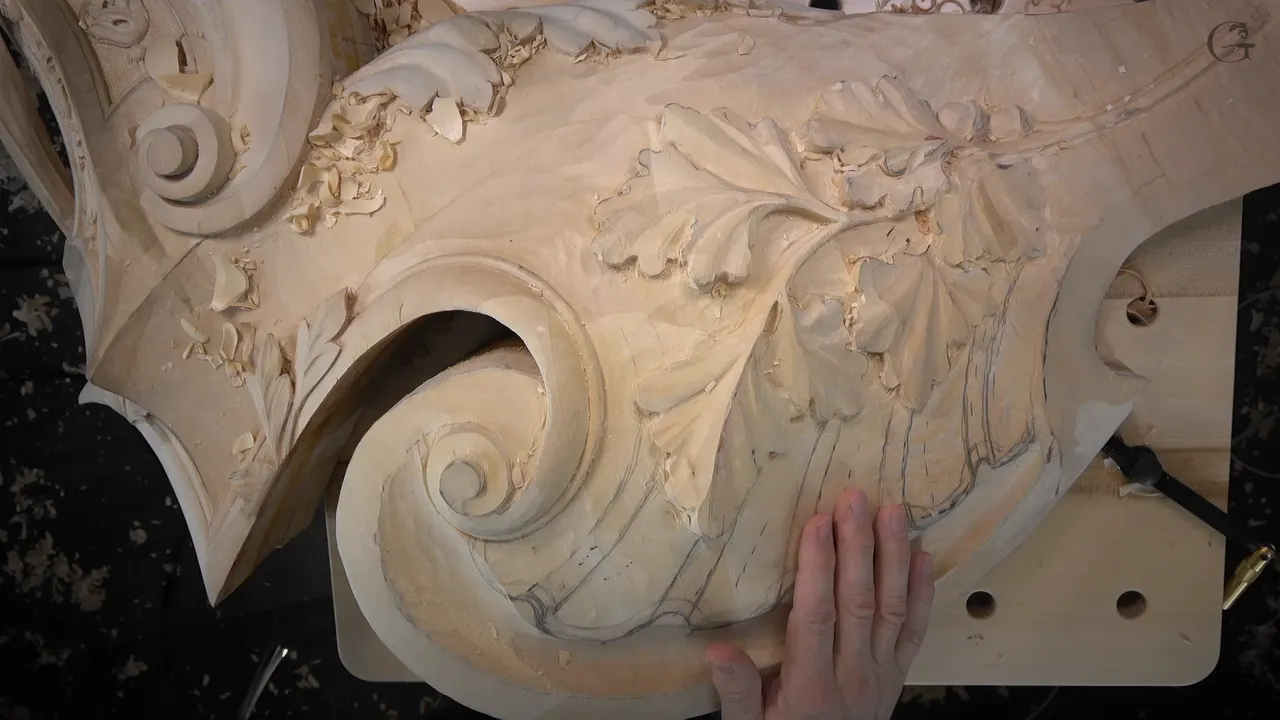

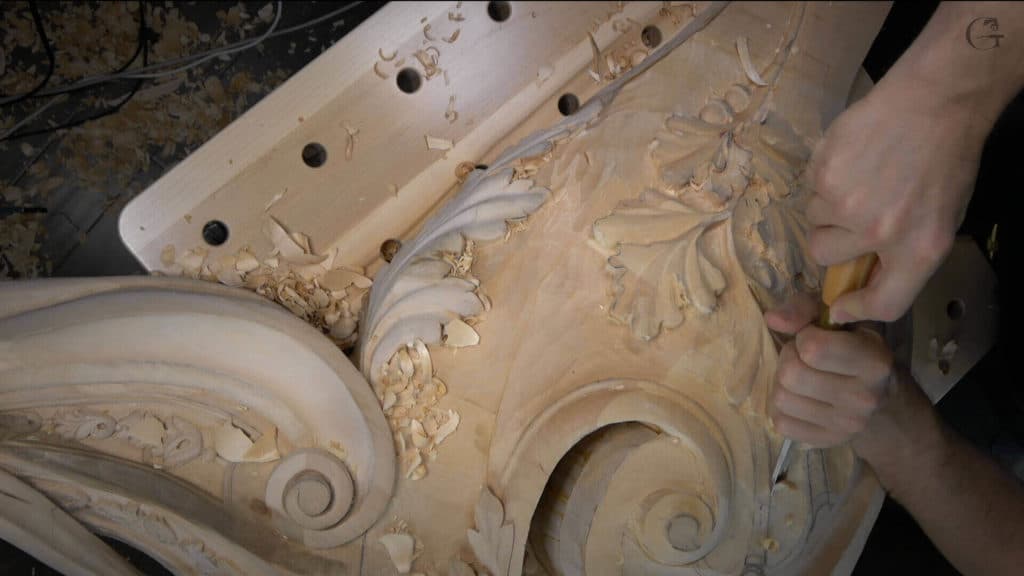
In part 11 of workshop 99 I said "So there's going to be some groove on inside." A shell on the Venice Room panel was next, and the word came right after I named my tool and my distance to the edge. Other lessons of mine use the word too, and each place is below. A lesson with a link is open to everyone. Names like 58-6 mean part 6 of lesson 58.
Ever dug a line into a board and wondered how deep it was allowed to go? Here is every place I said it.
What did I say about the groove in part 11?
Part 11 starts with "I am ready to work on a shell." Then I mention "the volute you don't see," and I say the shell is "the same what you saw on our main piece."

My first tool is "just probably number seven and about three-quarter of an inch" (about 19 mm). My plan is to leave "approximately 10 millimeters to the edge" (0.39 in), and my words for it are "the same idea what I've done before, and you'll see it, okay?" The line from the top of this page comes next. After "And let me do that," I plan to "excavate my concaves."
Oak comes up next. "Really, you have to attack that with the grain direction, but I do have that oak piece on my way, and that's almost impossible." My answer is short. "So the only solution would be to have really sharp tools." In some spots, "I am actually able to attack that from the right position." Later, "At least I need to make sure one of the sides clean cut, and then I can attack from an opposite direction."

Near the end I give the tool again, a "number seven" at "about the three quarters of an inch, about 19 millimeters, I'd say" (0.75 in). The part closes on a plan: "carefully have to approach some of the areas." For now it is "okay as of now to use that bigger three-quarter of an inch," and "I'll switch to a lot smaller one pretty soon."

Part 12 adds a reason for care. I say "I don't want to go too deep" because of "some bead molding on the inside." I name a smaller tool, "number eight and about 3/8 of an inch" (10 mm), and I check: "About an inch deep, so it's plenty" (25 mm). That area is "somewhat forgiving," and it is "never going to be visible."
Where does a shell get its groove in other Venice Room lessons?
Shell sections come up in Venice Room 58. One is "somewhat rough yet," and I mean to leave it "for now like that." Part 2 has "the same groove like you saw right in the middle," and after it "exactly the same on inside everywhere."

Part 6 of that lesson names the tool: "a small number 11. It's like a groove." The groove has a rule, "it also has to taper." I add "I'm not actually creating straight line on the outside."
This groove is to come first. It is "the most accurate," and the outside line is "follow up. So it's a following line." Later I call it "preliminary and the first and the most important." By eye, at one point "it's about 10 millimeters, about three-eighths of an inch," and by another "about half an inch, maybe about 13, about 14 millimeters, I'd say" (0.51 in and 0.55 in). In my words, "I am just eyeballing."

Part 8 puts a number on it: "the groove right there, three millimeters" (0.12 in). A fillet comes next to it, and "concave closer to this groove has to be more pronounced." Inside the groove I expect "a much darker shadow."

How deep can a groove go before the edges break?
Venice Room 57 gives the depth in numbers, and I ask for it myself in part 7: "And how deep?" My answer is "Approximately, I would say a couple millimeters deep." Next come "A little more than 1/16 of an inch deep" (1.6 mm) and "Like 3/32 of an inch or so" (2.4 mm). One more line: "You could go deeper than that."
"It has to be really consistent cut," I say, and "I'm really slowly creating that groove." The sides tell me when to stop. "If they starting to crumple or just those fibers are breaking, that's enough. You can't go deeper than that." I add "that's the deepest you can go with this particular tool."

I name a smaller tool next, "1/16 of an inch number 11" (1.6 mm), "a veiner, 1.5 millimeters" (0.06 in). I plan to "excavate deeper." My reason for not starting with it: "there's a limitation how deep you can cut with the tool, and those edges, you can break easily. So I needed to make a wider space before I hit with the smaller tool, and that way I can get a really deep cut if I need to."
Part 9 runs down the same line. I am "cutting with my tool all the way to the bottom of the groove cut, and I can actually excavate little deeper groove right here." I expect "a lot more shadow."

In 57-6 I plan a small veiner: "a groove cut like with a veiner but a small one," with "a groove between my beads and that convex." My words on the choice: "I need to choose the right tool for it, because I don't want to create too big of a groove. Maybe 2 millimeters" (0.08 in).

Width can vary, and Venice Room 24 says so: "if I got my groove uneven, somewhere wider, somewhere less wide, that is absolutely okay." Part 3 of that lesson aims for "only about one and a half millimeters thick right here," "to the edge from the groove" (0.06 in). Workshop 99 plans a larger distance.

Three more lessons put the groove in a list or a plan. Part 7 of Venice Room 46 has "Going to hit just the sides of this groove I just created." Part 12 of Venice Room 54 plans "the groove cut, like a concave cut on a side" with "number nine and the quarter inch" (about 6 mm). Then there is Venice Room 53, part 3, where I list "main setting in cuts, main groove cuts, concave cuts around this line."
Is a V groove the same thing?
The V tool gets the word too. Hashemi Flowers 40 says "Take number 16, a V tool, and just establish the border, or a V cut, or V groove, if you wish to say it that way." Over in Hashemi Flowers 11, part 5, I want to clean between two leaves with "a V cut or V groove."
The same part gives a way to a deeper look. "If you would take a number 11 and one millimeter or even if you have, let's say, half a millimeter gouge, like a micro tool." After that, "I can make a separation cut really deep." And "It's almost all the way through" (0.04 in and 0.02 in).
Beginners meet the word too. First Cuts workshop 2 names it with both words in part 5. On the Tray of Blessing I say "I'm not trying to do the V groove. It's my first cut." Then "it would be exactly the same like if you would do the V groove, but it's not gonna be V groove and you just follow that line." Find it in workshop 8 of the tray.
Greek work uses it too. Venice Room 60, part 5, has "I don't really like too much spooning effect, is what I mean." Next, "doesn't matter if it's Roman or Greek. If it's a Greek, you're supposed to have a V cut inside." Over in Venice Room 52, part 7, the early Greek acanthus "would have a groove with a middle line."
What is the groove inside a tool?
I use the same word for a part of a gouge. Floral 7 has it in part 2: "the flute is actually that groove right in the middle of the gouge, or in my case, it's a veiner number 11. That is a flute." Close behind, "place that flute away from that line and start digging right underneath."

Floral 13 says it again: "what is flute. And the flute is a groove on the inside of the tool right there." Next, "Not every tool has a flute, but that's a good idea to identify the part of a tool."
A cleaning move shows up in Vase with Grape Leaves 2, part 2: "I usually place my number 11 and 3 millimeters straight down, then facing flute outside" (0.12 in). The next lines are "clean it like that, okay, without undercutting" and "too early to undercut."

Questions and Answers video 4 shows two tools. "Those two tools are number nine" and "both of them are approximately quarter inch" (about 6 mm). One "has a long groove," and "I can use that pretty much all my life until that groove ends somewhere right there." The other one "is a fishtail." Find it in the Questions and Answers course.

Part 7 of Lily Box 3 answers a missing tool: "there is a solution if you don't have access to a number 11 or any small, tiny tools." Then "You can make it yourself." About sewing machine needles, "some of them, they do have a groove." Further on, "you can actually use a needle, create a handle for the needle, and that way you can create micro tool."

When does a groove go wrong?
One way is too deep. In the Grape Leaves vase I say "clean it without digging too deep." Then "so I'm going to create too deep of a groove, and that's going to create a problem." A second case sits in Lily Box 3, part 5: "if I didn't use my tool properly, for example, I can create a groove too deep closer to the inward." The fix I name is "with my heel, I can go underneath and blend it."
Another trouble is too pronounced. Lily Box 4, part 5: "Okay, let me recreate the groove." Close behind, "I do not want to create a too pronounced groove, just indication." Also, "this transition, I would like to see a smooth transition, okay?" Part 13 of Lily Box 2 says "Don't cut just straight down like a groove."
A V tool does the cleaning in Hashemi Flowers 21, part 3: "Take just a V-tool and clean it with the V-tool. If you need to make a groove a little deeper, just do it."
A groove can also wait. Part 10 of Venice Room 73 has "I didn't do the detailing yet on inside. There is a little groove." Further on, "on that side, I did not do it yet until I finish with this movement."
Where else did the groove turn up?
Chamomile and Bow Rosette 2 shows it in part 2: "create a groove cut, and then I'm going to smooth out both sides." Next, "I want to use just the 1 millimeter, number 11" (0.04 in). Part 3 of that lesson says "Second, I've done a groove inside. It's like a concave cut."

An order follows: "What I've done first, I've got convex and concave and a concave, and then I've got the groove." And "at the section cut, it's going to look like this."
Part 1 of Venetian Rosette 6 has "I've got another groove." Then "Let me go around and create the same cut on all the perimeter."

Lily Box 13, part 9, comes to dark color: "See, we made those parts dark" and "I want to exaggerate that groove." Right after, "blend little nicer the dark color."

A frame turns up in the Hazelnuts course, part 1 of lesson 1. "I'm trying to save as much as possible the material thickness." Then "insert that in a frame, some kind of frame, just to create a three-sixteenth or five millimeters groove" (3/16 in is 4.8 mm).

Which lessons say it?
The table lists the lesson, what I was making, and a few of my words from each. Each row is a lesson you can watch.
| Lesson | What I was making when I said it | My words |
|---|---|---|
| Workshop 99-11 | A shell with a number seven | some groove |
| Part 58-6 | A first cut with a small number eleven | follow up |
| Lesson 57-9 | The bottom of a cut I had dug | a little deeper groove |
| Venice 24-3 | One and a half millimeters left to an edge | from the groove |
| Hashemi 40-1 | A number sixteen V tool at a border | V groove |
| Floral 7-2 | A veiner number eleven set beside a line | the flute |
| Lily 4-5 | A transition I did not want pronounced | recreate the groove |
| Chamomile 2-3 | Convex, concave, concave, then the groove | a groove inside |
| Hazelnuts 1-1 | A panel I still wanted to put in a frame | five millimeters groove |
Where can you watch the lessons I name here?
The video for this page belongs to Venice Room 99, one of the twelve workshops, 98 through 109, in the Part 9 course. Workshop 98 is in the same course, and its page is open to everyone.
Flowers fill the Hashemi Flowers course, the Floral and Molding course and the Chamomile and Bow Rosette course. A box lives in the Lily Box course, a vase in the Grape Leaves course, and a tray in the Tray of Blessing course.
Plain definitions of a few words here are one click away: wood carving, carving, woodworking, gouge, mallet, chisel, grain, oak, volute, bead, fluting, Venice, millimeters and inch, plus sewing machine needles.
Want to hear all of this in my own voice? Start here.
How it's done
- Name the tool. Part 11 names a number seven, about 3/4 in wide (19 mm).
- Plan the edge. The plan leaves about 10 mm (3/8 in) to the edge, with "some groove" inside.
- Watch the grain. Part 11 says "the only solution would be to have really sharp tools."
- Go smaller later. Part 11 ends on "a lot smaller one pretty soon."
Frequently asked questions
Which tool did I take for the shell in part 11?
A number seven, about 3/4 in wide (19 mm). I also said it was fine for now, and that I would switch to a lot smaller tool soon. Part 12 then named a number eight, about 3/8 of an inch (10 mm).
What is the flute of a tool?
Floral 13 has "the flute is a groove on the inside of the tool right there." In Floral 7 I added that my own tool was a veiner number 11.
Can a V tool make a groove deeper?
A V tool was in hand when I said "a little deeper, just do it," in Hashemi 21. In Hashemi 11 I took one to "clean between those two leaves."
What to carve next