
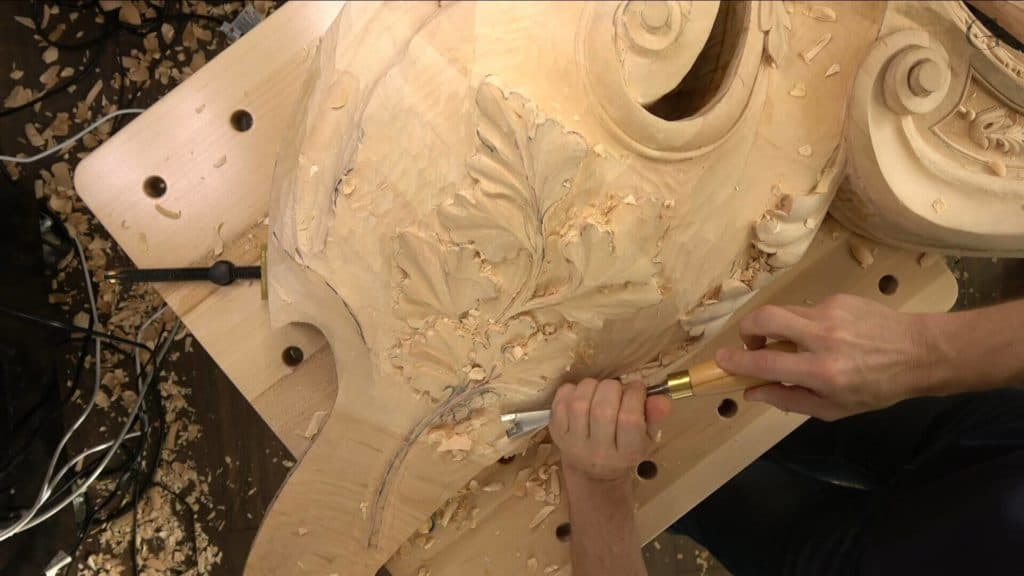
Alexander Grabovetskiy, woodcarver, School of Woodcarving · Published 2021
What does a wood carver mean by "just about"?
Quick answer: Workshop 99, part 6, holds the words right after my doubt about the wood left around two acorns. My other lessons put the same two words before a size in millimeters or a fraction of an inch, before "the same" something, and before one job like blending or shadow.
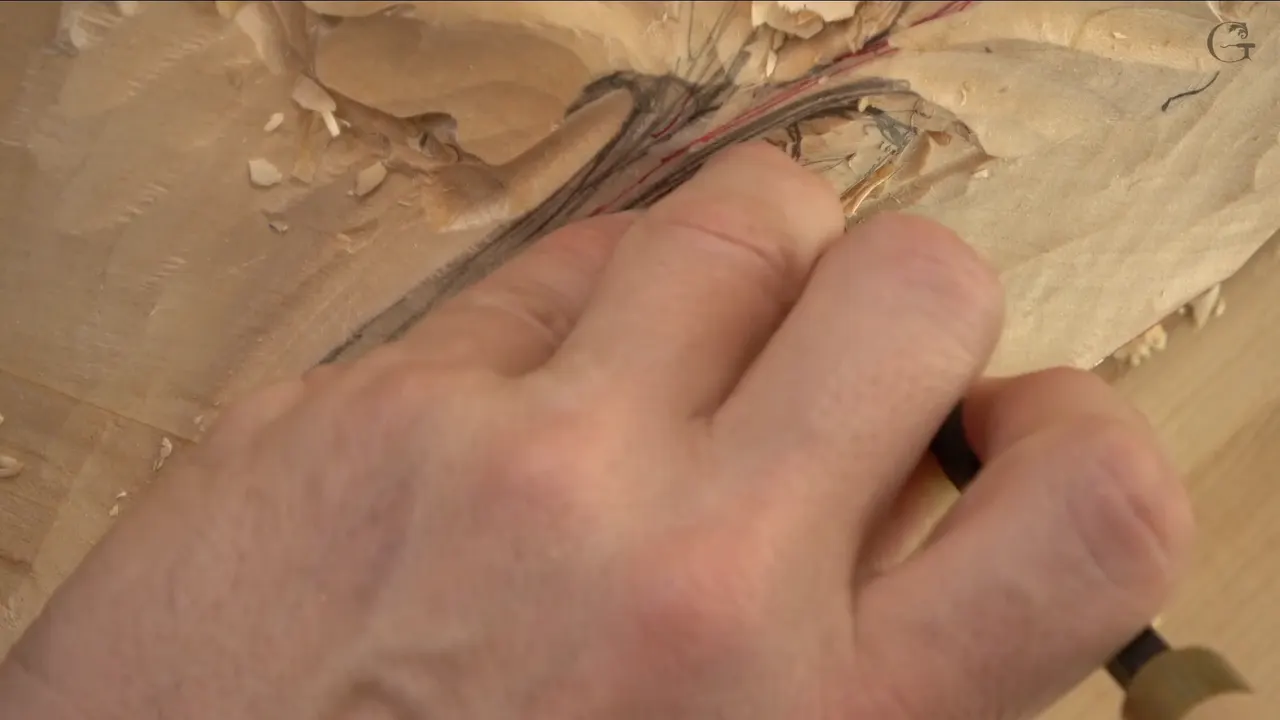

Part 6 of workshop 99 gives this page its words: just about. I say them while I dig beside two acorns, and I say them in other lessons too. Each place is below. A lesson with a link is open to everyone. A name like 85-5 means part 5 of that lesson.
Ever dug next to a small shape and wondered if the wood around it was enough? Did you ever judge a depth with your eye, with no ruler near? Here is where I said it.
What did I say in part 6 of workshop 99?
The part opens with short lines, "Wonderful," "Clean little at this section" and "Okay, that is good." Then I turn to the acorns: "I think I'm going to jump right now and just work on those acorns or oak nuts, whatever you call them." Two are coming, and I say "I think I still have plenty of material left," then "I'm not sure, but I sure hope so."

For their place I say "let me actually get them a little closer to the stem," and "I think they're going to face this direction," then "That's going to make more sense." The size is a maybe, "about an inch long and about three-quarter of an inch wide" (25 mm by 19 mm).
Digging starts with a need, "I need to excavate some area around, start working on them." I start with "I'll take number three first and kind of chip around a little bit." Doubt comes back with "Again, I'm not sure if I even have enough material there," and "I hope I do."
A tool change comes next. "Number seven, that is what I'm using," I say, and I need "just to establish overall shape of them." Then "Maybe use number 11, excavate around them."

Then comes the line this page is named for: "I don't know why I didn't leave enough material," I say, and next "But again, maybe there is enough, just about, just about."
My next words are a plan, "Let me use number seven or number five will work, and take care of this surrounding area." After it, "Got to attack that from the right position." A stretch against the grain follows, "Yep, I am going against the grain, little bit dangerous, but it's okay."
On the angle I say "I think I want to make it little tighter, don't want to rotate too much." Then "Okay, that's better."
The part ends on roundness. "And now I need to give some roundness to my acorn," I say, and my plan is "number seven." Later come "Same number seven, half an inch" (13 mm), and "And give an overall shape."
How do parts 5 and 7 sit around it?
Before it, part 5 names a tool for two points, "I need to use number 11 and 10 millimeters to get this point and that point right here" (0.39 in). Afterward, in part 7, I say "And it looks like I have plenty of material," then "I was worried a little bit." The video ends on the head of the acorns, "approximately on a golden ratio point," and "It would be about six parts out of 10, or 60/40 rule."
Which passages put a size after the words?
Each one below gives a size, in a fraction of an inch, in millimeters, or in both. I checked each pair by arithmetic, and one inch is 25.4 mm.

Some of them sit in workshop 85. In part 5 I talk about removing waste, "I'm not placing really low, just about six millimeters at a time" (0.24 in), and "three-sixteenths sometimes, about five millimeters" (0.20 in). "It's like a really sweet spot," I say.

Part 4 of that lesson is about a line. "I'm leaving about six millimeters," I say, and "I think it would be much safer for me to just get clean cut later." The same part has "just about a quarter inch away" (6.4 mm).
In part 10 I say "I'm really close now" and then "just about 1/32 of an inch or so" (0.8 mm). Next, "It became really dull," and "Let me just strop it for a couple seconds."

Venice Room 78 comes next. I check the wood first, "I've got less than 32nd of an inch right here" (about 0.8 mm too). My next tool is "a little smaller," at "maybe just about 16th of an inch, a millimeter and a half" (1.6 mm), "and I can excavate inside a little deeper shadow."

"Maybe a smaller tool, maybe just about one-eighth of an inch, three millimeters" (3.2 mm) is the line in lesson 67, part 3. A tool follows, "Number three."

Five-eighths of an inch (16 mm) comes first when I weigh a size in workshop 73, part 10. Then "maybe I can use just about half an inch, about 12 millimeters, number 11 veiner" (0.47 in), and I add "I probably should use even smaller" and "Maybe even just a seven millimeters" (0.28 in).

"And 10 millimeters, it would be at this point, but that piece is a little higher" (0.39 in), I say in workshop 92, part 3. Then "I'll go with just about maybe six millimeters right here at that point because it's too close to the edge."
A size a little over another sits in Venice Room 90, part 3: "maybe about 9/16 of an inch in this section" (14 mm), "just about a millimeter and a half bigger" (0.06 in).

"I'm using just about three millimeters, number 11" (0.12 in) comes from workshop 34, part 2, followed by "that is also a longer bend."

"Just about 3 millimeters all around" (0.12 in) opens part 7 of workshop 32, and then "I'm just eyeballing, of course."
Two sides get compared in workshop 101, part 10, with "I've got exactly, maybe slightly, just about one millimeter difference I would say in this spot, but it's okay." That is 0.04 in.

A pair of sizes comes in workshop 57, part 1. "Seven millimeters, that's what I'm going to use," I say, then "Quarter inch." After that, "Well, little bigger, to be exact," and the next words are about "1 millimeter bigger than a quarter inch." Seven millimeters is 0.28 in, and a quarter inch is 6.4 mm.

"Approximately 14 millimeters is what I'm using," I say in workshop 4, part 9, and then "Again, it's approximate. It's not exactly 14 millimeters" (0.55 in).
Which other courses put a size after them?
I support a fragile piece from the bottom in Hashemi Flowers 11, part 1, and say "this is just about one-eighth of an inch" (about 3 mm). Hashemi Flowers 6, part 4, goes "I could take number nine probably, just about quarter-inch number nine, and I'll make a cut inside of the cut" (about 6 mm).
Furniture Panel 21, part 11, names the thickness of a small detail, "actually just about one millimeter, I'd say" (0.04 in). Panel 19, part 14, sets a depth, "just about 64th of an inch deep right here" (0.4 mm).
A gap shows up in Floral and Molding 4, part 1: "maybe about half a millimeter, maybe even less" (0.02 in). I try a piece of paper there, and "the gap is just about paper."
Rosette 5, part 3, gives a share, not a size. "About maybe two-thirds of the way, that's what I want to do," I say, then "I would say it's plenty. It's enough." After that come the words, "just about two-thirds, just like that, with my cut."
Where do the words point back at something I already did?
Here nothing is measured. They point back at something I already did, such as a movement or a tool.
Venice Room 13, part 3, has me say "It's about the same thing," and right after it come the two words with "the same thing" after them.

A slope on two sides turns up in workshop 62, part 10, where I say "I have to somewhat repeat on this side," and then "I don't have to too much, but just about the same."
A leaf is the subject in workshop 95, part 2. "So it has to repeat this side," I say, and the two words lead into "the same, like the main movement." Then I say "it is going to look good."
The two words sit ahead of "on the same line" in workshop 152, part 1.

Moldings 7, part 1, is about the middle part. I say "The middle part going to be raised up," and "it's gonna have concave and a concave on the side." Ahead of "the same movement" stand the two words.

A V tool goes all the way around in Greek Acroterion 2, part 2, with the two words ahead of "the same depth." I give "about 3/16, about 5 millimeters" (4.8 mm and 0.20 in), and call them "initial cuts."
Floral and Molding 14, part 2, matches a tool, "the same tool what I'm holding in my hands," and then "right in the middle of this line."
A place for the tool appears in Moldings 3, part 1. "I'm gonna position my flute almost straight down," I say, and "That would be like, maybe one o'clock." Then comes "just about like one o'clock."
What job comes after the words?
A pass that is not deep still shows in Venice Room 87, part 9. "Of course, it's all about shadow," I say, and "Nobody's going to measure here, but the shadow is really important." Then "So that is just about the shadow."

A ridge under side light is the subject in Lily Box 8, part 6, "it's going to be much more visible," and the two words lead into "the shadow and the light."
Blending comes next. The words stand before "the blending together" in Moldings 8, part 1, and before "blending pretty much" in workshop 158, part 3. Rosette 3, part 2, has "But I want to see that raised part," then "the blending all together."

Other jobs get the words too. They come before "refining all the lines and so on" in Rosette 4, part 3. In workshop 159 they stand before "the shape in this case, just the shaping," and in Greek Acanthus Leaf 10 before "refining," where I add "let me take my number five."
Roman Acanthus 1, part 2, ends on a different job: "I know it looks probably complicated at the beginning, but that's not as complicated." Then the words come before "the symmetry, how symmetrical it's going to look."
Does it ever mean a time?
A quick job sits in workshop 75, part 1, where after "let me make that quickly" I say "it took me literally just about 30 seconds." In Venice Room 1, part 1, the words sit before a span of years: "We're talking about just about 300 years ago right here in the United States."
Which lessons say it, and what was I doing?
The table lists the lesson, what I was doing, and the words that come after the two. Each row is a lesson you can watch.
| Lesson and part | What I was working on in that part | The words after |
|---|---|---|
| Venice 99-6 | Digging around two acorns and doubting the material | Maybe there is enough |
| Venice 85-5 | Removing waste in small steps, not placing really low | Six millimeters at a time |
| Workshop 78-1 | Planning to excavate for a little deeper shadow | A sixteenth of an inch |
| Workshop 92-3 | Excavating a spot that sits close to an edge | Six millimeters |
| Lesson 101-10 | Checking the depths on one side, then the other | One millimeter difference |
| Lesson 87-9 | Carving a line that is not deep but still shows | The shadow |
| Lily Box 8-6 | Showing a ridge when the light hits from the side | The shadow and the light |
| Moldings 8-1 | Blending two convex shapes into each other | The blending together |
| Greek Acanthus 10 | Planning a number five to clear the background | The refining |
| Roman Acanthus 1 | Adding lines to subdivide the base even more | The symmetry |
| Panel 21-11 | Naming the thickness of a small flower detail | One millimeter, I'd say |
| Acroterion 2-2 | Running a V tool all the way around | The same depth |
Where can you watch these lessons?
The video for this page belongs to Venice Room 99, among the twelve workshops, 98 through 109, in the Part 9 course. Number 98 sits in the same course, and its page is open to everyone.
The other Venice lessons sit in Part 1, Part 3, Part 5, Part 6, Part 7 and Part 8. Leaf lessons belong to the Acanthus over Moldings course, the Greek Acanthus Leaf course and the Roman Acanthus course.
Panel work is in the Furniture Panel course. Flowers live in the Hashemi Flowers course and the Venetian Flowers Rosette course.
Plain definitions of a few words here are one click away: wood carving, gouge, mallet, chisel, grain, relief, oak, shadow, molding, rosette, grape, millimeters and inch.
Want to hear all of this in my own voice? Start here.
How it's done
- Find the words. Part 6 puts them right after a doubt about material for two acorns.
- Read what follows. A plan for number seven, with number five as another, comes next.
- Check the size. Some lessons give a size right after, in an inch fraction or in millimeters.
- Check the other meanings. Other lessons put the words before the same movement, or before one job like blending.
Frequently asked questions
Where do I say it in part 6?
Right after I say I don't know why I didn't leave enough material.
Which tools did I name in part 6?
A number three first, then a number seven and a number 11, with a number five as another choice.
How big did I say the acorns were?
A maybe, "about an inch long and about three-quarter of an inch wide," which is 25 mm by 19 mm.
Which size sits near the words in workshop 92, part 3?
What to carve next