

Alexander Grabovetskiy, woodcarver, School of Woodcarving · Published 2021
What does a wood carver mean by "cleaning everything"?
Quick answer: In Venice Room 99, part 9, I said I am not doing really final work from the beginning, and gave my reason in the next lines. My other lessons put the words cleaning everything beside undercutting still to come, another movement, a check of the overall shape, and clean-up away from the camera.
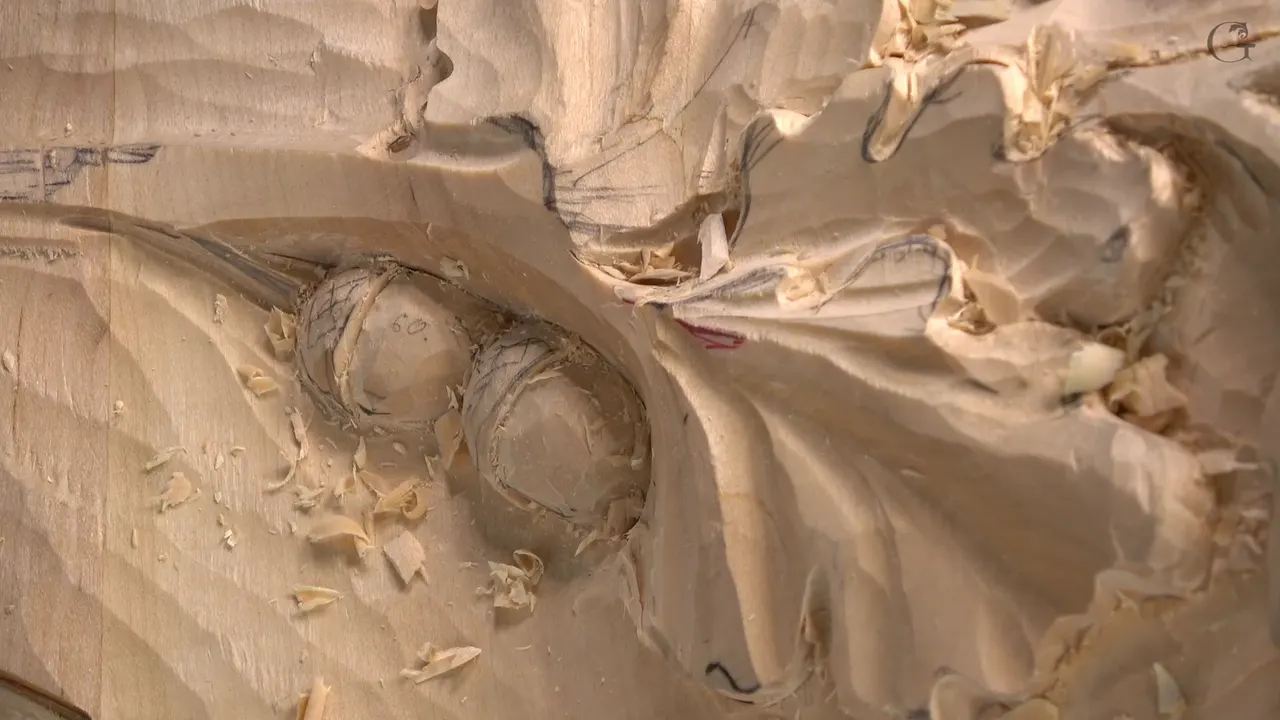

In part 9 of workshop 99 I asked "See why I'm not doing really final work from the beginning?" and gave my reason: "That would be really frustrating if I'd spent too much time cleaning everything and refining and then make the decision to change something." The same words, cleaning everything or clean everything, show up in other lessons, and each place is below. A lesson with a link is open to everyone. A name like 21.11 means part 11 of lesson 21.
Ever stood over a leaf and wondered whether to polish it now or leave the clean-up for later? Here is what I said, and where else I said it.
What did I say in part 9 of workshop 99?
Part 9 opens with "And even lower." Then comes "Let me get a little bigger spoon." Here is how I answer my own question: "Because I'm doing a lot of changes if I don't like something."

The line that follows is "That is really frustrating."
My plan for the leaf is a number 11 and 10 millimeters (0.39 in), to "fix little bit the shape of this leaf." I name "Number five and a quarter inch" (about 6 mm), and "Number five and spoon." One more line is "And now I can probably shape a little better."
"I need some more lights, okay? Because I don't really see really good." Light comes next: "much more lights and get a little closer to it. Otherwise, it's just almost impossible for me to get to the details."
Then "I'm able to actually see much better." And "I can see, and I can refine everything, and I could just do micro cuts."

For tools I plan "let me use number seven again and half an inch" (about 13 mm), and "maybe I can refine this shape." Then "Sorry if I'm covering it, but I have to make that cut." Part 9 ends on "It doesn't look too bad at all."

What do the parts around it say?
Part 8 names a head and a nut, and plans a skew. "That is preliminary form," I say. My aim is to "make sure it's just growing from somewhere." The line "that's all about refining and cleaning around and so on" is in the same part.
The inner part of the nut gets a number 11 and 2 millimeters (0.08 in) in my plan. My words are "I'm not going to do a final form because like I said, there's going to be a shell below." I add "that's going to give me a chance to undercut and just to create the final form." Then "So this is like I'm after 60% done." And "Want to see only 60%."

Part 8 also says "it's not completely supposed to be clean yet. Only after I've done the main shell."
Part 10 has "And I can give somewhat like undercut, not really undercut yet because, like I said, we still have to do a shell." A number seven and 14 millimeters (0.55 in) is the tool I name there. A plan reads "Maybe off camera," for work on "the overall shape."

Workshop 99, part 3, says "Again, I'm going to have a chance to clean everything. So that's why I don't really worry about to make my cuts super clean right away."
When do I say it is too early to clean everything?
Lily Box 7, part 9, has "I don't worry about the mass yet on that side." And "it's too early yet to clean everything because we're still going to be undercutting."

One place I left alone is part 8 of Venice Room 64: "So probably now you understand why I did not clean everything in this area when I was working on that eye, because I didn't need to yet." More movements of the same detail were still to be made. I use a number 11, three millimeters (0.12 in), "One-eighth of an inch" (3.2 mm).

In Grape Onlay 11, part 3: "for me it's a little too early." My reason is "just in case if I'm gonna change something or if I'm gonna break something." A long clean-up before that, I say, "that's not gonna make me happy."

Onlay 2, part 3: "obviously it's not clean at all." One way to fix it is "with my skew or my knife and clean everything." Then "that is the stage when I'm looking back and changing some of the shapes and even sometimes the position or the motion, how it's supposed to fall down."
The clearest version is in Gibbons class 18, part 1. Time goes "at the beginning." Then "make it look perfect. And then if I want to change something I don't know. How about you but I get frustrated."

My logic in that class is to "work on the whole thing at first make it look how it's supposed to look and then I'm gonna spend a lot of times." The clean-up gets its own time, "cleaning up stuff," to "make it to the Perfection."
Floral and Molding 12, part 3, goes "See why I don't have to attack on inside right away, because I know I'm going to have a chance to clean everything."
In Hashemi Flowers 17, part 2, the final cleaning waits for one more leaf. It comes "once I establish this piece right here." I want to "develop another leaf on the inside curling out, and then I'll clean everything." "But now I just pre-establish my form."
Floral 6, part 2, comes with a reminder: "I said multiple times, later on, I'll spend a little more time and clean everything. Refine all those lines." The shape is not there yet: "all I see is just the overall movement, but it's not the end result, what I want to see."
Venice Room 90, part 6, ties the clean-up to a measure: "one millimeter is not a big deal to take out, but I want to make sure before I create my final cleanup cut." One millimeter is 0.04 in.
Why does digging too deep first cost so much?
A warning sits in Venice Room 56, part 7: I say I have to be careful how hard I hit: "I really don't want to deal with the background cleaning later on." Dig too deep, I say, and "you have to spend time and clean everything."

Clean-up, I say, "sometimes takes much longer than just to create initial idea, unfortunately, but it's true."
Part 3 of Venice Room 24 has a warning. There is a point that is "a little too deep," and I say it will be "hard to clean everything." "I've got to keep an eye not to excavate too deep," I say. For that point I name "probably a small knife." Later on, "I can get with magnifier glass and get that to the perfection."

A story from Hashemi Flowers 49, part 4, shows the other cost. "When your project is almost done, and you already clean everything, and just really fragile, and you decide to do extra cut, just because you don't feel like it's enough." The next words are "and boom, you crank against some detail, and you just break it."

Why do I clean off camera?
Over in Venice Room 103, part 3, clean-up still waiting, but "I can do that off-camera. I don't really need to spend time showing you how to clean everything. Really easy. Just a flatter gouge." A back bent is the plan, to "create preliminary form before I clean everything to the final."

Workshop 87, part 4, has "clean everything just off-camera because I really don't want to make it a boring process." Then "soften everything and clean everything this side, and I'll jump on that side." Number seven at 14 millimeters (0.55 in) goes "to the line, blend everything, and clean it."
In Venice Room 31, part 2, the clean-up goes "maybe off camera." Cleaning has "nothing special, but it takes time," and "sometimes doesn't make any sense to spend your time."
Gibbons class 12, part 2, lists the work: "cleaning everything refining everything." It is work "you don't need to see," I say, and "it's gonna be off camera."
When do I say it is time to clean everything?
Part 8 of Venice Room 36 says "right away when you clean it, you can see if you need to fix something and refine, which I think I do." I call it "a good practice to clean everything" as a way to "check if something needs to be done to the overall shape."

Venice Room 29, part 9, calls getting rid of pencil marks "probably smart." And "that way I can see much clearer." Then "Just cleaning everything and I'll see where I can make my next move."
A number three plan in Venice Room 98, part 8, reads "clean everything, or I would just get rid of all the pencil marks and create clean canvas where I can see what is going on."
Furniture Panel 19, part 6, says "Let me now work on kind of cleaning everything. Again, that is not the final look yet." The shapes of the leaves are "creating overall canvas."
For Greek Acanthus 15, part 1, I say "Now it's the time actually to clean everything, clean the edges, lower down the background, and so on." Sharp tools do not remove the rough edges: "Doesn't matter how sharp tools you have or doesn't matter how good you carver," and "some kind of rough edges" stay.

Acanthus over Moldings 7, part 3, puts the choice with you: "Almost perfect. up to you and you can spend as much time as you wish."
Furniture is a case of its own in the Dining Table Apron course, workshop 17: "You really have to clean everything because furniture is really close to your eyes." And "If it's a leg, it's noticeable all the time."
Curly Kitchen Cutting Board 15, part 1, has "I'm not cleaning right away because I know I still going to come back and work on that a little bit more." Maybe half an hour: "I'll spend maybe half an hour just cleaning everything, just to find whatever I find." Then "Hey, let's leave it like that."
The long version is in Venice Room 21, part 11. "I'm spending at the last moment, when almost everything is done, I'm spending a few days, actually, just to clean everything and just refine everything and get to the edge, and so on." The method is "All you do, just clean, clean, clean, clean, clean, and clean again." Its verdict is "Almost perfect, I should say. Because it's never perfect."

Furniture Panel 24, part 1, goes the other way: "Sometimes it's a good idea to just attack right away and clean everything." Toward the end, I say, "you still have to clean." And "But some of the areas I don't have to revisit."

Which lessons say it?
The table lists the lesson, what the work was, and a few of my words from each. Each row is a lesson you can watch.
| Lesson | What the work was about | My words |
|---|---|---|
| Venice 99-8 | The inside of a nut, a shell ahead | the main shell |
| Lily Box 7.9 | A shape that still needs undercutting | too early yet |
| Venice 64.8 | The eye of a detail, more movements ahead | I did not clean everything |
| Onlay 11.3 | A place I might change or break | that's not gonna make me happy |
| Onlay 2.3 | Work that was not clean at all | I'm looking back |
| Gibbons Maine 18.1 | A whole piece shaped before polishing | I get frustrated |
| Floral 12.3 | The inside of a shape | right away |
| Venice 56.7 | A tool dug too deep into the background | takes much longer |
| Hashemi 49.4 | A fragile piece that was almost done | you just break it |
| Venice 103.3 | A flatter gouge for the clean-up | I can do that off-camera |
| Venice 36.8 | A wall that needed a small fix | a good practice |
| Greek Acanthus 15.1 | Rough edges and a lower background | some kind of rough edges |
| Apron 17 | Furniture, a table apron, a leg | really close to your eyes |
Where can you watch the lessons I name on this page?
The video for this page belongs to Venice Room 99, among the twelve workshops, 98 through 109, in the Part 9 course. Workshop 98 belongs to the same course, and its page is open to everyone.
The Gibbons lessons live in the Grinling Gibbons class in Maine. Flowers fill the Hashemi Flowers course and the Floral and Molding course, and grape leaves are in the Grape Onlay course. For panels, open the Furniture Panel course. Leaves are the subject of the Acanthus over Moldings course and the Greek Acanthus Leaf course. A beginner board lives in the Beginner course, and a table apron in the Dining Table Apron course.
Plain definitions of a few words here are one click away: wood carving, carving, woodworking, gouge, mallet, chisel, grain, oak, acorns, shadow, Venice, millimeters and inch.
Want to hear all of this in my own voice? Start here.
How it's done
- Shape the leaf. My plan in part 9 is "fix little bit the shape of this leaf."
- Leave the final form. In part 8 I say "I'm not going to do a final form" and name the shell below.
- Get light and get close. I say I will use "much more lights" and move "closer to it."
- Wait for the shell. Part 10 says "not really undercut yet." A shell is still ahead.
Frequently asked questions
What reason did I give in part 9?
"Because I'm doing a lot of changes if I don't like something." I add "That is really frustrating."
What did I say about the light in part 9?
"I need some more lights, okay?" Closer to the work, "I'm able to actually see much better."
Which line in part 8 speaks to the clean-up and the shell?
"it's not completely supposed to be clean yet. Only after I've done the main shell."
Do I ever clean everything right away, in my other lessons?
What to carve next