

Alexander Grabovetskiy, woodcarver, School of Woodcarving · Published 2021
What does a wood carver mean by "the perimeter"?
Quick answer: In part 3 of workshop 99, the words come right after I name a number 11. Other lessons of mine use the word with several gouges, a V tool, a knife and a saw, and with a design. Each passage is read with the lines around it.
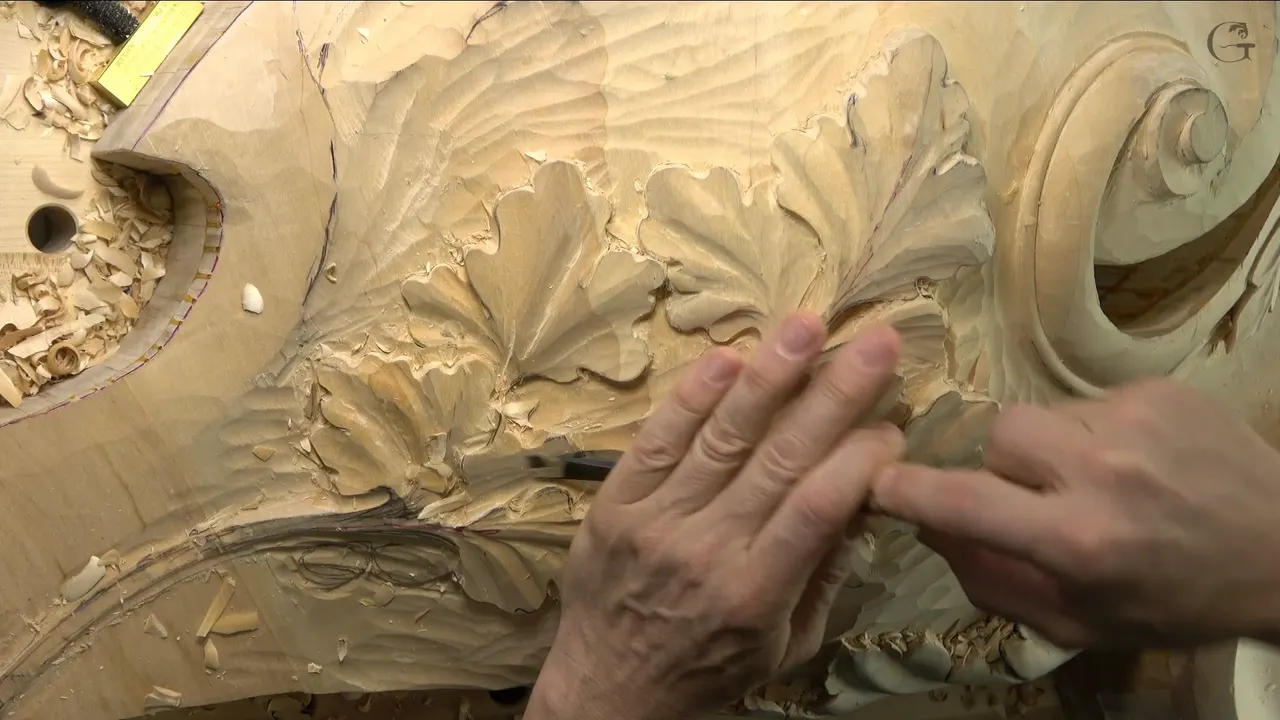

Part 3 of workshop 99 gives this page its word: perimeter. The video is short, so I follow the word through my other lessons, one passage at a time. Every lesson named below has a link, and each link goes to a page that is open to everyone. A name like 98-12 means part 12 of workshop 98.
Ever drawn a good line on a board and then wondered where it ends and where the inside starts? Did you ask what a carver does about that? Here is where I said it.
What did I say in part 3?
Part 3 opens with these words: "Take half an inch." Next is "Clean it a little more." And then the plan: "And now I can establish the movements and make it look like oak leaf."

One side gets a remark. "I kind of don't like this side, but it's okay. Maybe I'll just get a little deeper movement right here and go like this." A question goes out to you: "What do you say? Does it look like oak?" My own answer follows: "I think it looks more like oak. At least for me, it looks more like oak."
What came right before "my perimeter"?
A tool and a size, and then a slip. "I'll take number 11 and 5 millimeters." With 5 mm at 0.2 in, I fix it right away: "Oh, my apologies, that would be 3 millimeters, one-eighth of an inch." Three millimeters comes to about 0.12 in, and 1/8 in to about 3.2 mm. Next comes the line for this page: "And I'm going to go around my perimeter."

Another size of the same tool is next. At 10 mm (0.39 in) it is for "little better movements in those areas." Next: "I guess I got a little too extreme right in that section."
My number five is next, and I give its size in my own way: "not quite 10 millimeters. It's a little less than 10 millimeters, but I would call it 10 millimeters, three-eighths of an inch." Three eighths of an inch equals 9.5 mm. After that I say "Now I'll just go around and create some movements."

Here is a line about clean cuts. "Again," I say, and then comes "a chance to clean everything. So that's why I don't really worry about to make my cuts super clean right away."
For the clean-up I plan a number seven, and my words are "I'll clean a little bit this section." Another plan: "And let me also get inside." The next remark is "I am somewhat happy."

One thing goes wrong, and I name it: "Oh, I made a mistake. So it's too early for undercutting, but it's okay. I'll clean it." One more area comes up: "And I've got one more area to make it more leafy."
The part ends with clean-up and a tool remark. "Now I need to clean all that mess inside this area." For that mess I plan a number seven of 4 millimeters (0.16 in), and "we'll take care of it." Last of all: "It's not the only tool to do that operation. There is multiple ways you can do it. I just don't want to use that many tools."

Is it in other Venice lessons?
In Venice Room 98-12 the same word comes with a different tool. "And I'll take number three and work around the perimeter." Later in that part: "So now I need to blend it and establish the final form."

The lines in Venice Room 159-2 are these. "Important not to force it. I don't want to chip too much." In that part I say I can probably use the same tool. The word perimeter is in that line. My other option, with a number two: "Or I could use number two and go on that curvature."
Next I check a chip: "Looks like I chipped too much in one of the points. Let me see if I see it or not. No, I did not. I'm okay. I'm pretty much right on the line." Earlier in the same part I say "Slightly above my final line." I also say "Now I can take probably number one and single bevel, and I can actually strike right on the line."

Which tools go along the edge?
Hashemi Flowers 2-1 has a plan with a maybe. My words are "and I'll just start removing across the grain." Next: "Although, probably a good idea to take the V tool and make a cut around the perimeter."

Venetian Flowers Rosette 6-1 has a plan: "Let me go around and create the same cut on all the perimeter." My tool in the plan is a number three, "just a flatter tool." Its size is about 13 mm, or 1/2 in. I add "although I have to attack that from the opposite side."

That part has this: "Here you go. So this step is done. So I knocked down a little bit the outer perimeter." Another plan follows, with a small number 11: "two millimeters, two and a half to be exact, okay?" Two millimeters is 0.08 in, and 2.5 mm is 0.1 in. I add "I kind of like a small one."
The concave cuts come next: "create the concave cuts on all of those sides." A warning follows: "So be careful not to destroy the molding itself when you're creating the cut."

Number seven gets the job in Furniture Panel 16-12. "And now I could probably just work" starts a line there, and the word perimeter ends it. Next: "By the way, let me probably get, I think, number seven first and work around here." The size: "14 millimeters is what I'm using, okay?" That comes to about 0.55 in.
The profile does not match the tool, and I say so. "It's not exactly the same profile. That's much bigger, but just because I angle my tool like this, so I'm able to use just a part of my tool, and I can actually get really close to the profile I need to."

A size comes first in Furniture Panel 25-1: "Let me think which one I should use. maybe about I would say number 11 and in my case, it's 1/8 of an inch." That equals about 3 mm. The plan is an outline: "And I'll just outline at first outline that first with the 1/8 of an inch."
More areas come with the word. "I'll outline. Perimeter and I also gonna outline the inner movements and I will outline my Center so it has a three parts."

The word serves a lowering step in Floral Molding 13-1. "Our next step and the next tool, we really have to just lower down overall perimeter. Those petals." Then "I need to check what I did, how low did they go."
Next, the petals: "Yeah, I've got only about, I would say, a millimeter and a half." Then: "about a 16th of an inch." Those 1.5 mm are 0.06 in, and 1/16 in is 1.6 mm.
My tool for it is a number nine: "And I really like this one, it's a fishtail, and that's quarter-inch, six millimeters, number nine." A quarter inch comes to 6.4 mm. A limit comes with it. "leave approximately maybe a couple millimeters before I hit that lower detail." Two millimeters would be 0.08 in.
Does a knife work the edge too?
Yes. The beginner, acanthus and butterflies lessons use it with a knife. Curly Kitchen Cutting Board 16-1 is about a frame: "do first perimeter, like a frame look. So that's going to give you a feel how it feels in your hand, the gouge."

The knife gets the work. "start from the farthest point right there, establish the same approximately bevel what we have on the walls right here," and then "make continuous cut with the knife. So just follow as straight as possible the line." About being a little off, I say "If you off little bit, it's not a big deal. Just make sure you are really close."
Curly Kitchen Cutting Board 4-3 is about an angle: "the same angle you're going to maintain all around" is where I stop the quote, since the next word is "perimeter." The cut runs "until I reach the low point right here."

Then the knife: "So I'll place my knife again and make a deeper cut until I can hear it separates easily. Although, I need to make sure it separates everywhere."
In Greek Acanthus Leaf 5-2 I say what I am doing. "I'm actually just refining the outside borders, outside perimeter, and see how deep I can get with just a knife, and I can remove really sharpest points with the knife, just like that."

Greek Acanthus Leaf 3-3 has this: "Now, we have to actually make sure we do have a straight-down cut, which is called wall cut, like I mentioned before, before we do any shaping. So we still have to establish the wall cuts on the outside perimeter and also on the inside, what we just removed." For that I say "I do have a 20 millimeters number three." Twenty millimeters is about 0.79 in.
Plate with Butterflies 5-1 opens with a job for the knife: "I'm ready for the next step and I'm gonna work on a perimeter, but I have to make my knife ready."
Here are my words from part 2 of that lesson. "I'll be able to fix it. But still I have to be more careful." Next, the words I say about the step in that part: "That is my perimeter. That's how it's supposed to look." My next line: "I kind of like it how it looks. It's not bad for that step."

What about a saw?
Two saws appear in Floral Molding 1-1. "And you can just do it in one pass on a scroll saw, which is actually also a good idea to use a scroll saw." Then: "But for those of you who want to use just the band saw, outside perimeter, you able to use just your band saw."

The blade matters, I say: "And again, if you have a really tiny blade than a scroll saw, even better." A catch comes after that: "Even if you have a tiny blade with the scroll saw, so you really able to just cut all around until you hit some spots like that. That would be really hard to get in, just like that triangle."
What is an inside perimeter?
The words come up in the design lessons too. Designing Furniture Panel 1-2 is about the paper: "What I did, I cut the paper oversized at approximately maybe an inch on outside perimeter." An inch is 25.4 mm. Then "Any paper will work."
Furniture Panel Design 3-1 has a major and a minor. First: "I have to find the major, a golden point or golden center, okay?" Then: "And then on inside perimeter of the inner part, I have to find the minor."

Panel Design 5-2 names a center. "the second minor of the composition, but still this is going to be the center of inside perimeter. So that means the real center, which the eye is going to focus, it's right here. Okay?"
In Venetian Flowers Rosette 5-3 I stop on a word. "So with the outside, I can't say... rim, I should say. I can't figure out what else I can say. Perimeter." A second point follows: "hit my second point and get to the outside perimeter right there. Okay?" At the end I say "And I hope I was close. And yes, I was really close."

What do I do on the outside perimeter of a flower rosette?
Carving Flower Rosette 2-1 has these words. "I don't worry too much about what's right here. Right now, I'm trying to concentrate on outside perimeter, because on the inside, it's going to be a little deeper."
My plan is to rotate, and then: "Take it all the way to a line." And "And it does look like I'm there."

The inside stays undecided in Furniture Panel 17-7. "that's really deep, and that is really shallow, but it still has some definition. Beautiful." Then "But I still did not make the decision on what I want to do on inside of this perimeter."

What goes with the perimeter on a lid?
Lily Box 2-1 has the depth first: "all I need is maybe about a 16th of an inch deep, maybe some spots about eighth of an inch deep, so no more than a eighth of an inch." The depths come to 1.6 mm and 3.2 mm. Then the lid, where I say "I routed this. There's a quarter-inch round over." A quarter inch is 6.4 mm, and a router made it.
Then "And I would like to keep my high point or high spot at the edge." The side view comes in too: "I keep on a perimeter exactly the same level on the perimeter when you're going to look at the side view." A glue plan sits in the same part: "But I still have to keep the high spots somewhere right there where I'll be able to glue on, okay, this piece right on top."
Carving Hazelnuts 1-1 makes the word plural and starts with the nuts. "You know what? I probably going to do not just the outline, but right away," and then "establish my whatever the perimeters of the nuts itself."
Which lessons say it, and what was beside the word?
The table lists the lesson, the work or the plan beside the word, and a few of my words. Each row is a lesson you can watch.
| Lesson and part | The work or plan nearby | My words |
|---|---|---|
| Venice 99-3, oak leaf | Number 11 at 3 mm (1/8-inch), a number five of 10 mm next | My perimeter |
| Venice 98-12, oak leaf | The number three, plus a plan to work around it | The perimeter |
| Hashemi 2-1 | A hedged plan for the V tool, after a number nine | A cut |
| Rosette 6-1 | A flatter tool of 13 mm (half an inch), then a small 11 for concave cuts | Outer |
| Panel carving 16-12 | A seven of 14 mm (about 0.55 in), angled | Work around |
| Panel carving 25-1 | An 11 of 1/8-inch (about 3 mm) to outline the inner movements | Outline |
| Floral Molding 13-1 | Number nine of a quarter inch (6 mm), after a check of the depth | Overall, those petals |
| Cutting Board 16-1 | A line to follow, knife in hand | First, like a frame look and a feel in my hand |
| Cutting Board 4-3 | A knife held at one angle, from the highest point to the low point | All around |
| Greek Acanthus 5-2 | A knife, to see how deep I can get | Outside |
| Butterflies 5-2 | A step that is done, and the next one different | My perimeter |
| Floral Molding 1-1 | A band saw, or a scroll saw with a tiny blade | Outside perimeter, just your band saw |
| Hazelnuts 1-1 | Not just the outline, but right away | Establish my whatever the perimeters of the nuts itself |
| Lily Box 2-1 | A lid with a round over, and my wish to keep a high spot at the edge | A quarter-inch round over |
Where can you watch these lessons?
The video for this page belongs to Venice Room 99, among the twelve workshops, 98 through 109, in the Part 9 course. Workshop 98 is in the same course, and its page is open to everyone.
Part 14 holds Venice Room 159. The Hashemi lesson is in the Hashemi Flowers course. The Furniture Panel lessons sit in two courses, the design lessons in the design course and others in the carving course. The rosette lessons are in the Venetian rosette course and in the flower rosette course, and the floral and molding course has the saw lesson.
Courses for the other lessons: Greek acanthus, butterflies, hazelnuts, lily box and beginner cutting board. A plain definition of a word here is one click away: wood carving, perimeter, gouge, acanthus, rosette, relief, golden ratio, band saw, scroll saw, hazelnut, millimeter and inch.
Want to hear all of this in my own voice? Start here.
How it's done
- Find the plan. Part 3 puts the words right after my number 11.
- Check the size. The size I name first is 5 mm, and I fix it to 3 mm (1/8 in).
- Watch the clean-up. I say there will be "a chance to clean everything."
- Spot the mistake. Too early for undercutting is where I say "I'll clean it."
- Compare the other lessons. The Hashemi, rosette, panel and knife lessons put a perimeter beside a tool.
Frequently asked questions
Which tool goes with "my perimeter" in part 3?
Number 11. I name it at 5 mm, I fix it to 3 mm (0.12 in), and my plan is the line about going around. Another 11 of 10 mm (0.39 in) comes later, then a number five and a number seven.
Which plan did I make for the edge in Rosette 6-1?
Number three of 13 mm (about 1/2 in), "just a flatter tool." After it, "a small number 11" of 2 mm (5/64 in) was my plan for the concave cuts.
In the Floral Molding lesson 13, how deep were the petals?
About 1.5 mm (0.06 in), which I also put as a sixteenth of an inch. My plan was to leave "a couple millimeters" before the lower detail.
What to carve next
- Venice Room 99
- Venice Room Part 9
- Venice Room 98
- Venice Room 159
- Hashemi Flowers 2
- Venetian Flowers Rosette 6
- Furniture Panel 16
- Furniture Panel 25
- Floral and Molding 13
- Curly Kitchen Cutting Board 16
- Curly Kitchen Cutting Board 4
- Greek Acanthus Leaf 5
- Greek Acanthus Leaf 3
- Plate with Butterflies 5
- Floral and Molding 1
- Designing Furniture Panel 1
- Designing Furniture Panel 3