
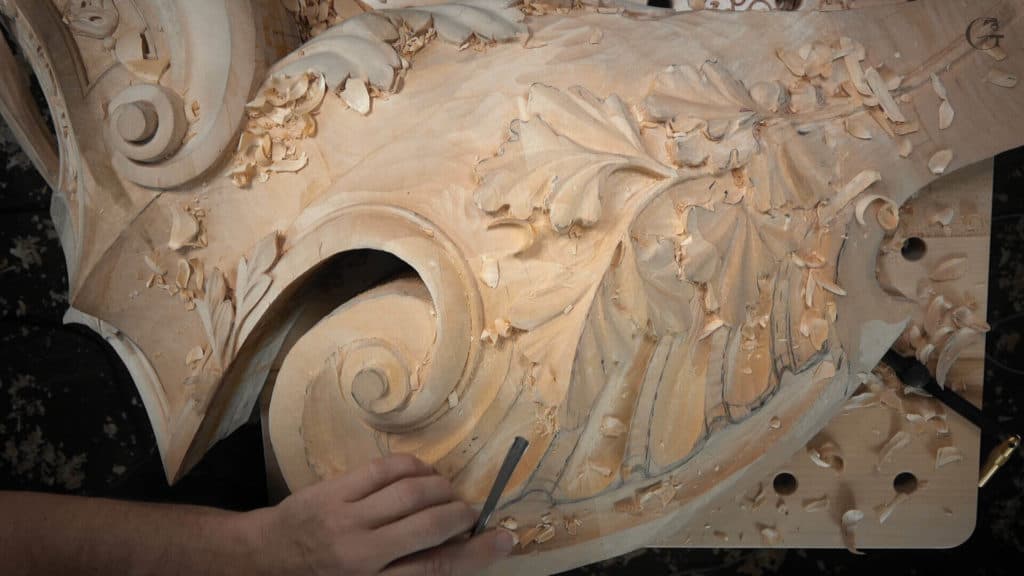
Alexander Grabovetskiy, woodcarver, School of Woodcarving · Published 2021
What does a wood carver mean by "visible"?
Quick answer: In Venice Room 99, part 12, I said a spot would be visible, so I did not really have to be too extreme, while I planned the undercut under the leaves with a number eight. Other lessons of mine use the word for what people see from below, from the side and from the camera.
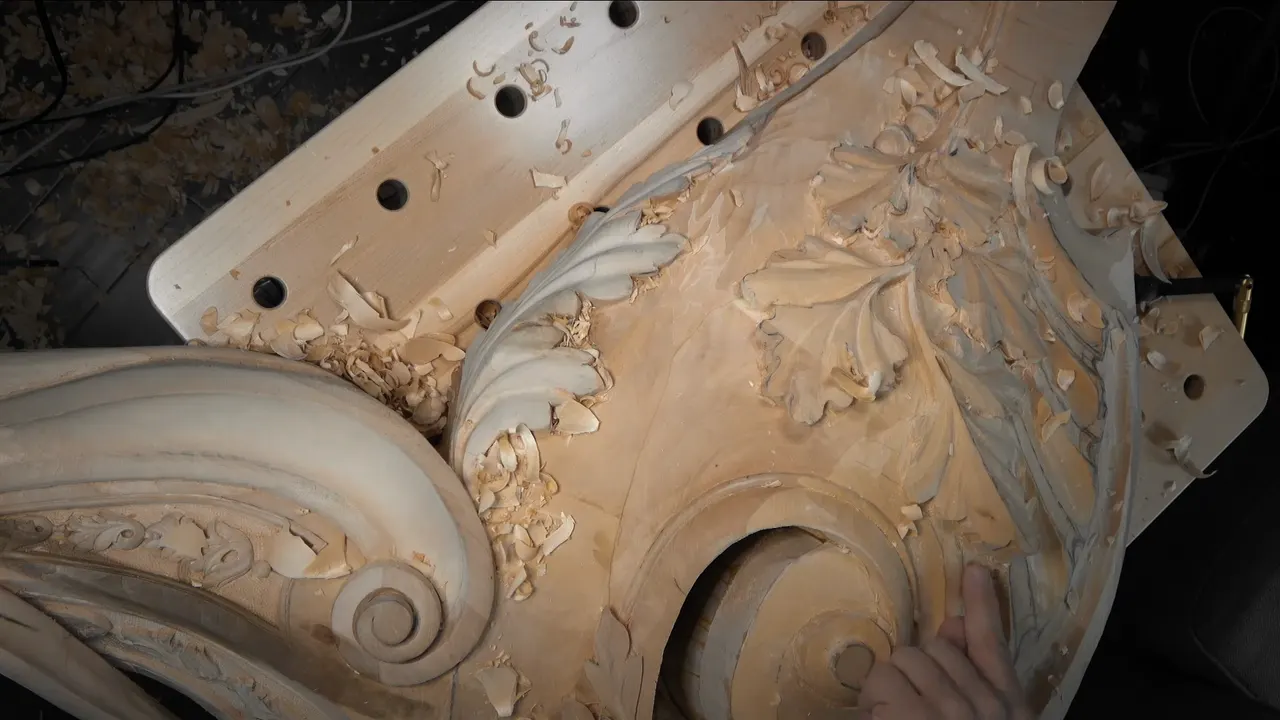

In part 12 of workshop 99 I said a spot would be visible from "this point of view," so I did not "really have to be too extreme." I was about to carve right underneath the leaves. Other lessons of mine use "visible" for what shows from below, from the side and from the camera, and each place is below. A lesson with a link is open to everyone. Names like 62-11 mean part 11 of lesson 62.
Ever carved a spot and wondered if anyone would ever see it? Here is where I said it.
What did I say about "visible" in part 12?
Part 12 opens with a limit on depth. I do not want to go too deep, I said, because of "some bead molding on the inside." The tool was "Number eight and about 10 millimeters" (0.39 in), and I added that I could go "even smaller than that, but it should be okay."

My plan for the leaves: "I have to do my carving right underneath of the leaves, and I can start pretty much undercutting." The shell came up in the same breath, as something that goes "right underneath." Then comes the line at the top of this page, with "But on the other hand," in front of it.
Two cautions sit beside it. "I don't want to create too weak a spot," I said, but "some of the stuff I still able to remove." On the amount, "I don't know, maybe about half what I usually do."

A deeper cut came up too. Maybe I could go "much deeper for just the shadow's sake." Against that, "I don't want to overcomplicate because I'm going to have a bead molding." Still, "I still able to get underneath."
A plug cut came up for the hole: "that's a number eight and that's true gouge." "I'm actually able to do that," I said. Then: "Remove that plug." Further on I said I was "probably going to switch to a smaller tool to get a smaller hole."
Depth got a check. "Let me see how deep I am." The answer was "About an inch deep, so it's plenty" (25 mm). I added that otherwise it is "a problem for me to carve."

The word shows up again in this part. I called the area "a somewhat forgiving area because it's never going to be visible." Still, "I'll try to get that clean." My next line was "Let me use a little bigger tool."
Light is here too. I said it "already casts a shadow and just creates more beautiful look." "During the day, it matters." After dark "the light going to shoot from above," so "You're not going to see it." In the daytime, "especially in the morning," it gives "a beautiful effect." Then: "At least I hope so."
Two sibling parts say something about sight: part 11 has "that is actually going to go all the way to the volute you don't see," and part 10 has "I am sorry that I'm covering it."

How do I treat a spot that people see from below?
Venice Room 82 has three small answers, all about rolling a part. In 82-2 I called it an "excellent touch" and said it "just rolls that direction." I was "on my knees working" in 82-6, and I said you really don't see that roll from above, though it is "really visible from below." In 82-11 the roll would make sense, for the same reason.

Depth came with the word in Venice Room 44. Inside, I need "some kind of secondary eye," and "I need to make that much deeper." My reason was the view from the bottom. I called it "really good spot to get really good and nice movement in."
Venice Room 40, part 8, has a different move. Probably I should "give slight concave to this area." Raising it was out, because the area is seen from underneath, and "there is no reason to do that."

Workshop 62 has two parts with the word. In 62-11 I said "We are exposing the side," and called it "really important part." A pipe in 62-7 was "visible, but it's not deep enough for my taste." More depth was the plan, "a little deeper," because "it's really important for me to cast some shadows."
How clean is a part that will be seen?
A triangle in Venice Room 66, part 9, needed the number 11 and 3 millimeters (0.12 in). I wanted to avoid messing up "an inner movement," because all of that inside is seen from below. My closing words were "So I can't mess this up."

A wall in Venice Room 73, part 6, called for care, "really careful in this area." The wall on the inside would be seen from below, so the cut was "supposed to be really clean undercut," taken "little by little."

Near a face, in Venice Room 63, part 6, the words were "Much deeper." The spot had to be "really accurate." It is "really close to a face," and "not too close, but still." It has to be "100% beautifully done if you wish."

Another distance sits in Venice Room 70, part 9. The spot is not close to your eyes, but still visible, so I need a "really clean transition from underneath." Number 11s give me "beautiful transition."
A deep excavation in Venice Room 76, part 1, got "little cleanup" since it shows. "Not as much, but still," I added. It also "casts beautiful shadow already."
The middle of the piece is the subject in Workshop 72, part 10. It is "visible a lot more than the sides." People look at the center, "and everything's supposed to be really looking good."
Do I carve a spot that nobody sees?
One answer is in Venice Room 67, part 5: "I don't have to go really deep for the reason I said too many times maybe." The reason was that the area is not "visible at all."
I planned a number 11 at 2 millimeters (0.08 in) for a hole in 73-5. "I really don't need to go this way," I said. The part shows "only from the ceiling," not from underneath. It should be "just deep enough, but not to the extreme," and "I could, but I really don't need to."

A spot in Venice Room 64, part 2, asks for depth on one side: "I need to excavate much deeper on that side because it also has to wrap," I said. The undercut is another matter, not "too deep," since the spot is "visible only from the bottom."

Eyes came into Venice Room 69, part 7. "I could do the eye farther, but there's no reason." Nobody would see that eye, so I am doing those eyes "a little closer," which "in another case, would be a little farther on the back."
A separation leaf in 66-11 was one I wanted to bring "a little closer to underneath." It would not show from that position, "but I still want to make it look nice." Then: "We've got that hidden underneath now."

A maybe sits in 72-4. "Maybe I shouldn't even do it," I said, since people from below would see less. Still, "that's going to give me a shadow." Then: "Not much, but still difference."

Background leaves are the subject in Hashemi Flowers 6, part 2. "They will be visible, but not as much." Their main purpose, I said, is "just to serve as a background."
Why carve what stays out of sight?
I answered my own question in Hashemi Flowers 44, part 6. The question was why I dig underneath if you will not see it. You will not catch it by the eye, I said, "but light will travel inside and it's going to create the shadows." I added that you do not have to dig there, since nobody will see it.
A tool came up in the same stretch: "Well, I could use number seven. It's actually even probably better."

In Hashemi Flowers 45, part 6, I was "really happy" to be "all the way through to another side," even if it would not be visible. "Maybe it will be visible," I added, and "I can easily place my gouge or veiner on inside, and the light going to travel there."
A cut for the shadow is in Hashemi Flowers 7, part 3. I planned a "small number nine, maybe about 10 millimeters" (about 0.4 in). Out of sight, yes, "but my main movement is here." The "shadow cut, I call it," goes right on the side of "this main detail."

Hashemi Flowers 42, part 3, talks about fitting. A little more would come off "around the center part," I said, and nobody would see it anyway, but it would be "easier for me to fit."
Visible from where, and to whom?
Two places come up in Venice Room 69, part 4. I have to consider the position that will show, "which in my case" is from below, "Mostly, okay?" Someone who stays "really far in another point" would still "detect that movement."

In 69-7 the "main point" was the one that would show more, "from this position."
Lesson 73-12 names a part "right on the ceiling." What I did there is "visible from different points," I said, and I want it to look "really good from all points of view."
A sloped volute in Venice Room 62, part 9, "should be visible when you're looking at from bottom, from below, and also when you're looking straight to it." The idea comes back in part 12: "visible from all of the points."

Depth ties to a side in Venice Room 134, part 2: "I cannot be too deep on this side, but I can be much deeper on that side." I named the place it is seen from in the same stretch.

A spoon gouge plan sits in Venice Room 145, part 1. I could "take probably number 11 spoon, maybe five millimeters or so" (0.2 in) and "start excavating like this both sides and go in." "That's legit," I said, and I tied it to what you can see from the spot I named.

Two such places are in Venice Room 162. In part 1 I will make the undercut "as clean as possible," and if it is not perfect, it will not be as visible "to the human eye." The logic in part 2 is that nobody's "going to look inside." I used "Seven millimeters" (0.28 in) and "Number 11, of course."

Does it show on the camera?
The word can be about the video. Over in Venice Room 124, part 2, a plug cut at "about half an inch or so" (13 mm) came with my wish to see which side would be "more visible for you."
More visible comes up in Venice Room 129, part 3: "I guess" it is "more visible this way," so "I'm going to go from underneath and reveal on top of it." Floral and Molding 14, part 3, has me saying it might be "much better, more visible" seen from one side.
One line from lesson 70, part 12, is "I know it's not really visible on the camera."
Hashemi lessons use it too. In lesson 44, part 2, my doubt was about what is "visible on a camera." Lesson 19, part 1, has "I'm not sure if it's visible on the camera or not," and lesson 39, part 2, has "I don't know if it's visible or not on the camera." Modern Acanthus 5, part 2, asks "Is that visible on this camera or no?"
Which lessons say it?
The table lists the lesson, what I was doing, and a few of my words. Numbers alone are Venice Room lessons, and each row is a lesson you can watch.
| Lesson | What I was doing | My words |
|---|---|---|
| 99-12 | Planning an undercut beneath the leaves using a number eight | half what I usually do |
| 82-2 | Rolling a part that shows from below | excellent touch |
| 44-10 | A second eye on the inside, still only a plan | much deeper |
| 66-9 | A triangle that needed a number 11 | can't mess this up |
| 63-6 | Working a spot close to a face | really accurate |
| 73-5 | Number 11 at 2 mm (0.08 in) going into a hole | not to the extreme |
| 67-5 | Leaving an area shallow where it will not be seen | visible at all |
| Hashemi 44-6 | Answering why I dig underneath | create the shadows |
| 134-2 | More depth on one side of the piece | that side |
| 124-2 | Naming a plug cut at about half an inch (13 mm) | more visible for you |
| Hashemi 44-2 | Working with a micro tool | on a camera |
Where can you watch the lessons I name here?
The video for this page belongs to Venice Room 99, one of the twelve workshops, 98 through 109, in the Part 9 course. Workshop 98 is in the same course, and its page is open to everyone.
More lessons live in the Hashemi Flowers course, the Floral and Molding course and the Modern Acanthus course. The Venice Room has many courses, and the lessons above come from Part 4, Part 6, Part 7, Part 11, Part 12, Part 13 and Part 14.
Plain definitions of a few words here are one click away: wood carving, carving, woodworking, gouge, mallet, chisel, grain, oak, volute, acanthus, bead, molding, shadow, daylight, ceiling, Venice, millimeters and inch.
Want to hear all of this in my own voice? Start here.
How it's done
- Name the limit. Part 12 gives a reason to hold back: some bead molding on the inside.
- Take the tool. The tool in part 12 is a number eight.
- Plan the undercut. Part 12 says I have to do my carving right underneath of the leaves.
- Check the depth. Part 12 checks it with "Let me see how deep I am."
Frequently asked questions
Which tool did I name in part 12?
Number eight, about 3/8 of an inch (10 mm). I also said I could go even smaller than that, but it should be okay. Further on I said I was probably going to switch to a smaller tool for a smaller hole.
How deep was the hole in part 12?
About an inch deep (25 mm), and I said "it's plenty."
Does a spot nobody will see still get a shadow?
In Hashemi 44 I said light will travel inside and cast shadows there, and in workshop 99, part 12, I said the shadow matters during the day.
Does a spot seen from underneath need a deeper cut?
What to carve next