
Alexander Grabovetskiy, woodcarver, School of Woodcarving · Published 2017
How do you carve a V groove in a leaf with a knife?
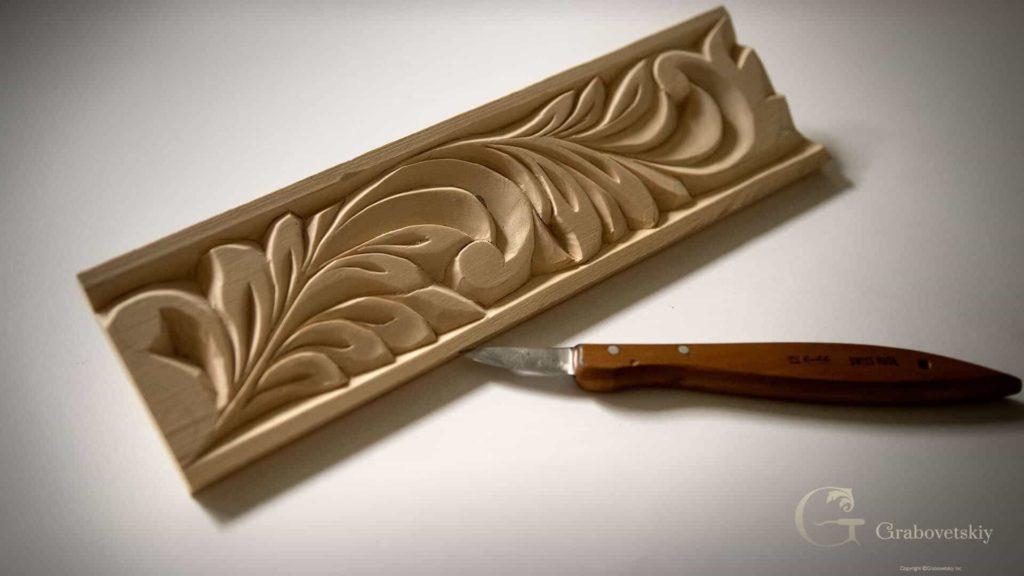
Quick answer: A leaf's V groove is a pair of angled knife passes, one from each side of its middle line, meeting in one sharp line underneath. In my First Cuts course it went in on a leafy border after every outline was carved, and pretty much every leaf got one, right down its middle.
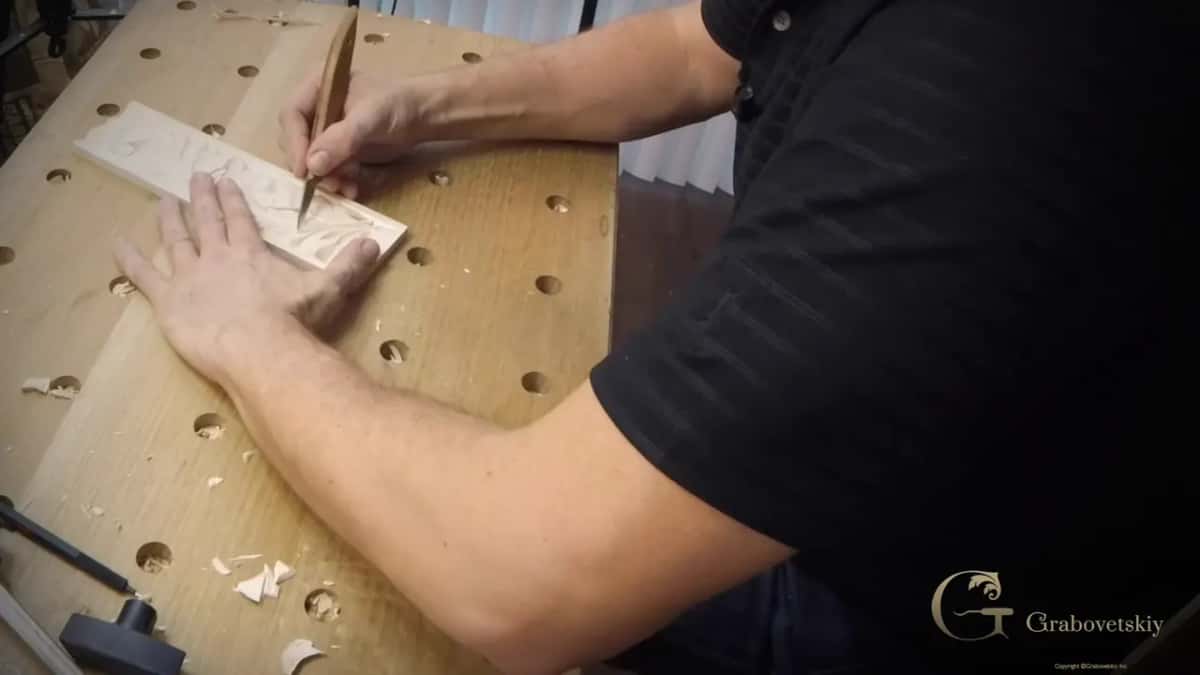
A V groove in a leaf, carved with a knife, is two angled passes down the leaf's middle, one from each side, that meet in a sharp line at the bottom. Mine went in on the leafy border in part 6 of Workshop 2, and only after every outline on the board was carved. Then the leaves got their V.
You can do v groove wood carving like this without owning a V tool. If you don't have one, you're really not limited, I said over a small rosette, and the knife does the job.
Have you ever seen a carved leaf with a thin groove running down its middle? Would you like your own leaves to have one? Then take it from me, that groove is two passes of one knife, made once the outlines are done.
Below is when I put the V in on that border, how its two sides meet, how deep it goes, and how the middle of a leaf went on a few other pieces of mine, each one named where it comes up.

The leaf groove in six lines
- Every outline on the border was carved before any leaf got its V.
- I called it the same idea as the other side of the board, this time inside the leaves.
- Nearly every leaf along the band got one.
- I picked the knife over a V tool for the butterfly plate, because of its sharper floor.
- A toothpick helps two passes that miss.
- On a Greek acanthus, and again on Hashemi flowers, my line moved off the center of the leaf toward one side.

When does the V go into the leaves?
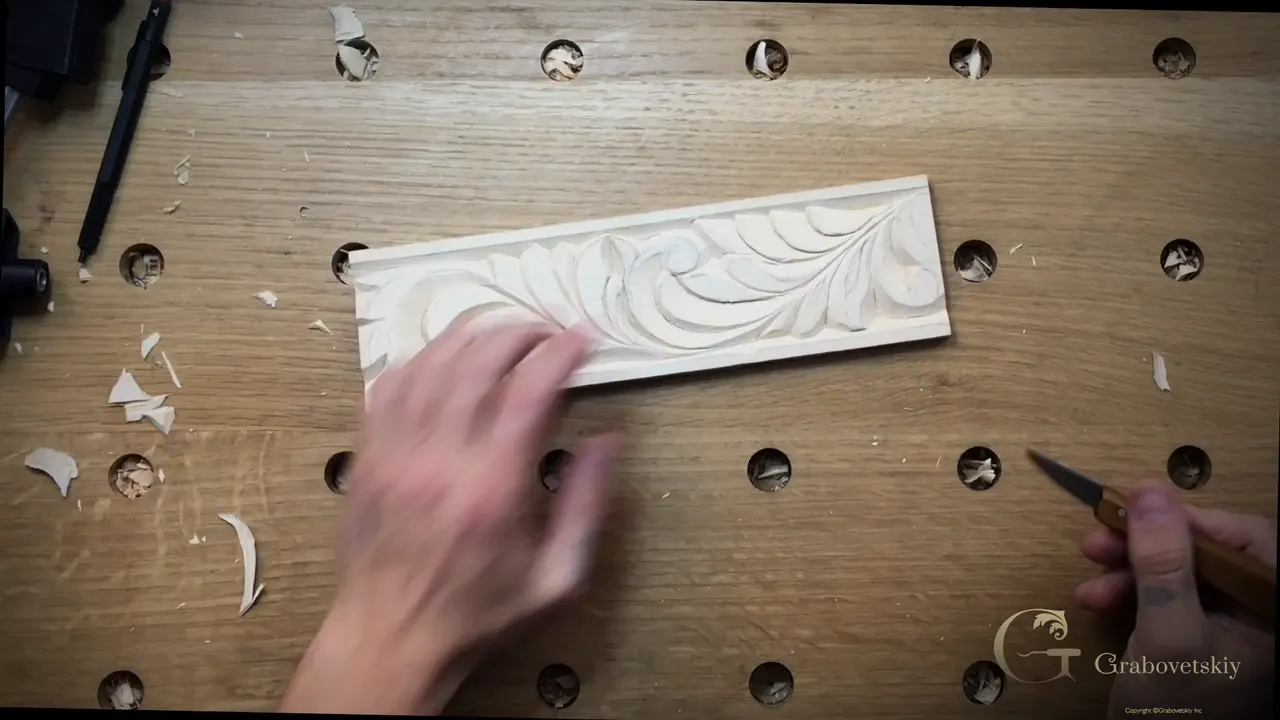
After all the outlines. About three minutes into part 6 I said it plainly: now I've got all my outlines, so let's make more beautification, as I would call it.
Before that, the board was still getting cleaned. If a spot needed it, I came back with one more clean pass, and when the work is right you can blow on the piece and all the chips fly away.
By then the border already looked pretty good to me. I like it personally, how it looks, and I said so on camera. But it was also common, I said, to put V grooves in the middle of the leaves, to make them look even more beautiful.
So the outlines came first. The V waited.

Is the V the same as the first leaves on the board?
Same idea, I said, as what we did on the other side, only this time right in the middle of those leaves.
That other face is where Workshop 1 put its tiny leaves along a stem. Each leaf there went in right first, then left. When I came back to that face at the start of Workshop 2, I described those leaves as sunk in, like a boat. Almost every pass on that face is an angled one, right-hand or left, I said then, and where the two meet you should have a really clean line.
I flipped the board over next. The new face keeps its leaves flat and high while the wood around them goes, so the groove in part 6 sits inside a raised leaf instead of around it. A little later I said that everything on this board is just a V cut, or the right and left angle passes.

How do the two sides of a V meet?
From both sides, toward a line you cannot see. My butterfly plate had leaves with some movement inside them, I said, and that would be dug out like a V. I took my knife again, carved toward the center, and told the camera there is an invisible center line that I then attack from the opposite side. I'm not sure if you see that or not, I added, but this is the one I'm after.
Before its micro V grooves, I compared a small flower rosette to the original and said it looked really close, but not completely yet. My passes there were not straight down. I set some kind of angle, just a little, made my first pass, turned the piece and made my second. I gave no degree for that angle there. This rosette is done, I said a minute later, and mostly a knife made it.
Right before a knife V on a Venice Room piece, I said I'm just eyeballing it, and I know sometimes it's scary to eyeball. But I feel safe, and I'm okay with that, I added.

Do you need a special V groove carving knife?
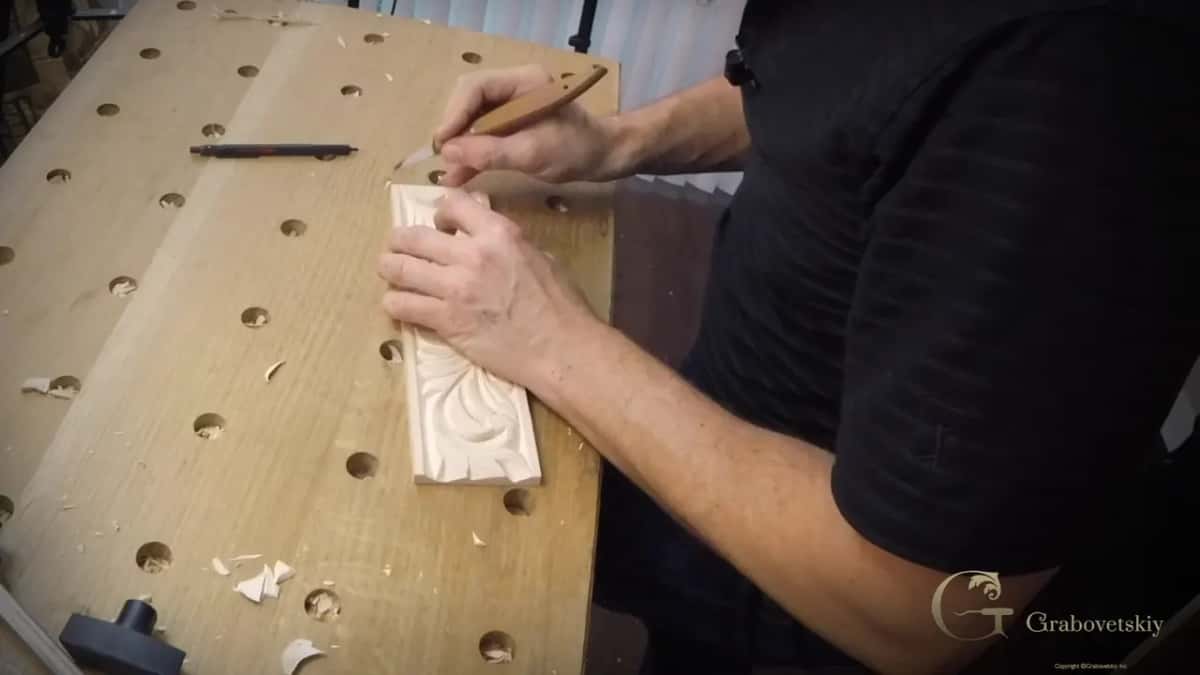
The one that carved the outlines. In Workshop 2 it was just a knife, the same block of wood and the same technique as on the other side, and near the close of part 6 came the line that you could add smaller details and still use the same knife.
There in the Venice Room I reached for the knife I love, a number 12. One pass went in as I pulled it toward myself, then I went to the other side and made the V. Double check, double check how it is going to look, I said next.
Back on the butterfly plate, over a little lattice, I said attack from the opposite side, and then I answered the V tool question myself. A V tool has a gouge on the bottom, so it won't give you a really sharp V. The knife gives you the true, really sharp line at the bottom of the groove.
V tools still have their place. For a Greek acanthus I took a 45 degree one and said any V tool will work. Later we do different acanthus leaves without a V cut, I said there, but that one had to be accurate to the history. There I told people not to force it, to dig in and escape before the tool hits the edge, and to keep it really sharp, because the grain changes on that leaf.


How deep should the V go?
Part 6 gives no number for it. Over a Curly cutting board I said there is no way to measure the angle, pretty much. You train your hand to feel it, and to feel how deep the V will go and where its two sides will meet, and that is not as easy as some people think.
Depth changed along this border too. In part 4 I held about the same angle everywhere, yet some spots went a little deeper and some not as deep, because of the space I left in the design between those leaves.
One small figure came from the butterfly plate. A groove there ran on a little lattice, not a leaf, and it was about one millimeter wide (about 0.04 inch).
Deeper can hurt. Where two grooves sat really close on the Curly board in a later workshop, I said it is better to take care, make multiple passes in tiny spots like that, and work your way in. Then I dug one in too deep and broke the fibers on the next part. That means I have to make a sharper V in this case, I said.
On that Greek acanthus I made the V somewhat deep, saw that the right-hand side was kind of clean, and repeated, changing my angle a little each time.
A groove can also stay a hint. Carving the olives on my lily box, I said I had much more control with the knife there, went in and made a small groove, not really a V. It is a subtle effect, I said, and if you do too much it will not look natural. Just give a hint that it goes inward.


Does the groove always run down the middle?
On this border it does. The V sits right in the middle, I said, and I went pretty much everywhere I had my leaves and put one in each.
Other leaves asked for something else. For the Greek acanthus, the V groove is supposed to sit in the middle, but it does not apply to every detail. Where the leaf went downhill, I moved my groove a little to the left and gave it a little curvature.
Hashemi flowers were different again. I never put my line in the middle of the leaf, I said in that Hashemi lesson. If one side is higher, the middle line moves closer to that higher side, and the leaf gets even more of a 3D look. From the middle I made freehand passes out, and the ridges between my tool marks actually look like veins of the leaf.
Old styles split the same way. In the Byzantine acanthus course I laid it out: a Greek acanthus leaf has a sharp V inside, just like with the knife. A Roman one has a concave, and a Byzantine one has a raised convex. In the Venice Room I said that the Romans did not use just a knife for that middle line, and with some kind of gouge it became a concave.
The table puts five of my pieces side by side.
| Piece | Groove | Tool |
|---|---|---|
| First Cuts border | One groove down each leaf's middle line | One knife |
| Butterfly plate leaves | Both sides attack an invisible center line | Knife again |
| Greek acanthus leaf | Shifted left where the leaf ran downhill | V tool |
| Hashemi flower leaves | Line set closer to the higher side | Freehand passes |
| Small flower rosette | Micro V grooves, first pass, turn, second | Knife, angled |

What if the two passes do not meet clean?
Come back for one more pass first. The video for part 6 opens that way: if I need to clean it, I just come back and make it clean.
The Curly board is where I showed why it happens. The knife blade has some stopping point, and when you make the second pass of a V, it is not always meeting at the same spot. Sometimes my knife goes underneath and leaves a little undercut, and weird stuff shows up in the point.
It's a good idea to come back and clean everything anyway, I said on that board. Of course, I was exaggerating a little there. It is still really close, but between those two lines there is some spot you have to take care of.
Probably the easiest fix is a plain toothpick, rubbed from both sides until those two planes look like they meet. It's not always possible, but believe me, it helps a lot.

How many leaves get a V?
Pretty much all of them. I went everywhere I had leaves, and later in part 6 I said I'll just add some more V cuts. The next 42 seconds of the recording carry no words at all, only my hands and the knife working along the board.
The butterfly plate went the same way. In multiple spots I'll just do the same, I said, and wherever I saw that detail I went around and carved it. Since I was there anyway, the separation went in at once too, before I could forget it.
Around the six-minute mark of part 6 the border had already taken some form, I said.

Can a beginner carve a leaf V on a first board?
It takes some practice. I said so over the butterfly plate, where I call the work somewhat beginners style, and in the same breath I called it more of an advanced beginner. Every tool you have to use for a little bit before you really feel it.
Please just practice that, I said in part 6, about a minute before the first V went in. If you train your hand from the first time to carve clean in this type of work, you are not going to have any limits on what you can do later on. And if you can manage a board like this, I think it's really good, especially for a beginner.
What came after the V on this border?
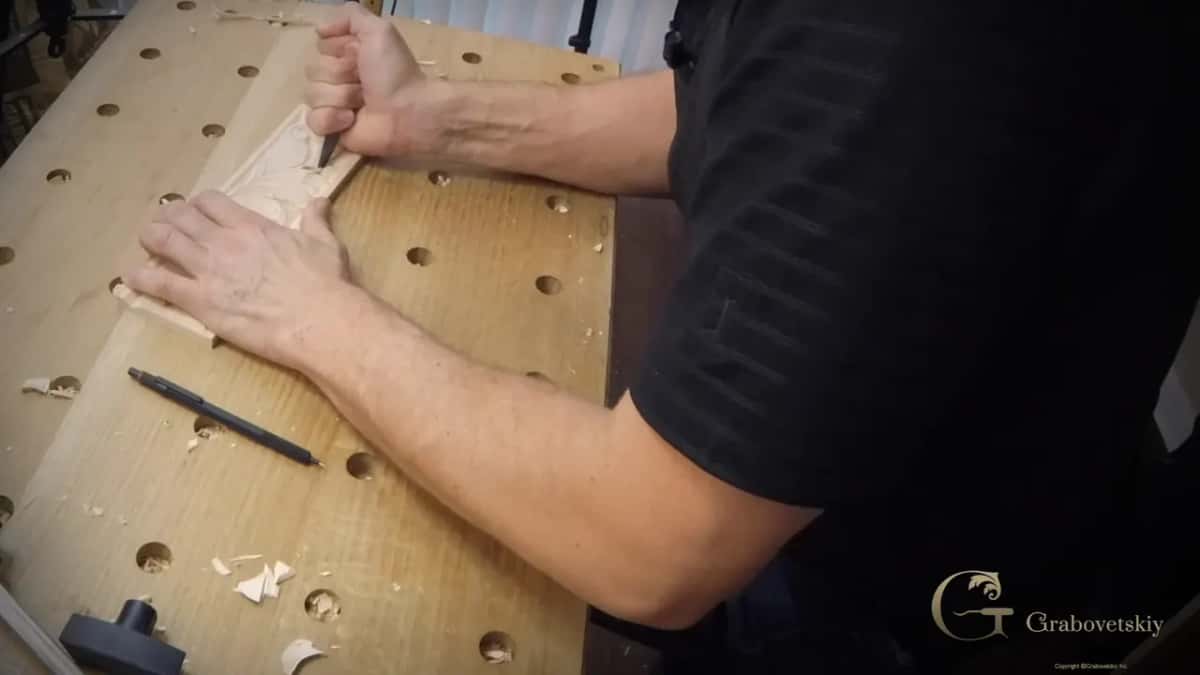
A few more knife passes. First I refined one element with the low angle to make it a little more appealing, then went around to check which ones I could do, and found another that needed it.
Near the end I refined some points to make it look good. Maybe I can just lower this side a little bit, I said, and I did the same on another leaf. The small rosette ended the same way, once its knife work was done: just a matter of refinement, and you can always go back and refine.
It was just a quick design. You could spend more time and add a lot more details, and the leaf grooves would still come from one knife. That is a simple design, I said, but with exactly the same technique you can do really beautiful things.
Where does your first leaf V go?
Got a leaf on your board with its outline carved? Then put the knife in its middle next, one side and then the other.
Tuition opens Workshop 2 and the rest of First Cuts for Beginners, along with the butterfly plate course, the rosette, the cutting board and the acanthus leaves I named here.
How it's done
- Finish the outlines. All the outlines on the band were done before the first groove went in.
- Pick the leaf's center. On this old style of leaf the groove follows the center.
- Lean the blade in. Tip the knife a little and carve toward that hidden center line.
- Turn the work. Come in from the far side so the two walls end at one point.
- Tidy the point. If they miss, make one more pass with the blade, or rub a toothpick along both faces.
Frequently asked questions
How wide should a V groove on a small carving be?
My part 6 video names no width. A lattice groove on my butterfly plate was about one millimeter wide, and I called it my V cut as I carved it. Go deeper where two grooves sit close and you can split the fibers of the next part, which happened to me on a cutting board.
Can you carve a leaf vein with a V tool instead of a knife?
Any V tool works, I said while carving a Greek acanthus with a 45 degree one. For the butterfly plate my choice was the knife, since a V tool's floor carries a small gouge shape and the knife gives the truer, sharper line.
Should the V groove sit in the exact middle of every leaf?
The First Cuts border has it dead center. A Greek acanthus heading downhill had its groove moved slightly left, with a little curve. For Hashemi flowers I said I never put the line in the middle, and it shifts toward whichever side is higher.
What to carve next