
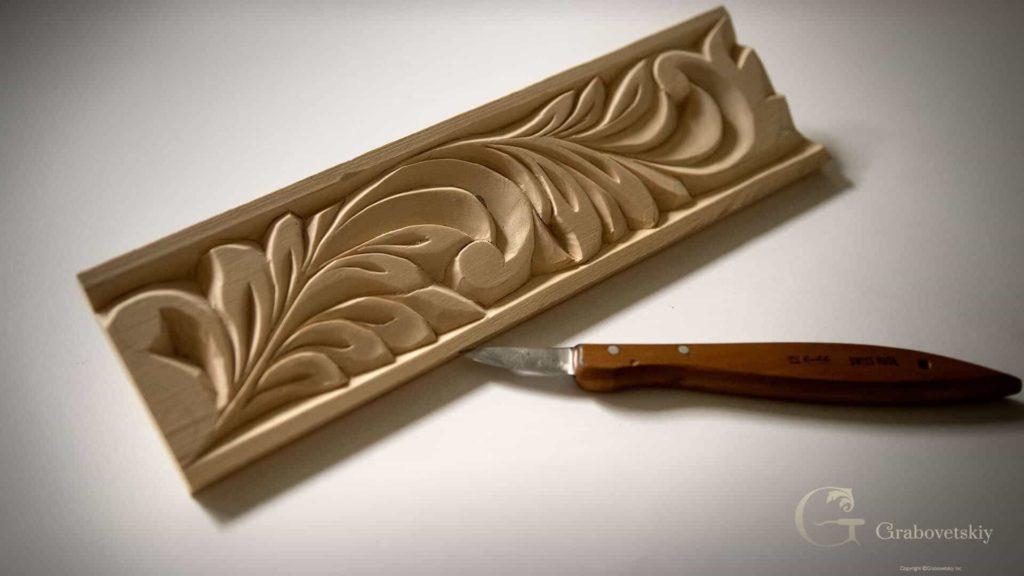
Alexander Grabovetskiy, woodcarver, School of Woodcarving · Published 2017
How low should you hold a carving knife to the wood?
Quick answer: Holding a carving knife really low is laying the blade near the board, and on this leafy border every first line gets it. A steeper blade digs deeper, so on a cutting board lesson I brought mine down. Low takes two or three passes, until both sides meet cleanly in a single point.
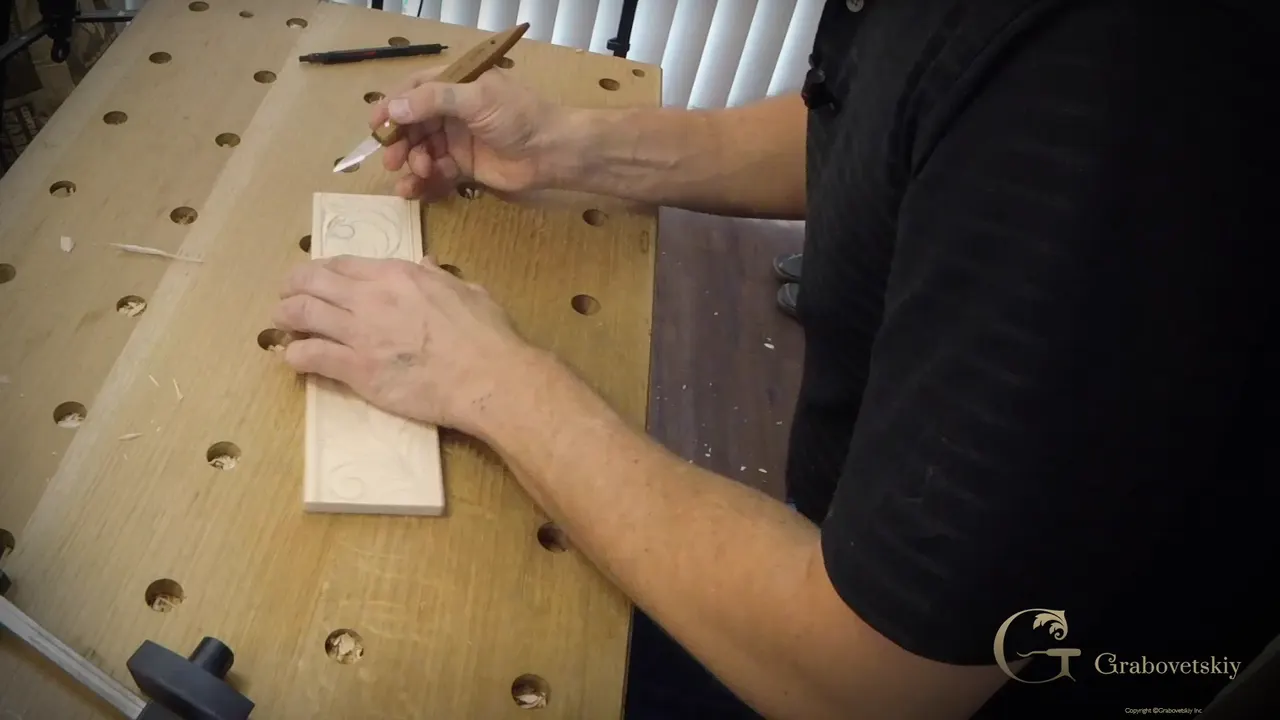
The carving knife angle to the wood is how far the blade leans over from straight up, and on the first lines of this leafy border I lay mine down really low. Low angle, really low angle, and follow the line. Those are my words on camera, and nowhere in this lesson do I put a number of degrees on it.
This is not the bevel on the edge. You put that one there when you sharpen. What we mean here belongs to your hand, to how far the handle comes down toward the board while the point travels along your drawn line.
Maybe you have watched a carver work and wondered why his blade seems to be lying down. I'm going to be honest with you. Low takes more passes. By the end of this page you will know what a steeper blade would have done to one of my boards, why I take two or three passes where one might do, and where a single pass stood up straight.
Do you have a knife with a point? Is there a line drawn on your board? Then put the point on that line, tip the knife down low, and carry it along the whole length.
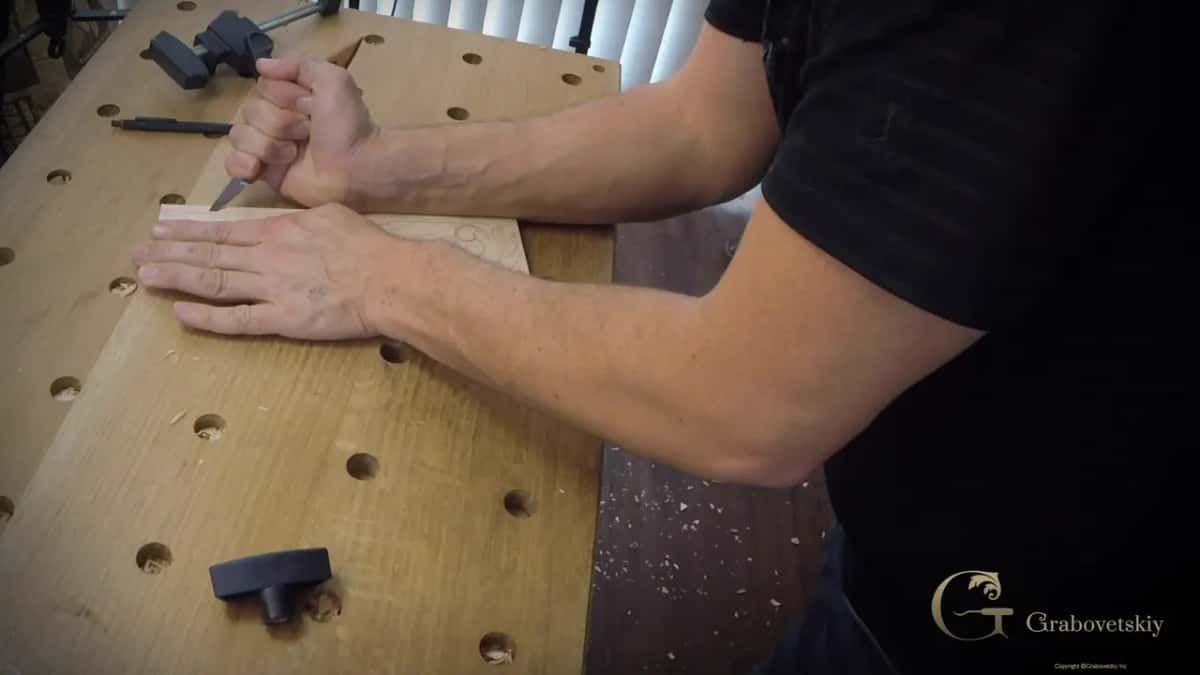
Six lines about a knife held low
- My only words for it on this border were low and really low, and no figure in degrees went with them.
- Steeper means deeper.
- On one cutting board I brought my angle down to keep a section from going really deep.
- Some spots take two passes, some three, some more.
- Both sides travel down until they meet in one clean point.
- One pass on a cutting board began low and had to finish at 90 degrees.
How low is really low?
As low as possible. That is the phrase I used on a kitchen cutting board lesson, for a single section of the board. Back on this border I keep it shorter and just say low, then lower, and stay on the drawn line.
Here is how this part of Workshop 2 starts. I hold the board freehand first. The knife goes right on the first line, which sits a quarter inch (6 mm) from the edge, and I lean it over until it lies low and run it along the full length of that line.
After the border come the design lines, the swirls and leaves inside it, with the blade still lying down. If you have to make a couple of passes, just do it. Be really careful.
My Greek acroterion got the same idea, said another way. You kind of have to feel in your hand where your one-eighth of an inch is, about 3 mm. Then, still in lesson 4 of that course, I said you have to feel in a three-dimensional world what angle you should hold to reach it.
Same on this side, I said, and turned the piece, the same depth on each side in turn. Really simple, I called it.
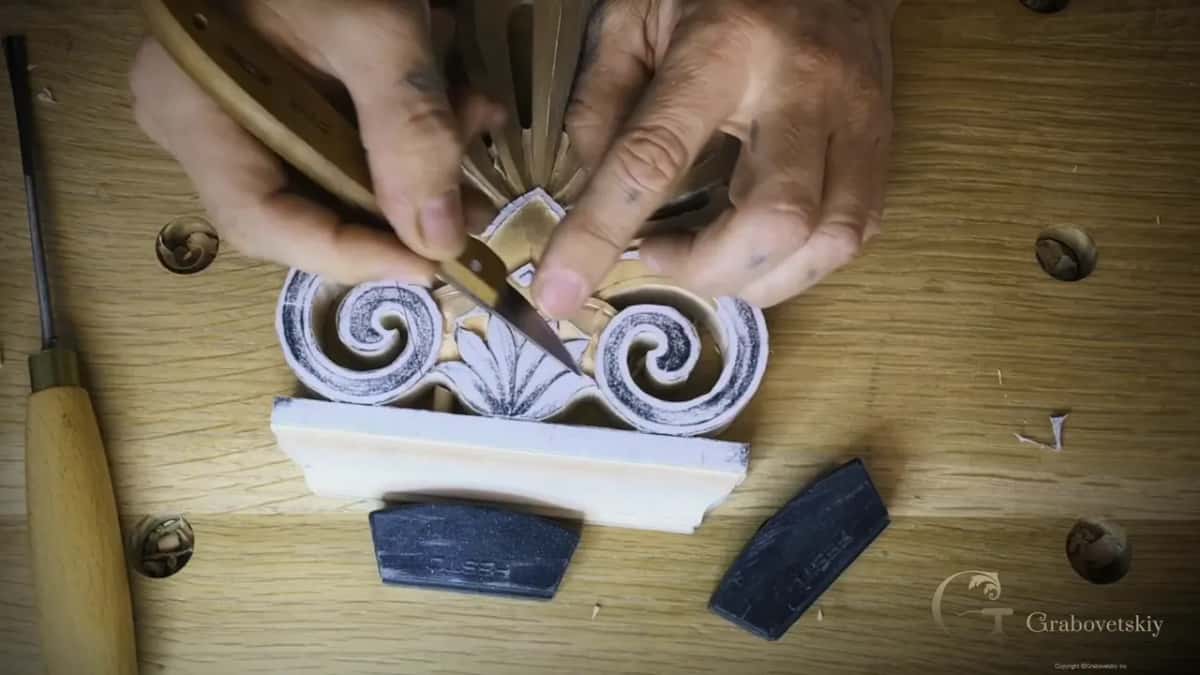
Is the carving knife angle to the wood the bevel you sharpen?
Two different things share one word. I mix them myself.
A bevel on the knife comes from sharpening. The lean on this page belongs to the whole blade, and your hand sets that angle fresh each time the point goes down.
Over on the cutting board, in workshop 7, I called one low pass a bevel cut, said I was not sure I was saying that correctly, and called it beveled anyway. A few lessons on, workshop 12 got both words at once, a low angle beside a low bevel. Both times I was talking about the slope in front of me on the wood, and the edge of the knife had nothing to do with it.
The two do touch, though, and the straight gouge sharpening lesson shows where. Sharpened with a high bevel, my gouge just lay on that part and would not carve until I raised my hand really high, almost the elbow. For oak I like that higher one, because it is stronger. For fine detail in limewood or basswood I prefer the bevel really low, as long as you can get it. I can't say how many degrees it is, I said there, maybe about five, even lower, and with it my second hand lies on the wood too.

Why not stand the knife up and finish sooner?
A steeper blade goes deeper.
Back in workshop 4 of that cutting board, the one with the bird of paradise, I was angling the knife toward myself with a finger helping it along. It was a really, really low angle, and I said I could even go sharper. But then that section would be really deep, and I did not want to see that deepness.
So down came my angle, as low as I could get it, and I repeated the pass a couple of times, until I could see the wood would come away easily.
Earlier in that same part I said I needed the pencil. One pass by the wing would be really, really deep, and though I said I should be fine, I would probably add some small elements there to get rid of that deepness.
Material matters too. Lessons later, in workshop 8, a set of lines came down with the knife laid low, and I warned you not to dig too deep, because you do not have too much material there. Just be careful, I said, and don't rush it.

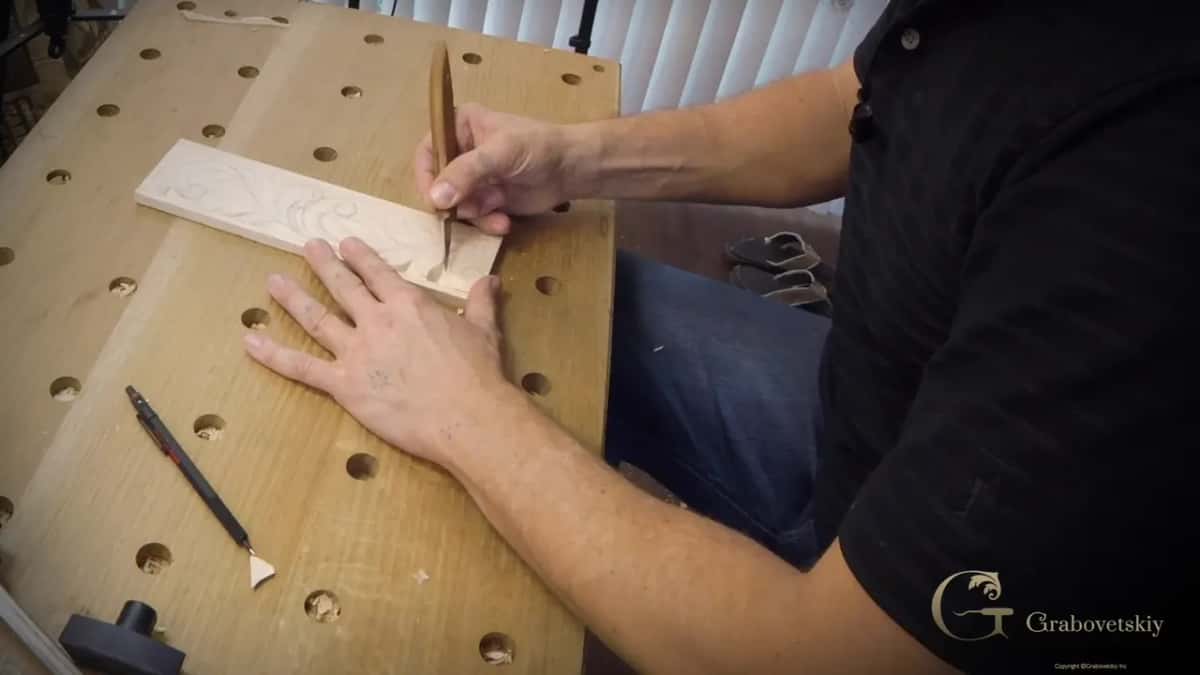
How many passes does a low knife take?
Two, three, maybe even more. Some spots on this border take two times, three times, or more, I said, before the waste just snaps out.
Two parts later, on the second swirl, I put it plainly. The lean was very low there, so it would take me multiple passes, and I was fine with it. Somewhere in there I said oops, then made my cleaning pass.
A volute in workshop 7 of the cutting board got the same slow treatment. I could probably try it in one pass, I said, but I didn't want to make a mistake, and a few different passes would be better. Little by little.
When the waste won't come away, I don't force it. Force it, I said in workshop 4, and you're going to break the fibers right there. Coming back was easier for me, so I put the knife straight down again and recut that section.
The eighth workshop of that course had its honest moment. Partway through I told you I was not really happy with what I saw right there, cleaned it, then called myself somewhat happy with that side, and said the other could go a little deeper, just to bring it out a little more.
The next part was more of the same. Multiple passes, clean it, the next one, recut, and again, with an eye on the edge of the knife so it was not digging past the separation line between two elements.
That patience is the whole lesson in small, and Access to the school opens every one of these boards for you to carve along with me.

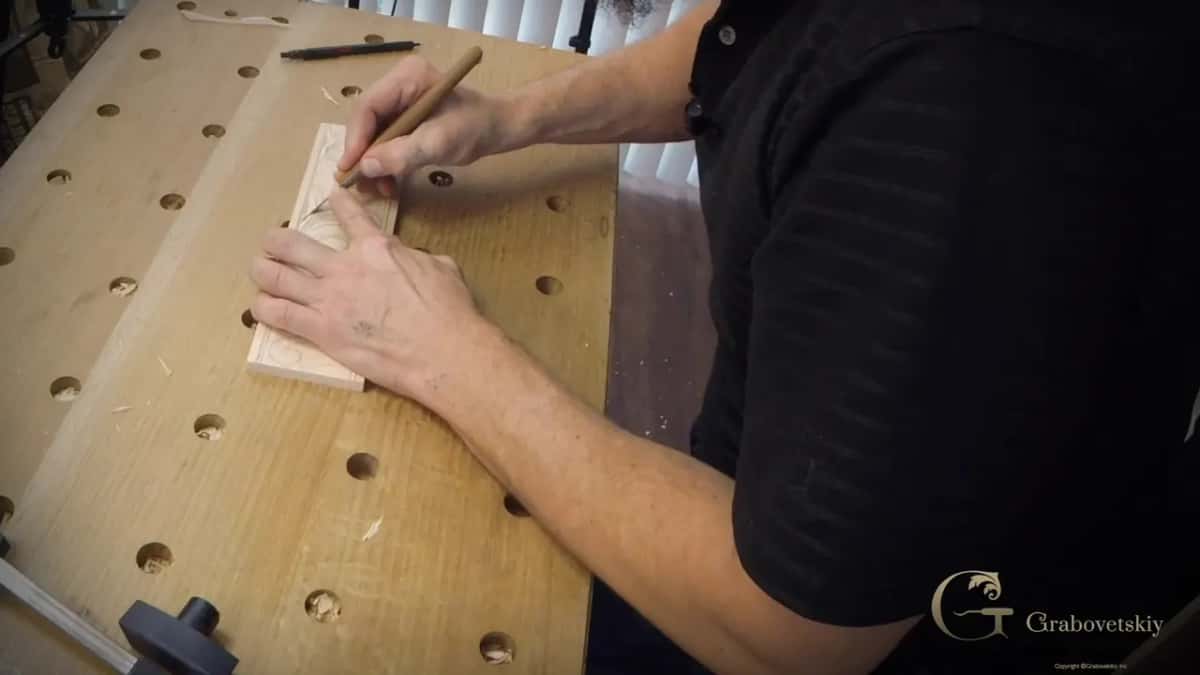
Where do the two low passes have to meet?
At one point. That point has to come out clean, and within half a minute here I said it twice. Keep low until you meet those two points, and if the wood is not easily removed, repeat your pass until you have a really clean point right there.
Near the end of the video I came back to it once more, saying the passes should be really clean at the places where they meet. Half a minute before that I had said of one shape, that is a swirl.
The next part went the same way. Knife really low, I made a couple of passes on two sides, met those two points, turned the board back and took one clean pass right there.
In part five I said it trains how you hold your angle, and you have to guess where the V is going to meet. A minute later I called it a V groove, with an invisible line on the inside that I have to meet.


Where did the knife lie low in my lessons?
| The piece | What the low knife did there | Which lesson |
|---|---|---|
| Leafy border, first line | Ran a quarter inch in from the edge | First Cuts, Workshop 2 |
| The second swirl | Took multiple passes, and I said I was okay with that | Part five of this workshop |
| One section of the bird board | Lowered as far as I could so it would not go really deep | Cutting board, workshop 4 |
| A volute on that board | Went in a few passes rather than risk one | Same board, workshop 7 |
| Two elements side by side | Recut again and again while the edge stayed off the line | Kitchen board, workshop 8 |
| Paper on a rosette | Came off quickly, the knife lying low | Flower rosette, lesson 6 |
| Corners of an acroterion | Reached about 3 mm, felt for by hand | Greek acroterion, lesson 4 |
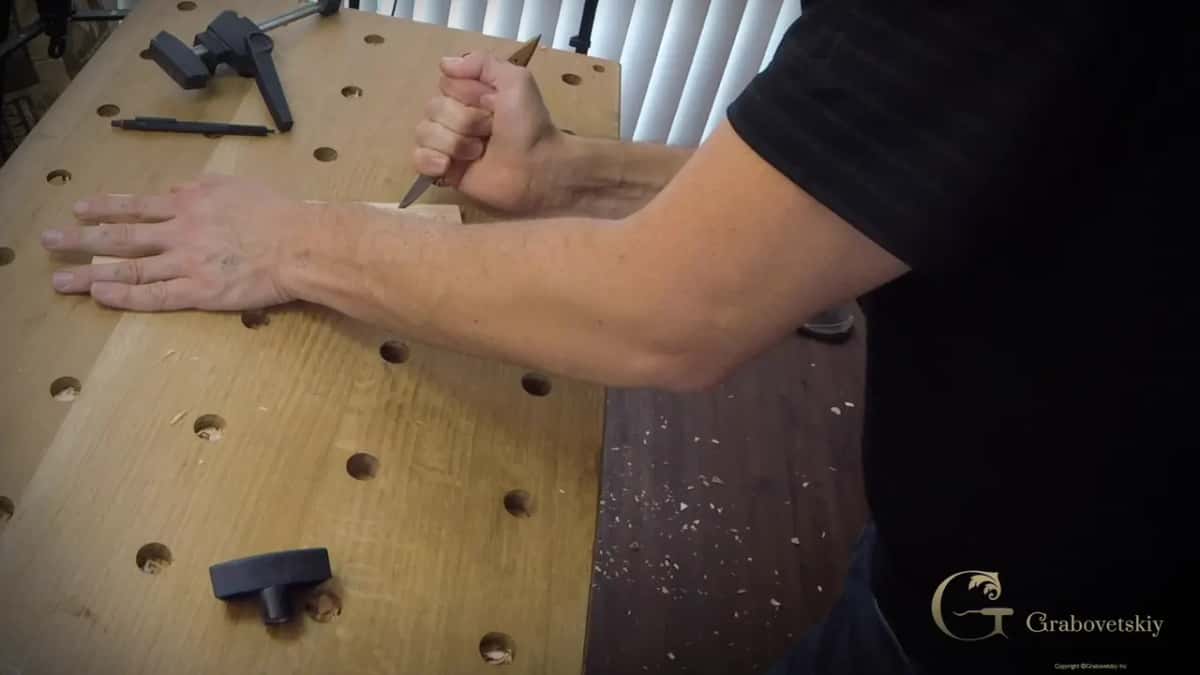
Why is one spot deeper than the next?
The drawing decides a lot of it. In the next part of this workshop I said the hand holds about the same angle everywhere, and still some spots go a little deeper and some not as deep, just because of the space I left in the design between those leaves.
Over here, one moment gets a short remark from me. That's really deep right here.
Back on the cutting board, workshop 7, I told you that you don't have to follow the rule of 3/32 of an inch (2.4 mm). You could go deeper. Then I said I'd do about maybe 3/16, about five millimeters deep, carefully as the blade came close to the edge.
Grain shows up here too. On that same part the grain ran kind of straight, so I told you I could attack it on both sides, and the wood left marks, chipping, until I worked it to look unified and clean.

Can one pass start low and finish upright?
It did on the cutting board. My pass in workshop 7 started low with the bevel, and as I moved it toward myself I had to bring it up to a straight down pass, like 90 degrees, to make that transition.
Two parts after this one the order went the other way round, between two leaves. The knife went straight down first, then a low pass traveled toward that straight line, and I said it creates a really beautiful look.
Sometimes I leave a side alone. In workshop 13 I said I could lower one side, but not in that case, because it already blends in with the detail beside it at a low angle.

What else can a knife held low do?
Take off a lot of wood, fast. Lesson 6 of the flower rosette had me holding my knife low to take off the paper, and I said that with a knife you can remove a lot of material really, really quickly.
In the same breath I told you the knife is not going to fly on the more complicated projects, so you are really limited with only a knife. I would still suggest buying good gouges, I said. But for the beginning it is probably the number one tool.
Lesson 5 of the acroterion saw me change the knife position, lay it low and make a channel, just slicing carefully. Woodcarving, I said a moment later, is probably one of the oldest trades on the planet Earth, and it doesn't change a lot.
Along one part in workshop 12 of the cutting board course the low knife went the whole length. Then I said that doesn't look right, right here, redo that, all the way to the edge.
And near the close of this workshop I went back over one element with the low angle, just to make it a little more appealing, a nicer looking one.
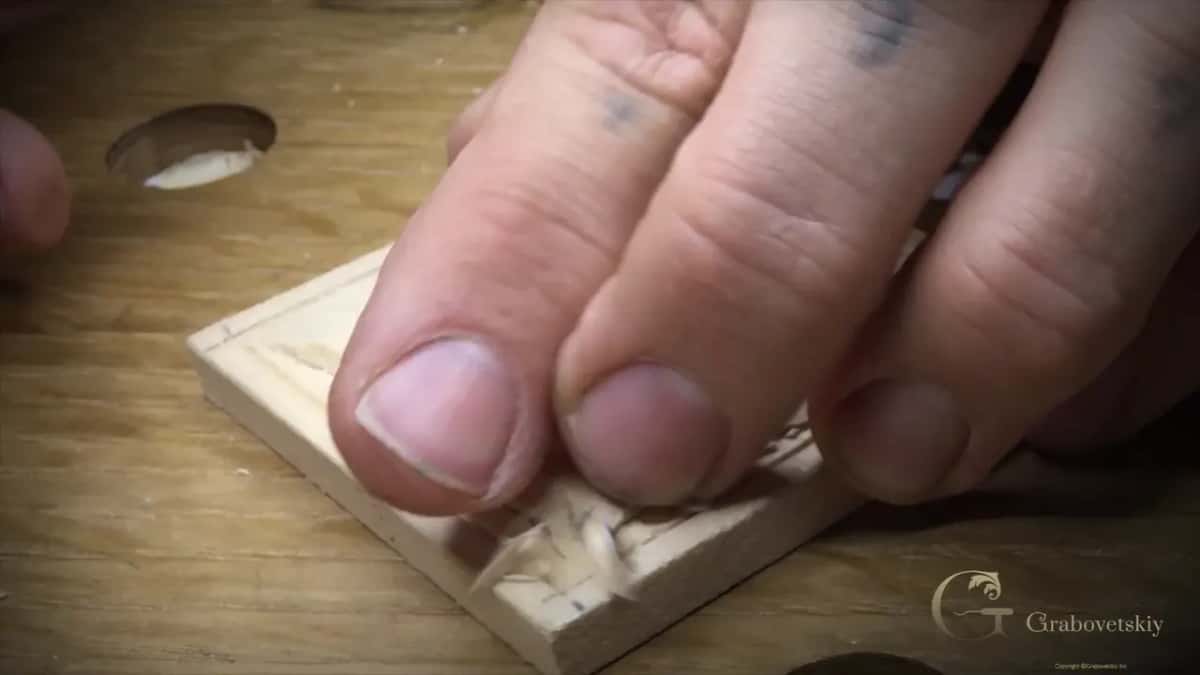
What should your first lines look like?
Like mine. A couple of minutes in, I said you should have something like that, and told you again to just follow your pattern.
A little later I said I would try to make my pass cleaner, and that I was not going to force anything out. Then one side was almost done, and I said let's repeat on that side, exactly the same.
In Workshop 1 the leaves sank into the board like little boats. Here the work runs around them, inside the border, and the low knife does almost all of it. You will find both in the First Cuts for Beginners course.
Is your knife on the line? Is it lying low? Then take it along that line, and add a second pass when the first one does not reach.

How it's done
- Put the point on your line. Place the knife right on the first line of the border, a quarter inch (6 mm) inside the edge.
- Lay the blade down. Tip it down until the blade lies low on the wood, and hold it there for the whole line.
- Take another pass if it falls short. Make a couple more, and be really careful while you do.
- Bring both sides together. Work from two sides, the blade still down low, until the passes meet in one clean point.
- Clean the meeting places. Go back over every spot where two passes come together and clean it.
Frequently asked questions
How many degrees is a really low carving knife?
I never gave a number in this lesson. Low, then lower, is how I said it on the border. For the Greek acroterion I told you to feel in a three-dimensional world what angle reaches about one-eighth of an inch, 3 mm, and that is a job for your hand.
Why does a low knife need more than one pass?
In part five of this workshop a swirl was getting a very low lean, so I said several passes lay ahead, and I was okay with that. On a cutting board volute I could have tried one pass, but chose a few passes over risking a mistake.
What goes wrong when the blade stands up too steep?
On part of the bird of paradise board, a sharper angle would have taken that spot really deep. I didn't want to see that deepness, so I dropped the lean to the lowest I could manage and repeated the pass a couple of times, until the wood looked ready to come away easily.
What to carve next