
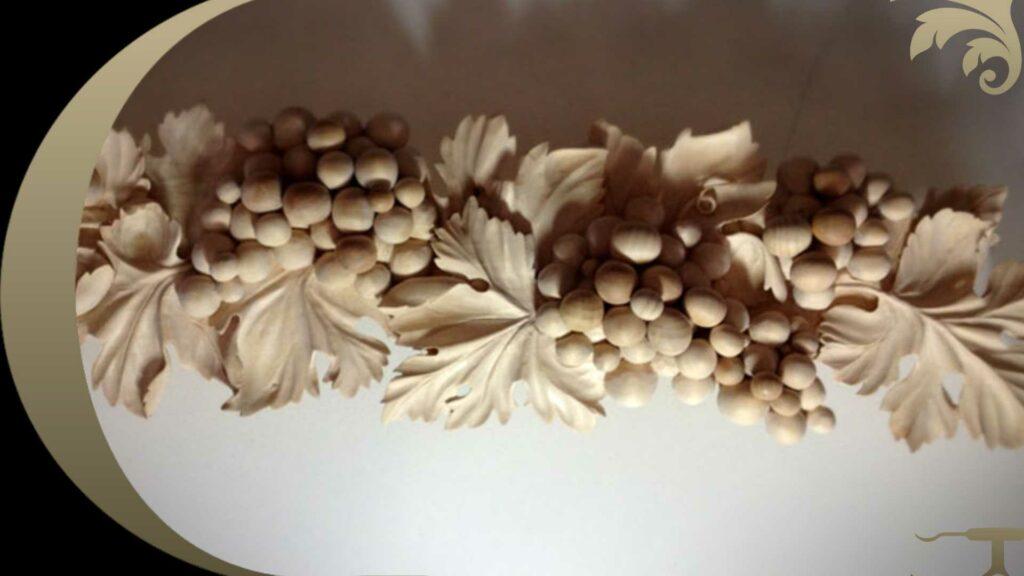
Alexander Grabovetskiy, woodcarver, School of Woodcarving · Published 2024
How do you carve grapes and grape leaves in wood?
Quick answer: Grape onlay carving is relief work where a cluster of grapes, leaves and vine is carved on a separate basswood board and then fixed to a mantel, a kitchen hood or a door header. Berries sit at different heights, the meeting points aim for triangles, and each pass slices sideways instead of pushing straight down.

A grape onlay is a bunch of grapes, leaves and vine carved on its own board and then fixed to something else, a mantel, over a kitchen hood, or above a door. My board is basswood, 24 inches long and just under 2 inches thick. Thickness is the whole point here, because the grapes have to sit at several different heights and a thin board simply cannot hold them.
Have you carved grapes and ended up with a plate of flat coins? Did the gaps come out square instead of pointed? Does the wood tear at you every time you go deeper? I taught this panel in an in-person class, and afterwards multiple people asked if I could show the same project online. So here it is. Grapes are not easy. I have watched carvers have a lot more trouble with one bunch of fruit than with an acanthus leaf, and the same mistake comes up over and over, detail started too early. Below is how I carve them, which gouges I reach for, and the mistakes I see in every class.
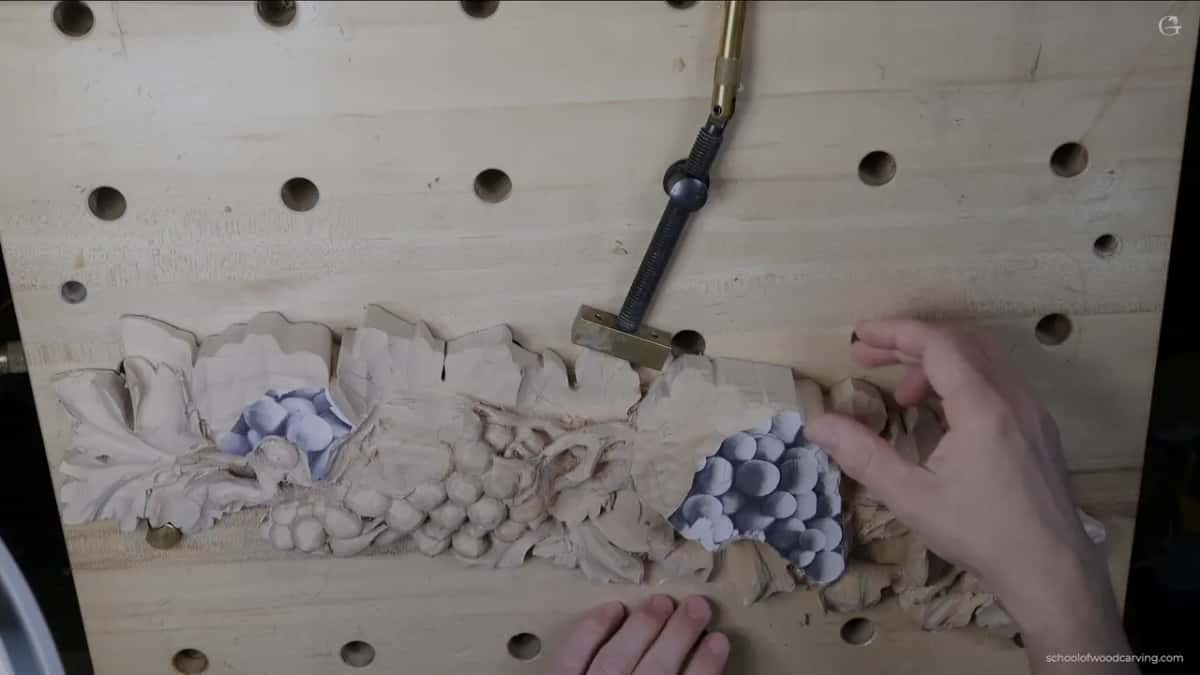
What decides whether a bunch reads as a bunch
- Rough out the whole movement first. Working details at the start is the biggest mistake I see, every class.
- Pick one grape as the high spot, then let the rest drop away from it.
- Make them different sizes and set them at different heights. Grapes all on one level read as fish scales, not fruit.
- Where two grapes meet, aim for a triangle. A square gap between them can still be cleaned out, but it is a little harder.
- Slice. Never take the tool straight down at 90 degrees.
- How wide a grape looks from above is how deep it goes. Not deeper.
Why do carved grapes come out looking flat?
Flat grapes come from carving every one at the same height, like coins laid on a table. Real fruit does not do that. In a bunch, some berries push forward at you and some hide behind their neighbours, and the wood has to do the same thing.
So the first decision is not a grape at all. The first decision is which grape sits highest. I leave a piece of the paper on top of that one, so I know it still sits at full height, and from there the whole bunch runs downhill, downhill, downhill. If they all sit on one level, it will not look like full 3D. It has to flow.
Size is the second half of it. Make them random. Some bigger, some smaller. Even a small one has to be full 3D, or you get what I call the fish scale effect. Wood carving is not a copy of real life anyway. Carving sits closer to interpretation, the way relief carving has always stylised what it shows.
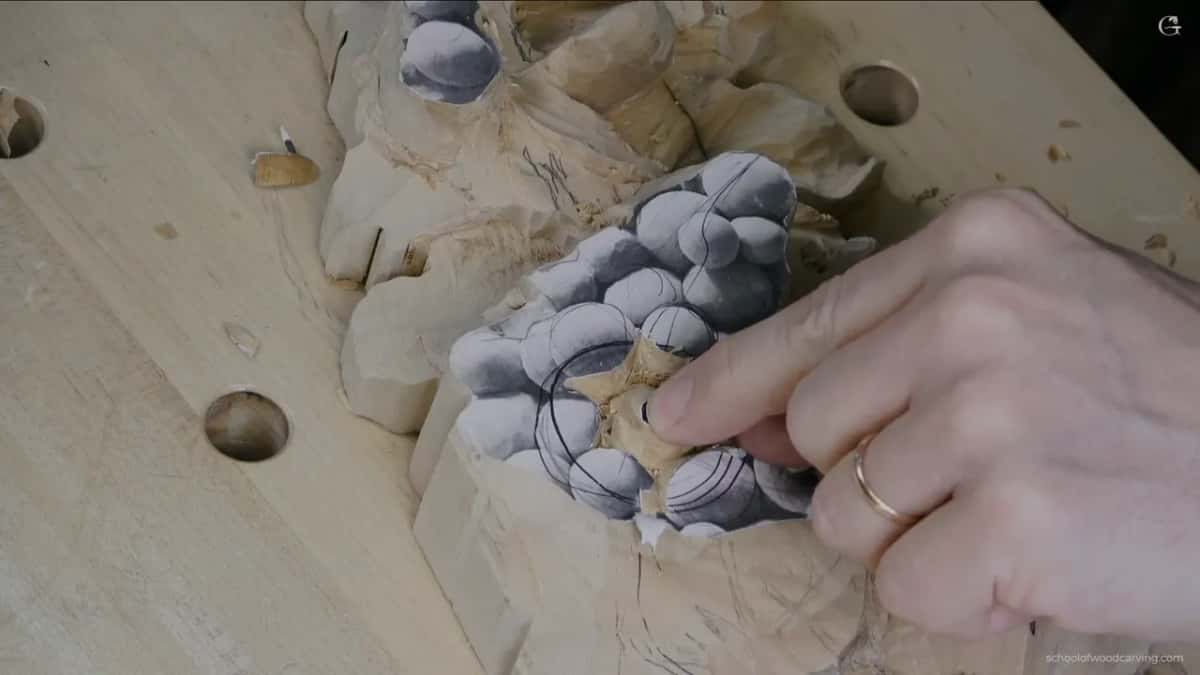
I think of it as building a house. Stage one is the basement, the overall movement blocked in with big tools. Stage two is framing, where the bunches get their real shape. Details are the roof, and nobody roofs a house before the basement is poured. Yet that is exactly what people do with grapes. They pick one berry and polish it while everything around it is still a lump.
What board do you need for a grape onlay?
Basswood, and plenty of it. In Europe the same tree is sold as lime wood, and you will also see it called linden. Whatever the label, it is Tilia, and it takes deep excavation without fighting you.
The board for this project is 24 inches long, which is 61 cm. Six inches wide, so 15 to 16 cm. Glue up to that width if you need to, since one plank is not required. For thickness, you want eight quarter stock, close to 2 inches. Mine measures 1 and 7/8, about 4.76 cm. If you can find 5 or 6 cm, take it. Depth is what buys you the third dimension, and I want to use the full block.
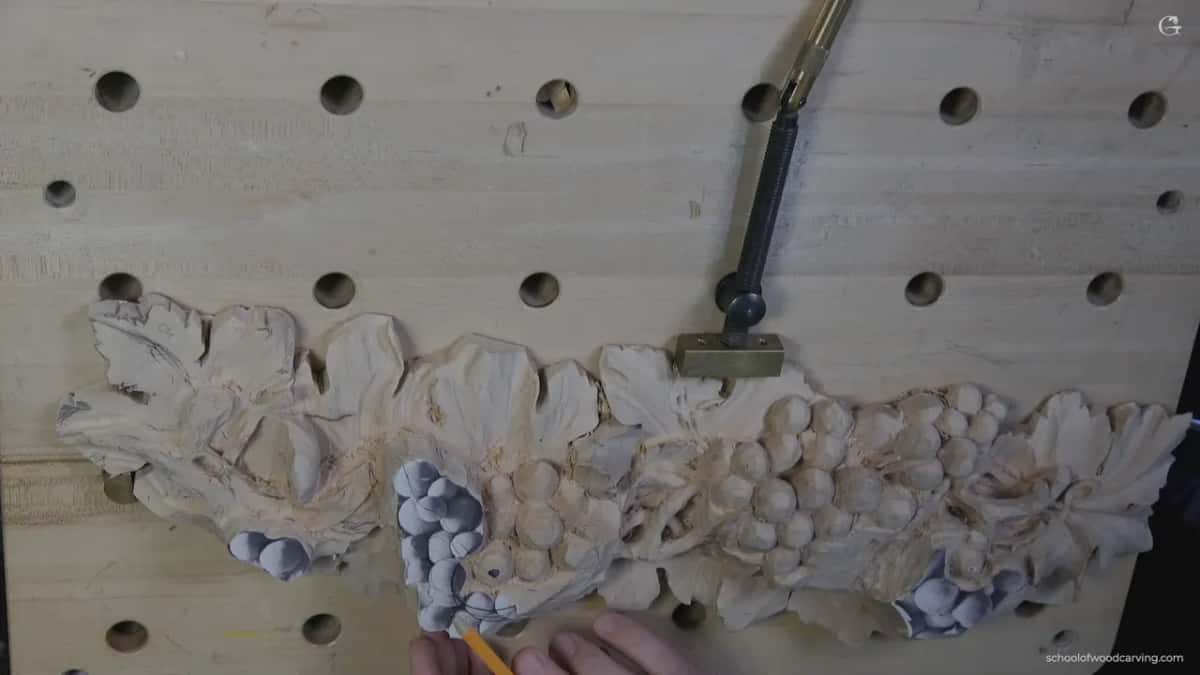
Dry stock helps. My piece is dry, so I do not have to baby it. Wet or freshly milled wood keeps moving on you as it gives up moisture, and the Wood Handbook will tell you more about that than I can. Basswood is soft, which is why it carves so kindly and why it is not too good for scraping, though you can still scrape it. Look up its numbers on the Wood Database and you will see how far down the Janka scale it sits.
One more thing before any tool touches it. Take a leftover block and try a few grapes on it before you carve the real piece. It looks easy, but for some people it is not that easy.
Which gouges carve grapes?
Two gouges do most of the work here, and neither one is exotic. A number 7 at 14 mm rounds each grape. Blocking in falls to a number 5, somewhere around 12 or 13 mm across the edge. Own neither and you do not carve grapes yet, so that is where the money goes first.
| Tool | Size | What it does here |
|---|---|---|
| Number 9 | 20 mm, and 25 or 30 mm is better still | Roughs the whole movement out |
| Number 9 | 10 mm | Lowers the ground, working across the grain |
| Number 7 | 14 mm, a shade over half an inch | The main tool here, it rounds each grape properly |
| Number 5 | 12 or 13 mm, about half an inch | Blocks in |
| Number 11 veiner | 4 mm, down to half a millimetre | Outlines, veins and undercuts |
| Skew, or a plain number 1 chisel | about an inch across | Blocks in fast and blends a shape smooth |
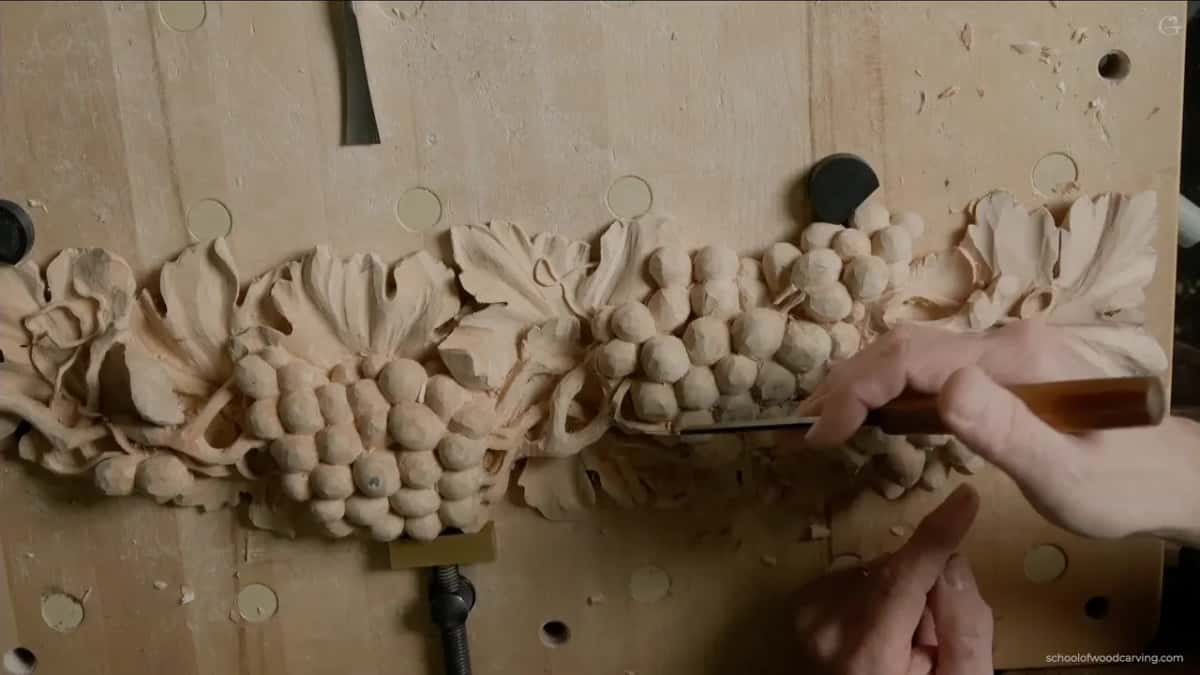
Brands matter less than people hope. Mine are a mix: Ashley Isles, one of my favorite brands, for its amazing steel, plus Henry Taylor, some tiny Dockyard tools, an antique spoon gouge by Herring Brothers, and a few from Pfeil. A number 12 Pfeil knife is a good knife to own if you are buying one. My own knife on this panel is a cheap one that just happened to be on my bench, but I like how it is shaped. What is not optional is sharp. I go over to a strop with honing paste right in the middle of the work, because every rule below assumes the edge is doing the work and your arm is not. If your kit is thin, start with the tools course before this one.
Where two grapes meet, aim for a triangle
Grapes touch each other, and the shape of that meeting decides how clean you can get it. I call it the marriage point. Look at any three berries pressed together and you get a small three cornered hollow between them. Aim for that. Try not to get squares.
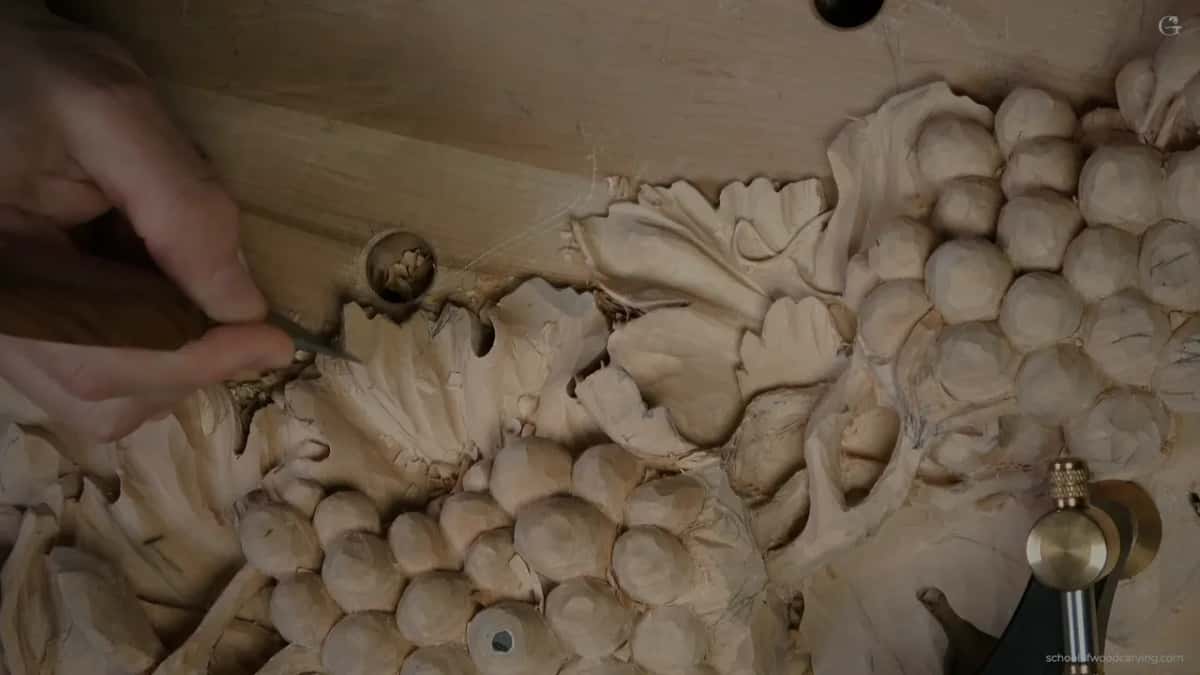
In one spot on this panel I had four grapes in a row, and that gave me a square I could not avoid. It is harder to clean, so I went in there with my knife.
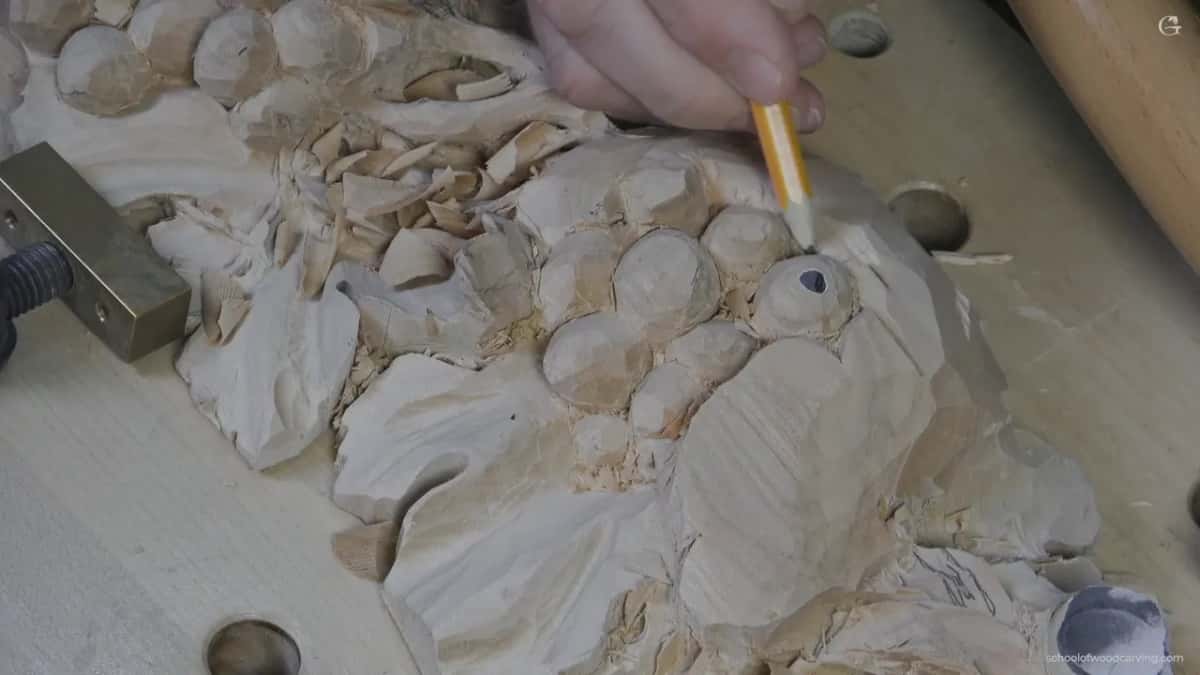
I carve those triangles before I round anything. Corner of the tool goes into the hollow, slicing motion, chip away, almost like chip carving. Once the triangles are established across a bunch, I work from the outside inward and bring each grape up to a true sphere. Not perfect, though. Sometimes a square connection happens anyway, and it is not the end of the world. Cleaning one is still possible. Just do not go choosing it on purpose.
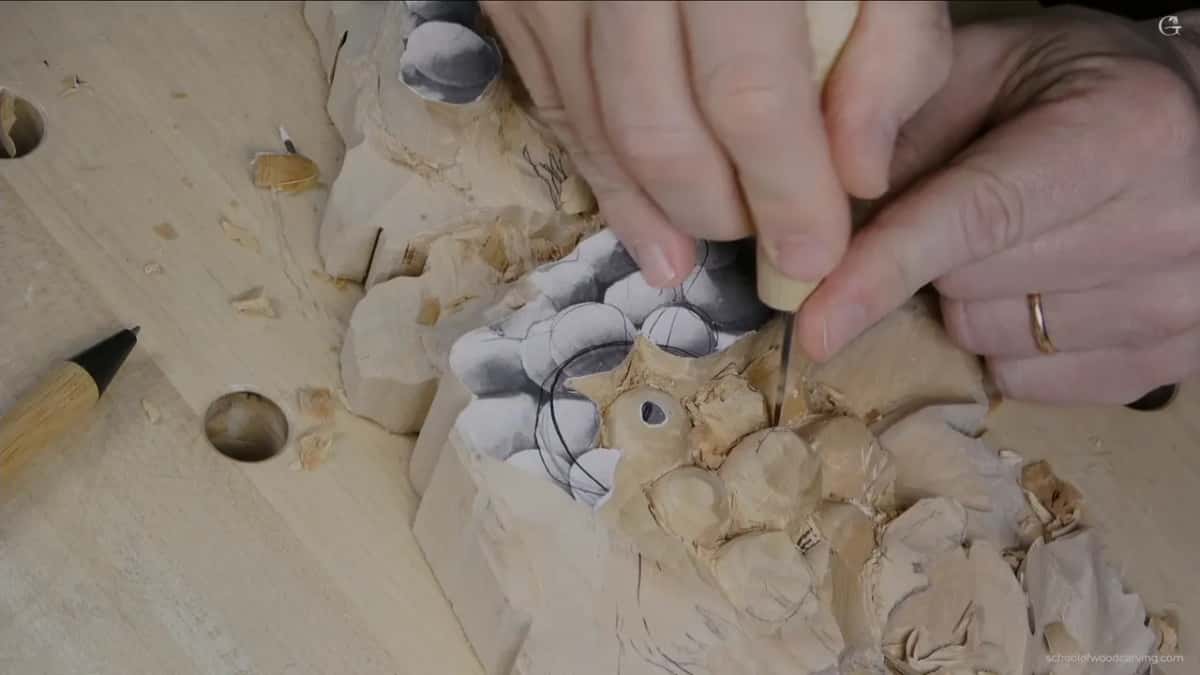
Do not outline a grape either. People take a small veiner, trace right around the berry, and think they have separated it. What they have done is damage the wall of the sphere they were about to carve, and there is no fixing that. The separation comes from the triangles, not from a groove.
Never take the tool straight down at 90 degrees
None of my passes on these grapes go 90 degrees down, and that is really, really important to understand. The blade always aims toward the next grape, roughly 45 degrees, never square to the surface.
Think about what happens underneath. A gouge is a wedge. Stand it upright and push, and you are forcing that wedge into standing fibres with your shoulder. Looks like carving. Feels like carving. What it actually does is build stress into wood you have not shaped yet, and on harder wood that is a big deal.
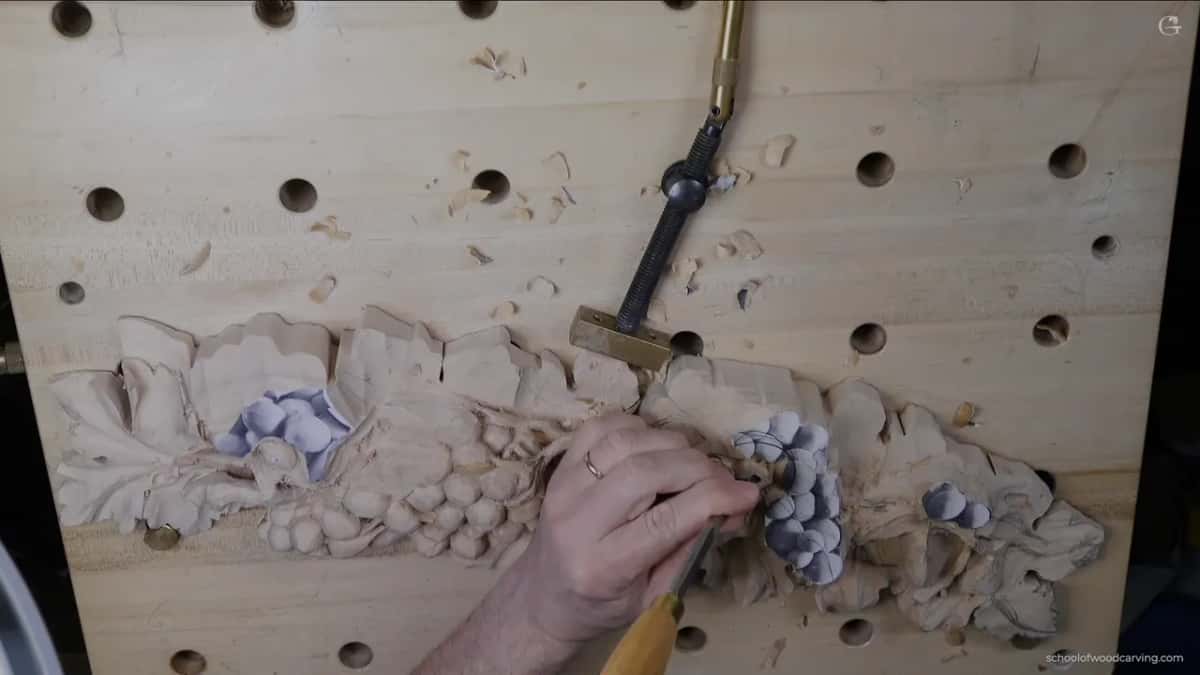
The other reason is access. Lean every wall in toward its neighbour and the hollow between grapes stays open at the top, so a tool can get underneath later. Chop straight down and you have made a well with vertical sides. I know that in life you sometimes see grapes with real voids between them, and the temptation to copy that is strong. Ask yourself first how you plan to clean inside it.
How do you carve deep without fighting the wood?
Slicing. Never pushing. Picture a clock face on the end of your gouge: I start with the flute over at 11 and finish the pass near 1, so the edge travels sideways through the fibres instead of crushing them. Start at 12 with the flute straight up and you are back to shoving a wedge.
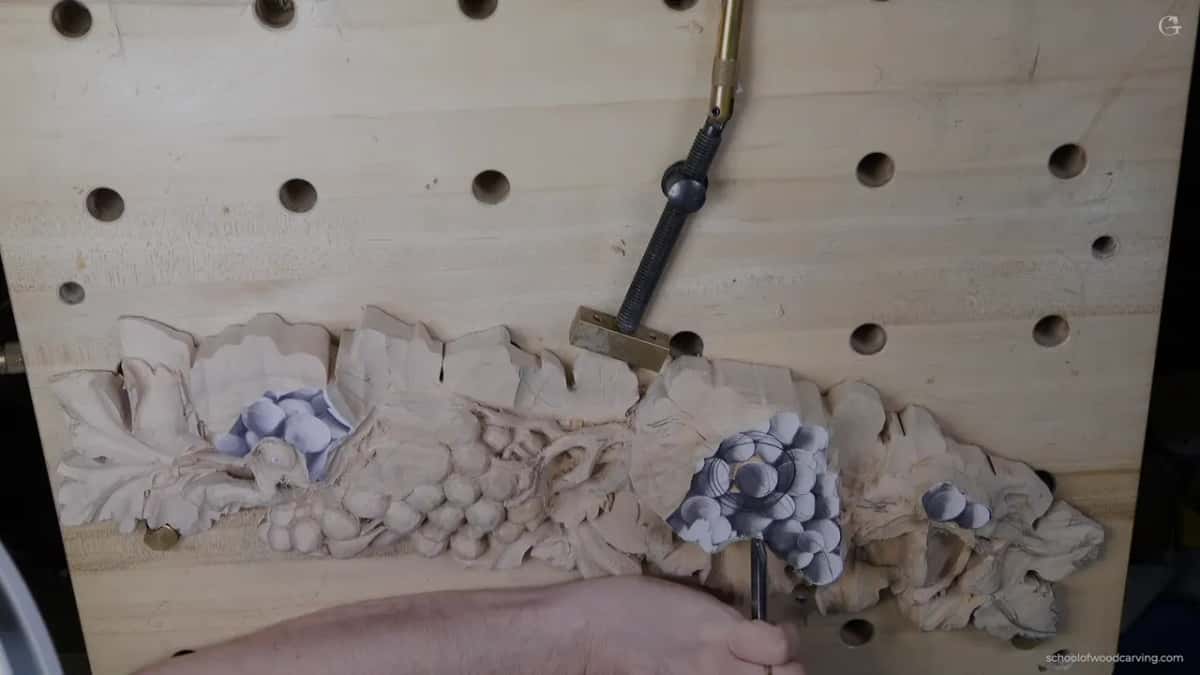
Often I am digging with just one corner of the tool, and even then I keep it moving sideways. Listen to it. A clean slice sounds different from a tear, and the surface it leaves comes off shiny rather than fuzzy. No pressure at all, just the sharpness.
Go little by little into a neighbouring grape. Deeper is always available tomorrow; the wall you crushed today is not coming back. And when the grain fights you, stop and come at the same spot from the other side. Attacking from both directions is nearly always better, because grain direction reverses depending on which way you travel.
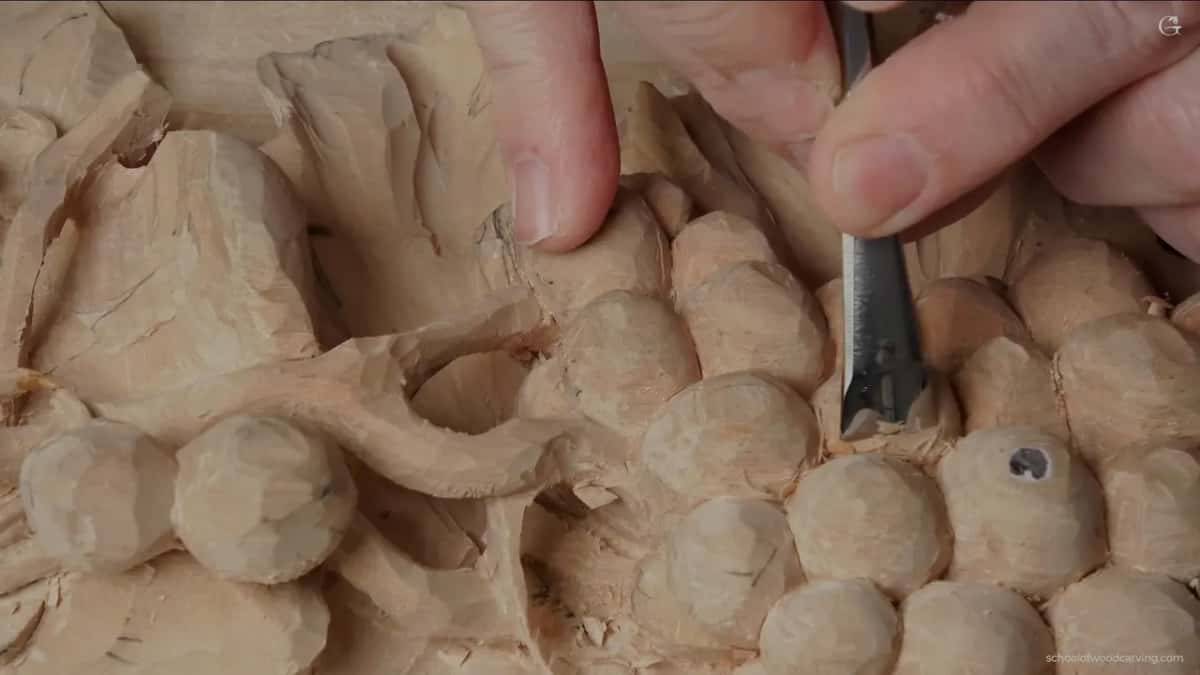
Depth has a rule too. However wide a grape looks from above, that is how deep it goes, and no deeper. Go past that and you have opened voids you now have to deal with, and that gives you trouble later.
Turn the panel over and carve the back
The undercutting is where a grape onlay stops being a picture and becomes an object. I flip the whole thing over, clamp it, and start excavating underneath. Before that I make sure a few high points stay proud, because once it is face down those spots become the legs it rests on.
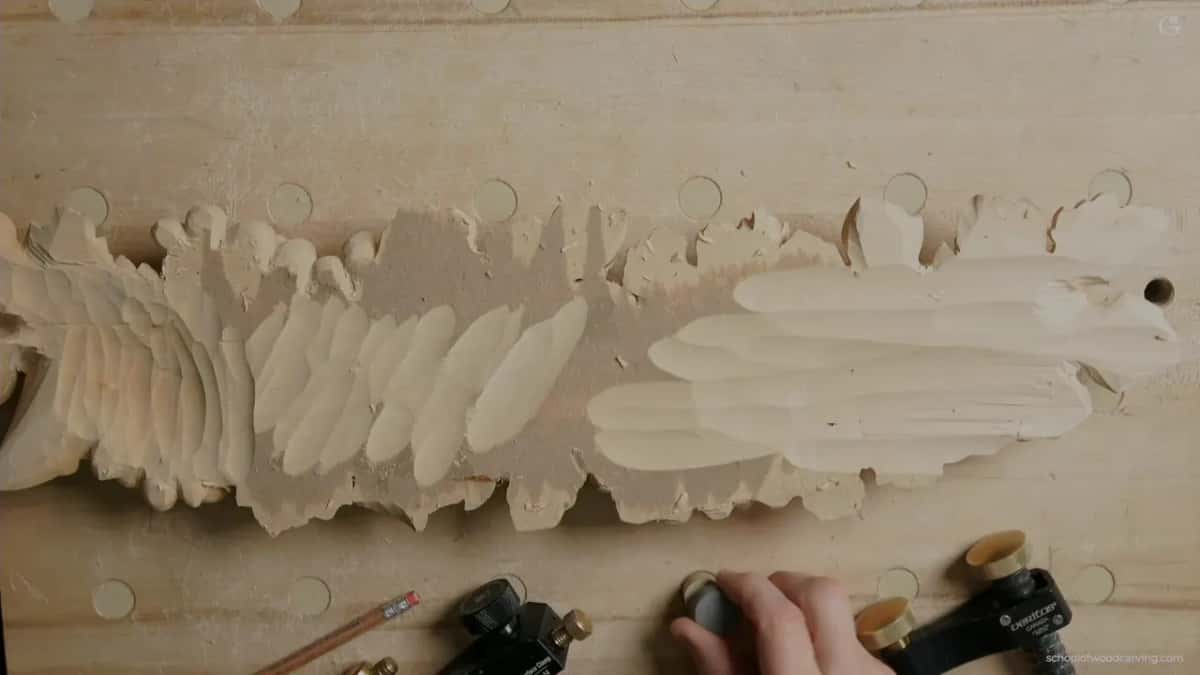
I argue for more undercutting rather than less. Cutting through those long fibres relieves the stress running along the board, so there is less chance of a crack showing up later on. Wood moves with the seasons, and how much depends on where you live. Think of the grain as bundles of tiny straws carrying juice up the tree, and undercutting as breaking that run before it can pull something apart.
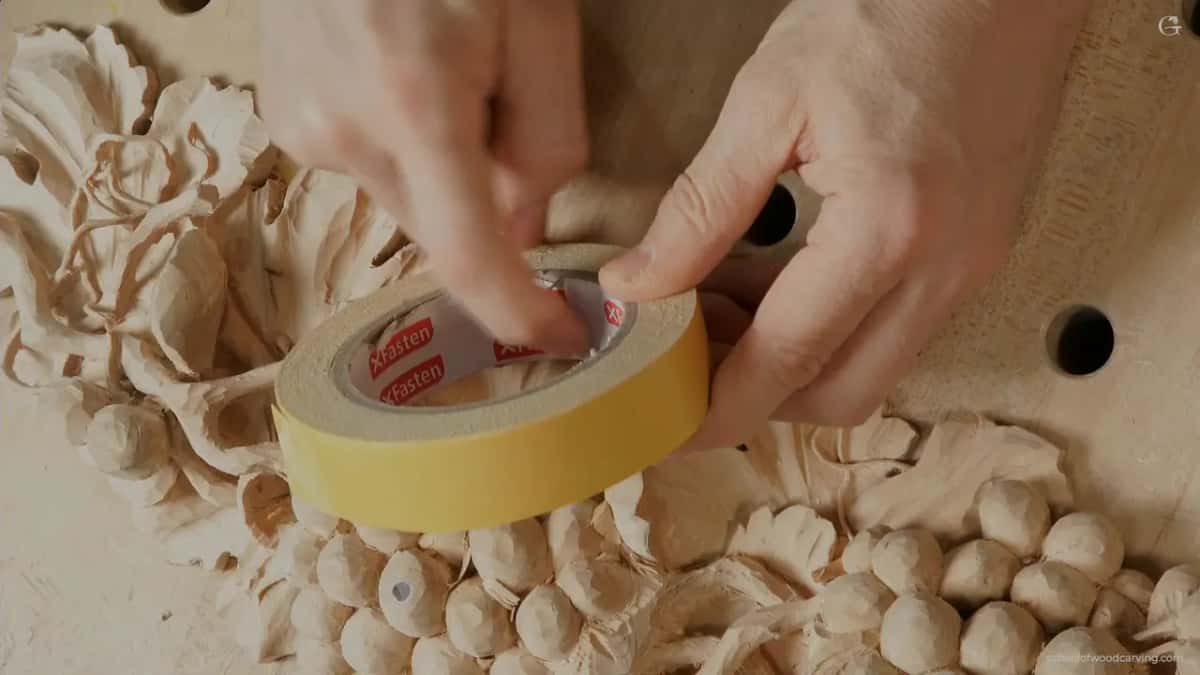
Leave about a quarter inch, 5 or 6 mm, of thickness and you should be okay. Some spots on mine end up thinner, about a sixteenth of an inch in one place. I don't want to take it too thin. I have made that mistake many times and gone all the way through. On a long project like this, I also hold the work with double sided tape made for CNC work, XFasten brand, never carpet tape, which grabs so hard it snaps the fragile parts when you lift the piece off.
Things break here. I broke a section on this very panel and had to glue in a new piece with hide glue and carve it again. Another time I attacked from the wrong side because I did not want to move the bench under the cameras, and a piece snapped clean off. Change of design. It happens, and it is not the end of the world.
Shadow is the material you are really carving
Wood carving is all about light and shadow. You are an artist who uses shadow and light as the medium. Deeper you go, the more dramatic it looks.
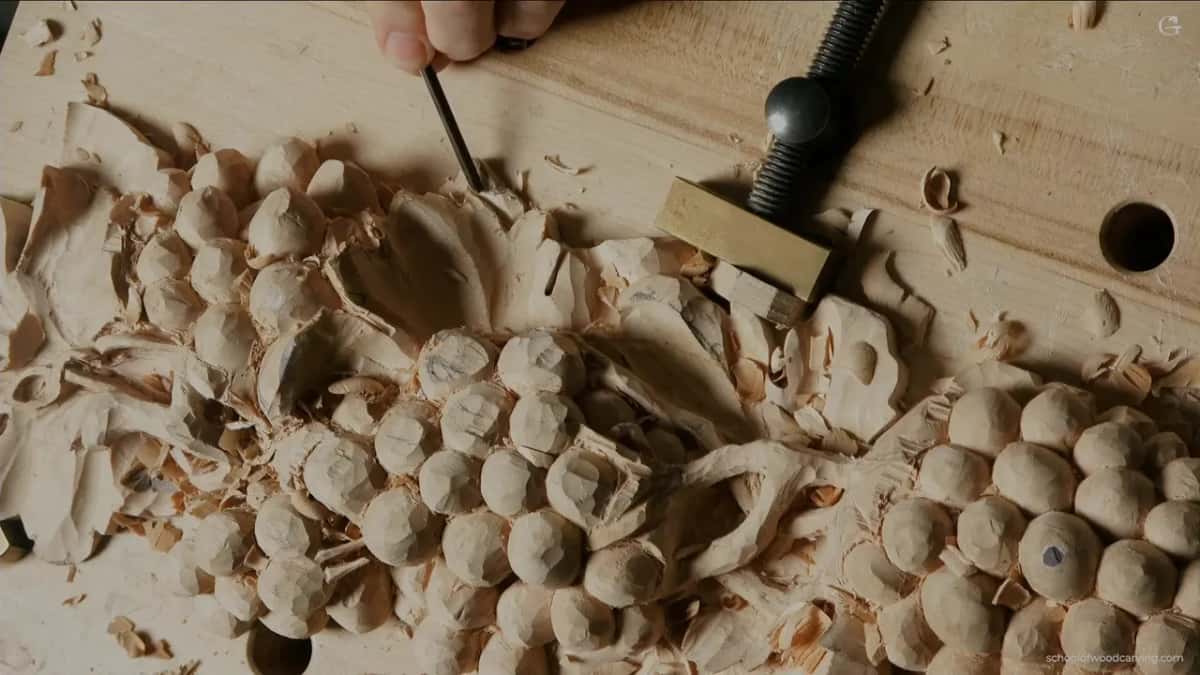
That is why, where a 2 or 2.5 mm tool fits, I take it over a 1 mm one. It gives you a lot more depth, so the shadows play much better. Look at your work from different angles, not just straight on, and you see how it is really looking.
The leaves follow their own rules. Wherever two lobes come together you get what I call an eye, and every eye must have a raised part running out of it. That ridge has a name, and I call it the pipe. The same law holds on a grape leaf as on acanthus, and it is what keeps a leaf from going flat. Every leaf also bulges in the middle. Each lobe gets three main subdivisions, and inside those you subdivide again, in three or more.
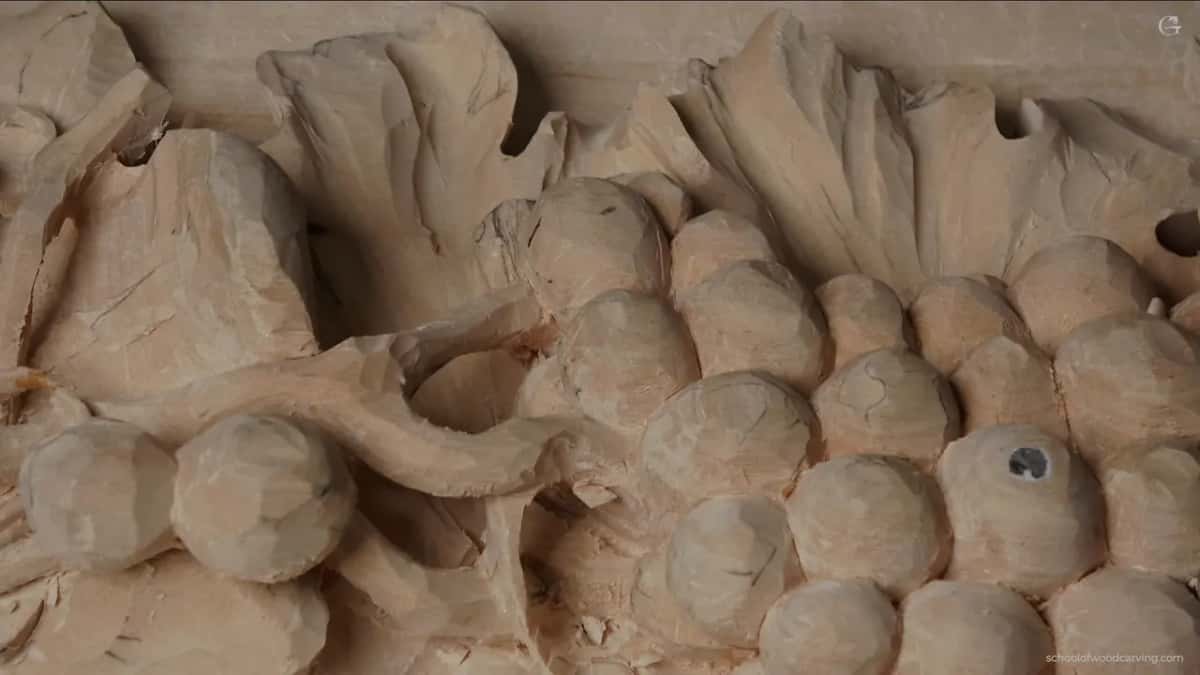
I placed the high spot by the golden ratio. Take two points across the panel and that bunch lands near 62 against 38, which is the golden ratio, on a diagonal. If that sounds abstract, my design course spends real time on it, and you can look for the same proportions in Baroque panels. I am planning a lot more complex work for the school, like Grinling Gibbons, and simple pieces for beginners too.
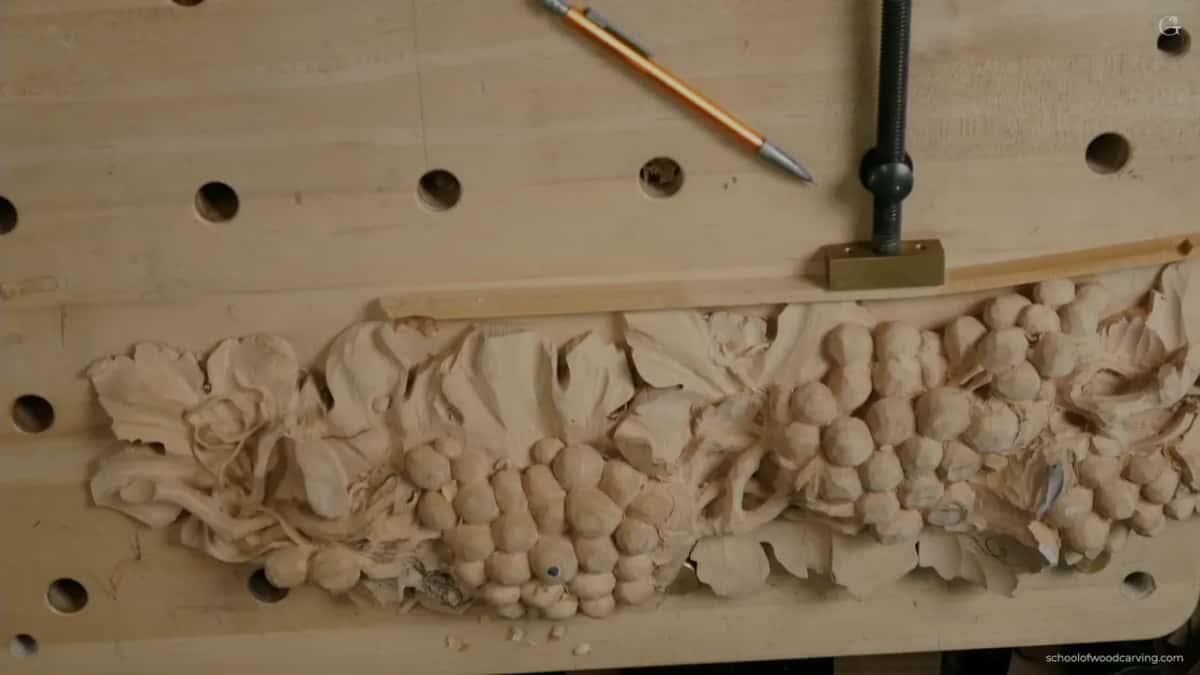
Sand the grapes, keep the marks on the leaves
Finishing is your decision, not mine. Where the piece will hang decides most of it. Put it on a painted mantel and you paint it. My own panels lately have been shades for a pipe organ heading to New York, and those are going under authentic oil based gold leaf, so they get sanded properly smooth first.
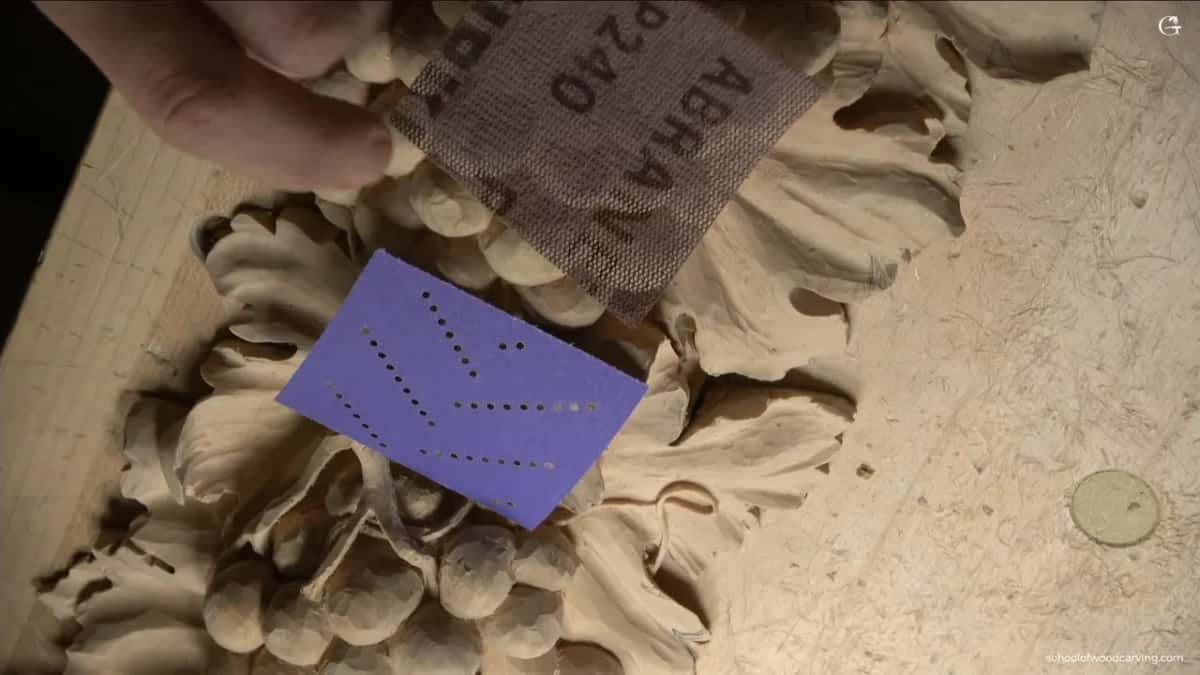
For the grapes themselves I do like a little smoothing. Abranet by Mirka at 240 grit is what I reach for, and lately a purple 3M automotive sheet at 220, which leaves less grit buried in the wood and is kinder to the tools afterwards. Never go below 100, and honestly 120 is my floor. Go lower and all those marks are hard to take care of later.
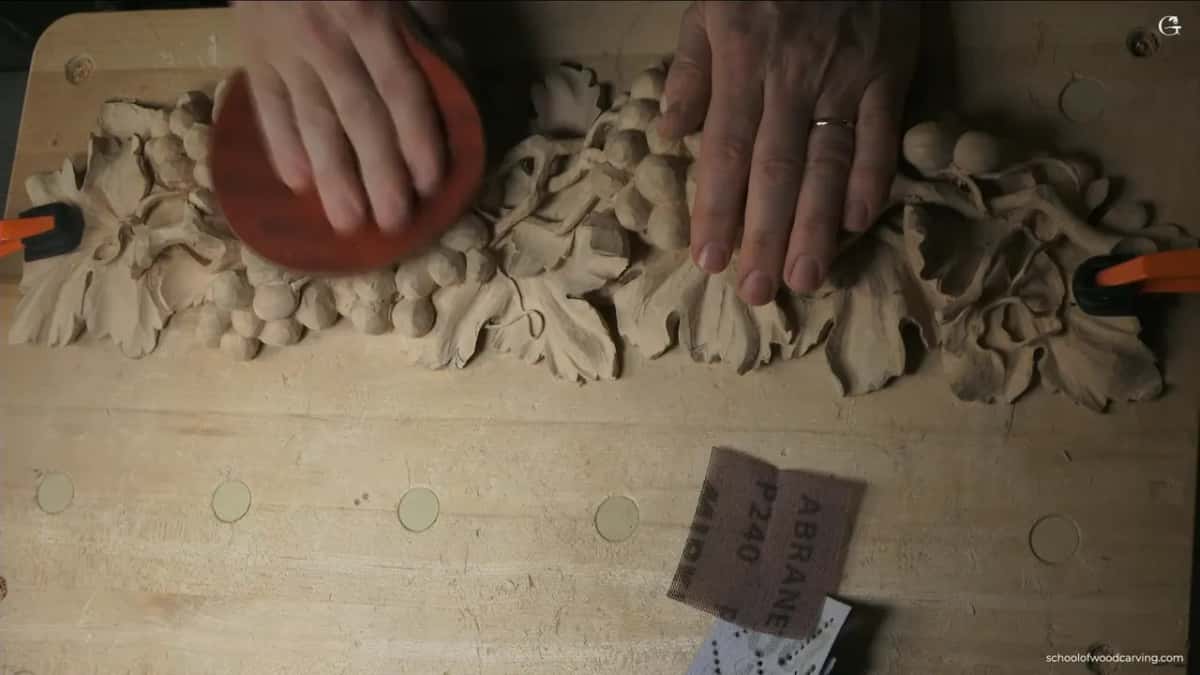
After the paper, a Mirka sponge at 4000 grit over the tops of the berries only. That gives you shiny spots right at the top. Be careful with it.
The leaves I leave alone. Tool marks are the nature of this work, and if you sand everything smooth nobody can tell a hand did it. Some rough spots earn their place. Knock the worst facets down lightly, then stop. Do not be too crazy.
Is a grape onlay too hard for a beginner?
Grapes are more advanced than almost anything else I teach, and I will not pretend otherwise. There is a lot of movement in this panel and a lot of deep relief excavation. When I taught it in person, the class worked pretty much one leaf and started on the grapes, and we did not finish it.
Take it anyway if you want a real challenge. Why not? If your hands are new to this, try first passes for beginners or the bird of paradise board, then come back here. Prefer to work up through fruit? Hazelnuts are gentler, and the Cabernet tray puts grapes on a smaller stage. Whatever you carve, take your time. Patience is the most important thing in this craft.
One last thing. Undercut deep enough, and people look at the vine passing over and under the bunch, at the leaves lifting clear of the ground, and they think it is a glued together piece. You can tell them no, take a look inside. It is one solid piece of basswood.
The full course runs 14 workshops plus a final session, and it picks up from the class panel we had already started, since I saw no reason to begin a new block before this one was done. See where it sits beside everything else on the lessons map, or pick a starting point on the course list. If you would rather stand next to me while we do it, the in-person classes fill quickly. Tuition for the whole library is on the access page.
How it's done
- Rough the movement. Take a 20 mm number 9, or bigger if you own one, and block the whole panel in. High spots come first, then everything else falls away from them. Details stay untouched at this stage.
- Frame the clusters. Set each cluster at its own height and decide which berry sits proudest. Sizes stay random, just to give some variation. Framing a house works the same way, walls before roof.
- Excavate the triangles. Put the corner of a number 5 into the three cornered hollow where berries press together and slice the chip free. Those hollows get carved before anything is rounded, and carved clean, because they are very hard to clean afterwards.
- Round each berry. Switch to a 14 mm number 7 and work from outside inward until every berry reads as a true sphere. Slice sideways flute rotated from eleven round to one, and let sharpness do the work.
- Undercut from behind. Flip the panel, clamp it on its high points, and hollow underneath with a number 11 veiner. Leave roughly 5 mm of wood. More undercutting means less chance of a crack later.
- Sand only the berries. Abranet at 240 grit over the fruit, then a 4000 grit sponge across their tops for the shine. Leaves keep every tool mark, since sanding them flat hides the hand that made the piece.
Frequently asked questions
Can a beginner carve a grape onlay?
Grapes sit at the advanced end of what I teach. Plenty of movement, plenty of excavation. Try it anyway if you want a real challenge.
What wood should I use for carved grapes?
Basswood, sold as lime wood across Europe and sometimes labelled linden. Softness is what lets you excavate deep without the panel fighting back. Eight quarter stock, close to two inches, gives a cluster the depth it needs, and five or six centimetres is better still.
How deep should each carved grape go?
Depth matches width. However wide a berry looks from directly above, that is how far down it travels, and no further. Push past that and you make voids, and voids are trouble later on.
What to carve next