
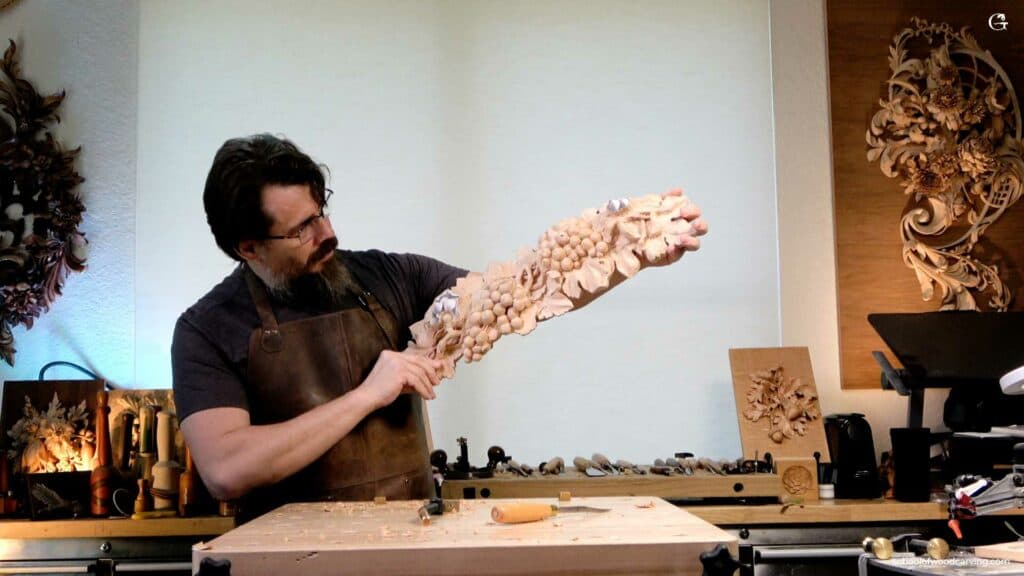
Alexander Grabovetskiy, woodcarver, School of Woodcarving · Published 2024
Should you finish one grape before you start the next one?
Quick answer: Carving a bunch of grapes is blocking work before it is finishing work. You settle the shape of the whole cluster first, and only then does any single berry get placed inside it. Any one of them can still move or change size until the run of them reads right.
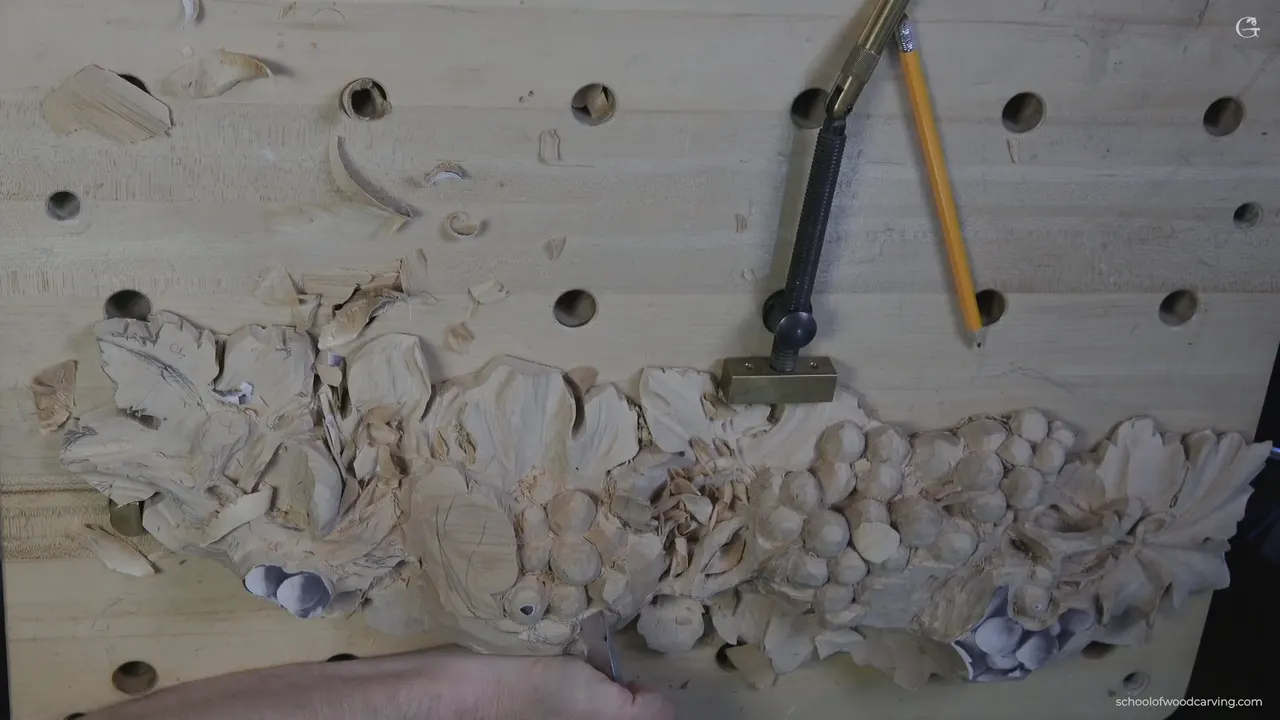
Work the whole bunch before you work any single grape. Block the cluster in three dimensions with a wide tool, then treat every berry inside it as something that can still move. Every size on that board is still negotiable. The grape you fussed over on Monday is usually the one you chop away on Tuesday.
I have taught this in a room with real students more times than I can count, and the same thing happens every time. Somebody picks one grape and polishes it. Beautiful grape, honestly. Around it the panel is still a lump of basswood, and that beautiful grape is sitting in the wrong place.
This second workshop of the grape onlay is where the order gets fixed. I take a skew, knock the whole cluster down to the shape I want, lose half the pencil lines doing it, and then put the grapes back where they belong. Nothing here is precious yet. Being able to change your mind is the whole point of the stage.
Key takeaways
- Shape the cluster first. One grape carved to perfection inside an unshaped lump tells you nothing.
- Pick the high spot early, then let every other berry fall away from it.
- Losing pencil lines is fine. Redraw the grapes wherever the new shape wants them.
- Random sizes. A row of matching berries reads as fish scales.
- Stop the corner of your gouge before it reaches the wall of the grape beside it.
- Rough work is finished when the bunch reads right from three angles, not when it looks clean.
Why does one finished grape ruin the rest of the bunch?
A single finished grape gives you nothing to measure the others against. You have committed to a height, a size and a position before you know what the cluster wants, and every berry you add afterwards has to obey that one early guess.
Watch what happens in practice. The polished berry sits proud. Now you need the one behind it lower, except the wood behind it is already gone, so the second berry has to shrink. Then the third shrinks to match the second. Four berries later you are carving currants and wondering where the bunch went.
I will be honest with you about the exception, because it exists. Some very good carvers work one area right through to finished, then move to the next, and I have done it that way myself on certain jobs. When a piece is simple, or when the idea in your head is fragile and you are afraid of losing it, finishing as you go is reasonable. On a grapevine with four clusters crossing each other it is a trap.
The reason is that a bunch of grapes is not a collection of grapes. It is one shape with lumps on it. Your eye reads the silhouette of the whole thing from across the room, long before it reads any individual berry, and the silhouette is exactly what you cannot judge while you are nose down on one sphere.
What does blocking in actually look like?
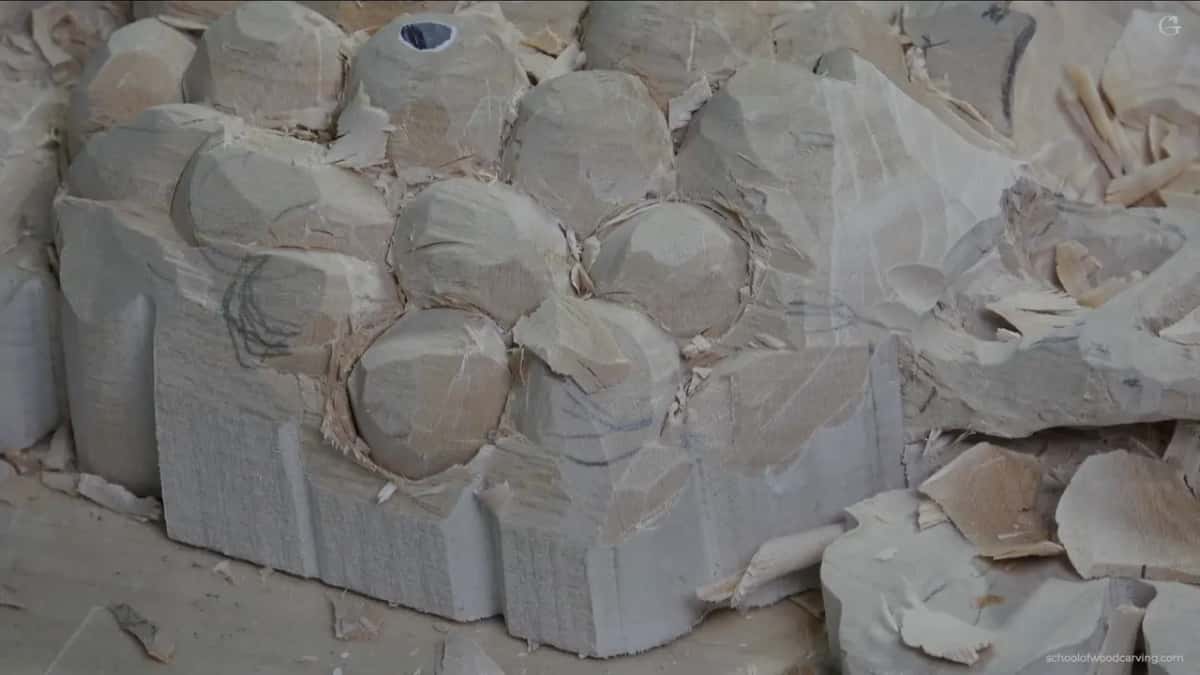
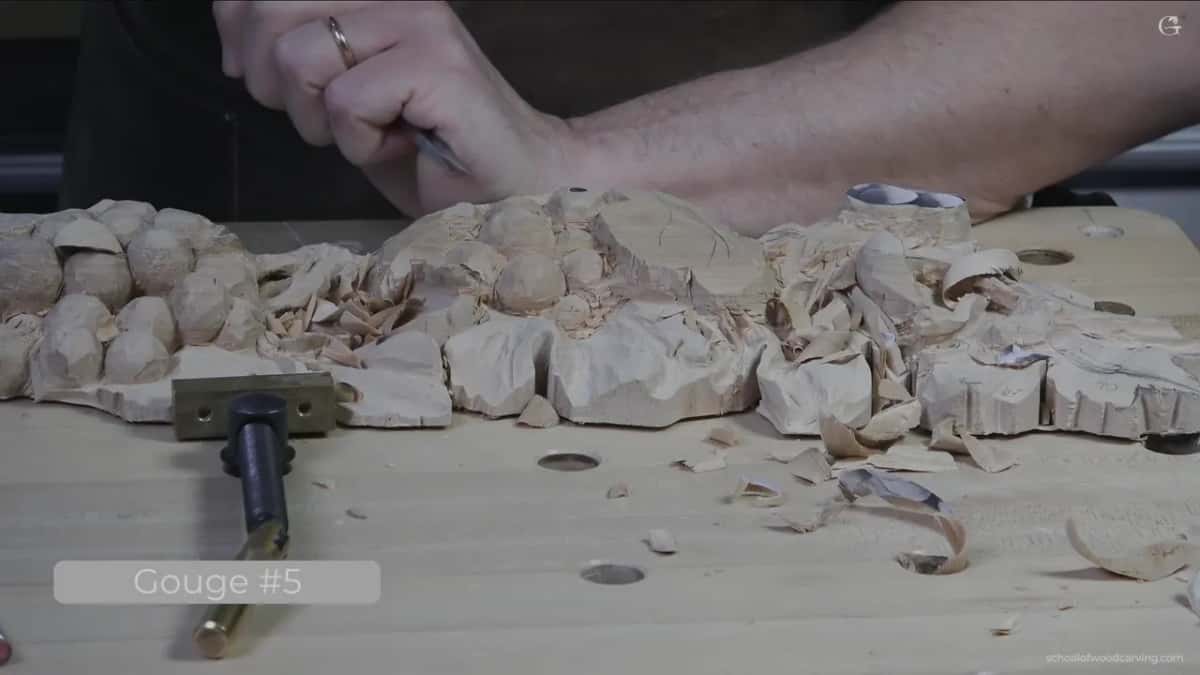
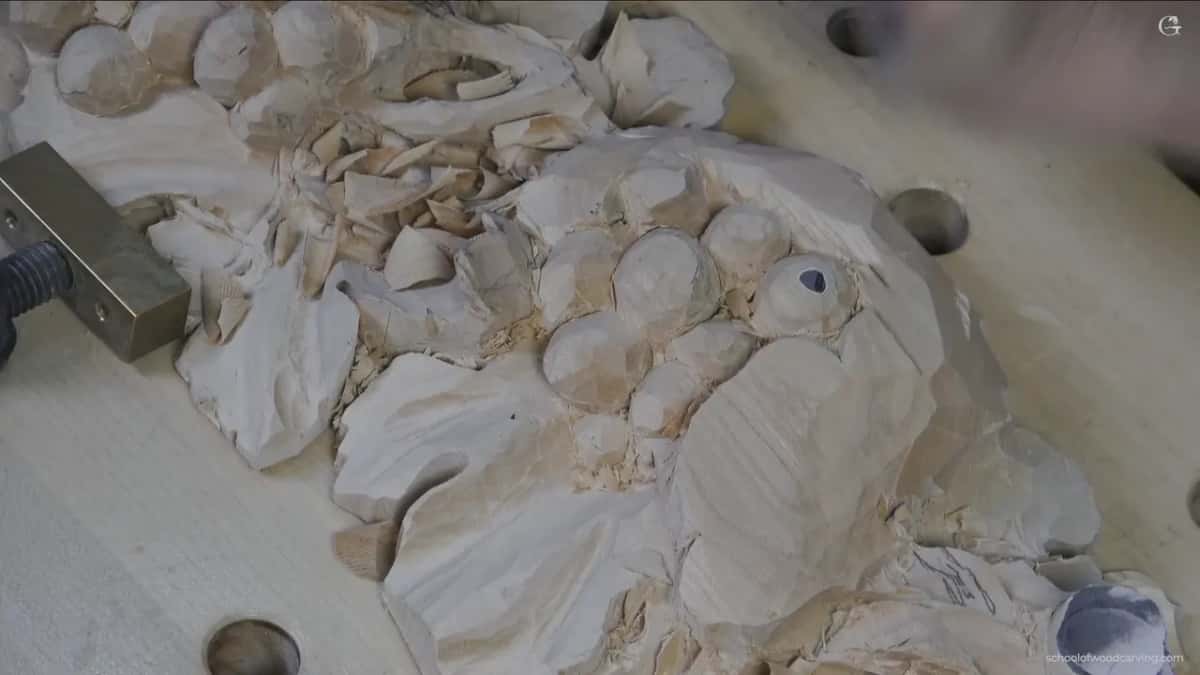
Blocking in looks like damage. At the start of this workshop my panel still carried the full one and seven eighths of thickness across the top of that cluster. First thing I did was chop most of it away with a skew.
Before any of that comes one decision, and it is which grape will stand highest. On this bunch that was the same one I marked in the first workshop, with a scrap of the pattern paper left standing on top of it so I could not cheat. Everything else in the cluster has to come down from there. Get that wrong and the bunch flattens out no matter how well you carve the individual berries.
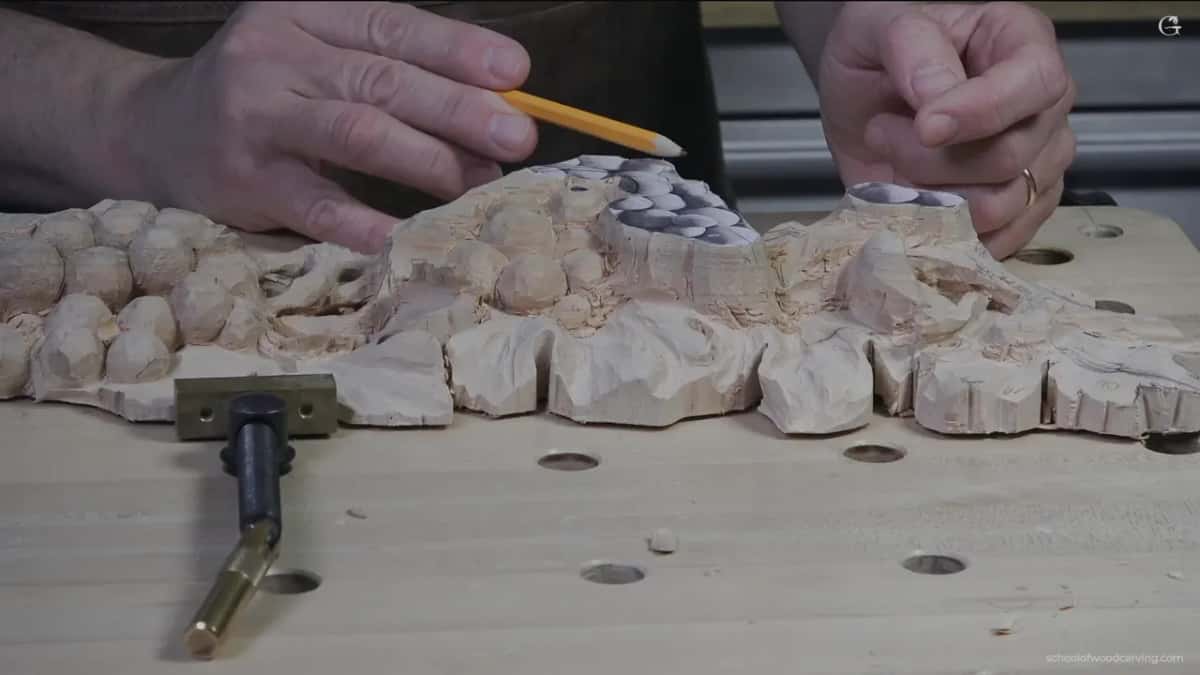
Then I check it from somewhere other than where I am standing. This matters more than people expect. Straight down from above, a cluster can look perfect and still be a disc when you drop your eye to bench level. Walk around it. Tip the board. A relief carving is seen from a room, not from the carver's chair.
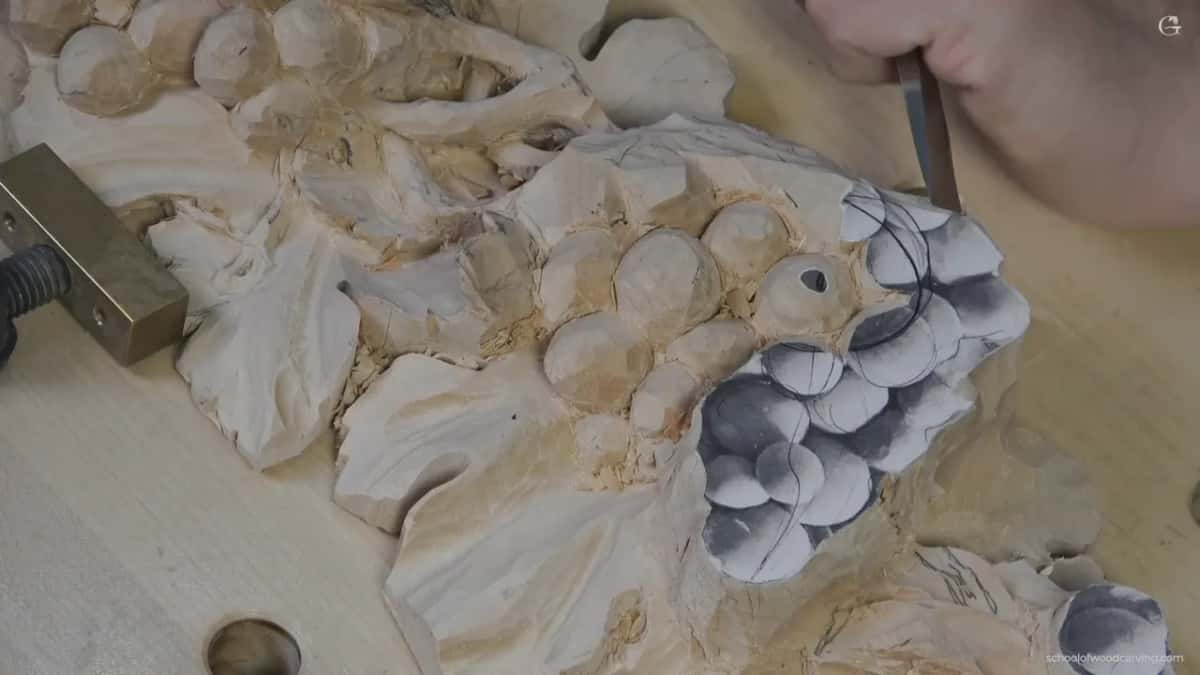
Pencil lines vanish during this. Let them. I redraw grapes constantly at this stage, and where they land the second time depends on what the new shape is telling me, not on what I drew last week.
Which tool blocks a whole cluster?
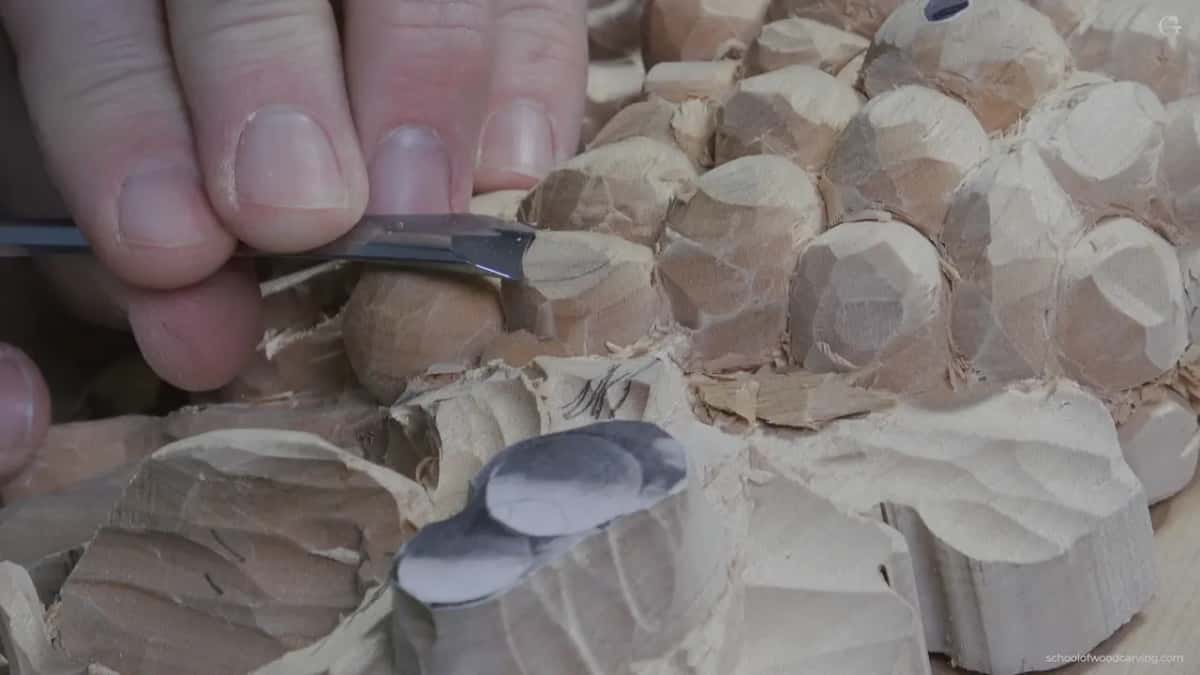
A wide, flat tool blocks a cluster fastest, and a skew is my favourite for it. Mine is an Ashley Iles skew about an inch across. You can also hunt down a Gonzales tool, which does the same job beautifully, and Tools for Working Wood is where I send people looking for one.
Please do not go shopping on my account. An ordinary gouge blocks a bunch perfectly well. I reach for the skew because I like it, and because the long flat edge lets me knock a mass down in four passes instead of fifteen. That is a preference of mine and nothing more.
| Tool | Size | Job at this stage |
|---|---|---|
| Skew | an inch across | Takes the cluster down to a rough mass in four passes rather than fifteen |
| Number 5 | 12 to 13 mm | Places every berry in the cluster, one shallow pass at a time |
| The 14 mm number 7 | a shade over half an inch | Rounds a berry once its neighbours have stopped moving |
| Number 9 | 10 mm | Drops the ground behind the bunch |
| Any sharp knife | worked on its heel | Opens a junction that a gouge cannot reach |
Numbers 4, 6 and even 3 will place a grape if that is what is on your bench. The sweep matters less than people worry about here. What matters is that the edge is sharp enough to slice rather than crush, which is why my strop sits closer to my hand than any gouge does. If your kit is thin, the tools course will save you money, and sharpening will save you the rest.
How far can you move a grape after you carve it?
Further than you think, while the work is still rough. A berry blocked in this morning can shift a quarter of an inch, grow, shrink, or disappear entirely this afternoon, and none of that costs you anything except wood you were going to remove anyway.
That freedom is the whole reason for the stage. I am not carving grapes yet. What happens here is closer to asking the panel a question and reading its answer, and when that answer says a berry belongs two centimetres left of my pencil line, it moves.
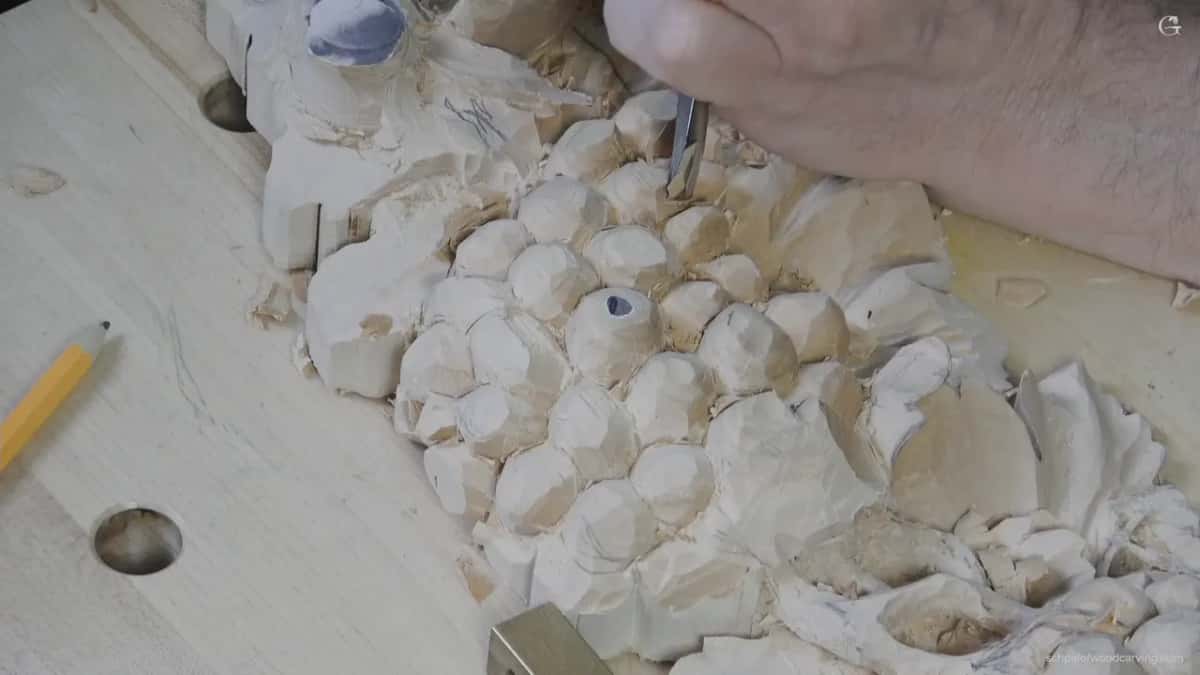
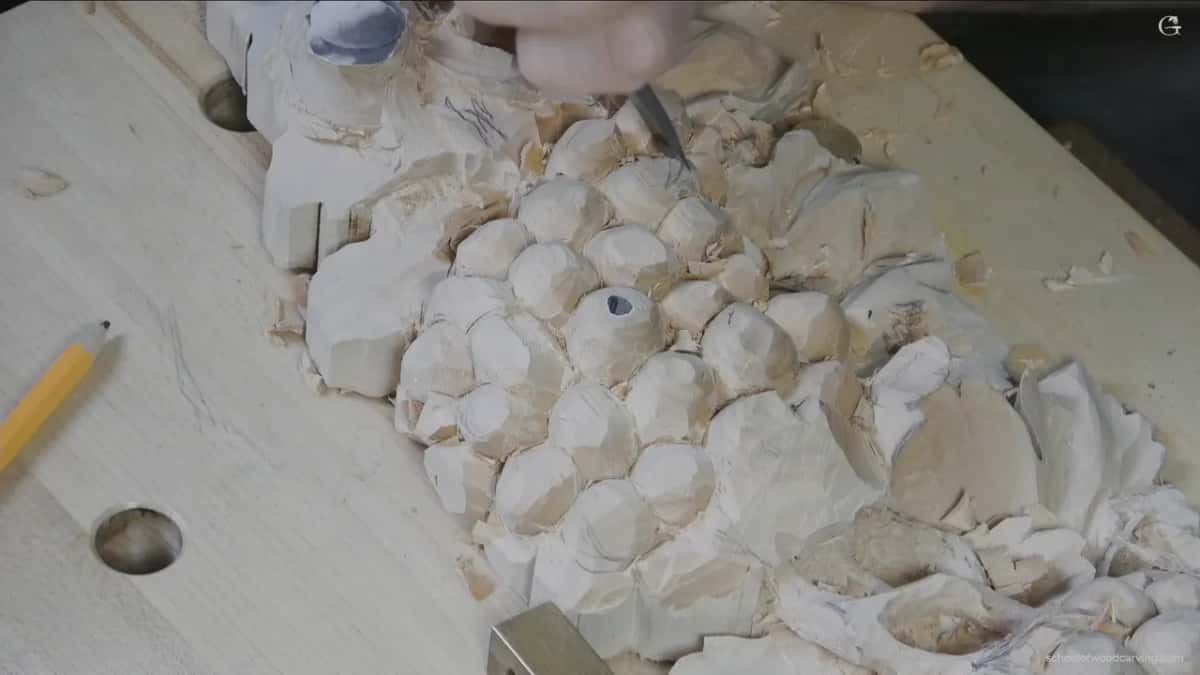
Size is the part people get timid about. Make them random. Some bigger, some smaller, and never a run of matching spheres, which is what gives you that dead scaly look. Real fruit crowds and shoves. One berry pushes forward, the one behind gives way, and nothing in a real bunch has been sorted for size.
There is a floor, though. Carve them too small and they stop reading as grapes altogether, and you also leave yourself nowhere to put a knife when the cleaning starts. I would rather a berry came out slightly too big today. Big is fixable. Small is a new grape.
What stops you carving into the grape next door?
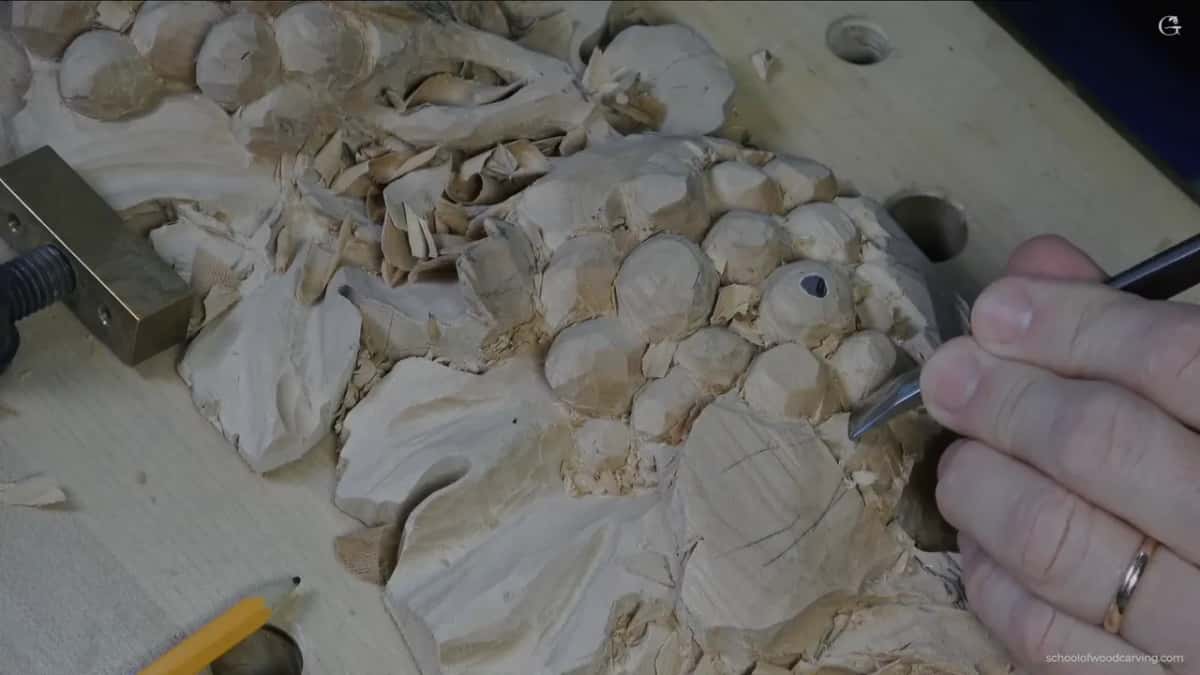
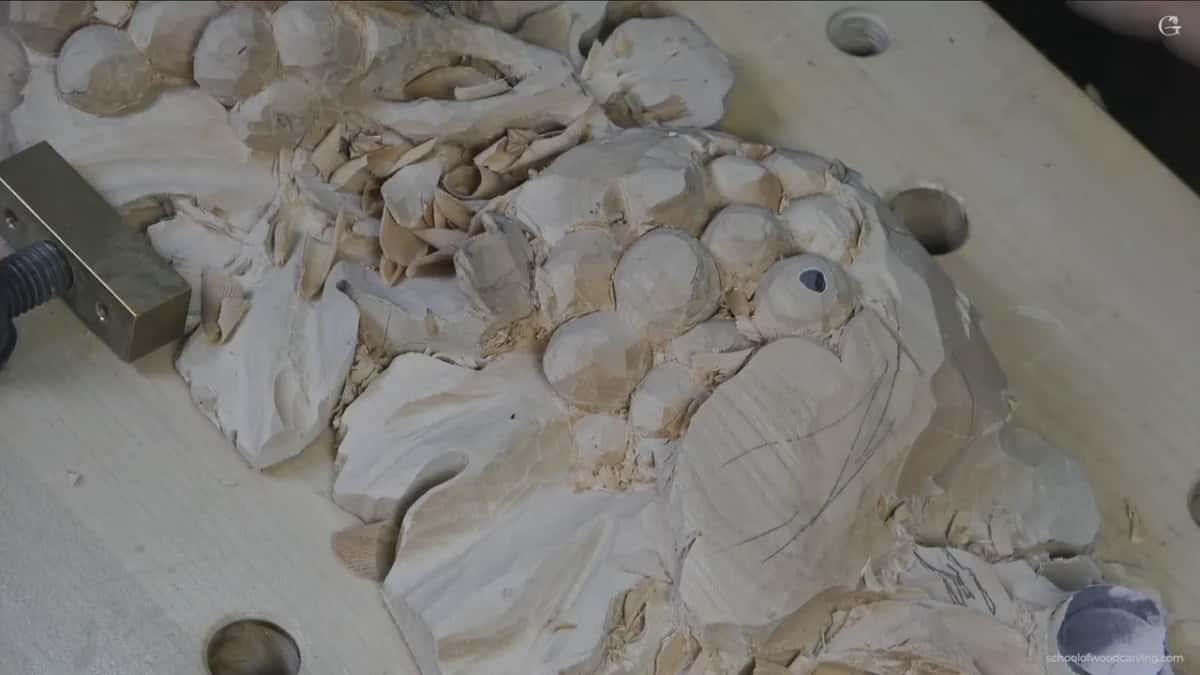
Your own hand is the only brake there is, which is why this one is worth saying out loud. When one corner of the tool goes into a junction, it is very easy to keep going and put a gash into the wall of the berry beside it, and that wall is the one surface on the whole panel you cannot repair.
Go little by little. Deeper is a choice you still have tomorrow. The crushed wall is not.
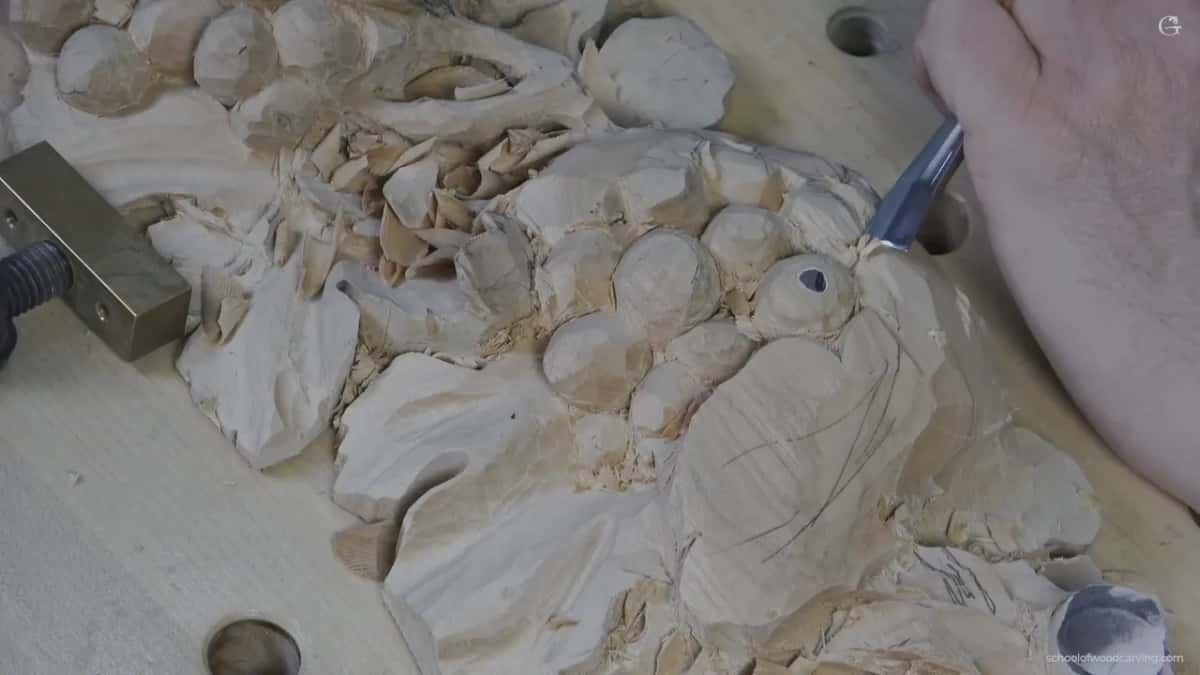
The same restraint applies to roundness. It is tempting to bring a grape all the way round the moment it appears, but if the sphere closes over too far you will never get a blade into the gap underneath to clean it. Leave the shape slightly open and slightly unfinished. Undercutting belongs later, once the run of the bunch is settled, and rushing it here only makes work you will curse in three weekends.
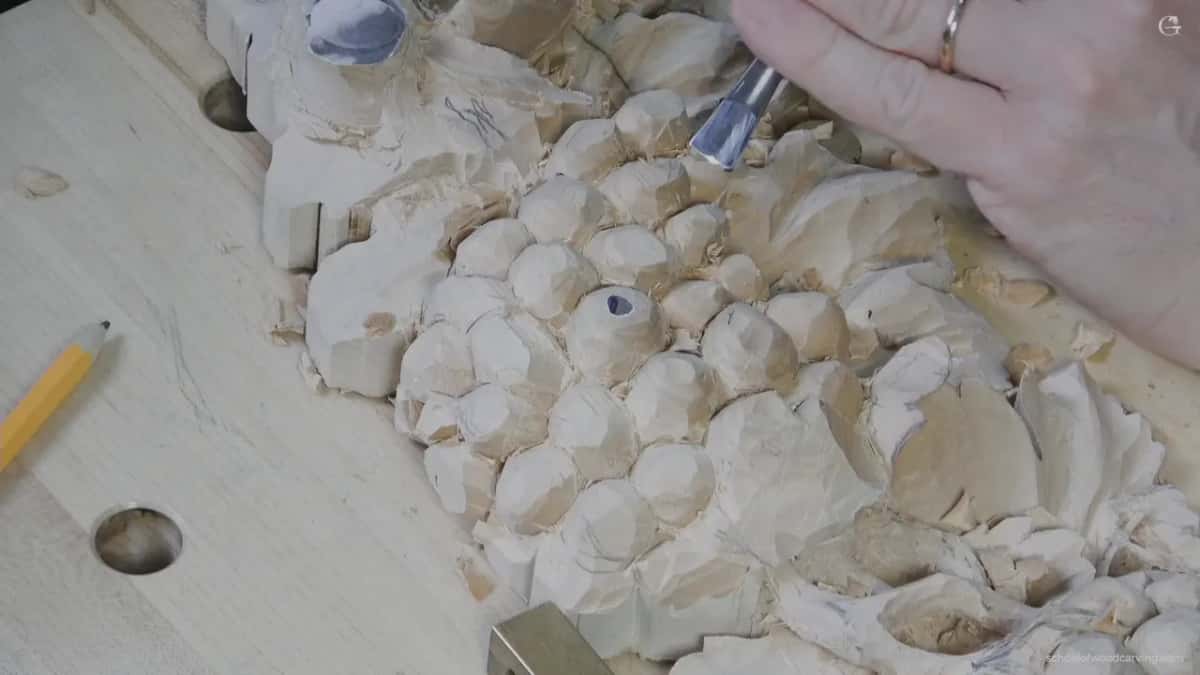
My own panel at the end of this session was not clean anywhere. Facets everywhere, chips in the corners, junctions still ragged. Correct looks exactly like that at this point, and I want you to see it rather than measure yourself against something tidy.
When is roughing in finished?
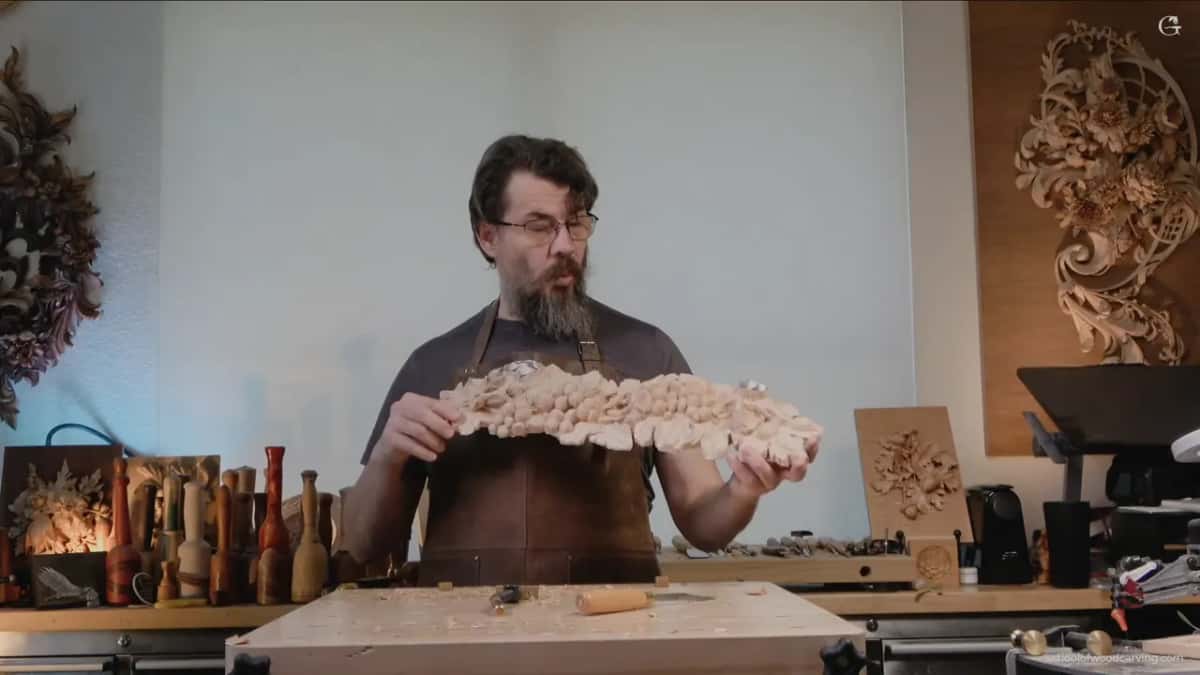
Roughing in is finished when the cluster reads as a bunch from three different angles. Smoothness has nothing to do with it, and neither do the facets. When you can hold the board up, turn it in the light and see fruit rather than lumps, the stage has done its job.
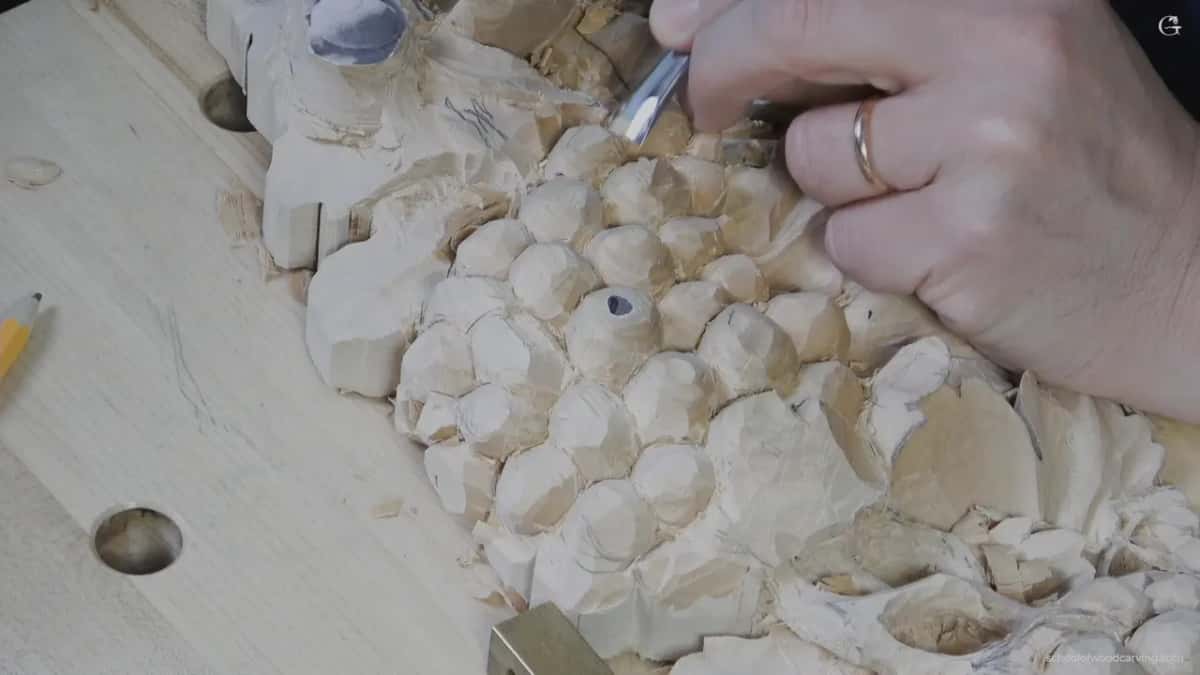
Only then do I start tidying, and even then I take it slowly, little by little, the way you would peel an onion. A knife worked on its heel opens the junctions. The number 7 comes back over each berry for the roundness, because that sweep sits close to the curve I want and leaves less for me to blend afterwards.
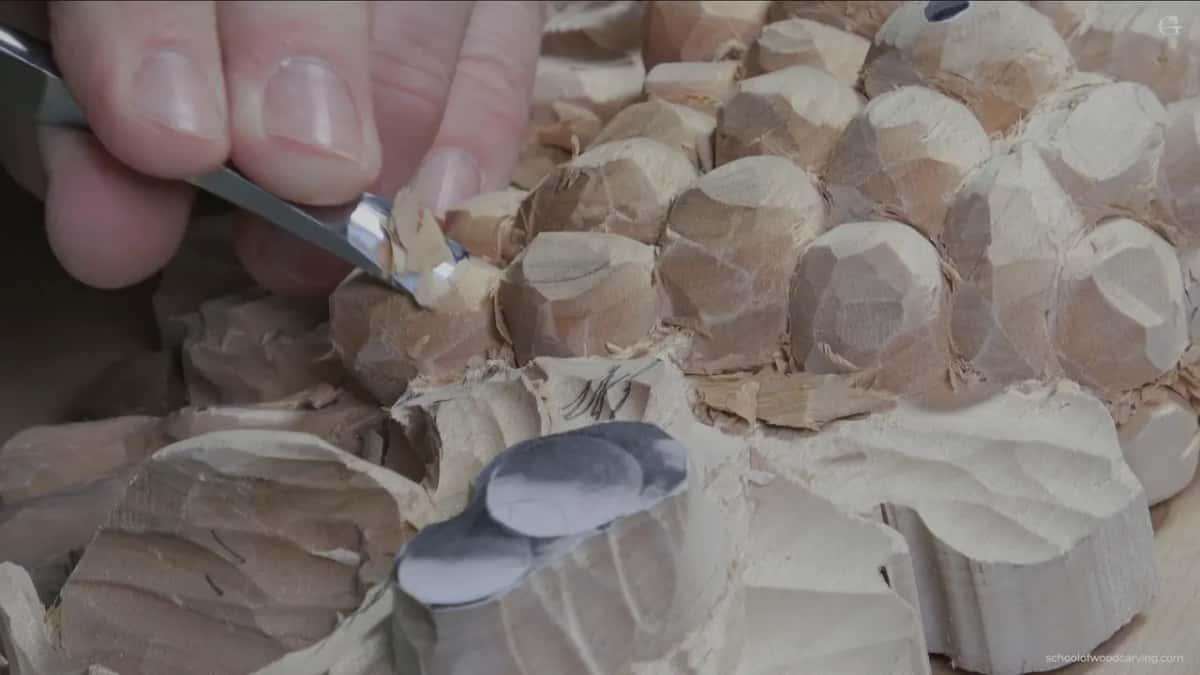
Even the cleaning is provisional. I will touch every one of these grapes again before the panel is done, my hands will darken the wood while I work, and the final surface is a job for the very end. Getting that order right is most of wood carving, and it is the thing I would put above talent if somebody made me choose.
What comes next on this panel is the connections. Stems, vines, the parts that tie one bunch to another and run underneath the leaves, and those decisions get made in the third workshop.
Why are grapes harder than an acanthus leaf?
Grapes punish you for a mistake that a leaf forgives. I have watched carvers who handle a Roman acanthus without breaking a sweat get completely stuck on a bunch of fruit, and for years I could not work out why. It looks so easy on the screen.
My best guess, after years of watching it happen in front of me, is that the difference lives in the surface itself. A leaf is continuous. The eye follows it, and small errors travel along that surface and get absorbed by the movement, so a lobe sitting half a millimetre low simply becomes part of the flow. Nobody sees it. Nobody ever will.
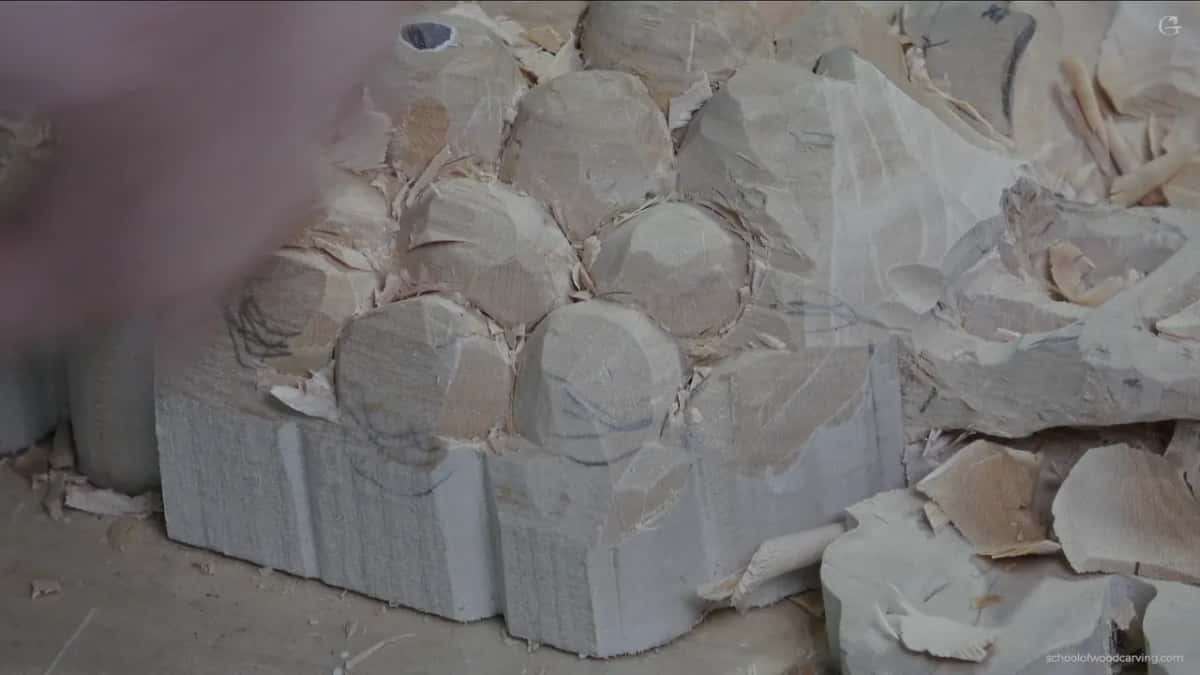
A cluster has no such mercy. Twenty separate solids, each one judged against the two beside it, and the junctions between them are the only places your tools can reach. Put one berry a millimetre too deep and you have not softened a curve, you have opened a hole in a shape that is supposed to be packed tight.
The second reason is that people know what grapes look like. Everybody has held them, so everybody arrives with a picture in their head of glossy, perfect, identical spheres, and they carve toward that picture instead of toward the panel. Carving in wood is closer to interpretation than to copying. The bunch on my board has berries that are not round, berries half hidden, and berries I invented because the wood in that spot gave me nowhere else to go.
None of this makes the project unsuitable for you. It does mean the thing to practise is the order rather than the sphere. Get the sequence into your hands on a scrap, on something as simple as a chip if you like, and the fruit stops fighting you.
Does this order work outside a grape panel?
It works on everything I carve. The rule is older than me and older than this school, and you can read it straight off the great work if you know to look for it.
Stand in front of a Grinling Gibbons drop and the first thing your eye takes is the overall cascade, the swing of it, the way the mass hangs. The individual pea pod comes second. He shaped the whole before he shaped the parts, and every good Baroque carver worked the same way because there is no other way that holds together.
You will find the same sequence in an acanthus leaf, in a vase of grape leaves, and on a carved tray. Mass, then movement, then parts, then surface. Where the proportions of that mass come from is a longer conversation, and the design course is where I have that one properly.
None of this is out of reach for a beginner. I would start you somewhere kinder than a grapevine, though. The beginner course exists for exactly that, and a scrap of basswood plus three practice berries will teach you more in an evening than reading will.
How it's done
- Mark the high grape. Choose the berry that will sit highest and leave a scrap of the pattern paper standing on top of it, so you cannot carve past full thickness without noticing.
- Knock the mass down. Take a skew around an inch wide and reduce the cluster to a rounded mass. Pencil work disappears during this. Let it.
- Look from bench level. Tip the board and read the silhouette from the side and from both ends before committing to any single berry.
- Redraw the berries. Put the grapes back on the new surface in varied sizes, keeping none so small that a blade cannot follow it later.
- Place each one with a number 5. Sink one corner of a half inch number 5 at every junction, one shallow pass at a time, and stop short of the wall beside it.
- Round with a number 7. Bring the widest number 7 you own back over each berry once its neighbours are settled, then leave the surface alone until the whole panel is done.
Frequently asked questions
Can you carve grapes with only one gouge?
A number 5 around half an inch will block a whole bunch on its own, and a 4, a 6 or even a 3 will stand in for it. What you cannot manage without is a sharp edge. A dull tool crushes the junctions you need to keep open.
How big should a carved grape be?
Vary them. On my 24 inch panel the largest sit near three quarters of an inch and the smallest are half that, and no two match. Matching berries give a scaly surface that reads as decoration instead of fruit.
What if you carve into the grape beside the one you are shaping?
You have damaged the one wall on the panel that cannot be repaired, and cleaning around it costs far more time than the heavy pass ever saved. Stop the corner of the tool early and take a second shallow pass instead.
What to carve next