
August 28, 2024 · Updated August 23, 2026
By Alexander Grabovetskiy — Master Woodcarver · Founder, School of Wood Carving · 24 min read
What does the gravity of wood mean?
The gravity of wood is what the Wood Database calls specific gravity: the weight of a board set against the weight of the same volume of water, so the figure carries no unit at all. The number is not something I measure. What I read is the spot under my gouge, and that spot keeps moving.
You looked up a number, and the board still fought you. That happens to me too, and my grandfather put a chisel in my hand when I was six. The chart is not lying to you. It answers a different question than the one your hands are asking.

One board of lime wood, two different woods under the edge.
So here is what I can give you. The published figure, what it is measured on, and where I got it, all named out loud so you can check me. Then the part no table holds. Density changes the sound your tool makes, and it changes which gouge you reach for. On a bad day it decides whether the board carves at all.
- Specific gravity is a ratio against water, which is why it has no pounds and no unit in it.
- The USDA Wood Handbook says mass and volume both move with moisture, so a species owns no single true number.
- That handbook calls roughly ten percent variation in bone dry density inside one common species ordinary.
- Basswood reads soft on every chart. My tools still go dull faster on it than on oak, and I cannot tell you why.
- A number tells you what to expect. One pass with a sharp gouge at steady pressure tells you what you have.
What does the gravity of wood actually mean?
Carvers use that phrase as shorthand for specific gravity, which the Wood Database defines as the ratio of a wood's density compared to water, with water sitting at 1.00.
No unit hides inside the figure. One weight gets divided by another and they cancel out. A board reading 0.50 weighs half what the same block of water weighs.
Chapter four of the USDA Wood Handbook, written by Samuel Glass and Samuel Zelinka, gives density its own definition: the ratio of mass to volume, reported in kilograms per cubic meter, in pounds per cubic foot, or in grams per cubic centimeter. Strip the units away and specific gravity is what remains. Wikipedia files it under relative density, which is the honest name.

Oak with the pores wide open, and a blue line to keep me honest.
Strict recipe, though. Every specific gravity figure pairs a weight with a volume, and the moisture at which each was taken changes the answer. Change the basis and one plank earns three different numbers. So the Wood Database prints two of them per species: a basic figure pairing oven dry weight with green volume, and a second taking weight and volume together at twelve percent.
Put real wood against all that. Its basswood page gives 0.32 basic and 0.42 at twelve percent, an average dried weight of 26.0 pounds a cubic foot, and a Janka hardness of 410 pounds-force. Basswood also gets called perhaps one of the most suitable species for hand carving there. The white oak page gives 0.60 and 0.75, with 47.0 pounds in that same cubic foot, and 1,350 pounds-force.

Basswood, a softer wood, the one my tools complain about.
By the chart, white oak comes out more than three times harder. Hold that thought. Later on this page my gouges go dull quicker on the soft one, and I still cannot tell you why.
| The number | Where I got it | What it measures | What it never tells you |
|---|---|---|---|
| Specific gravity | The Wood Database | Weight against water at 1.00 | Which spot in your plank went soft |
| Density, in pounds per cubic foot | USDA Wood Handbook, chapter four | Mass divided by volume at a stated moisture | That the figure drifts while your board breathes all year long |
| Janka hardness | The Wood Database | Force to push a steel ball halfway in | How a slicing edge behaves |
| Moisture content | USDA Wood Handbook | Water in the wood against bone dry mass | Where inside the board that water sits today |
Not one of those figures is wrong. Every one came off a small clear block that somebody cut, conditioned and tested. Your board went through none of that. It has been sitting in a shop somewhere, breathing.

Olive under a paper pattern, with the figure that will fight me.
School pages already rank and argue these figures, so repeating their work here would waste your afternoon. What wood density means walks the definition from the other side. What is high density wood sorts the heavy end. The lowest density wood takes the light end, and is denser wood stronger settles a strength argument I am staying out of.
Why does the same board carve differently from one day to the next?
Wood keeps drinking water and giving it back long after the tree came down, and that water sits inside the fibers where your edge has to go.
People write to me about this. One man bought basswood online and told me his piece was just not good. My teacher used to say there is no such thing as not good wood, only knives and gouges that are not sharp. I knew exactly what the man meant, though, and the fibers explain it.
Sometimes the same board carves normally one day. The second day it just becomes mushy. A third day can feel absolutely different, like the board is not even basswood anymore.

The acanthus panel from the workshop where I said this.
Please do understand. Wood is alive, and it is a living thing. It sucks the water in, it swells, and then it shrinks. There can be more water inside those fibers or less water inside those fibers, so the wood is going to get more dense, or softer, or more mushy. Just like that.
The handbook agrees in flatter language: for wood, both mass and volume depend on moisture content. Both halves of the fraction move. A species cannot own one honest figure while that stays true.

Tan and grey through one olive surface. Each band cuts differently.
And it feels different every time. No mystery I need solved; just a fact I plan around.
Now the part that catches people out. My great grandfather worked mahogany for Chippendale furniture, and his was the true Indian, mahogany from India. The nearest figure I can hand you is the Honduran mahogany entry, at 36.8 pounds and 900 pounds-force, which outweighs basswood and reads more than twice as hard on the Janka scale. About mahogany I say this. It is easy to carve. If you want to do sanding, it sands really nicely.

A carved shell chalked white, pale wood on a bench full of dog holes.
The Wood Database lands in the same place on that same Honduran entry, calling it typically very easy to work with hand and machine tools. So a wood twice as hard as basswood turns out friendlier under a gouge. This whole page exists because of that.

A light gouge on a bead run in basswood. Thin walls, low weight.
Chasing the drying side of it? Two shorter pages handle that better: do I have to dry wood before carving and how long wood takes to dry for carving.
Where does density live inside one board?
Density lives in patches inside a single board, not in the species name printed on the invoice.
Chapter four backs that up harder than any carver could. Its authors call a coefficient of variation of about ten percent suitable for how oven dry density varies inside common domestic species. Then they name the cause. Earlywood against latewood, heartwood against sapwood, in the tree your plank came out of. Textbook and hands finally agree on something.
Here is how that looks while I work. Sometimes the wood itself, the density or softness of wood, even if it is the same species. I am talking about the same lime wood. But even with the same lime wood, you can see variations of softness, and you can see the color changing. On the darker color right here, in my case, the wood is a little softer.

Dark and pale bands in one olive carving, clamped soft.
Notice how that goes against the folk rule. The darker patch was the softer patch, in my hands, on that board, on that day. Color is a hint and nothing more.
Other days it lands the other way round. It feels like in this area, fibers are more dense than in other areas. Really interesting. Much denser, which is not really common for the basswood, but okay. Olive lets me walk right onto it. Okay, here is the heart, most dense area.

Curly figure in a small olive block, and a blue line for the cut.
Soft is not the same as easy either. Some boards carry a green stain, which means water damage, and that area has already started to rot. Sharp tools are a must there, otherwise every cut comes out unclean.
Why does that area fight a gouge so much? Like I said, it is just a much softer area. Soft is only half of the story, because the structure of fibers is different. Like I say, it is just really mushy. I do not even know if there is a word. Maybe I made that word myself, but it is exactly what it feels like.

Roughing stage. Every soft pocket announces itself here.
That one line does more work than any density table I have read. Structure of the fibers, not weight. A ratio against water cannot see structure, and structure is what your edge meets.
David Esterly wrote about lime wood the same way in his book The Lost Carving.
"soft enough to be carved quickly but strong enough to be radically undercut" (David Esterly, The Lost Carving)

A deep hollow, where soft wood earns its keep.
Two properties pulling against each other, described by what the wood lets you do, and not one number in it. For the arithmetic side of the same story, try what makes wood less dense and does dense wood float, plus can walnut wood be used for carving on one hard species. Wikipedia on wood grain covers structure plainly.
Can you feel and hear density with a tool?
You can hear it long before you can explain it, and my own camera caught me doing exactly that on the olive box.
Watch what a wide gouge did in two woods at one pressure. See? Especially this spot is just really, really dense. So not the easiest spot. I barely removed any wood from the olive itself, but this is a white oak, and I got a really deep cut with the same amount of pressure.

Two woods in one frame: pale oak above, olive bosses below.
Both of those woods sit on the hard side of any chart you can find. One let the tool in and one refused.
That is why a little tool is always a good idea to use at the beginning. Spots like this. Well, not spots like that, details like that, I should say.
Keeping the self correction in matters. A dense patch is rarely a region you could circle with a pencil. Usually a detail, and only the tool finds it.

Both hands on a short gouge. Small bite, more control.
So for some reason, this area is kind of dense. Kind of dense. And a smaller tool will give me a lot more control. See? Even the way it cuts, you can hear it.

The literal answer to a dense patch: two hands, one short handle.
Different woods each make their own particular noise, and you learn them. I know this sounds like an old door. That is just really tight grain. Really tight grain. You hear that squeaking, and it is trying to smush my tool.
Oak says something else again. You can hear that crunchy sound, and that is oak. Working against the grain gives a cranky sound instead, which warns about direction rather than density, and why wood grain matters for carving takes that apart properly.

White paint on dark hardwood so the lines survive the first pass.
Crunchy is my own word and I know it. Better to use some kind of brush when you clean this wood, because it is really crunchy and you could get splinters. I never got any splinter from basswood, yet crunchy wood like this will hand you one.
Not sure if I am supposed to say it that way, crunchy. For me, though, I think it is probably the best word I can find. It is a crunchiness of wood.

Roughed bosses on a curved rim, every facet left by a tool.
Set that beside a specific gravity reading and the gap shows. Two boards can share a number and behave nothing alike, because one comes out crunchy and one comes out mushy. Which woods are hard to carve goes further, and the species pages help too, like is basswood good for carving and is red oak good for carving.
Do hard woods really dull a tool faster?
My own bench has answered that both ways, inside one course, and tidying it up for you would be a lie.
Take the first answer, from the dining table apron. A little different, carving basswood or lime wood, and different again carving oak. A different feel, a different way you create the pressure when using chisels, but it is still carving. Of course, oak is a little harder on tools, but doable.

The oak apron. This is the job where I noticed it.
Now the second answer, out of a workshop in that very same course. You probably noticed that I do not go to my sharpening station as often as I do when I am carving on basswood. And that is kind of a paradox, I guess.
For some reason, the basswood is a much softer wood, and you call it basswood, or you can call it lime wood. Same thing. Softer wood, and yet my tools are getting dull a lot quicker on basswood than on oak.

Green compound on a hardboard strop, and basswood sends me here more often than oak does.
My teacher tried to explain me, and I still did not get it. Basswood does not look like abrasive wood. There is some woods that are really abrasive, some abrasive inside of the fibers, but in a basswood, not the case. Really nice and smooth, and still the tools are getting dull quicker for some reason. At least mine. Maybe not yours.
Every time I told that story I said for some reason, and every one of those stays. Any man who tells you he knows why is selling you something.

A slim tool in a micro detail on basswood, the work that eats an edge.
So the chart and my strop disagree, and both are honest. White oak at 1,350 pounds-force against basswood at 410 is no small gap. Look at what the gap is made of, from the Wood Database write-up of the Janka test: the force needed to embed a steel ball to half its diameter, in wood dried to twelve percent moisture. A ball pressed into a face is a long way from a bevel sliding through fibers. Wikipedia's article on the Janka hardness test describes the same method. Useful for a floor. Almost silent about an edge.

An undercut flower still holding the chips it gave up.
Should your edges be the thing going wrong, that is a sharpening problem before it is a wood problem. Our sharpening lessons deal with it directly, and what to look for in a carving tool set covers the steel. WOODWEB and Fine Woodworking both carry decades of shop argument about it.
What bevel does a hard wood want?
Mine has been short in one lesson and long in another, and the honest version is a low main bevel with a small micro bevel on the inside.
People ask whether I shorten my bevel on harder wood. I do. On the harder wood, when you create a really long bevel, there is a problem. This metal becomes really weak at the point.

The chalkboard from the Maine class, my hand on the weak tip.
And if you are using that on the hard woods, like oak, for example, cherry, for example. Well, not all oaks. Let us say the brown oak is a little softer than a white American oak. The red oak is also really hard wood. But any of those hardwoods, that would be really kind of little dangerous to use a weaker or long bevel. So for those hardwoods, I use most of the time really short bevel like that.

One chalk wedge on the board. A bevel is a wedge.
Then I turn around and contradict myself, and you should hear that from me rather than from a comment section. Short bevel, I use harder woods, like oak. And with the long bevel, I use almost everywhere, pretty much. Actually, on oak also. A really, really low bevel slices through the fibers much easier. A lot less resistance, I should say.

The bevel going in, close up, and this little wedge is the whole argument.
A student in the Maine class pushed back on all of it, and he was right, so I told him yes and no.
The whole hardwood bevel lesson, on my own channel, tools in hand.
The point what you said depends on the wood, and let us say oak, it is a hardwood. And you can break the edge. And not necessarily, because what we do, we establish the main bevel first, then a secondary micro bevel on the inside. Not really high bevel, yet that point becomes really strong, and you are still able to use that on a hard wood.

Two gouges and a thin blade, and one shank there is built for oak.
Steel matters as much as angle. Those tools by Henry Taylor, I love this particular line, because the tool is super light. I am talking about the weight and the walls of a tool itself, really thin. Really good tool for a softer wood, like lime wood or basswood. For harder wood, you can break a thinner tool easily.
People want a figure for the angle, so here is mine with its warning attached. The best bevel, I am not measuring, the best bevel for me, does not matter mallet or not mallet. Place your hand underneath of your handle and grab that, and you are supposed to almost touch your piece of wood with the knuckle. And it comes to about, I would say, between 18 and 22 degrees, if you want to be really technical, but I am not measuring.

The knuckle test: hand under the blade, hand on the handle.
Read the hedge and not the number. Twice in fifteen seconds that warning came out of my mouth. Oak counts as a harder wood, and to carve oak, most likely you have to use a mallet, which makes do you need a mallet for wood carving worth ten minutes if you are heading that way.
How much does drying change what your hands feel?
Drying decides how much movement is still locked in the board, and movement is what you feel as mushy or dense on any given morning.
Movement itself is just because wood is just like a sponge. It takes water. If there is moisture in the air, it is going to just get that water in, and once it takes the water in, it expands. It just puffs out. Come a dry wintertime, and it shrinks back down again.
I like to say a piece of wood is like a bunch of drinking straws compacted together, and that is exactly what it is. Closer to the edge you get, you have got absolutely different movement of those straws.

My sketch of four log ends. Two crossed out, two I buy.
Where a board sat in the log decides most of it. If you look at the log, closer to the outside, it is actually going to puff a lot more. Inside of a log, those central rings will not move too much, especially nearer the heart. The tighter the rings, the less movement. My choices when I am buying wood are quarter sawn or rift cut.

Plain sawn, drawn with the cup it will grow.
Plain sawn is the other one, and it is going to warp, it is going to bow, and it is going to twist. All depends on what kind of rings you are going to get.
About the drying method I have said two opposite things over the years, and both are on tape. My wood is all air dried, and it is a big difference between kiln dry and air dried natural dryness. That method was always my preferred one.

Walnut with the background lowered, and it holds a detail beautifully.
Then in another video I said the opposite. Nowadays you cannot really buy air dried wood, so almost every time I am buying it is going to be kiln dry. I would not spend money on air dried basswood, because nobody really knows whether it was air dried.
Both are true, and they fit together like this. Kiln dry is what manufacturers and lumber yards use. They have a big, big, big stove, to be simple, and they really fry those boards. Air dry just takes time.
So I buy kiln dried, and then I do all of the air drying myself right here. Some of my boards I keep in my shop for over 10 years. And some of them actually I have 20 or 24, 25 years, and the movement stops at the mark about of 10 years in basswood. After 10 years all of those fibers are dead, they all dried, and the movement is pretty much gone.
Some micro movement stays, seasonal movement, depending on where you live. Also I do have a dehumidifier and I keep that at approximate 35 percent, even if I live in Florida, which is common humidity for my environment. Mind you, that figure describes the air in my shop and not the water inside my boards.
Textbooks call this settling into equilibrium. Wikipedia on equilibrium moisture content puts it as wood trading water with the air until the two agree, and its article on wood drying covers both methods I just described. Chapter thirteen of the same handbook is the long version, chapter three covers the cell structure underneath all of it, and the Wood Handbook landing page holds the whole thing.

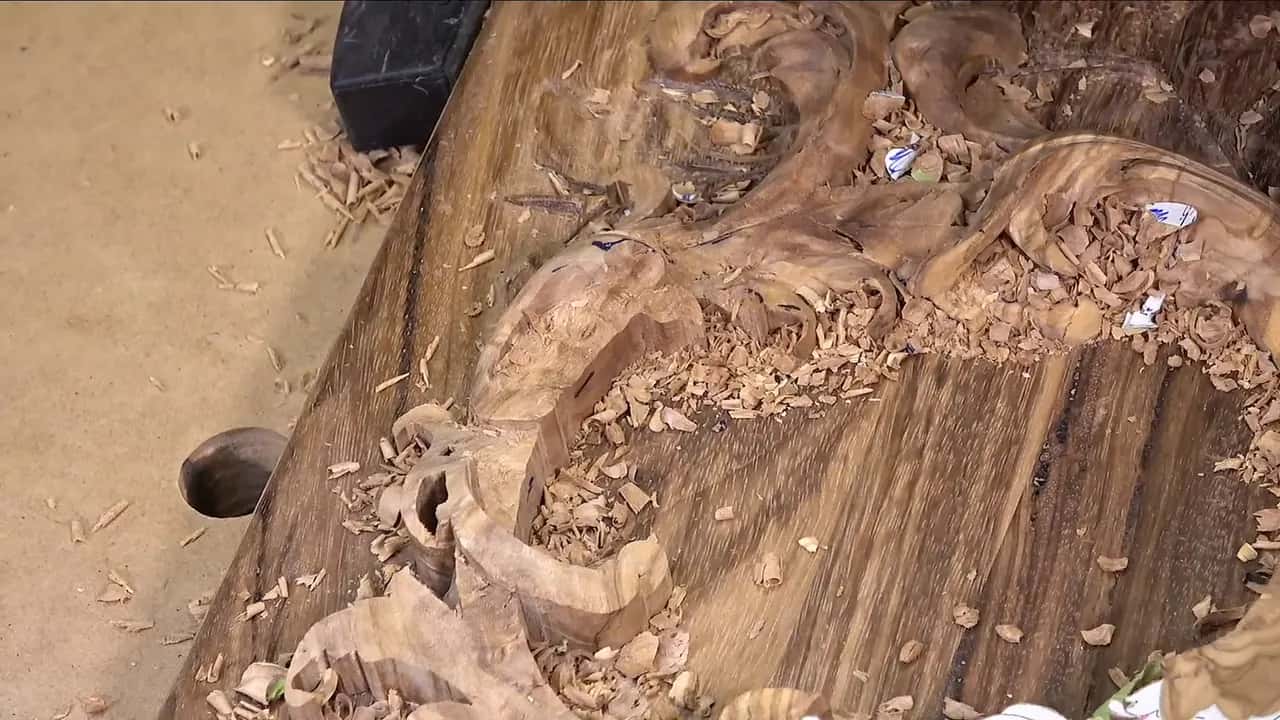
A long gouge driven under a volute, and a hollowed panel stops pulling.

A glued-up blank, layers visible, one end already carved.
How do you judge a board before you pay for it?
You read the published number first, then make the board answer for itself in five short moves.
None of this needs a scale or a moisture meter. One sharp tool, a few minutes, and a willingness to trust your hands over a printed figure.
Step 1, read the published number and then put it down
Look the species up before you drive anywhere. For background, try the Wood Database on hardwood anatomy. Wikipedia's density entry gives the arithmetic, and its article on wood covers the basics. Write the figure on your hand if you like. Then treat it as the middle of a range and nothing sharper.
Step 2, ask where in the log the board was cut
Look at the end grain. Tight rings mean a board that will move less. Buying wood, my choices are quarter sawn or rift cut, so plain sawn carving stock gets left on the rack whenever the yard offers me one.

Trimming an outside edge, with the rest of the row waiting its turn behind.
Step 3, take one pass on both boards at one pressure
Here is a test I once ran on camera without meaning to at all. One stropped gouge, the same push, one board and then the other. On olive I barely removed any wood. On white oak I got a really deep cut using that identical push. Your own hand keeps a far better record than any printed table ever will.
Step 4, listen while the tool is moving
A squeak like an old door means tight-grained wood. A crunch usually means oak. Crumbling and dull means a soft pocket that will not hold a detail. Even the way it cuts, your ears pick it up, and they learn this faster than your fingers do.

Thin ribbons and beads, all tool facets.
Step 5, match the wall of the tool to the wood
Thin walled gouges are lovely in lime wood and basswood. Harder wood will break a thinner tool easily, so bring the heavier shank instead. Getting this backwards costs a gouge. I broke lots of gouges carving heart pine by hand, and driving a nail into that stuff is almost impossible.

A symmetrical acanthus, finished.
Here are the deeper pages. What Janka hardness means for a hand carver takes that scale apart. What low density wood means and the densest wood ever handle the two ends. Wood shrinkage, crushing strength, elastic modulus and modulus of rupture cover the mechanical figures, which chapter five of the handbook tabulates in full.
One last piece of arithmetic worth carrying to the lumber yard. The balsa entry reads 0.12 basic with a Janka of 67 pounds-force, and the site still classes balsa as a hardwood, since it has broad leaves and is not a conifer. The lignum vitae entry reads 1.05 basic, past the water line. Hard maple sits between them. Wikipedia's hardwood page and the softwood page confirm the rest: those two words are botany, never a hardness ranking.
Every picture here came off my own lessons and my own classes, filmed while the wood argued with me. That bevel lesson sits inside All about tools for Wood Carving. The paradox happened during Carving Dining Table Apron, and the olive box work lives in the Olive wood Lily box course. Come and read a board with me instead of reading a table.
Frequently asked questions
Is specific gravity the same thing as density?
They are cousins rather than twins. Density arrives as a real quantity with a unit, like pounds in a cubic foot. Specific gravity divides that quantity by the density of water, so the units vanish and a plain ratio remains. The Wood Database publishes both figures for every species it lists.
Does a higher figure mean the wood will fight my gouge harder?
Often, and far from always. Honduran mahogany outweighs basswood and doubles its Janka reading, and the Wood Database calls that same wood easy under hand tools. My own easy-to-carve verdict is about the Indian mahogany my great grandfather worked. Grain direction, resin, tight rings and how wet the plank is today shift the fight more than any ratio.
Which figure should a beginner actually care about?
Almost none of them at the start. Buy basswood or lime wood, keep the edge polished, and pay attention to how each board behaves. After a season of that, tables begin to mean something, because you have felt what they are trying to describe. Numbers explain experience rather than replacing it.
Why do two boards of the same species feel so unlike each other?
The USDA handbook treats about a tenth of variation in bone dry density as normal inside one common species, and blames the mix of earlywood, latewood, heartwood and sapwood. Add whatever water the plank has taken on since the mill, and two boards stop being twins.
Does kiln dried wood carve differently from air dried?
Mine does. I buy kiln dried these days, since properly air dried stock is hard to find and harder to verify, then I stack it in my shop for years. Boards that have sat a decade have stopped fighting me. Freshly kilned stock still wants to move.
Can I judge density without any scale at all?
Yes, with one stropped gouge. Push the same slice into two boards, using an identical amount of hand pressure, then compare how deep each cut went. After that, listen to the noise. A squeak, a crunch and a crumble tell you three separate things about the surface.
Filed under
- best carving blanks to use
- best wood for carving projects
- carving wood density explained
- comparing wood densities
- density ranges for carving wood
- factors influencing wood density
- how moisture affects wood density
- how to choose carving wood
- impacts of moisture on wood density
- importance of wood density
- types of wood for carving projects
- typical density of basswood
- understanding wood carving materials
- understanding wood density
- Understanding Wood for Carving
- variations in wood density
- what is the gravity of wood
- wood block density for carving
- wood carving types
- wood for beginners in carving
- wood strength and density