

Alexander Grabovetskiy, woodcarver, School of Woodcarving · Published 2017
Is wood carving dangerous?
Quick answer: Wood carving is risky because the tools are sharp, and a knife held by a hand that is not in control can damage you badly. Most of what happens is small cuts on the fingers. Keeping the holding hand out of the blade's path, locking your hands when you work toward yourself, and taking short passes keep those cuts small.
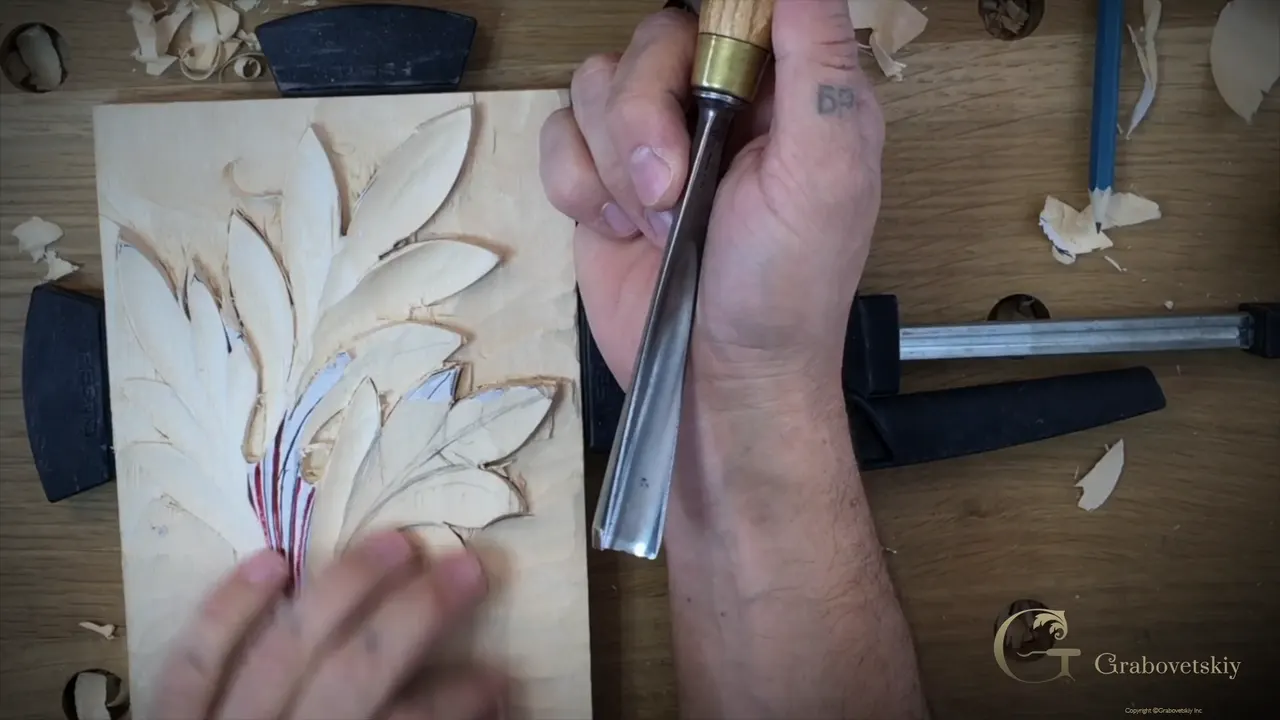
Wood carving is dangerous the way every sharp tool is dangerous, and I once told you on camera that a carving knife in your hand is sometimes more dangerous than a table saw. Mostly it gives you small cuts on the fingers. A few habits keep them small, and you can learn them before your first gouge comes out of the box.
Do you want to carve with tools sharp enough to slice wood clean? Would you like both hands whole when you put those tools away? Then learn where the edge goes when it slips.
So is wood carving dangerous for you? Here is what I actually do at my bench, taken from my own lessons, including the one rule I break and the way I break it.

Six things my lessons say about cuts
- A carving knife can hurt you badly if your movements are not under control.
- Small cuts still find carvers who work all day.
- Keep your holding hand where a slip goes forward into the air and not into you.
- The old rule says never carve toward yourself. I break it with my hands locked on the wood.
- Locked hands give you short moves only.
- When a shortcut turns into a safety concern, I skip it, even if it would save me a minute.
How dangerous is a carving knife?
Really dangerous, in my words, and you can damage yourself with it. Lesson 11 of the Lily Box had me carving a lily with a knife, and I said it plainly. That knife in your hand is sometimes even more dangerous than a table saw. With really sharp tools and movements you don't control, you can cut yourself.
Sometimes you have to work like that, I said, especially if you want to carve really complicated flowers. I remember a day when I cut myself many times. Small micro cuts. Nothing dripping. Still uncomfortable, because you keep poking and making little cuts in your skin.
A lesson later I warned you again near the fingers. That part of a knife can poke into your skin and leave micro cuts. Not a big deal, and not deep, but really uncomfortable. Safety is really important, I said.
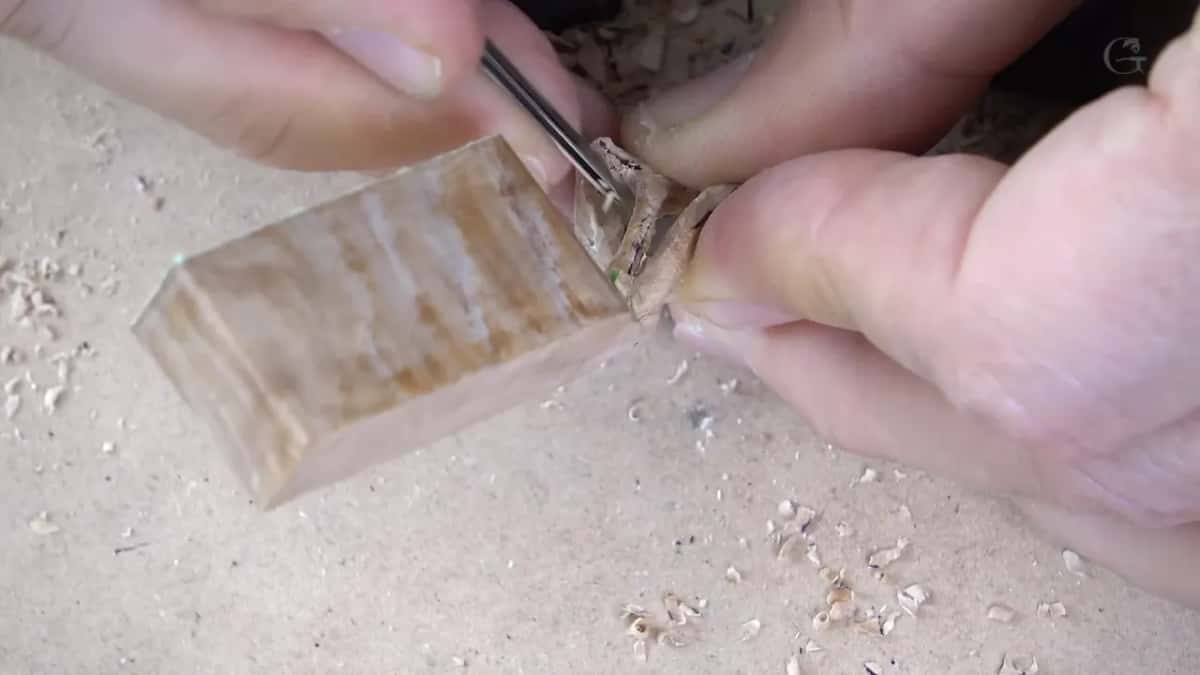
During a livestream in April 2020, with a knife in my hand, I said it another way. Never place your hand at the front of your knife, because you can slip and cut yourself really, really badly.
Knives go both ways, by the way. For my Chamomile and Bow Rosette I said you could pull the knife toward yourself if it feels safe for you. Take your time, check the grain, and don't take big bites. Little by little.
Do woodcarvers still cut themselves after years?
They do, now and then. On my furniture panel I held a finger close to the edge, because that gives me much better control, and I told you to be careful. Sometimes I cut myself.
It happens maybe once in a while. When you carve all day long you're not afraid of the tools anymore, and you cut yourself. Back on the Roman acanthus I told you about days when I cut myself over 100 times, on flowers so thin you could see through the wood.

With the Hashemi flowers I went further. Some people get cut even when they never point a tool at themselves. They still manage it somehow, and I said that's just the wood carving trade. I've cut myself too, multiple times. You kind of have to live with it, as long as you don't cut your finger off completely.
Where should your holding hand be?
Clear of the blade's path, every time, even when the edge is coming your way. Carving the first layer of the Lily Box, I was working toward myself, so I pressed one point down on the board, really stable, and used a finger to control the tool where it could slip.
The other hand stayed clear of the edge. If it slips, it slips forward. My hand is not in the way, so it won't cut me.

In the first cuts course for beginners I called it a really important rule. Never place your hand in front of your knife. Even if you have to hold the piece, your hand stays off the cutting side of the blade.
Outlining the kitchen cutting board in the other beginner course, I told you the hand that supports the piece has to be away from the cutting blade. Never on the way of the knife. And I've done it. I cut myself.
Lesson 16 of the Roman acanthus puts it shorter. Never put your hand in the way of a tool. Even when your hand sits somewhere ahead of you, it still has to be kind of away, because if the tool slips, you don't want it slipping into you. I guess you also have to cut yourself sometimes, I said there, so you understand and learn from your own mistakes.
What is the rule of direction in wood carving?
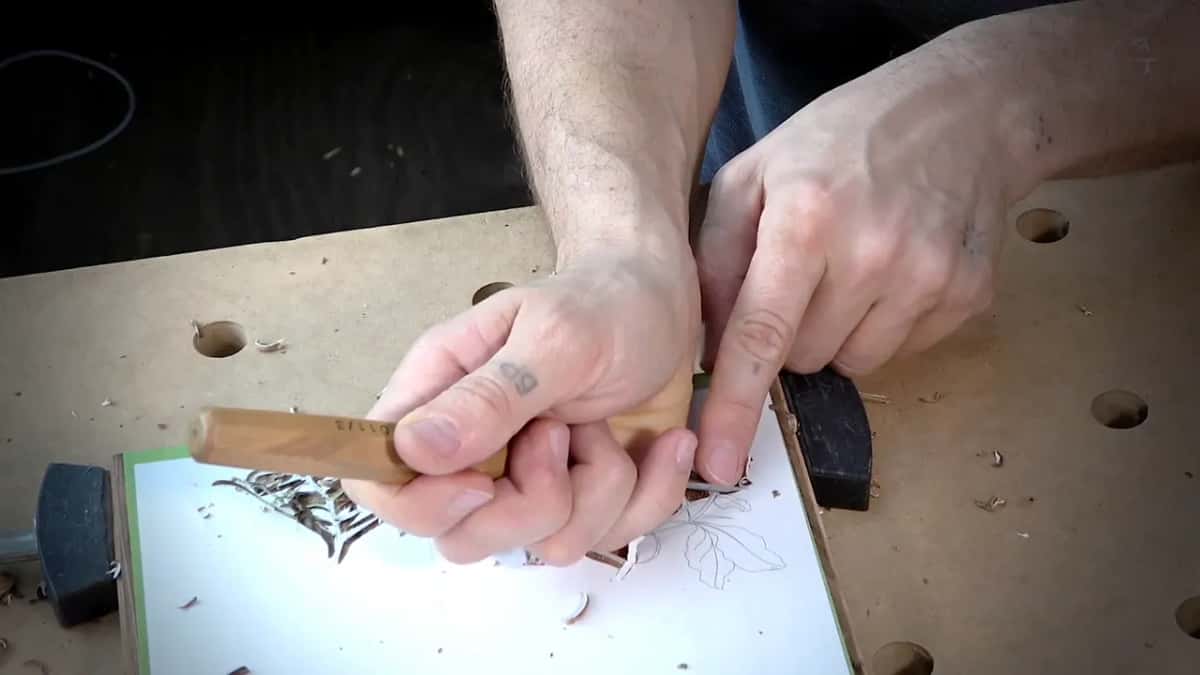
It says you never cut toward yourself, since you can slip with your tool and poke yourself. This short lesson is me explaining the exceptions while I carve a Corinthian acanthus leaf. Rotating the piece again would probably be the best idea. Sometimes, on a huge piece, there is absolutely no way, and the passes still have to come toward you.
The way to break it came from a student at the Marc Adams School of Woodworking who is also a student of my school, and a dentist all his working life. You work toward yourself, but you lock your hands, elbows on the work table, so you're not floating above it. You can always stop, and the tool is not going to fly toward you. The same footage is part of lesson 3 of the Corinthian acanthus.
The price is short moves. Your movement is going to be limited. You won't do a really long pass, only small ones, and I tried those, and they work really fine with no problem.
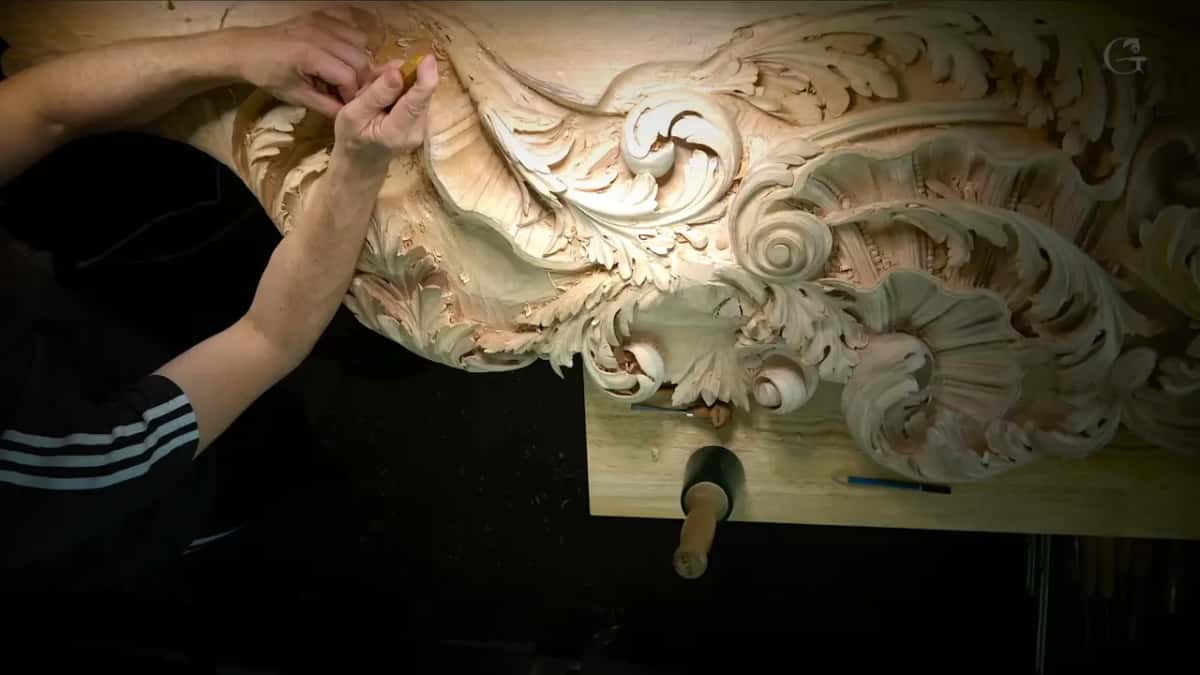
I was carving toward myself in workshop 67 of the Venice Room, and I said I would encourage you not to, because that's not the safest way. One slip and you cut yourself, which would be a big mistake. Then I gave the rule its second half. If you do have to carve toward yourself, lock your elbows and your hands right on the piece. Even if you slip, the locked hand won't let you get cut. And if you don't have to, don't do it.
Why do carvers break the rule anyway?
Mostly because there's no other way, and sometimes because of my cameras. During the modern acanthus I told you not to do it my way, never point the tool toward yourself. I was doing it just for the camera's sake, I said.
Carving an acanthus leaf in Byzantine style, I said I wouldn't rotate too many times, for the camera. One of the excuses I like to say. Really, I still carved toward myself. Everybody does, I admitted, and then I said I guess I'm breaking rules.
Right after that I showed how I was holding my hand. Still locking, still holding on something. The other hand almost does nothing. It just supports and guides, carefully, with hardly any pressure. Always lock on something, I said. If it's not the block of wood you're working on, lock on whatever surface you can find.
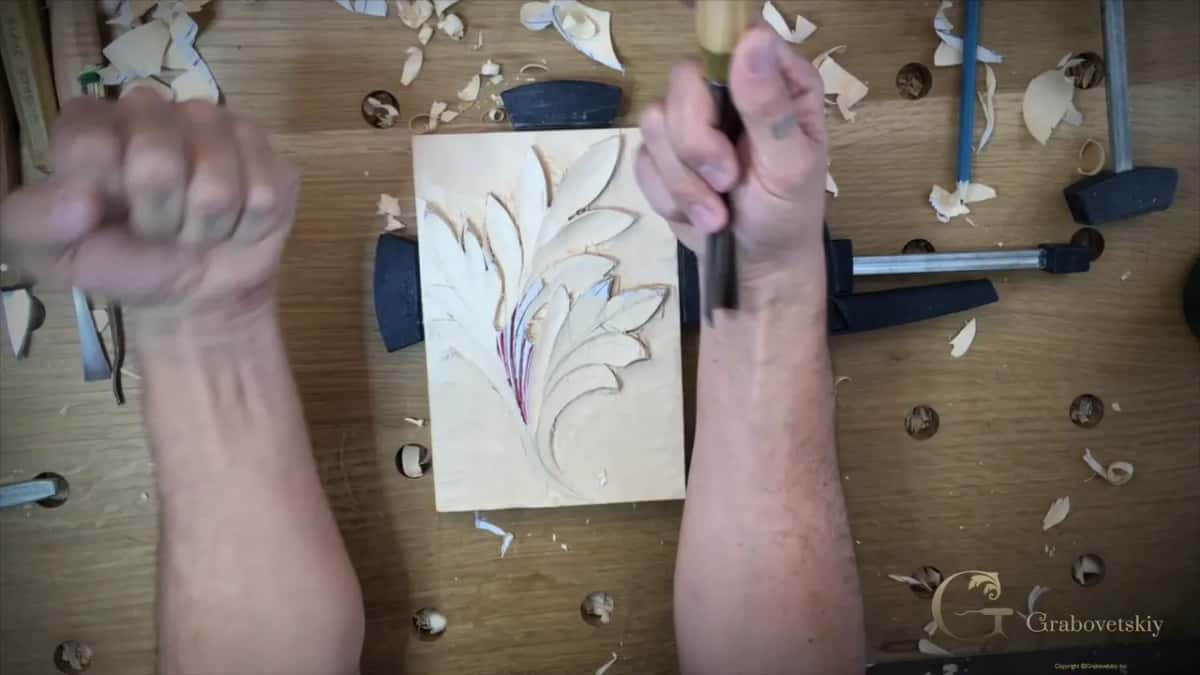
Late in the Venice Room, in workshop 162, I said it again. It's not the best way. But if I rotate that piece or even walk around it, I'm going to cover my cameras and you won't see what I'm doing.
In lesson 2 of Acanthus over Moldings I told you not to use the tool like I do. The reason was the position of my camera, because I really don't like to reposition all the time. Then I said it is better not to. Just be wise, and rotate the piece, or rotate the angle you attack from.
Other times the piece decides, as it did in workshop 53. I couldn't rotate the work, and carving toward myself was probably the only way I could attack that spot. I placed my hand right on the wood and held it strongly, and I believe that's safe enough. But I'm not advising anybody to do that.
Your bench can decide too. While I carved the Roman acanthus in lesson 6, I said it's easy for me because I use a vise and can rotate any time. Some of you work on a dining table, where every turn means unclamp, rotate, clamp again, and carve. A hassle.
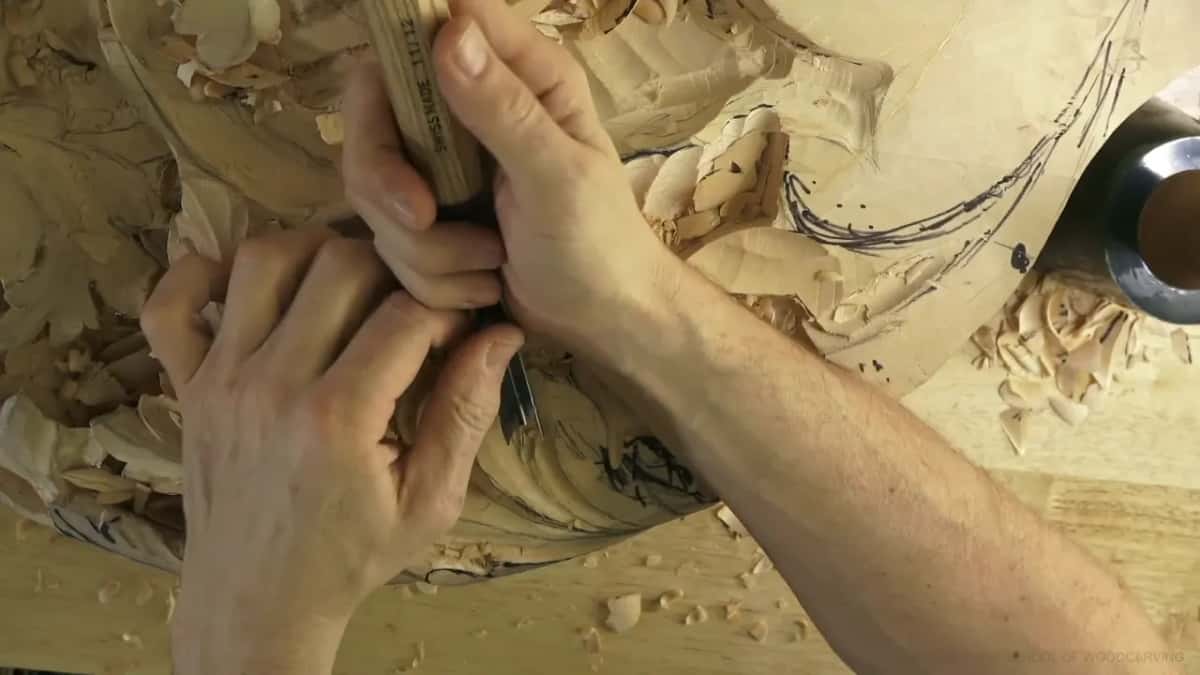
Whatever the reason, the hands go down first. My whole body was in front of the work in workshop 25, so I locked my hands really strongly on the wood. I'm not doing it from the air, I said. Then in workshop 82, in a spot that was not the best position to carve, I said that if you're locking your hands really solidly, it should not create any problem.
I'm going to be honest with you. Every carver will say don't do it, but everyone still does it. Back at the furniture panel I said most of the carvers I've met break that rule. There's a lot of stuff you're not supposed to do.
How much of the blade should stick out past your finger?
Very little. In lesson 11, on the lily, I put a finger right at the edge for reference and kept another one slightly lower. I wasn't exposing more than about a sixteenth of an inch, roughly 1.5 mm.
I still wiggled the tool as much as I could to control it, and I told you a slip was still possible.

Hashemi flowers again. There I repeated advice I'd given in an older lesson, never point your tool toward yourself, because you can always cut yourself. And yes, it's true. But when you lock your hand on one point, the way dentists do, and you're only doing micro movements, I said it's actually safe. Later, on Acanthus over Moldings, I added a sharp tool to that, so you don't have to press too hard, because a dull one makes you push really hard and it can slip.
When is a shortcut not worth it?
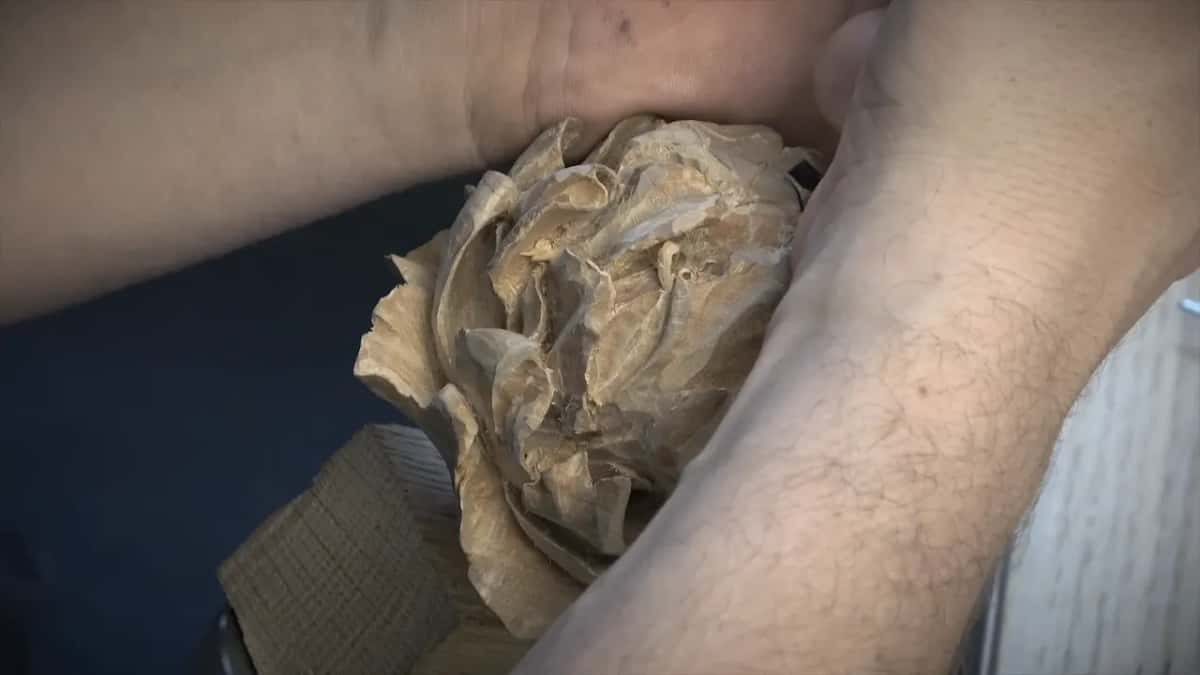
When it turns into a safety concern. Workshop 57 of the Venice Room had me working toward myself on a huge piece, using my finger to control the tool, with my hand placed really solidly on the wood.
With a smaller carving I'd rotate the piece or walk around and attack from the opposite direction. That would be smarter. Safer, I should say.

But that panel was too big, and walking around it costs time. I have a kind of deadline, not a real one, just the day I want the work finished, and if I can save a minute, I'd rather save it. Only if it's still safe. If it's a safety concern, no, I'm not going to save a minute.
And I said why I allowed myself that one. By then I had developed the skill of controlling the tool there without cutting myself.
What if a pass doesn't feel safe to you?
Then don't make it. Back on the lily, close to my own finger, I said if you're going to do exactly what I'm doing, be really mindful, because that is dangerous.

If you don't feel comfortable doing it, please don't try. Don't try. I don't really want to be responsible for the damage you can do to yourself. And I didn't go to the extreme either, because that wood was kind of crunchy.
Earlier in that lily lesson, with the piece not clamped, I warned that you'll most likely end up working toward yourself. Sometimes you have to. I used a number 9, about 10 mm, 3/8 inch, toward myself, taking the center out little by little. Just be really careful.

Six moments of wood carving safety from my lessons
| When it happens | What I do, in my own words | Which lesson |
|---|---|---|
| Knife near fingers | Holding hand stays away from the blade | Beginner course |
| Piece won't turn | Hands locked on the wood, small moves | Venice Room |
| Camera blocks turning | Lock the forearm and tell you why | Byzantine acanthus |
| Work not clamped | Go slowly toward yourself, be really careful | Lily box |
| Shortcut feels risky | Don't save the minute, skip the shortcut | Venice Room |
| Pass feels uncomfortable | Please don't try it at all, I said | Lily box |

Where to watch these habits at work
The lessons I named are where you can watch the hands. The Techniques course collects short answers like this one about wood carving, the workbench and the grain. Want me watching your hands while you learn this? That is what the school is for.
How it's done
- Turn the work first. If the piece can rotate, rotate it and come in from the other side, because that is probably the best idea and the safer one.
- Keep the holding hand behind the edge. Find a position where a slip travels forward into empty air.
- Lock down before working toward yourself. Elbows on the work table and hands on the piece itself, so you can always stop and the tool cannot fly back at you.
- Make small moves. Locked hands limit your reach, so take short passes only.
- Skip the pass you do not trust. Leave it alone. If it is a safety concern, saving a minute is not worth it, and if it does not feel comfortable, do not try it.
Frequently asked questions
Do professional woodcarvers cut themselves?
Now and then, yes, and I include myself. My furniture panel lesson has me saying that when you carve all day long, you stop being afraid of the tools, and you cut yourself. On the Hashemi flowers I admitted I have done it multiple times, and some carvers manage it without ever working toward themselves.
Is a carving knife really that dangerous?
The Lily Box is where I put the knife next to the table saw and said it is sometimes worse. Give a really sharp blade to a hand whose movements are not under control and it can damage you. The day I remember cutting myself many times left small micro cuts, uncomfortable but not dripping.
Should beginners carve toward themselves?
Not when the piece can turn. When I did it on camera in the Venice Room, I said I was not advising anybody to do that. A knife is different, and on the Chamomile rosette I said you could pull it toward yourself if that feels safe and you take no big bites.
What to carve next