
Alexander Grabovetskiy, woodcarver, School of Woodcarving · Published 2023
What makes a wood carving Rococo instead of Baroque?
Quick answer: A Rococo carving, on the French panel I brought home from a class, is still Baroque in its acanthus but brings in rocaille, a different style of shells. On a June 2023 live stream a viewer put that question to me. Yes and no, I said, and called the piece probably Rococo, a transition, a little later.
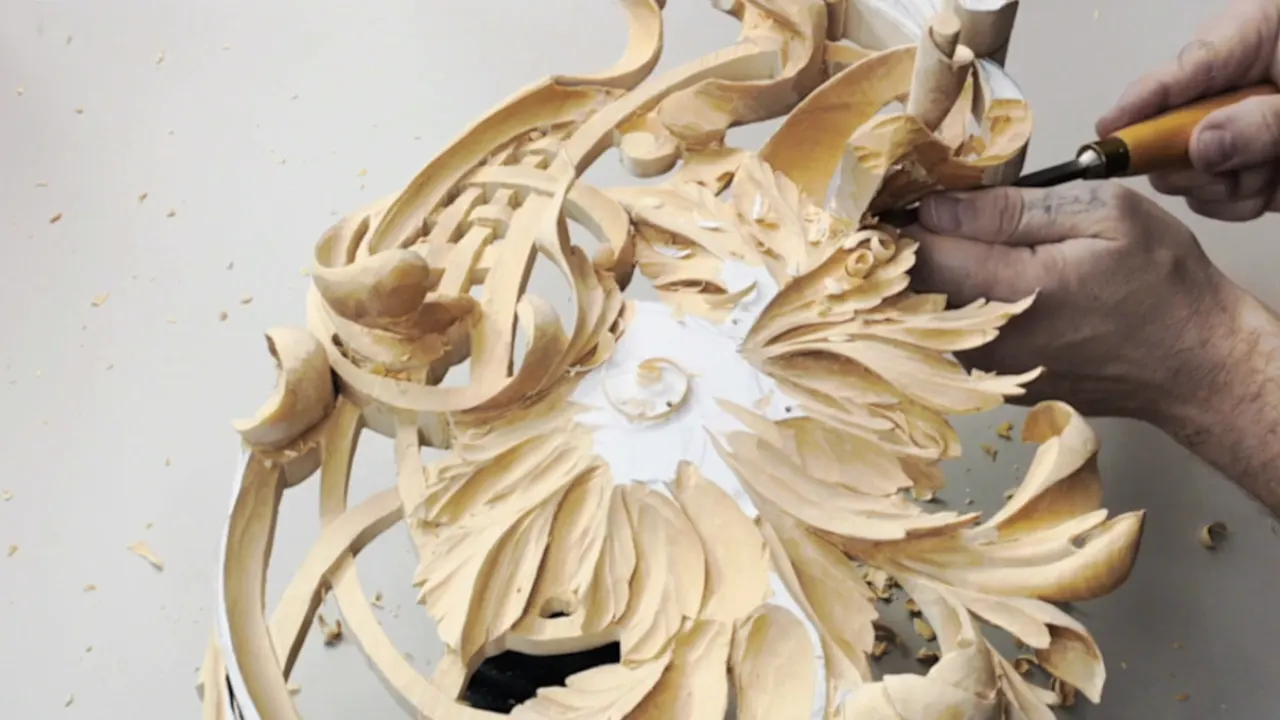
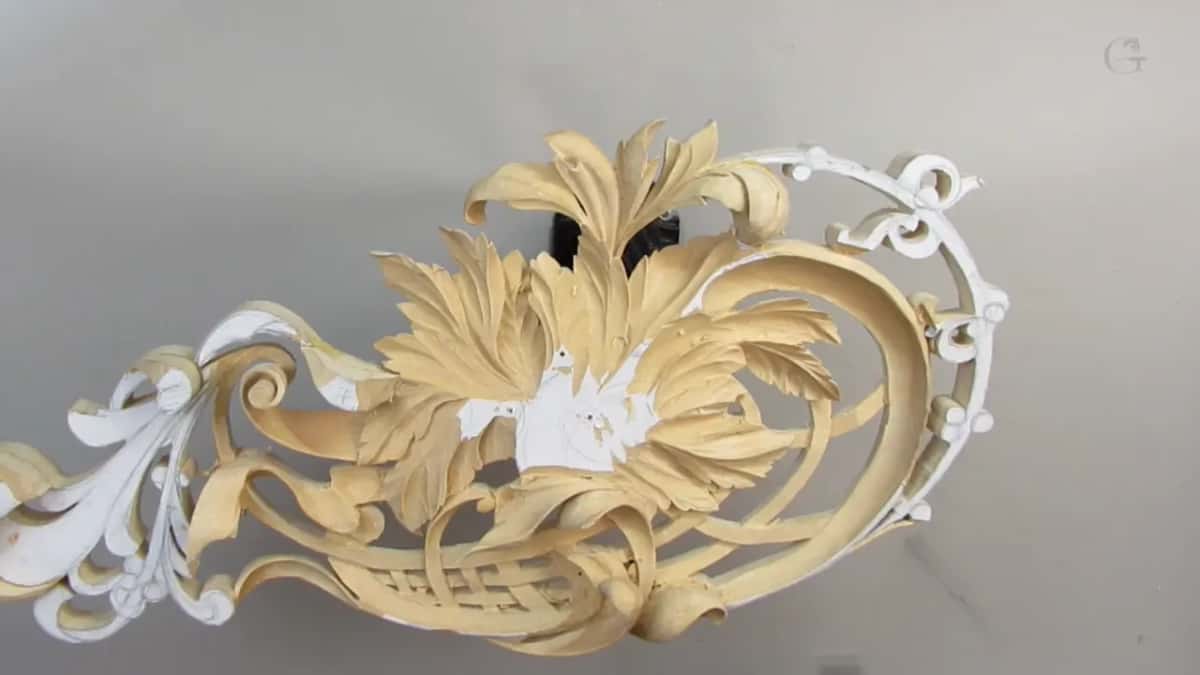
Rococo wood carving, on the French panel I brought home from my last class, is Baroque style acanthus with rocaille shells carved in beside it. A viewer asked me on a live stream in June 2023 whether those were Baroque acanthus leaves. Yes and no, I said. Then I called the piece probably Rococo, a little later than Baroque, and admitted I was not sure I even said the word properly.
Have you ever looked at a carved leaf on an old frame and wondered what to call it? Did Baroque come to mind first? Somebody in the chat had the same thought that day, and on this panel the shells beside the leaf settled it.
An excellent question, I said. I really liked it. What follows is what I pointed at on the panel that day, one part after another, and the places where I hedged. The stream ran close to fifty minutes, with questions from the chat coming in between bits of carving, and several of them were about tools and design.
The pictures come from my other lessons on Vimeo, where I carve the same kind of leaf, shell or ribbon. The panel itself appears in the last lesson of my butterfly plate course, where I held it up and called it a full 3D French style, Rococo in this case.
What the French panel showed on the stream
Its acanthus keeps a Baroque style.
Rocaille, the newer kind of shell work, is what made me say Rococo instead.
Baroque names a time, and that time came earlier in Venice than in the north.
One ribbon faces one way while the smaller one turns against it.
Big and small parts pair up near 62 and 38.
All of it comes out of one piece, and in one place the undercut runs close to an inch (25 mm) deep.
Is Rococo considered Baroque?
Partly. On this panel I said it's still Baroque style, but they already introduced some rocaille, so you cannot say it is Baroque. I'm going to be honest with you. That would be a Rococo, I said, and the word just sounds weird for me.
The question came from the chat, about whether the leaves were Baroque acanthus. Not really, I answered. Then I said it was both. When you say Baroque, you are referring to a time, to the Baroque period, and the trouble with that timing is that it all depends on where you are.
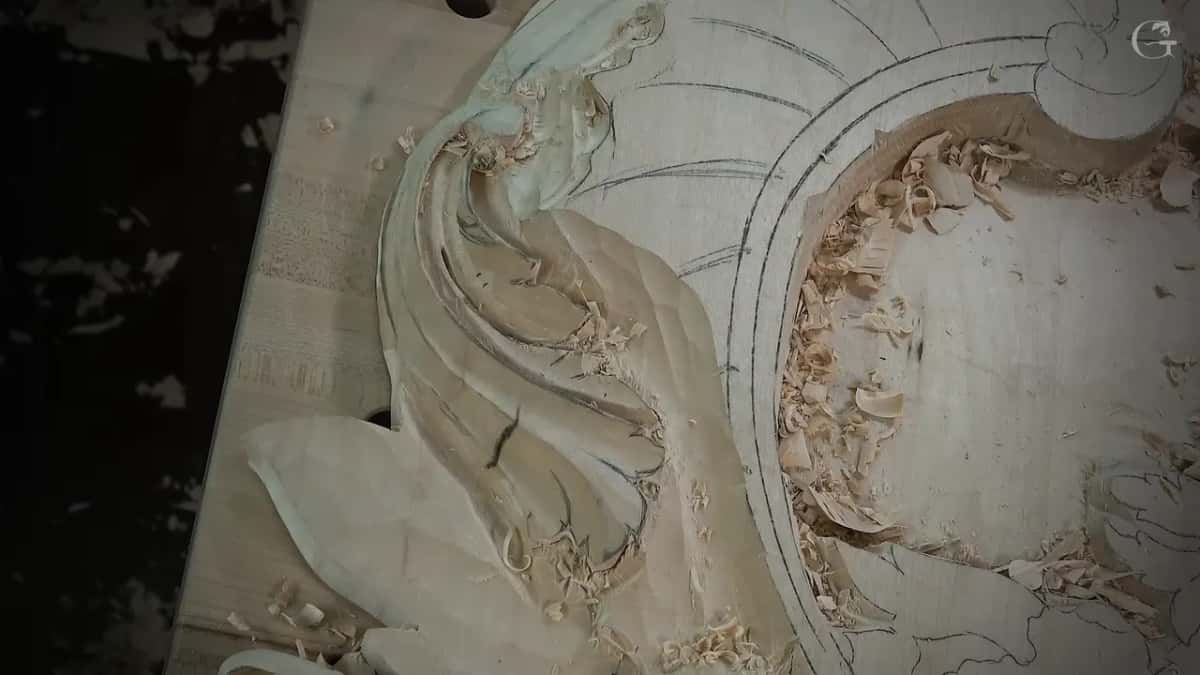
Venice, I said, had it long before the northern countries did. I started to say Italy and stopped myself, because Venice wasn't part of Italy; it was the Republic of Venice. England and Germany did not get to it yet, I said, for a long while after.
This particular panel is like a transition. It's a French style and a Rococo style, a little later, and they still would use that same kind of acanthus on it. There is a big difference between Baroque acanthus and the later ones, I said, and even so I would only say probably Rococo here. So the panel sits between two names, and I picked the later one with a probably in front of it. Why a style name needs a place and a time before it tells you much is the argument on my Venice Room page about the Venetian style.
What is rocaille on a carved panel?
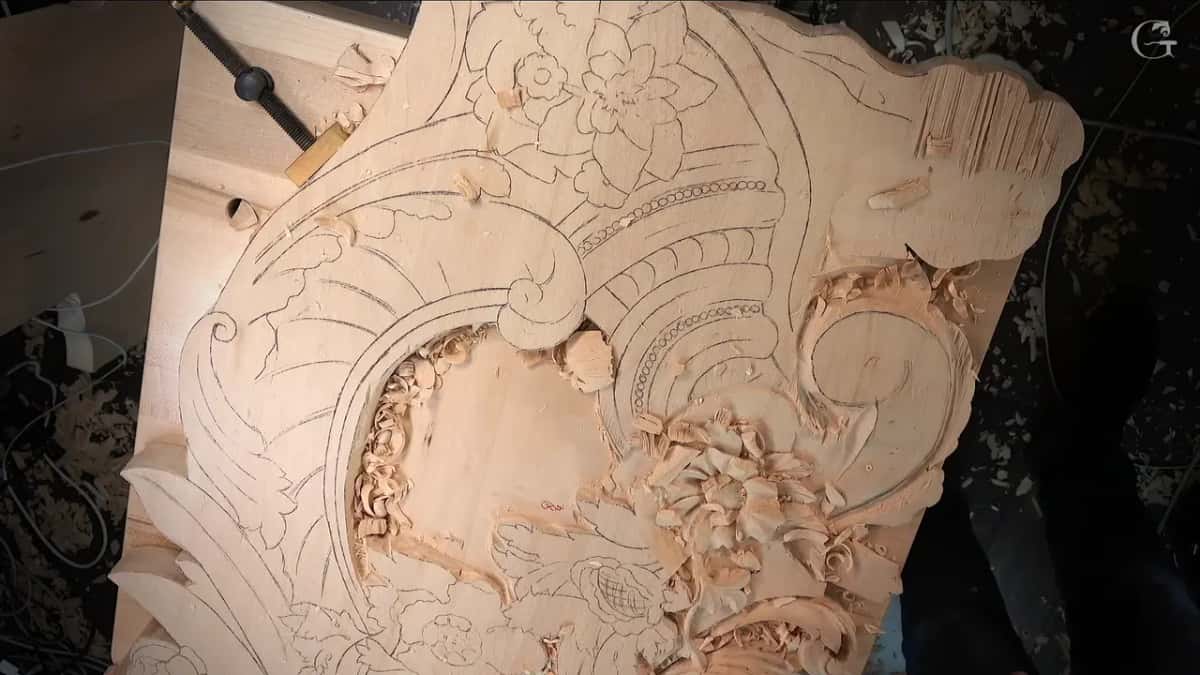
Rocaille is the word for the shells on this panel, and I put it loosely on the stream: some shells, or whatever, the rocaille they call it. Later in the same answer I called it a different style of shells. That was the part that moved the name away from Baroque for me. Leaves alone had not done that.
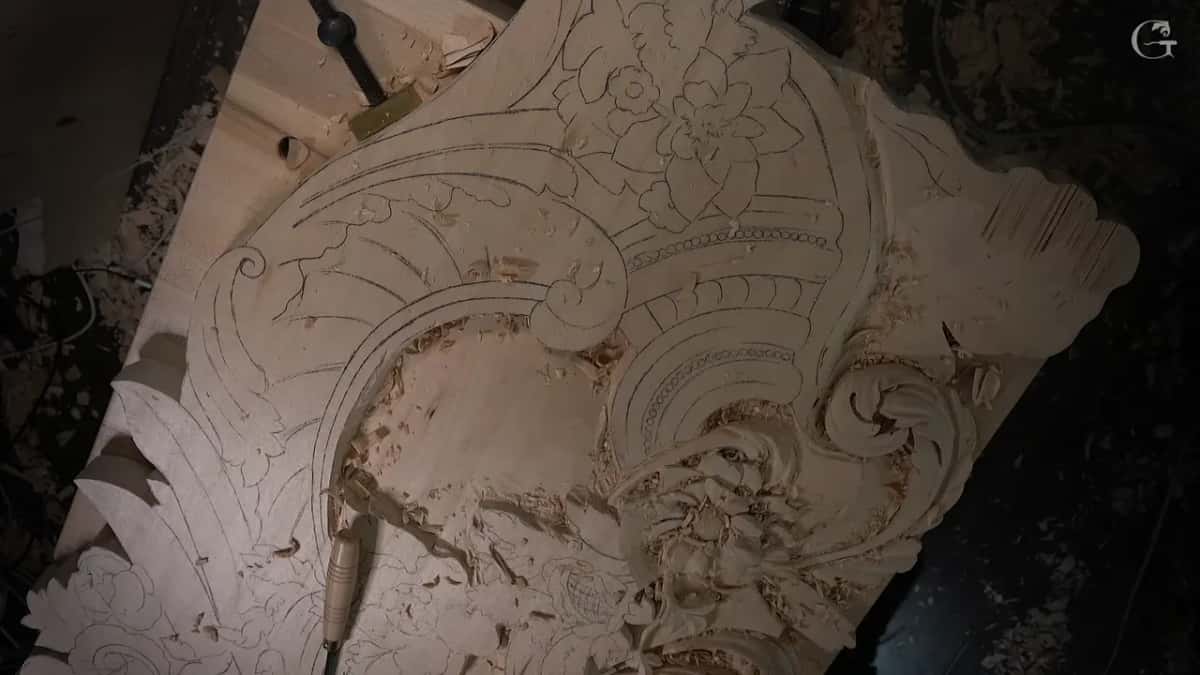
When I talked about the panel's proportions, I set one part of a shell beside the other part, the way I had just done with two ribbons. You can read about rocaille and Rococo as styles, with a long written history behind them, but I stayed with the panel in front of me.
Shells come up all through the Venice Room as well. Planning a shell movement next to an acanthus has its own page, from workshop 116 of my Venice Room.
What else is carved on this French panel?
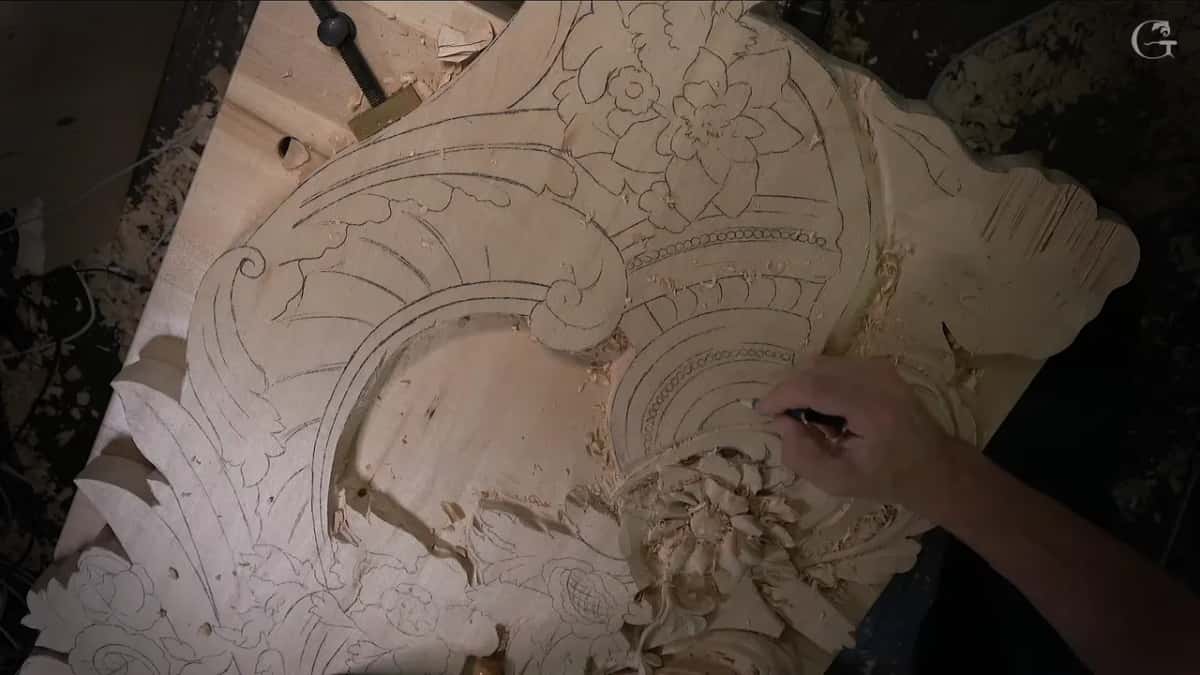
Acanthus movements, shells, a couple of ribbons and a flower are all on it. Actually a couple of movements, I corrected myself. Put together, I said, it covers pretty much all of the aspects of wood carving. I kind of like the idea of this piece. Anyway, that piece is really nice, I said. I held it a little closer so the camera could see it.
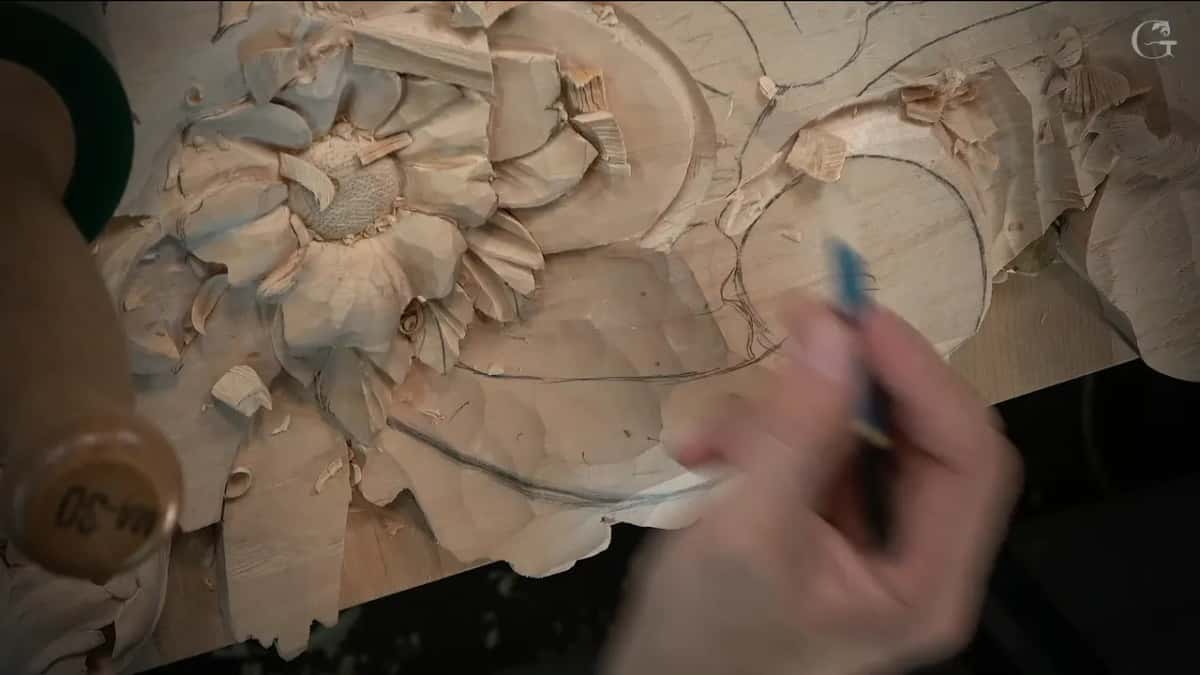
Our class worked on this traditional French style the last time I taught one, at the Marc Adams School of Woodworking in Indiana. My goal when I teach in person is to cover every part of the craft rather than to finish, and after five days it was not 100 percent done. I brought home whatever I need to finish it. During the stream it still looked somewhat rough to me, and I said so. Between the questions I carved a little.
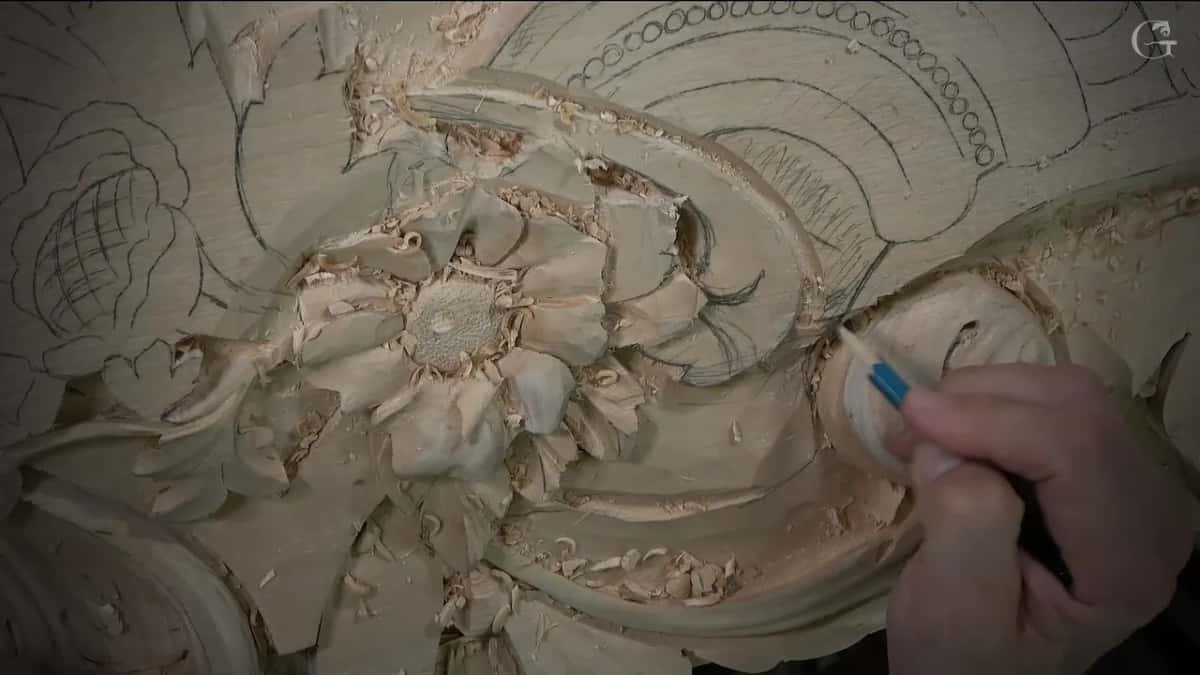
Why do the two ribbons face opposite ways?
One ribbon faces one direction, and the smaller ribbon tries to fight that and goes the opposite direction. Even in the movements, I said, you can do an opposition. I look at design that way.
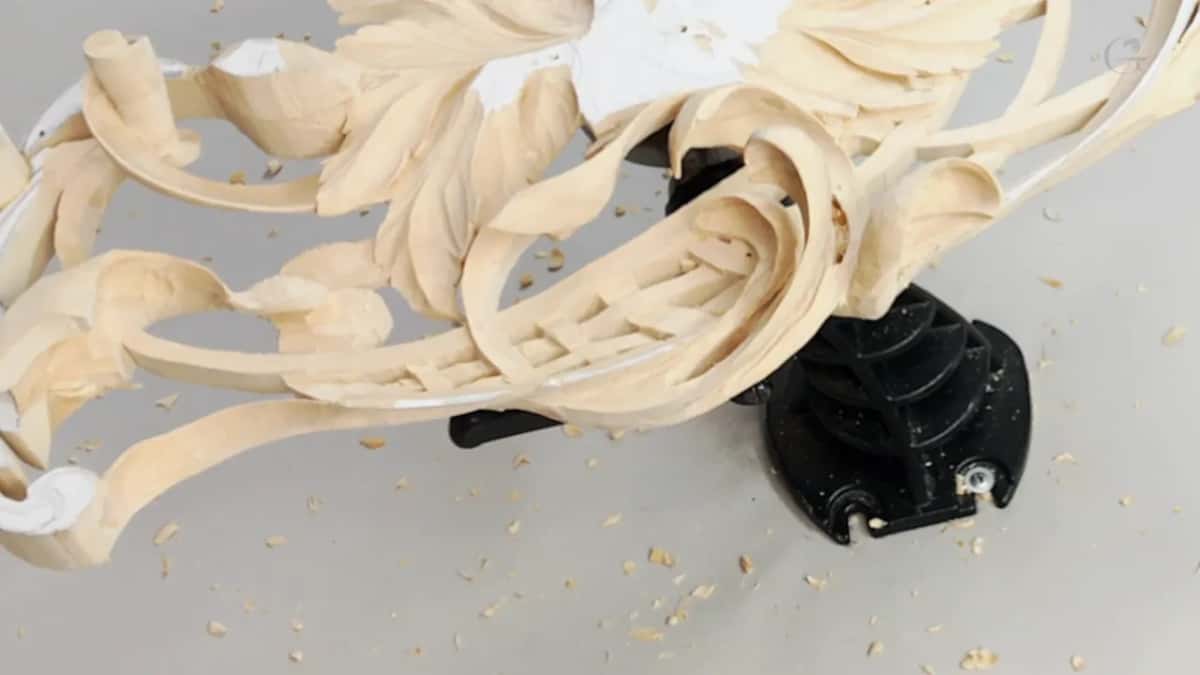
If you know a little bit about the logic I try to follow, I try to see conflict in everything, and then I corrected myself: not really conflict, but the idea of oppositions. When I look at nature, everything is opposing something: there is black and there is white, light and darkness, plus and minus in electricity. And always in those oppositions, one is dominant and the second one is lesser.
Opposites do not always fight, I said; male and female are opposite, and that is a harmony. I see conflict as the main idea of the design, and I have a whole course about design, conflict included.
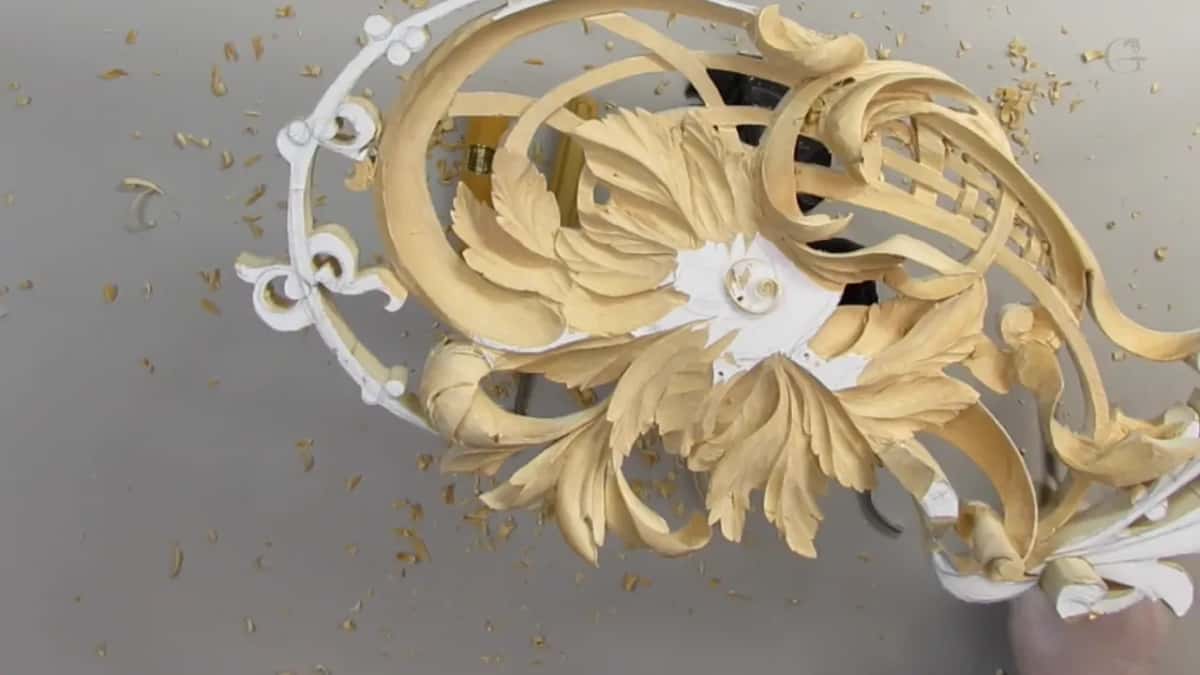
Not every pair on the panel turns against its partner. Two acanthus parts there go pretty much the same direction, and I said one of them is just less meaningful. Everything fights, and it is more harmony, was how I put it a little earlier.
On the butterflies I showed later that day, I said you can find the opposition there too: the space is a golden ratio, and the position from the edge is 60 40 again. I asked out loud whether turning one movement against another makes a huge difference. Not necessarily, I said. It just makes me happier when I bring those elements of design in.
How do big and small parts pair up on the panel?
In pairs, one dominant and one lesser, and I put them at about 62 against 38, the golden ratio. Call a stretch 100 units and the split lands at 60 and 40. I said every little detail of this project is based on the golden ratio and the Fibonacci sequence, even inside the acanthus.
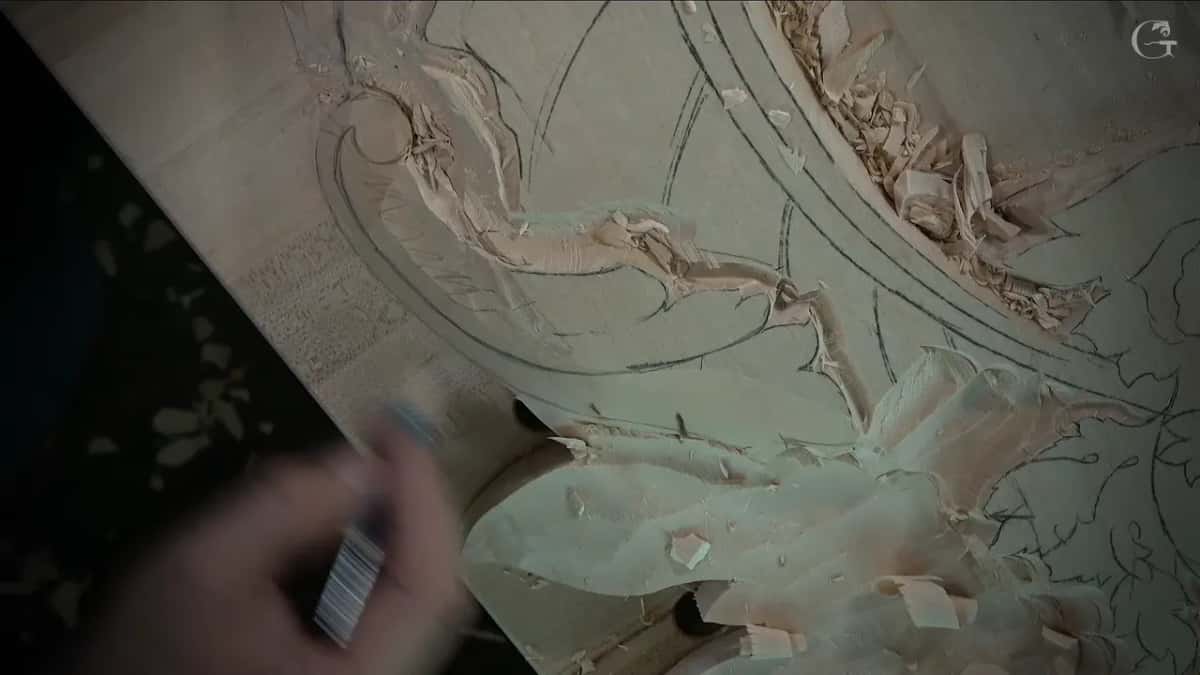
This one is an acanthus leaf, I said, and I repeat that leaf right here; those guys are in opposition to each other. There are two pieces of acanthus, and two volutes as well. Take a look at this volute and take a look at that one, I told the viewers: this one is bigger, that one is smaller.
Where one part begins against the next came out the same way, and so did the distance between one ribbon and the other. So everything is just connected. I also showed the main golden spot, and the space between one end and the center, set against the center and the other end, gave 60 40 again. The camera doesn't show it really well, I admitted.
Placing a design by that ratio is taught in a lesson of my design course.
What changes when the whole panel is one piece?
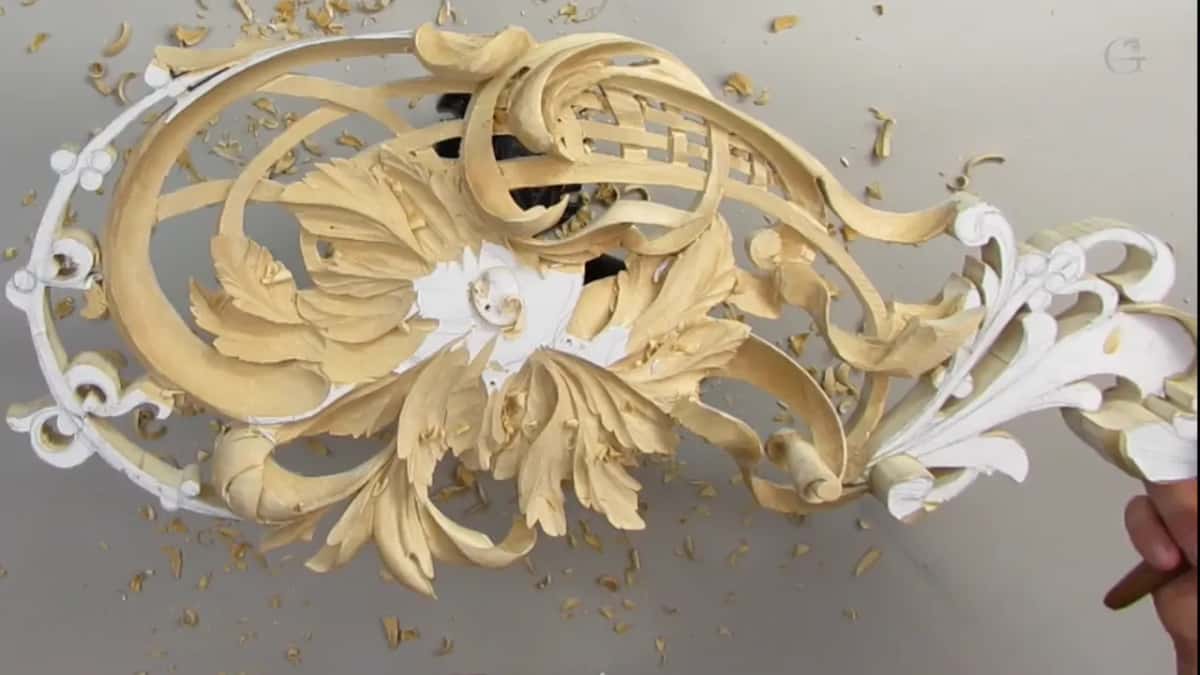
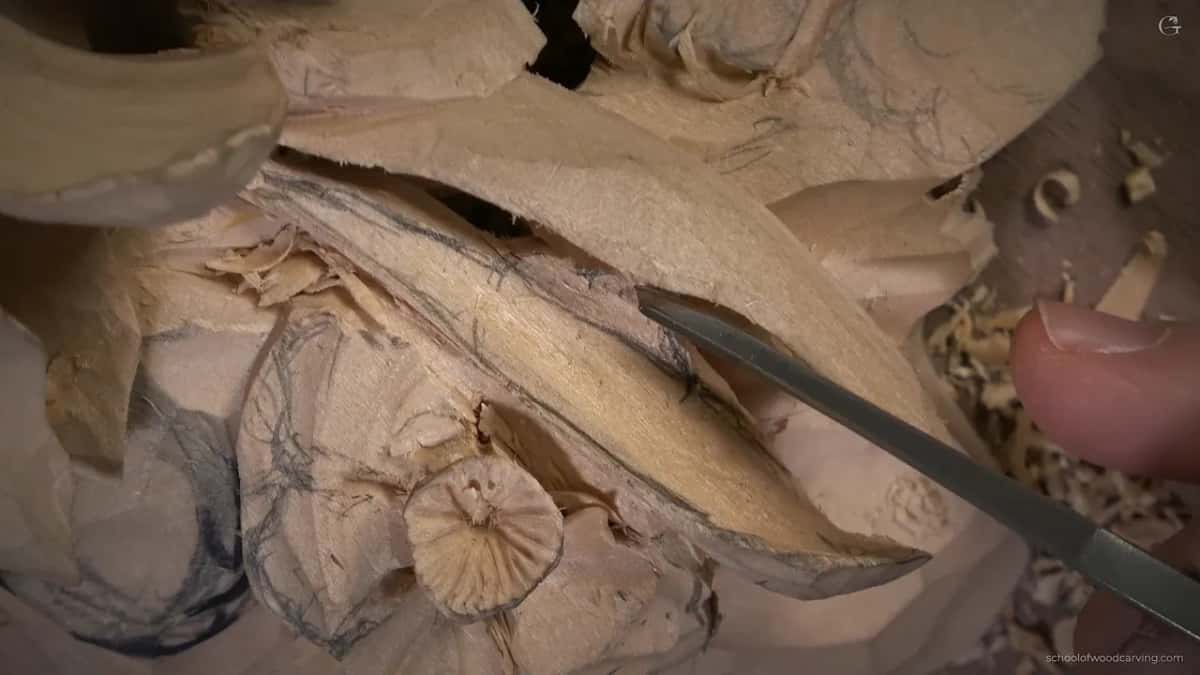
Reach changes. Everything on it is carved from a single piece, nothing glued on, and just because of that, in some spots a straight tool is not going to give you the ability to get where you need to be. It's a single piece, by the way, I said, and to get really deep you really need some kind of tool.
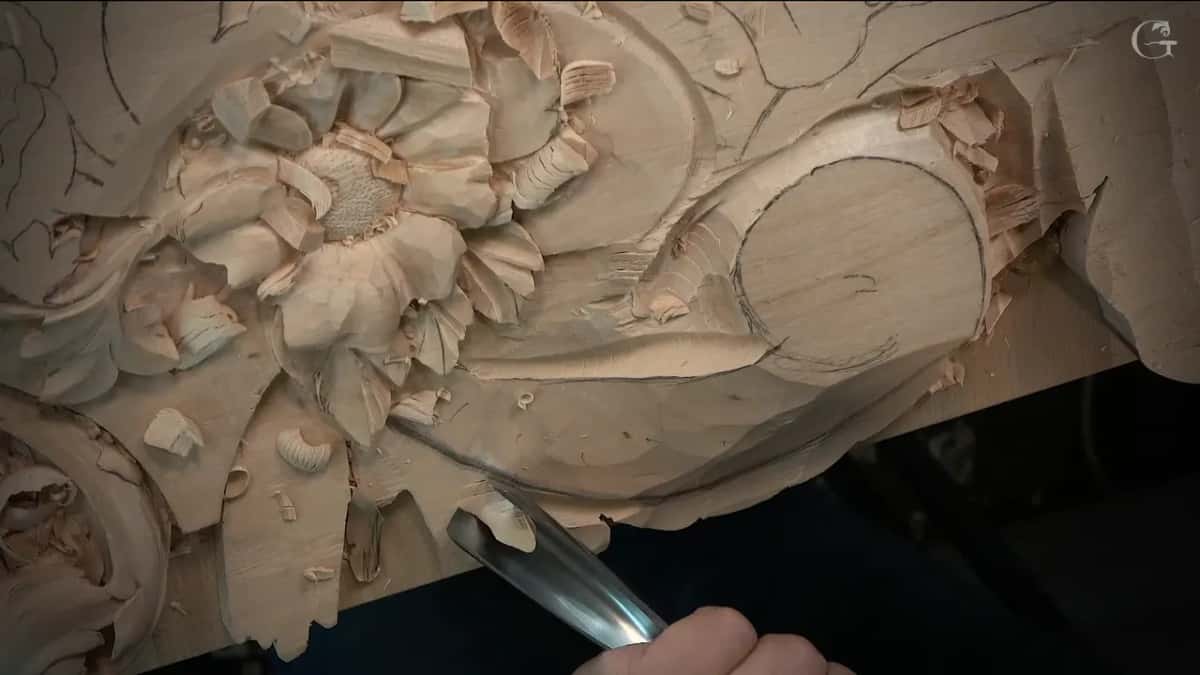
There, that tool was the back bent, and my page on back bent gouges covers the two jobs it does. Asked about the tool in my hand, I showed a straight gouge next, an Ashley Iles.
How deep does the undercut go on a piece like this?
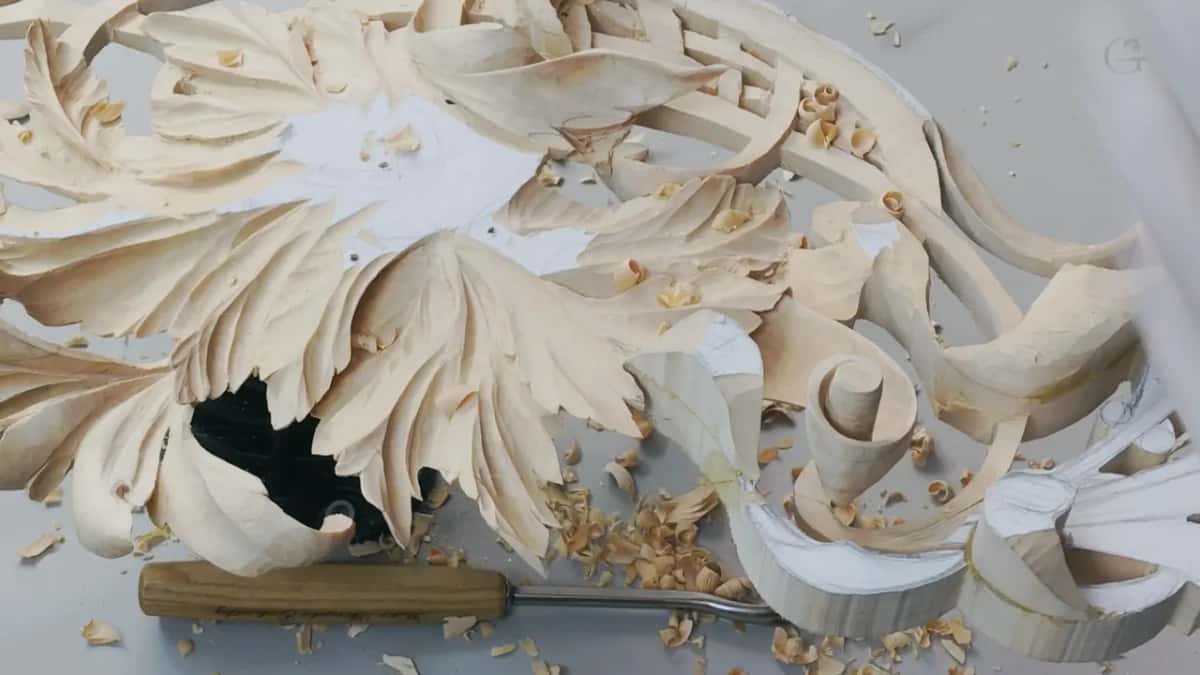
About one inch (25 mm), going right underneath, in the spot I showed when a viewer asked about reinforcing undercut leaves. Let me show what you mean, I said, picking a place where it goes right under. I checked the depth on camera first. A really deep undercut, I called it. I keep in mind the direction of the grain, and there it's pretty strong.
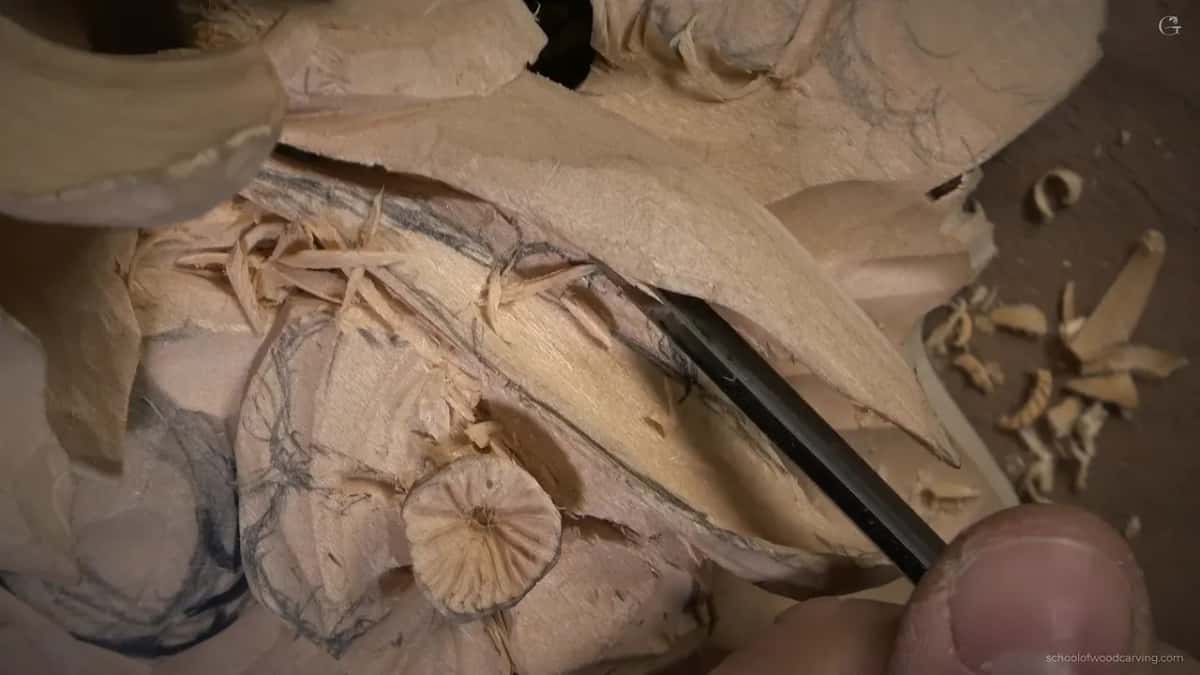
But sometimes there is absolutely no way to reinforce it. On another piece I showed, all of the leaves are carved from a solid piece and undercut, with no reinforcement. Just be careful, I said.
I tried to explain it a little better after that. From the top the leaf is flat, but the bottom goes almost like a V, with some kind of rib right in the center. Not sure if it makes sense or not, I said. The edges are thinner, even if it looks paper thin, and it still goes almost like a keel on a boat: every fishing boat has a keel like this, and that just reinforces it. Whether I had understood the question correctly, I could not say, and I told the viewer that.
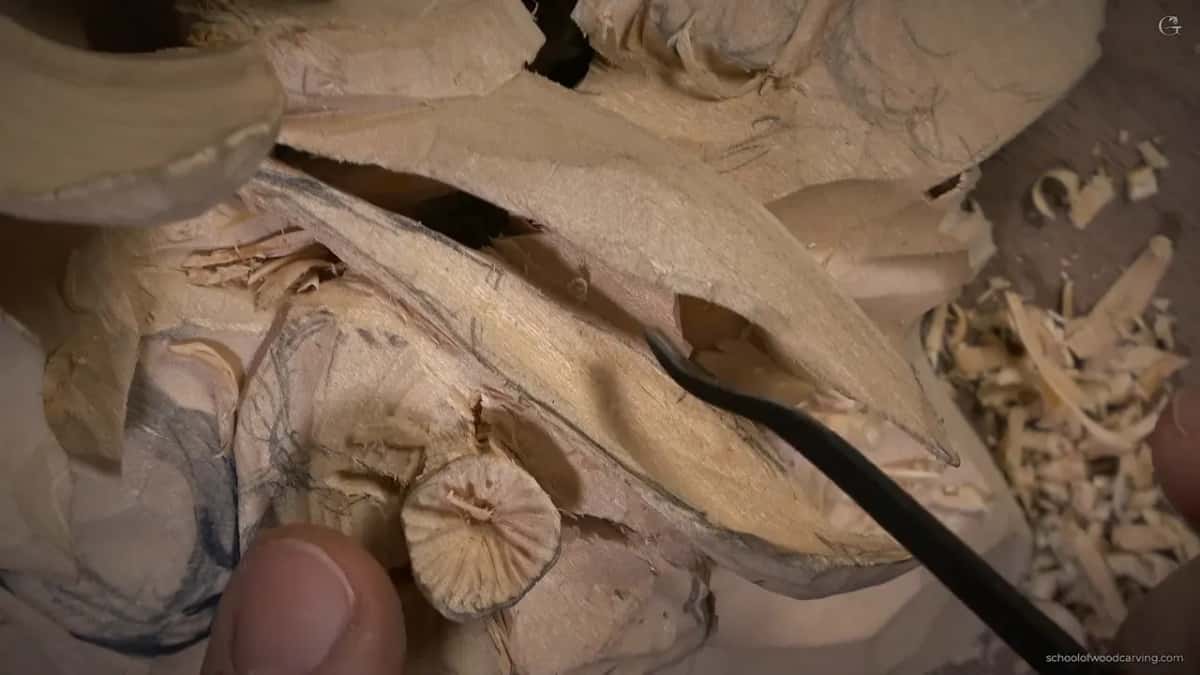
Some of that work you can't really do anything about. A piece like that is fragile, and if I drop it, I'm going to break it. That same day the Grinling Gibbons style piece from my Maine class broke twice on camera. The next stream, with landscapers mowing my grass outside, was about how I stabilized fragile pieces like it, and the long version is in my article on stabilizing thin carvings.
Which parts did I point to on the stream?
Here is the panel part by part, in my words from that day, with what each one shows about the name.
| Part | Said | Shows |
|---|---|---|
| Acanthus movements | They still would use a Baroque style acanthus on a piece like this | The older root |
| Rocaille shells | Newer shell work, and the reason I would not call it Baroque | What came later |
| Two ribbons | The small one fights the big one and heads the other way | Opposition in movement |
| Pair of volutes | Bigger and smaller, the bigger close to 62 percent of the pair | Dominant beside lesser |
| The flower | One more part on a piece that covers nearly the whole craft | One of several |
| Single piece | Every part from the same wood, so a straight tool misses spots | Reach picks tools |
Read down the middle column and you have my answer from that stream, cell by cell. The left column is what you would see if you held the panel, and the right one is what each part told me about the name.
Where do these parts show up in the lessons?
Ribbons are carved in my Hashemi flowers course, and the ribbon pictures on this page come from it: a pierced carving with a woven lattice, painted white in places. The Maine class was filmed, and it is in my Grinling Gibbons course, where the undercut leaf pictures come from: a narrow gouge going in under a leaf edge while a thumb presses on the handle. The Venice Room pictures show shells laid out in pencil next to volutes that are already carved. Shells and volutes run through the Venice Room, a Venetian style carving that took me about two years of filming.
In the butterfly plate course I also show how I draw and design that plate right in front of the camera. If you want to follow my logic, I said, the online school is where I explain my approach to design, and I carve there pretty much the way I carve.
This stream sits in the livestream events course, beside the other streams I have run since 2020. Every lesson there is open with Access, and the lessons map shows where each course sits. All of it is wood carving by hand, the kind of old ornament I have carved for most of my life.
Got an acanthus on a frame near you? Look at what sits beside it.
I said near the end that if I make some mistake, I leave it right there.
How it's done
- Start with the leaves. Look at the acanthus first. Here they kept the older kind of leaf, so the leaf alone did not give me a name.
- Find the shells. Rocaille is what made me say this panel cannot be called Baroque.
- Ask where it was made. Venice had Baroque long before the north, I said, and mine is a French style, a transition, a little later.
- Compare the two volutes. Hold one volute up against its partner. One of them is dominant and the other is lesser.
- Check which way each ribbon faces. On this panel the smaller ribbon fights the bigger one.
- Size a part against its neighbor. Where one part begins and where the next begins gave me a 60 40 split, and so did my two ribbons. Everything is just connected, I said.
Frequently asked questions
Can you call a panel Baroque just because it has acanthus leaves?
On that class panel I could not. Its leaves kept the older style, I said, yet the newer shell work came in with them, and Rococo was the closer word, probably. A style label also hangs on the place a piece comes from, since Baroque reached some countries far later than others.
What is rocaille in wood carving?
Rocaille meant the shells, on the panel from my class. I named them loosely on camera and later spoke of them as shells of another style, brought in after Baroque. Beside them sit a flower, two ribbons and some acanthus movements, which together cover most of what carving asks of you.
Why does one ribbon turn against the other?
Opposition sits at the center of how I design. On that panel the bigger ribbon heads one way, and its smaller partner pushes back by heading the other. I look for a dominant part and a lesser one, in nature and in carving, and all that fighting brings more harmony.
What to carve next