

Alexander Grabovetskiy, woodcarver, School of Woodcarving · Published 2020
Can you learn wood carving from books?
Quick answer: Learning to carve from books is possible only part of the way. A good book shows designs, history and period styles, and some are really good. But carving is three-dimensional and a page is flat, so you have to see the work done, in person or on video.
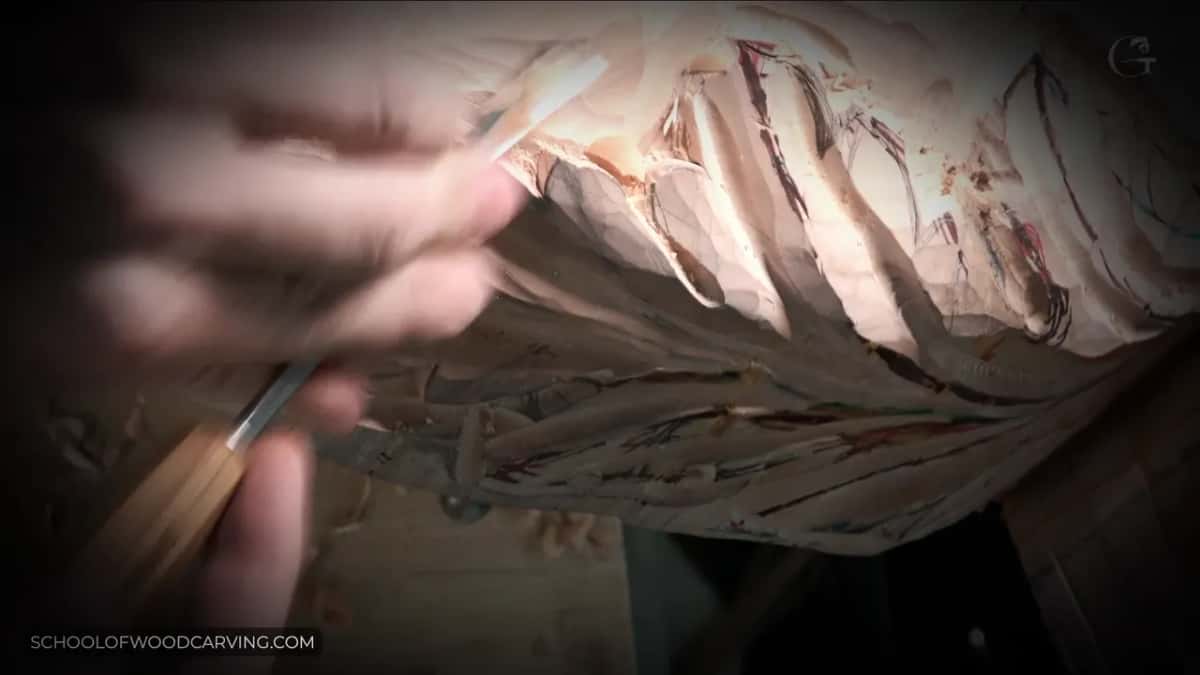
Wood carving books are good for designs, history and old period styles, but you still have to see how it's done. That was my answer on my livestream of October 21, 2020, with a Venetian acanthus leaf on the bench in front of me. "In the books, it's okay," I told the people watching. "It looks like it's easy, but sometimes you really don't get it because it's three-dimensional."
Somebody in the chat had asked me about books, so I showed what I had at the bench. One was an English book of ornament. The other was an antique catalog of a company that used to be in Syracuse, New York, its pages going yellow. I also named a book on acanthus leaves by Mary May. Then I told them about the books page on my school site. Below is each one, what it holds, and where a page stops and your hands have to take over.
What I said about books that night
Some books are really good and some are not so good, and I don't think the English one I showed is in print anymore.
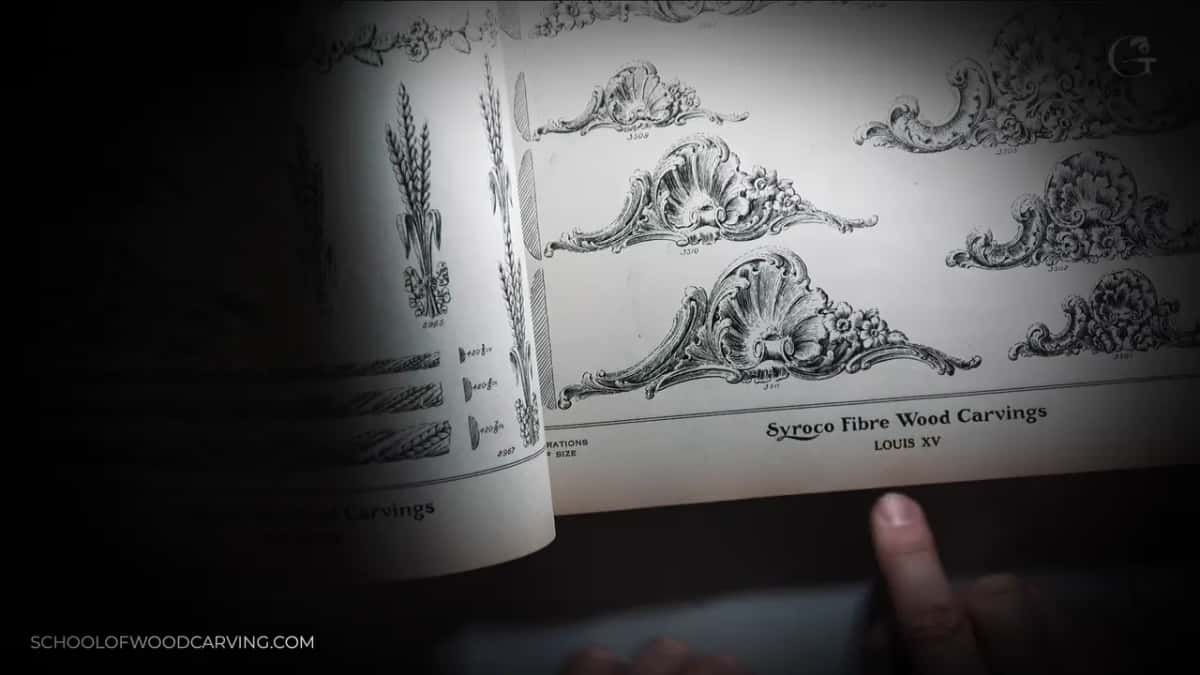
The antique catalog labels each plate with its period, and one of them is Louis XV.
Yellow pages are the only problem with antique books, I said.
Mary May explains acanthus leaves well in her book.
Many titles on my school's books page are in German or French.
Carving is three-dimensional, and at some point you have to watch it done, in person or on video.
Which book did I hold up first?
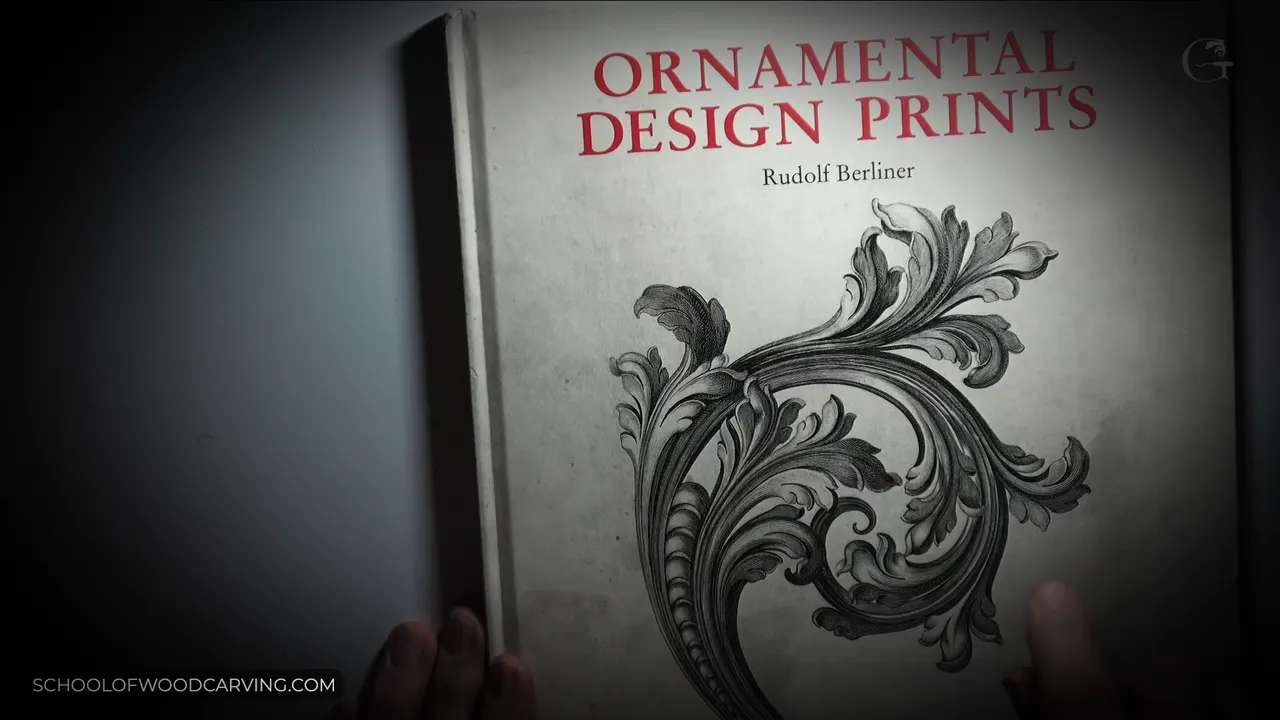
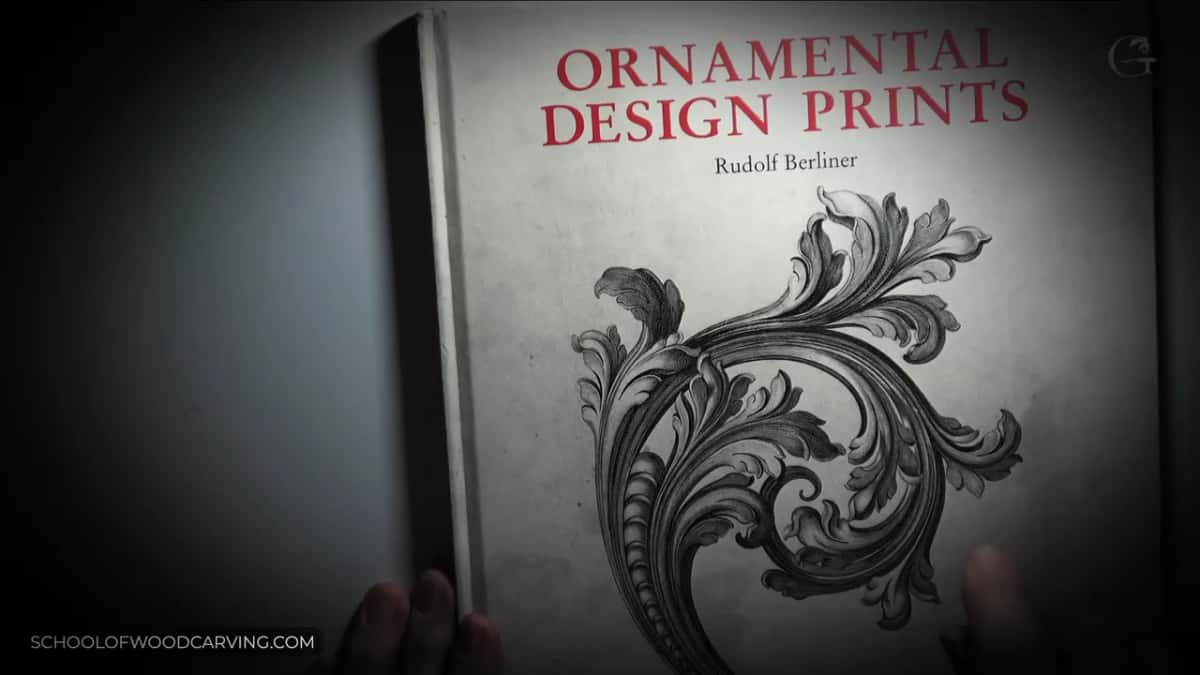
The English one came first, and its cover reads Ornamental Design Prints, by Rudolf Berliner. I don't think it's sold in the United States. It's sold in Europe, in England to be exact, and I don't think it's in print anymore, so you'd probably have to look on the used book market. They'll be able to ship it to you.
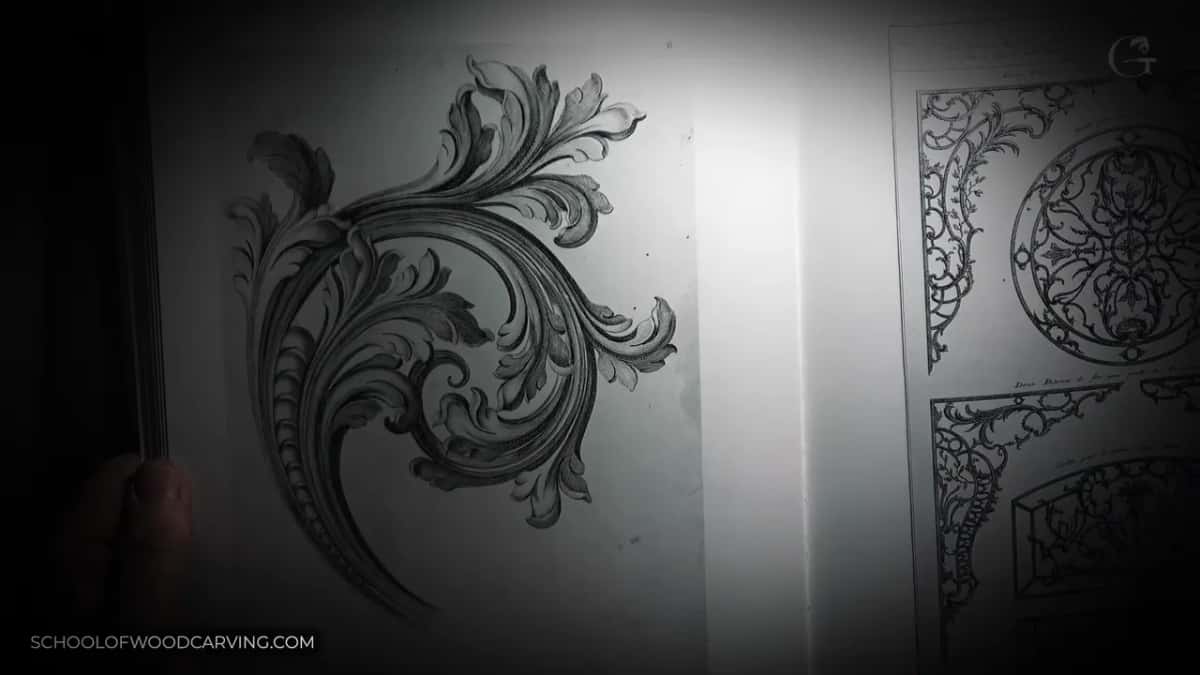
There aren't a lot of designs in it, not much. But some of them have really nice movements, and the book is historical and really accurate. As far as I know, it's one of the best. The page I opened for the camera had a big acanthus scroll on one side and plates of pattern borders on the other.
I keep a list of books about the design principles and the golden ratio too. There are some good ones among them. One more book got a page of its own here, a book on mathematics and art, and who it's really for.
What is inside an antique carving catalog?
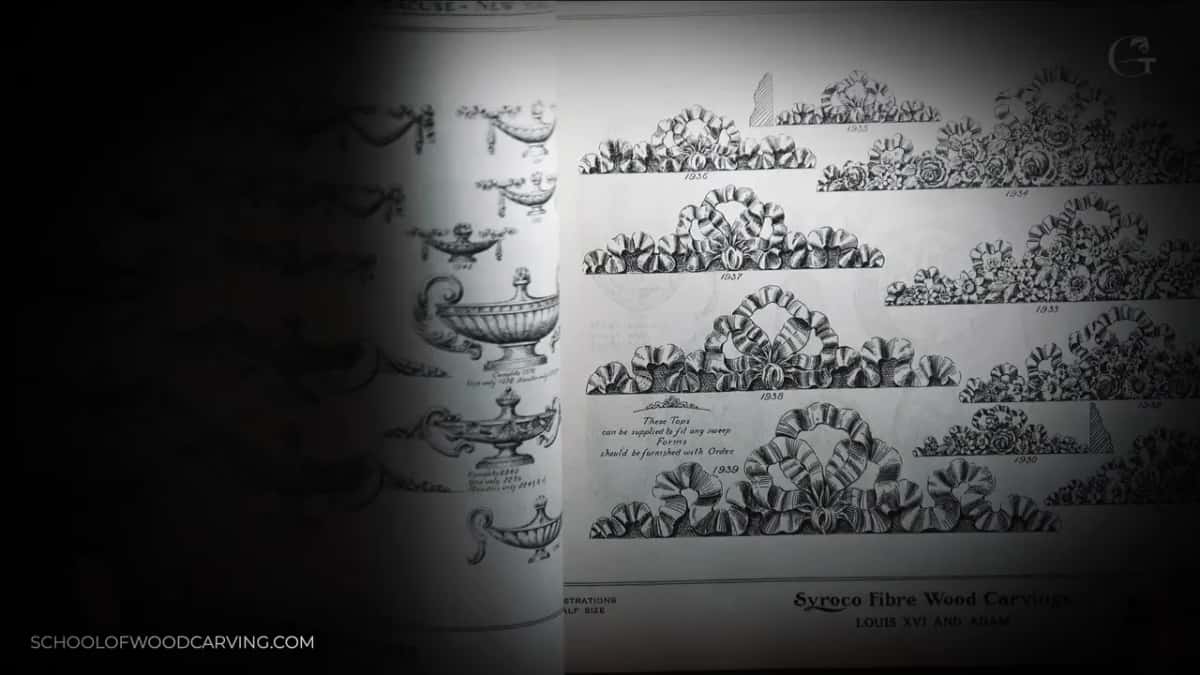
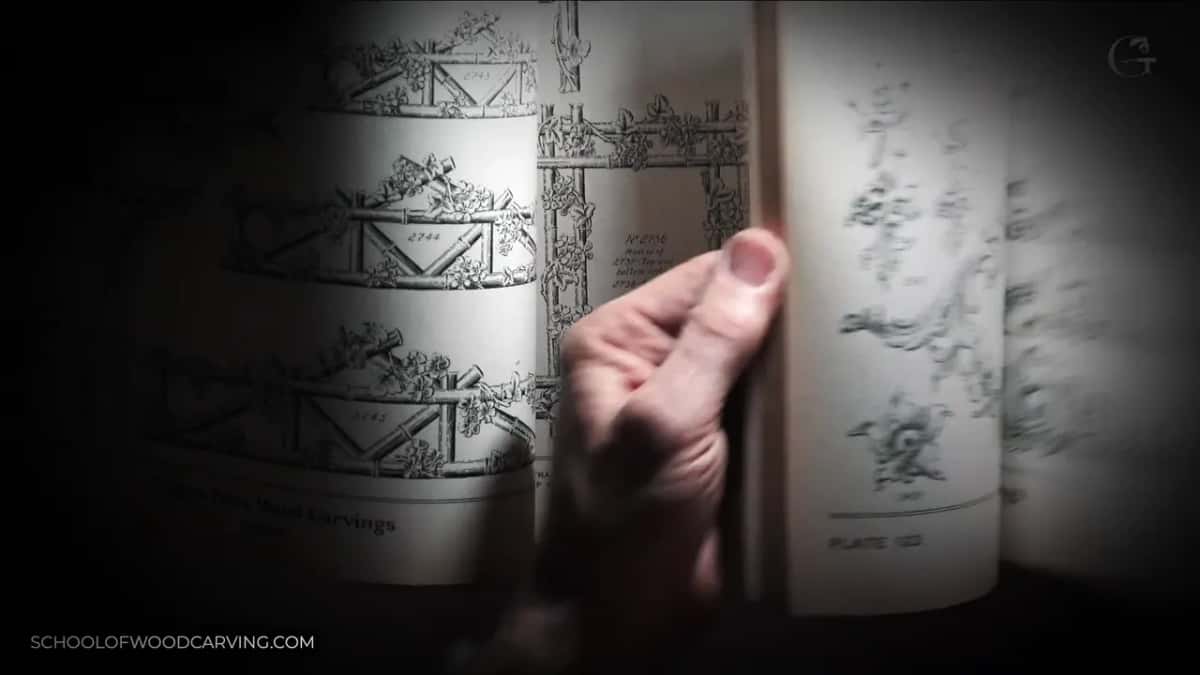
Plates, page after page, each one captioned with its period. The second thing I held up was really a catalog, a very old one. It came out of a wood carving company that used to be in the United States, in Syracuse, New York. The plates carry the printed caption Syroco Fibre Wood Carvings. It's the catalog of the products they had back then, and it's really thick, with a lot of different pages and styles.
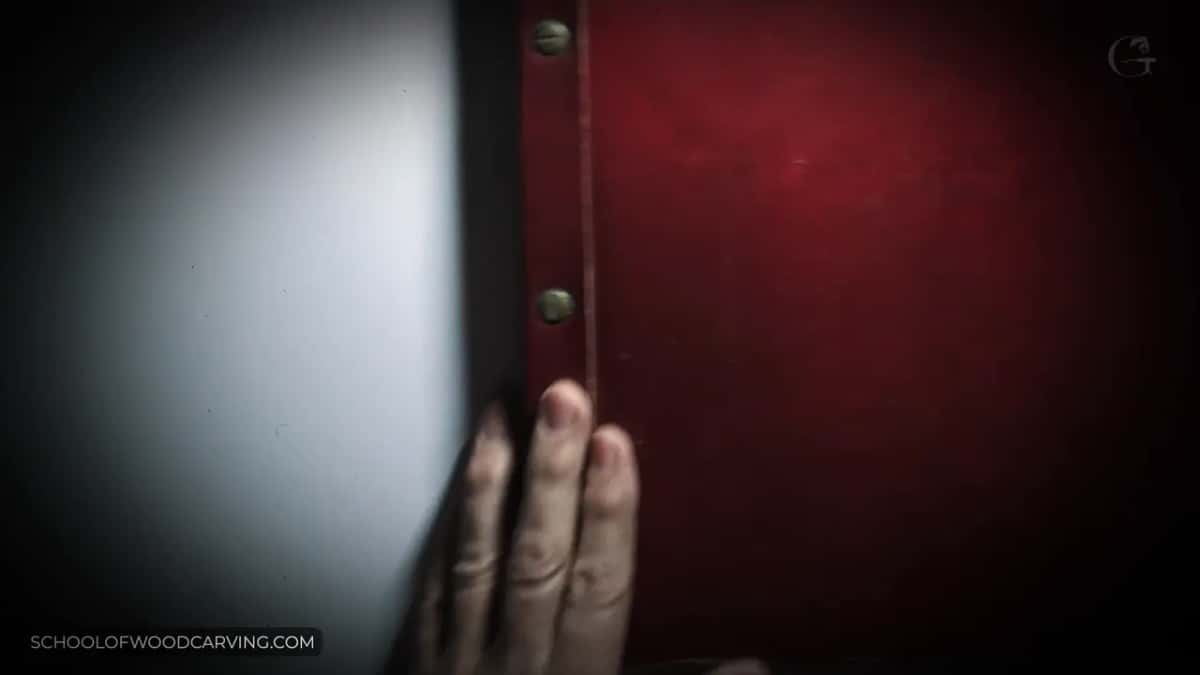
Before I could show a single plate, I had to turn the book around. It was upside down. Then you could find all the different periods of time in there, one plate for Louis XV, others for Queen Anne and for William and Mary designs. Another plate reads Georgian and Chippendale.
During the October 14 stream I got a question about the carving on the grand staircase of the Titanic. I watched that movie a long time ago, the first year it came out, I believe. I remember it was traditional carving, and I couldn't answer more than that, because I really don't remember.
Can you still buy a catalog like that one?
Mine, you can't buy. It's only one in the world, I would say, and I think I've got the last copy of this original catalog.
Then a viewer wrote in the chat that Dover has a lot of copies of this catalog. Oh, they do? I didn't know that, and I said so right there on the stream. Mine is the original.
That page has gone yellow, you can see it, and it's already deteriorating. Some pages are getting so old I can't keep up with them. That's the only problem with antique books. But this is what I love.
Is there one book that holds every acanthus leaf?
Probably not. It's impossible, probably, to put all the acanthus leaves in one book, because they're all different, and it depends on the country you go to and the period you're trying to replicate.
For the leaf itself, I pointed people to Mary May's book on acanthus leaves. You can check it if you want to. I think she writes really well and explains them. Why the leaf changes with every country is its own subject, and it came up in workshop 52 of the Venice Room.
We've carved them one style at a time on the school site. Corinthian, Greek and Roman were done by October 2020, and Byzantine was still to come. The plan was to go one by one, so you'd understand the design principles behind each. They aren't the same leaf, even on the inside. The one on my bench had a convex inside, and a Roman acanthus has a concave.
Are the old carving books in English?
A lot of them aren't. On my school site there's a page for books on the history of carving, sculpture and acanthus leaves, and many are in other languages, German and French and so on.
I said the same about old European books as acanthus references, in workshop 28 of the Venice Room. For carving history itself, the best books I've found are university books, and I named some in workshop 5 of the antique style rosette.
Even Wikipedia got a mention. Someone wrote Tilia in Portuguese on October 15, and I said it's the Latin word for basswood. If you just look up American basswood on Wikipedia, it'll show you the name tilia.
Why haven't I written a carving book myself?
Time, first of all. People have asked me to write the book for many years, and I just really don't have the time. Maybe someday.
There's a second reason. I still think in Russian, and I keep my Russian accent even in writing, so I doubt people would understand what I'm trying to say. Talking while I carve isn't easy either. I told the viewers that working and speaking at once is a struggle for me too, and they stay and watch the videos anyway.
People kept writing wash hands in the chat on October 15, and I had no idea what it meant. Finally somebody explained it was an emoji of hands rubbing together, like clapping. I guess I'm ancient.
The wood carving books on camera, side by side
Here's what I showed or named that night, and what I said about each one.
Source | Holds | Said |
|---|---|---|
An English book | Designs with really nice movements, historical and accurate | One of the best |
The antique catalog | Thick plates labeled by period, Louis XV included | Yellow and already deteriorating |
Mary May's book | A whole book on the acanthus leaf alone | Writes and explains well |
My books page | History, sculpture and acanthus, many titles in German | Often not in English |
A Wikipedia page | The Latin name tilia, under the American basswood | Just look it up |
What can't a book show you?
The third dimension. Someone else in the chat wrote that there are a lot of old publications on the subject, and he was correct. One person in one of my classes in Florida that year had studied acanthus leaves for over 10 years, and he still didn't get it. He got it when he tried it himself, in person, carving together with me.
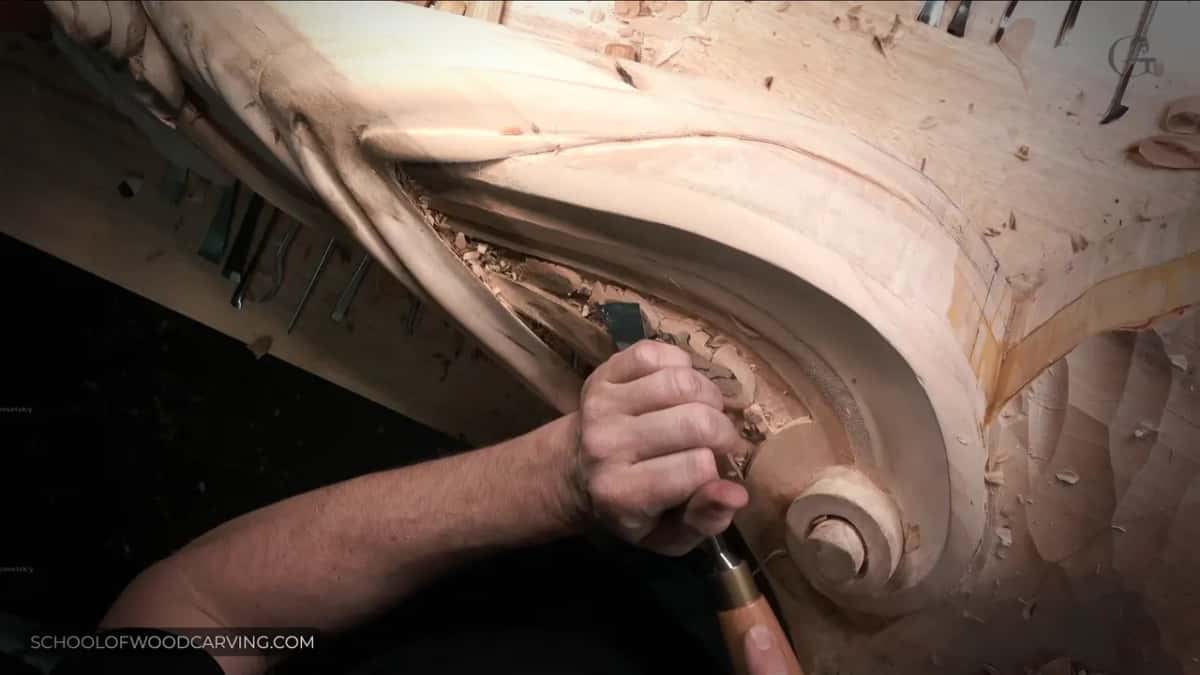
Books are good. But digging into the wood, poking a gouge into the fibers, is the easy part to learn, and the design is much harder. On that corbel, one leaf had to wrap two surfaces almost 90 degrees apart. You don't see what I see on the stream either, because of where the cameras sit.
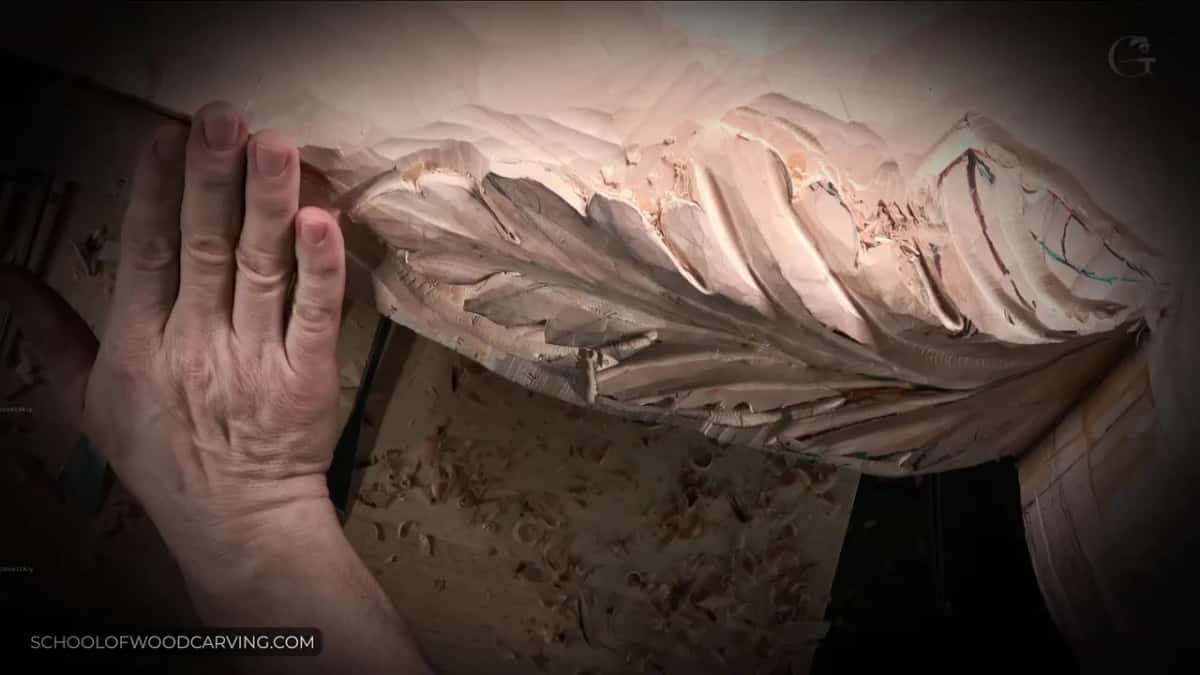
What was on my bench while we talked about books?
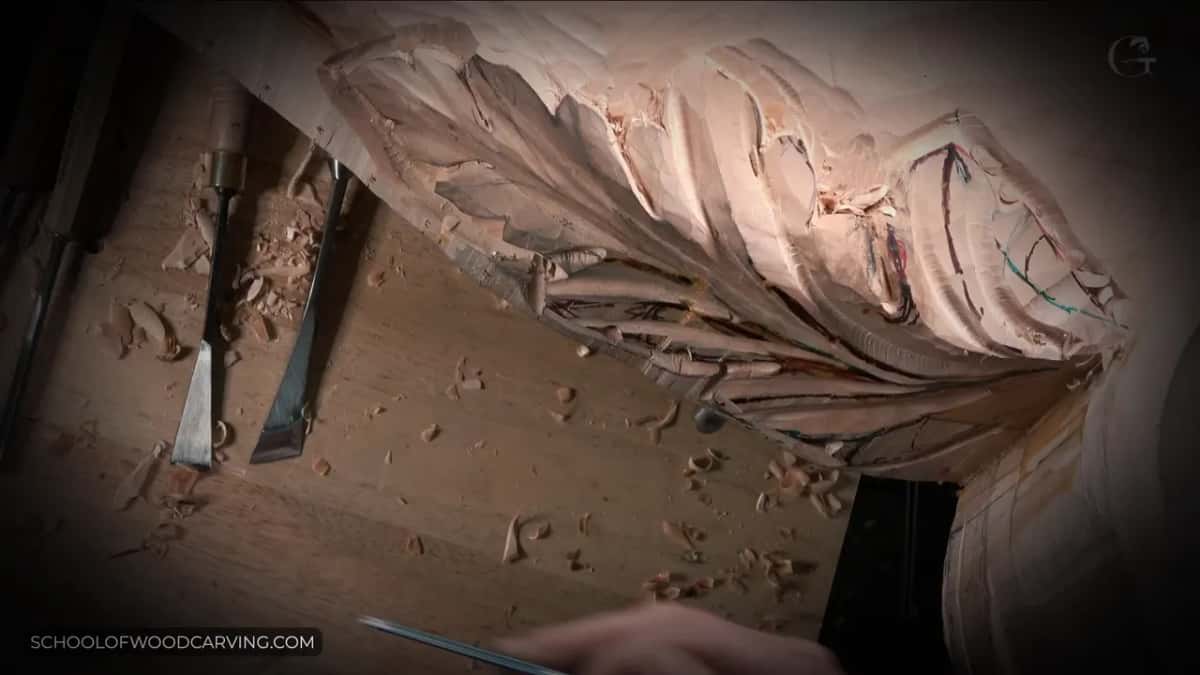
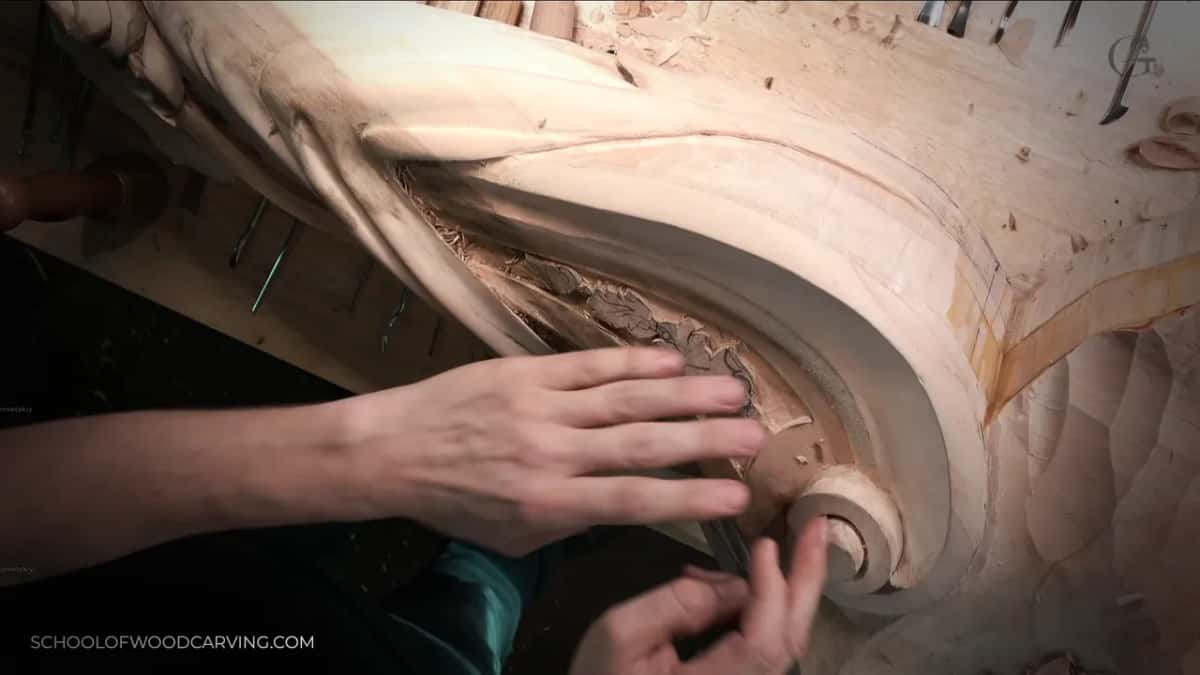
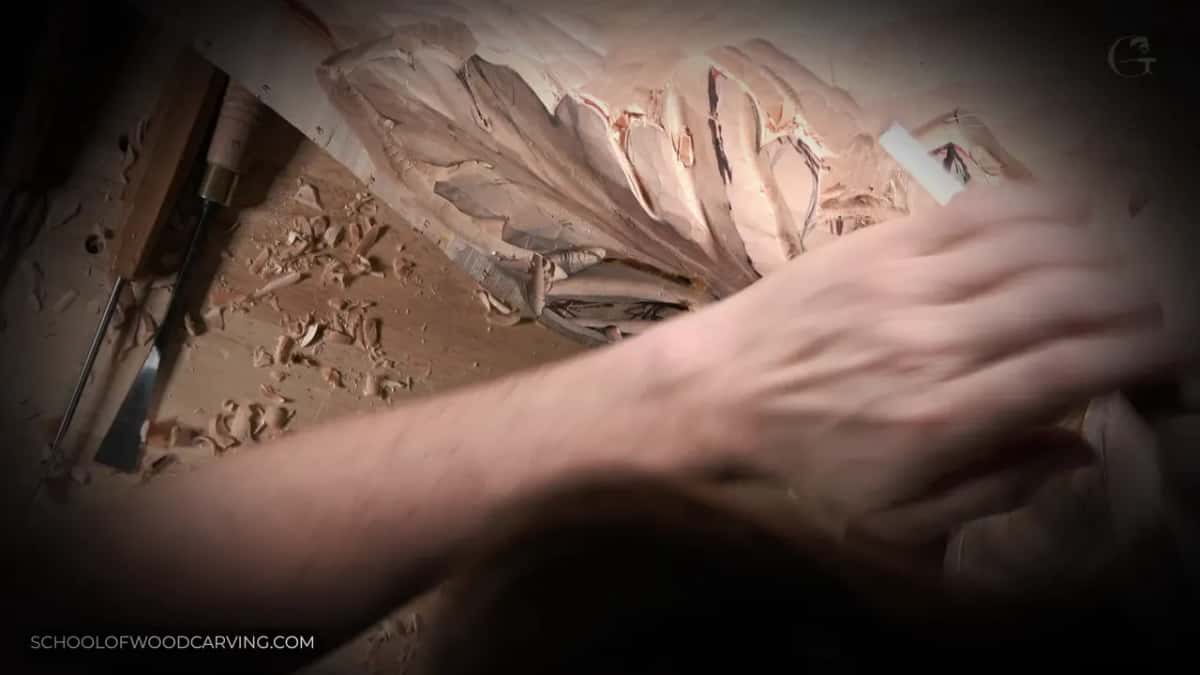
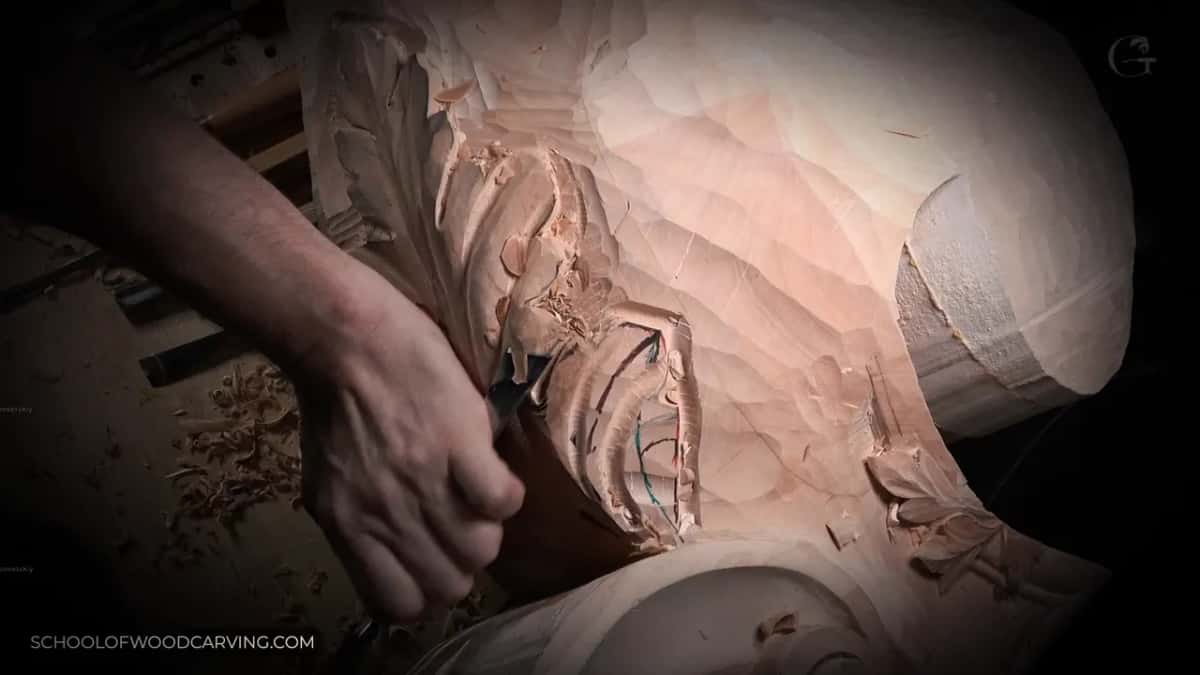
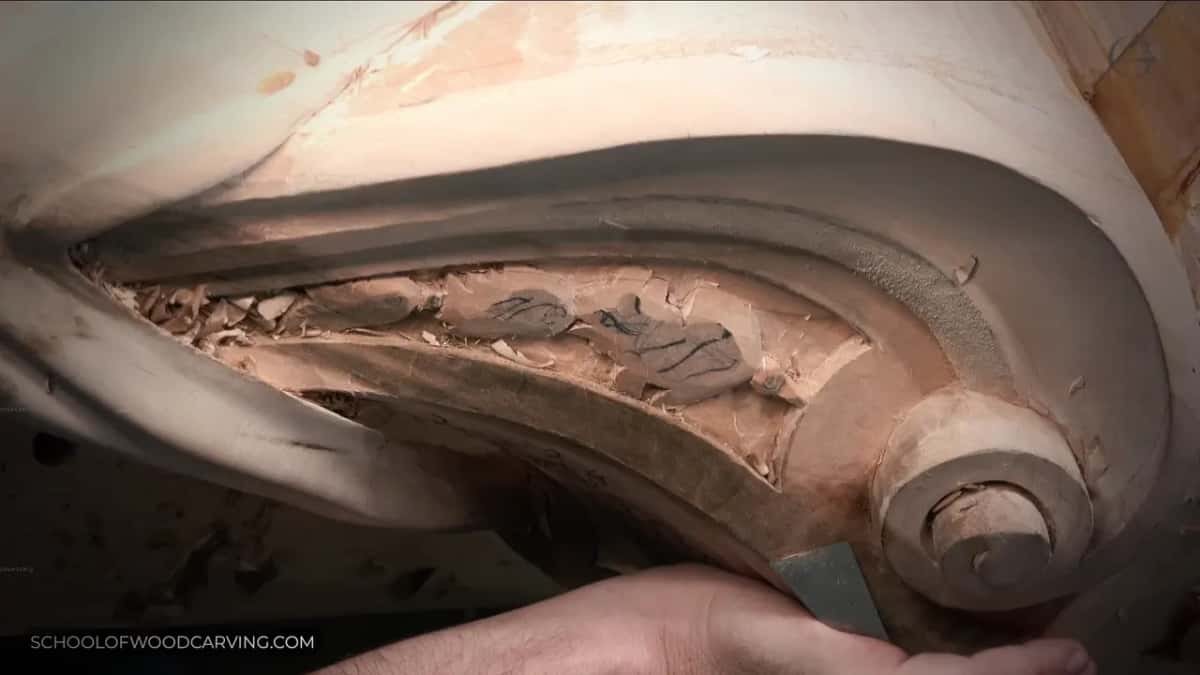
A Venetian acanthus on a corbel, carved for a client. It's a somewhat simple form of acanthus, and it belongs to Italian work of the 15th and 16th centuries, Venetian acanthus to be exact. I do the design myself, of course, but I have to be accurate with it, so I wasn't free to carve whatever I liked. The wood was American basswood, which is the question I get on almost every stream. The customer asked for a piece true to the end of the 15th century and the start of the 16th, so I had to be accurate to that period.
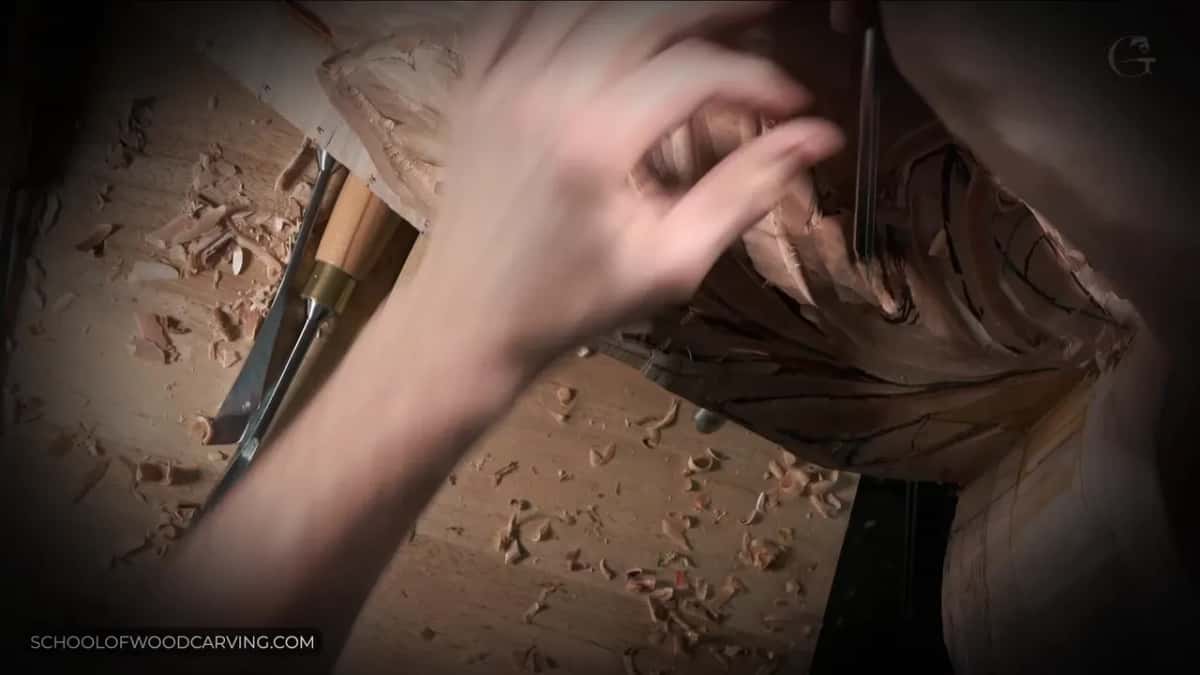
Even the tools had to fit. I had to study what they used back then, and I try to use the same tools, and they used a lot of gouges and veiners. A number 11 is a U-shaped veiner, developed pretty much for carving acanthus. At one point I was carving against the grain, which is not really good in an area like that, and I said so. That night I used a 1 mm (about 1/32 in) one to clean a spot, then a 2 mm (about 5/64 in) one for a line under the place where the eye goes.
A favorite of mine that night was a number 7, 14 mm (about 9/16 in), a fishtail. I can do a lot of work with that one. Ask me another day and it may change, since it depends on the day.
How far will a student go for a class in person?
One of mine gave up a whole day. A few weeks before these streams I flew to teach two classes at the Marc Adams School of Woodworking in Indiana, and both were sold out. Traffic held me up, and I got to the airport 45 minutes before my flight, a few seconds past the limit. The lady at the counter would not take my bag. "Policy is a policy," she said.
There were no more flights to Indianapolis that day, so I bought a ticket to Cincinnati and called a student who lives there and comes to every class. He didn't ask me a single question. He drove to the airport, waited for my bag, drove me about an hour and a half, waited again while I found a way into the closed school, and took me to a house the school keeps, where I was staying. He lost all day. When I asked what I owed him, he said, "Oh, please." Someone at the school told me those classes sold out in seven minutes that year.
Where does watching come in?
Right after the book, and for as long as the job lasts. I call my school a virtual apprenticeship. I shouldn't even call the people there students, I said on the October 15 stream, they're members. It's not a school the way people are used to. I carve real projects, and you can watch the whole process pretty much as it happens.
In October 2020 the school already had over 2,000 videos, and none of them go on YouTube or Facebook. That one project had over 1,000 of them, and I wasn't taking anything out. The main piece is 10 feet (about 3 m), and that's only its middle part. It's pretty much the whole room. On the free streams I only built up the overall shape, and the details went to the members.
Nobody has to carve something that big to learn from it. I know some members don't check all the videos, and I told them on air to go ahead and watch. One member mostly carves ornaments for Christmas and the holidays, and he wrote to me that he got a lot from this project anyway. Another member has been with the school from day one. He checks what's new before anyone else and carves Baroque style himself, a really good carver. On October 15 I went live later than usual so members in Australia and New Zealand could watch, and one from Australia has been with me about three and a half years. A third member wrote in the chat on October 14 that you know carving is in your blood when watching someone carve is just as satisfying as doing it. I agreed, absolutely.
My own start was an apprenticeship too. At 16 I was the only apprentice of a fine-art master in Russia. He taught me to think like a tool.
Would you like to see a leaf like the ones on those old plates carved in American basswood? Would it help to watch the whole process, with nothing taken out? Then come to my bench for the rest of these livestreams and the courses behind them. Tuition and Access are on one plan page.
How it's done
- Search the secondhand sellers. I don't think my English ornament book is in print anymore, so a secondhand seller is where to look, and they can send it on.
- Read Mary May on acanthus. Mary May's acanthus book explains the leaf well. Have a look at it when you can.
- Look up American basswood. Type the name into Wikipedia and it gives you the Latin one, tilia.
- Open the school's books page. Expect a lot of German and French titles on that list.
- Watch the work done. Then see a real leaf carved, in person or in the full videos, start to finish.
Frequently asked questions
Can an old carving catalog still teach you something?
Mine is full of plates labeled by period, Louis XV among them, so you can see what each style looked like back then. Dover has a lot of copies of that catalog, a viewer told me, and I didn't know that. The pages of my original are going yellow, and I still love it.
Which acanthus book do I point people to?
Mary May wrote one on acanthus leaves, and I think she writes really well and explains the leaf. Still, every acanthus is different by country and by the period you want to replicate, so I doubt any single volume could hold them all.
Where do you find an out of print carving book?
On the used book market, most likely. The English ornament book I showed is sold in Europe, and I doubt it's still printed. A seller over there should be able to ship it to you.
What to carve next