
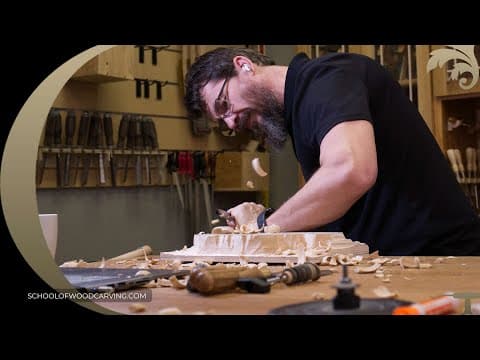
Alexander Grabovetskiy, woodcarver, School of Woodcarving · Published 2022
How do you carve a Bellamy eagle?
Quick answer: A Bellamy eagle, as my live stream guest William Brown makes one, is an American carved eagle built in parts. He traces a picture on a transparency, projects it onto 2 inch (51 mm) pine, saws the outline, glues on wings and haunches, often carves the head separately and gilds the finished eagle last.
A Bellamy eagle is an American carved eagle in the style of John Haley Bellamy, and William Brown builds his from several pieces of pine. Bill was my guest on one of my February 2022 live streams. He makes 18th century furniture, he has spent 35 plus years in anesthesia and intensive care, and he carves eagles. Several questions in the chat that day were about those eagles. So I let him talk. What follows is the eagle wood carving routine Bill walked me through from his own shop, and every step in it is his. My part was the questions.
Bill's eagles are built from pieces, and the one on his bench that day was getting its gold. Below is his order of work, the wood he uses, how he holds a carving that shape, and where the gold goes on. Wherever the recording was clear, I kept his words.
Bill's eagle, in seven moves
- A photocopied picture gets traced onto a clear transparency, and the drawing often changes right there.
- An overhead projector puts it up on the wood.
- Pine is his usual wood, 51 mm (2 in) thick.
- Extra pieces for the wings, plus haunches with claws, are glued on after the band saw.
- A block screwed on behind goes in his vise.
- Many times the head is carved on its own and fixed on near the end.
- Gold leaf comes last, with no top coat over it.
Who was John Haley Bellamy?
A carver out of Kittery, Maine. That was the first thing Bill said when I stopped his shop tour to ask why the style is called Bellamy. The Kittery and Portsmouth, New Hampshire area was shipbuilding country, he explained, so Bellamy got into carving for ships, interiors and the figures on the front of a vessel. Later came the folk eagle and a style of his own. In Bill's telling, Bellamy kept the detail low, could make these very quickly, and would make them by the thousands.
A short note of mine. The encyclopedia has him born in Kittery in 1836, and he died in Portsmouth in 1914.
Bill collects all of this. He held up two books about Bellamy and a museum brochure, and one picture was of a very famous eagle, which he said is now in the Mariners' Museum in Newport News, Virginia. In Bellamy's day these eagles were in huge demand, by his account. Local governments wanted them on town buildings. The firehouse had to have one, and so did the town hall.
How does Bill get an eagle pattern onto the wood?
Everything starts on paper. Bill photocopies a picture of the eagle he wants, lays a clear plastic transparency over it and traces the eagle with a magic marker. He often changes the whole thing right there on the plastic, to make it look more the way he wants. On the day of the stream he had the United States emblem waiting for that treatment, and the shield, he said, was going to change a lot.
Then comes the old-fashioned part. "Very old-fashioned," he said, "but I use an overhead projector." He decides how big this eagle should be, stands a sheet of plywood in front of the projector, sets his pieces of wood there, and traces the projected lines right onto the wood.
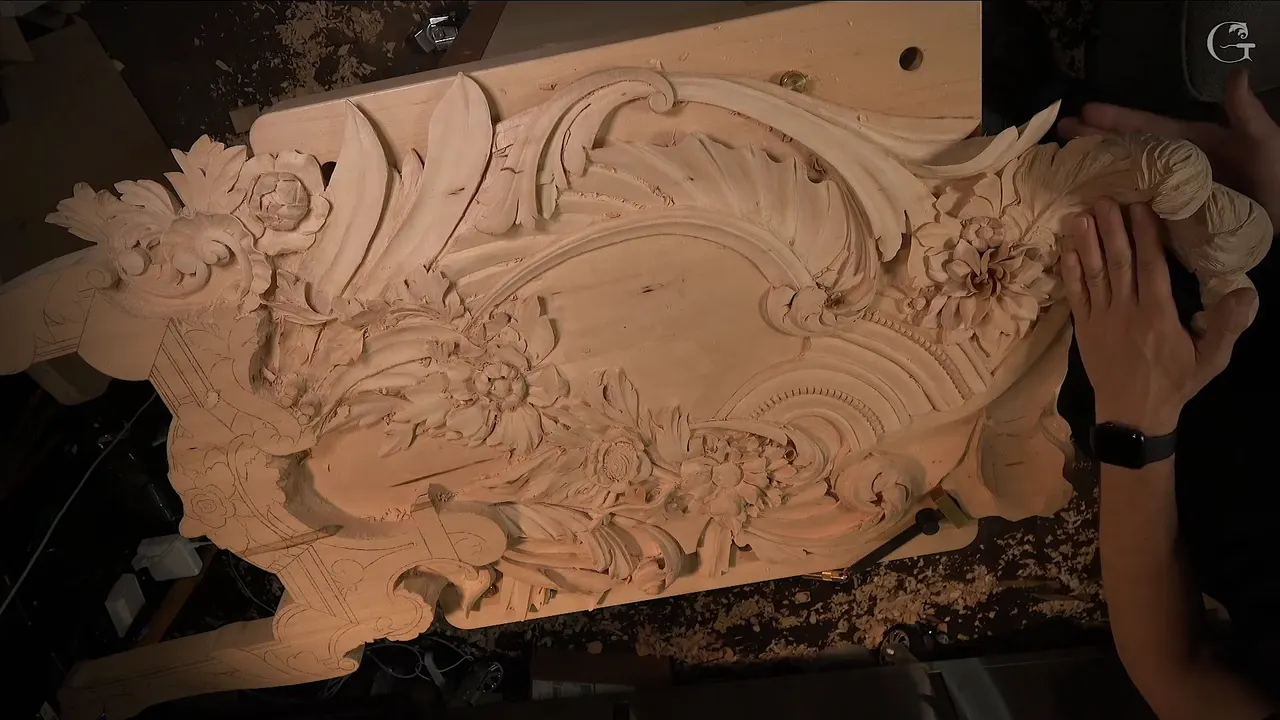
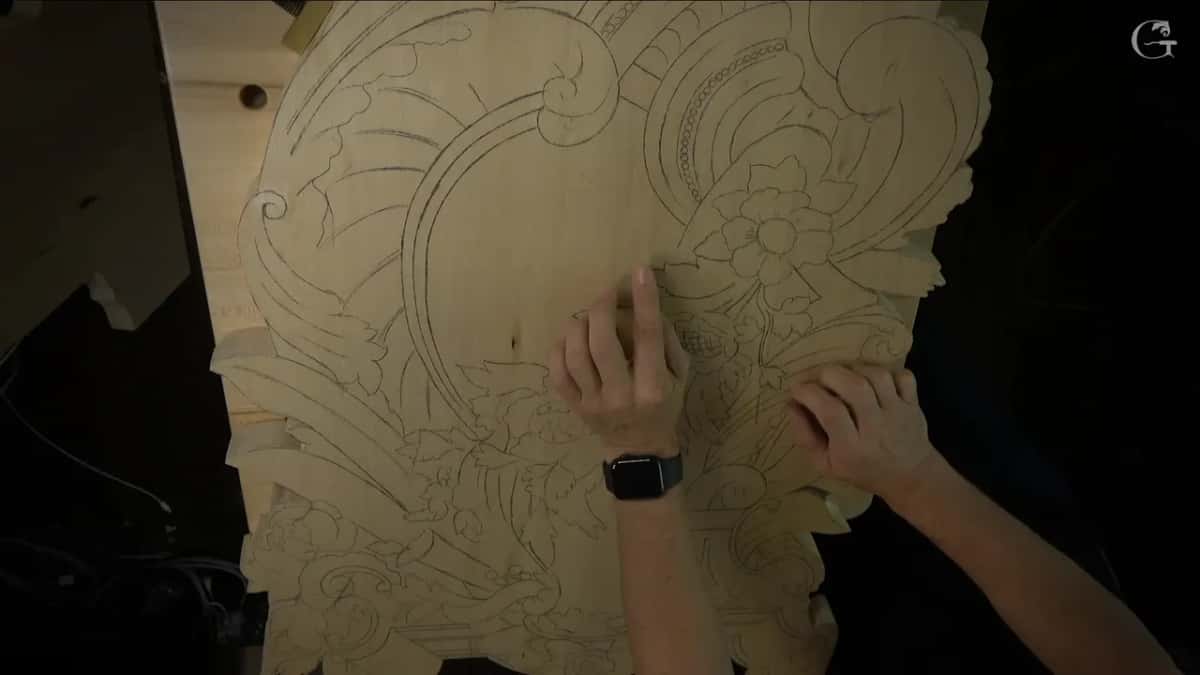
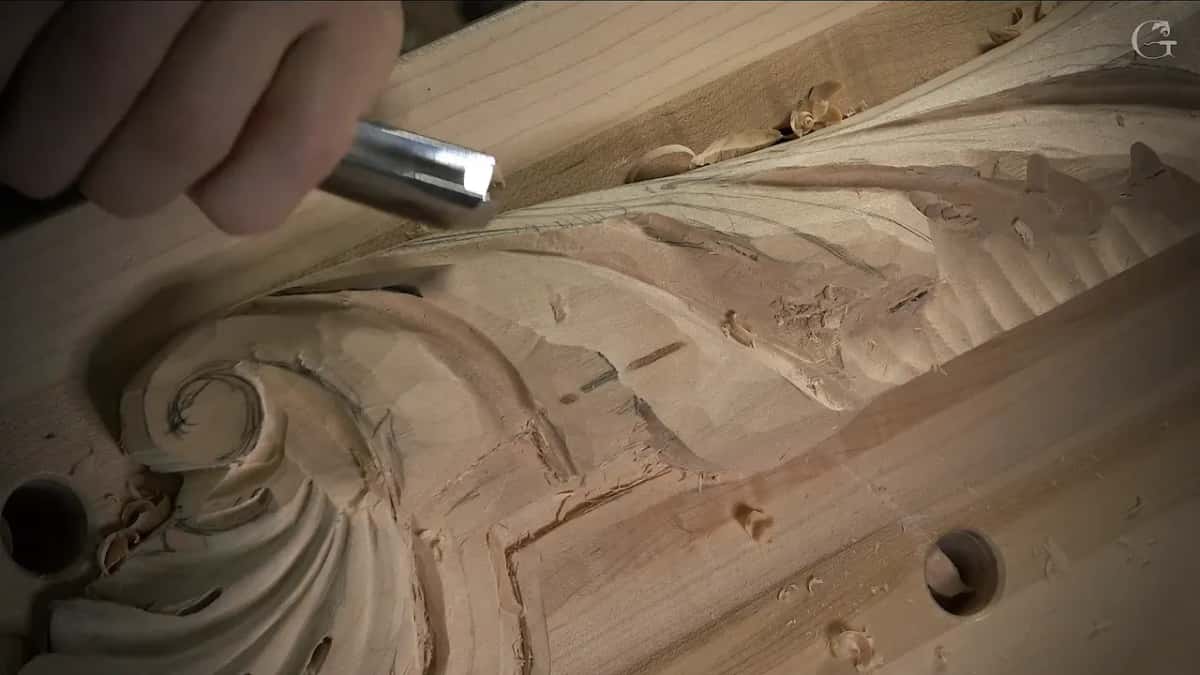
My own transfers go through a roll of clear plastic, a habit I have shown in other live sessions. The drawn board above and the carbon sheet below come from my own lessons, Venice Room workshop 104 and Chamomile and Bow Rosette 4, and have nothing to do with eagles.
What wood does Bill use for eagle wood carving?
Pine, mostly. "I use mostly 2-in pine, 8/4 pine for the carvings," Bill said. Wings and other built-up parts sometimes get thinner 4/4. Among his offcuts lay a big slab of basswood he called a carving in the rough. When someone in the chat asked whether the first shape comes off one slab on the band saw, his answer named both woods, 2 inch (51 mm) thick pine or basswood.
His furniture lumber is another pile. Walnut, maple and cherry, all local hardwoods, which he lets acclimate in the shop.
In another part of this same lesson I said something close about basswood. Someone asked me about cedar, and I told them its grain distracts your eye from the overall movement of a carving. Even for gold leaf, I said, basswood is much better.
How is the eagle built up from separate pieces?
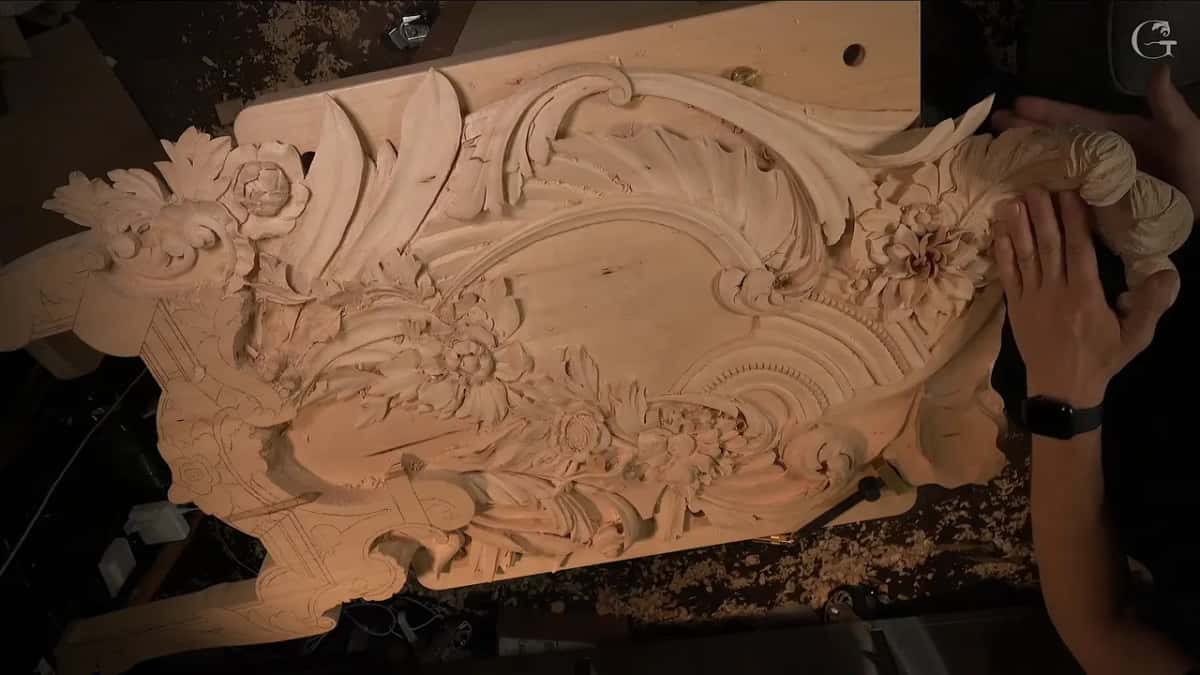
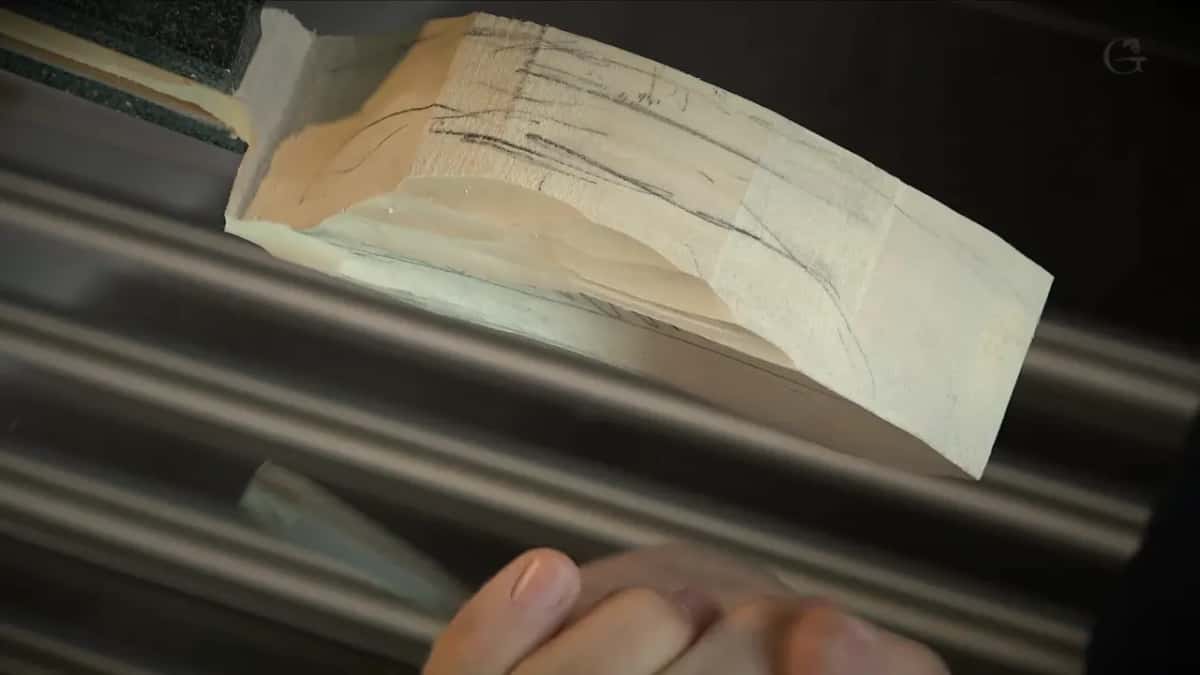
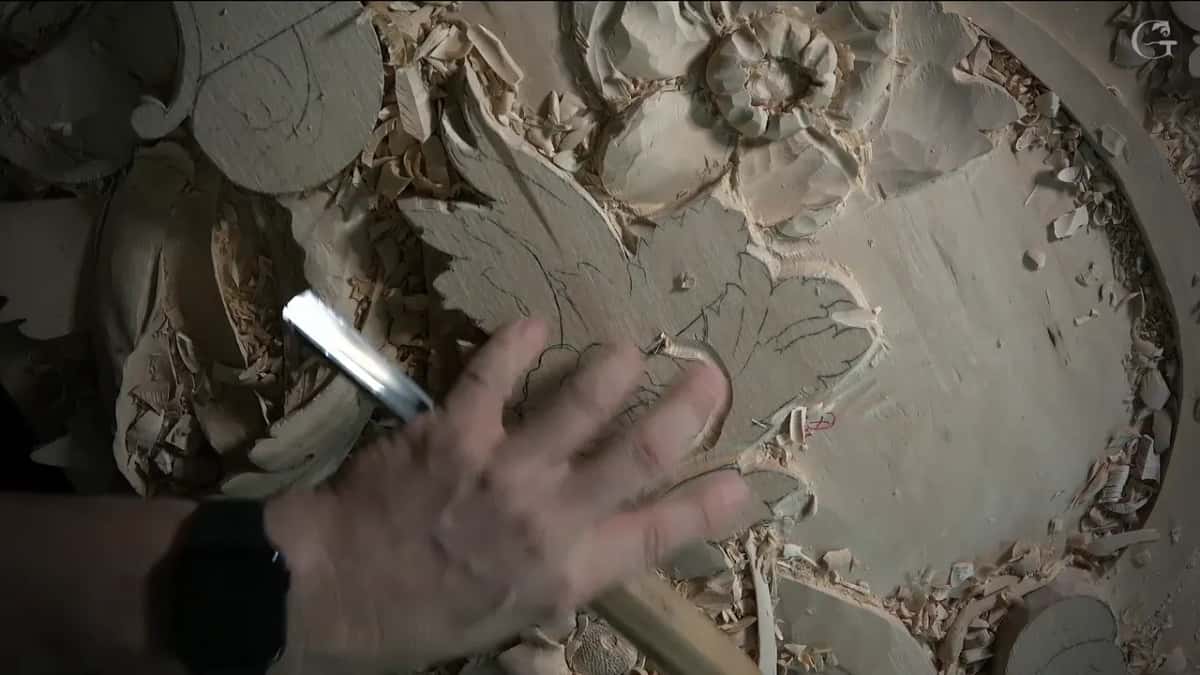
Glue comes before the saw. Often Bill glues up pieces first, and the entire eagle sits on that blank in outline. His band saw takes it out next. After that come what he called the built-up areas. On one eagle he showed me the haunches with the claws, pieces he had glued on, and more pieces glued in the back for the wings. The layered piece in the next picture is one of mine, from workshop 85 of the Venice Room.
The head is often its own piece. In Bill's words, a lot of times he carves the head separately and attaches it toward the end. One eagle in progress had a banner that will run right through the beak, scroll around under the shield and come out the other side. He called that one fairly elaborate.
Then there was the strange one. In that museum brochure, a Bellamy eagle has its left wing reversed, and Bill decided to carve it anyway because, as he put it, it's a Bellamy eagle. He was honest with me about it, and said he was really unsure how to make that carving work. One thing he had settled. The head would be a separate piece, and the reversed wing he was still figuring out.
How does he hold an eagle while he carves it?
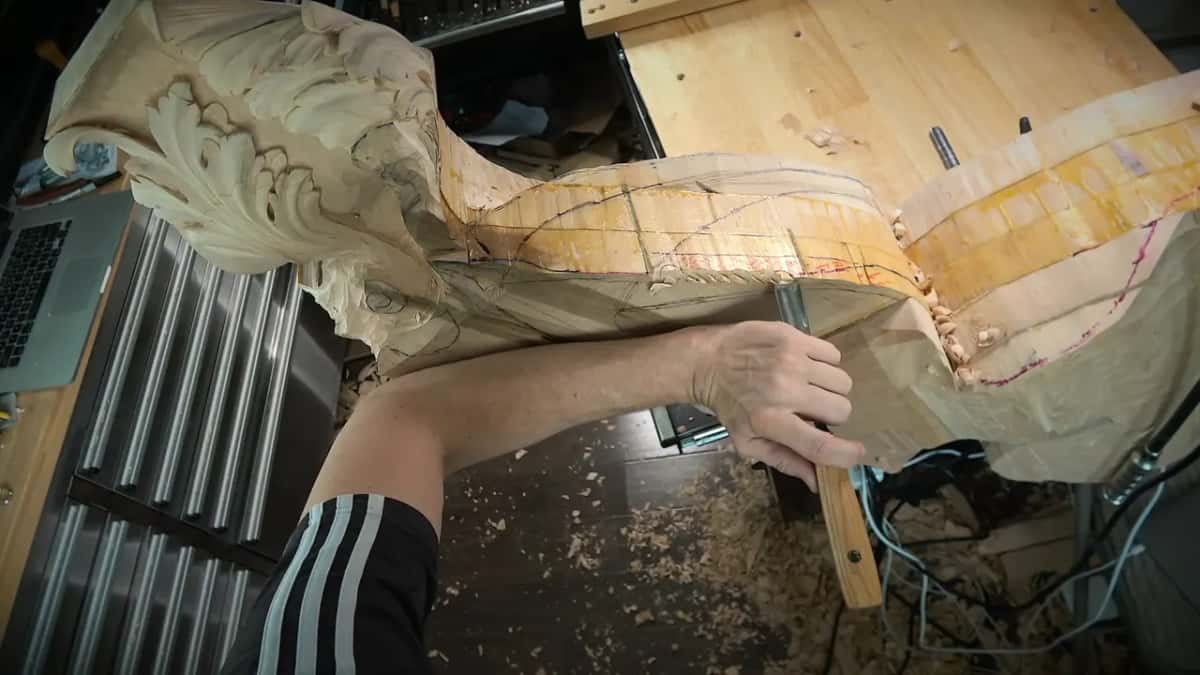
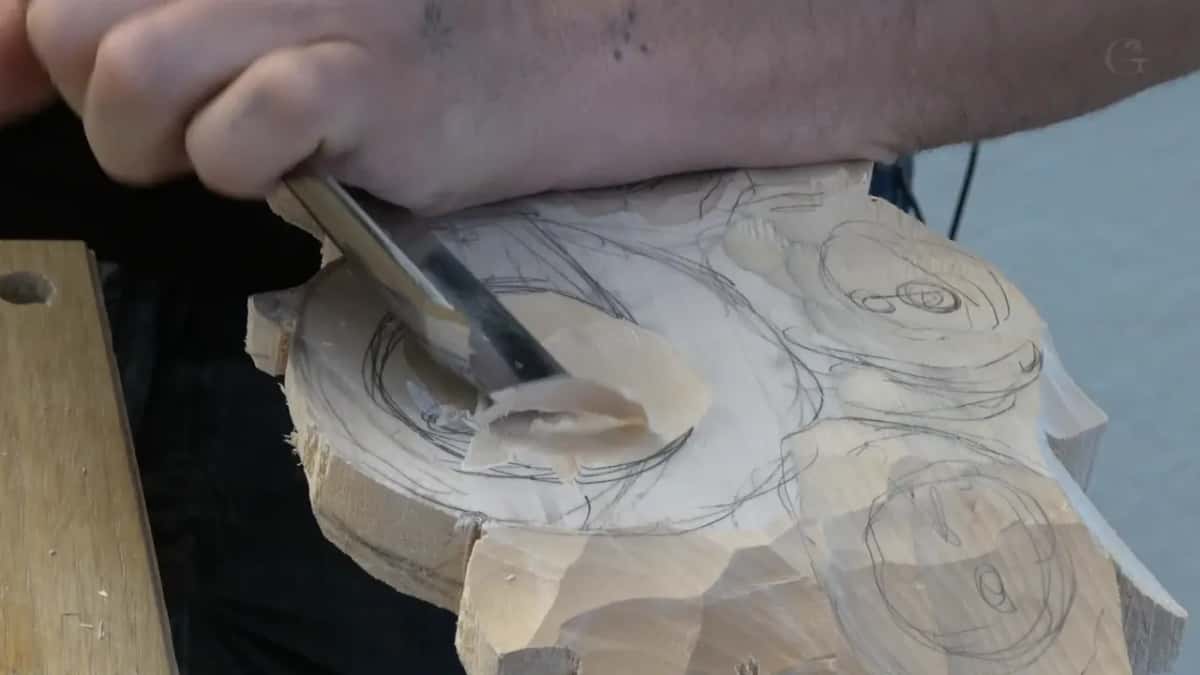
With a block screwed to the back. Once everything is glued on, Bill said, it is going to be "just big blocks." So he fastens a chunk of wood on the back, screws it on, and puts that into his vise. The holding post in the next picture is on my own bench, from Carving Furniture Panel 1.
For roughing out he has something heavier, an iron girder he mounted. Pieces clamp into it and can move in all directions. It weighs a ton, he said. On a nice day he takes it right out the door on a dolly and puts sandbags in it so it is rock solid. Out there he reaches for draw knives and spoke shaves, and does some power carving for the roughing out with a grinder. "It makes a lot of dust, Bill, right?" I asked, and he said he has to do it outside.
Everything in his shop is on wheels, and he is constantly rearranging things, he said.
Which carving tools did Bill keep in front of him?
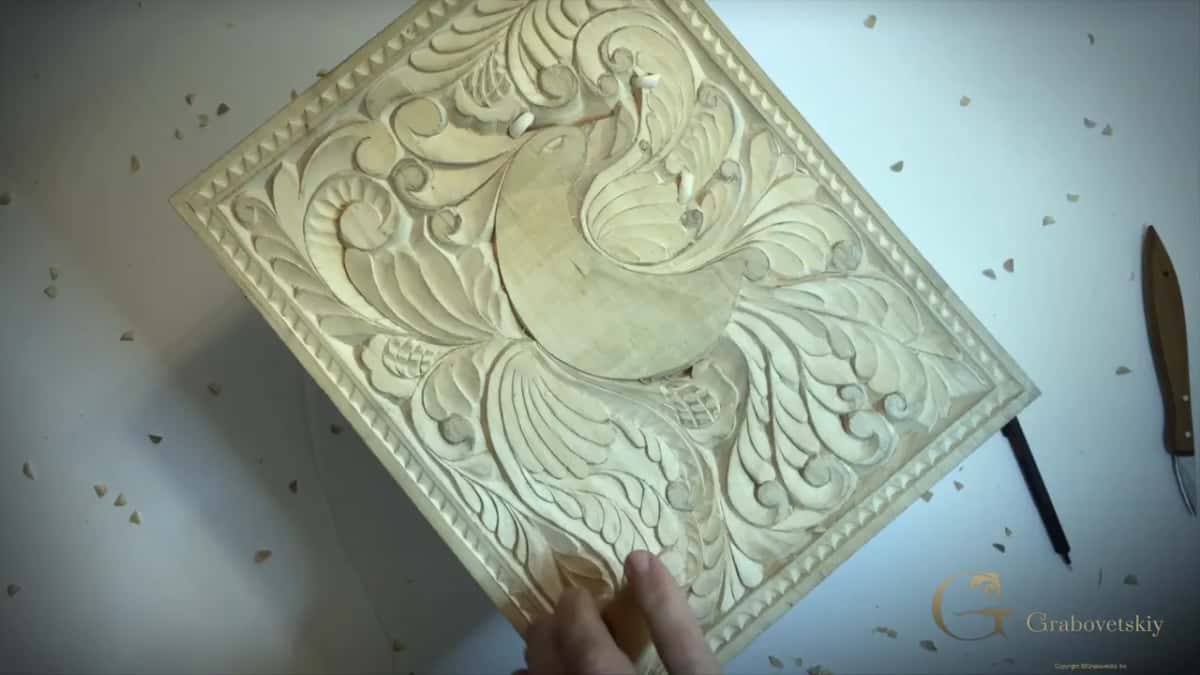
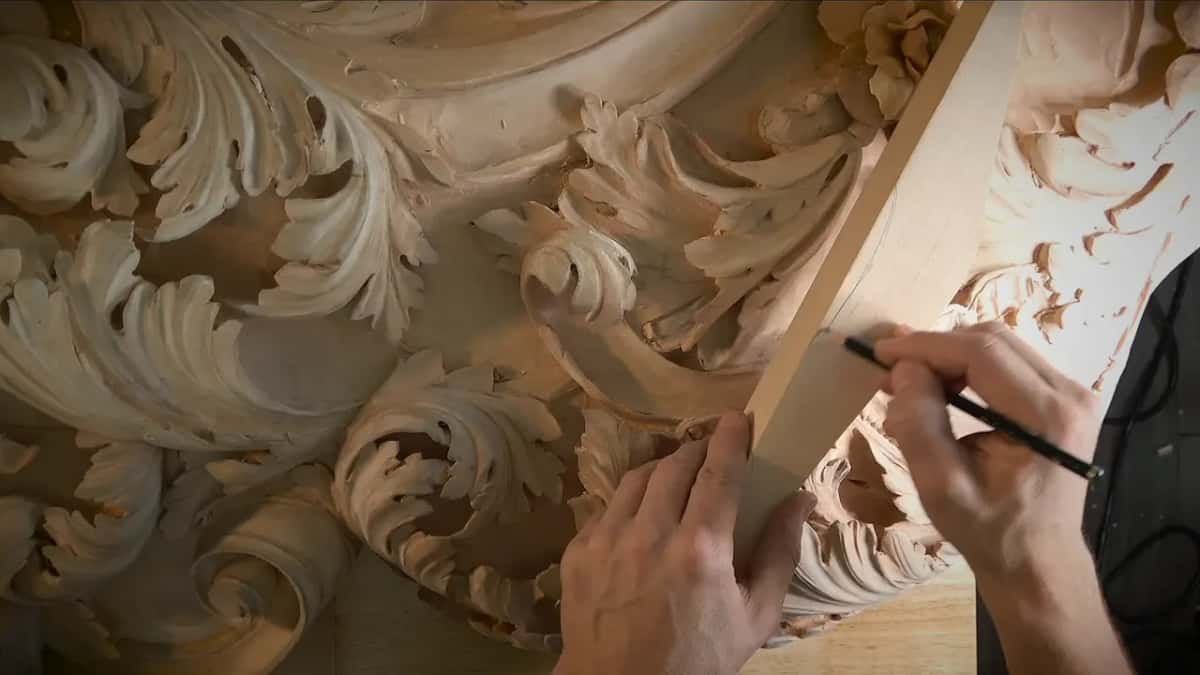
V tools, a whole collection. Bill made a little stand with magnets so the tools sit up in front of him instead of lying on the bench, and he has these racks up at his school as well. He collects V tools without knowing why, and uses them for everything. Along the bottom sit the ones he uses all the time, mostly twos, threes and fives in wide and narrow versions. Higher up are the sevens and eights he uses much less, some back bends, and large curved gouges. "I don't use tool cabinets," he said. The hands in the next frame are mine, on a pierced piece from Carving Hashemi Flowers 12.
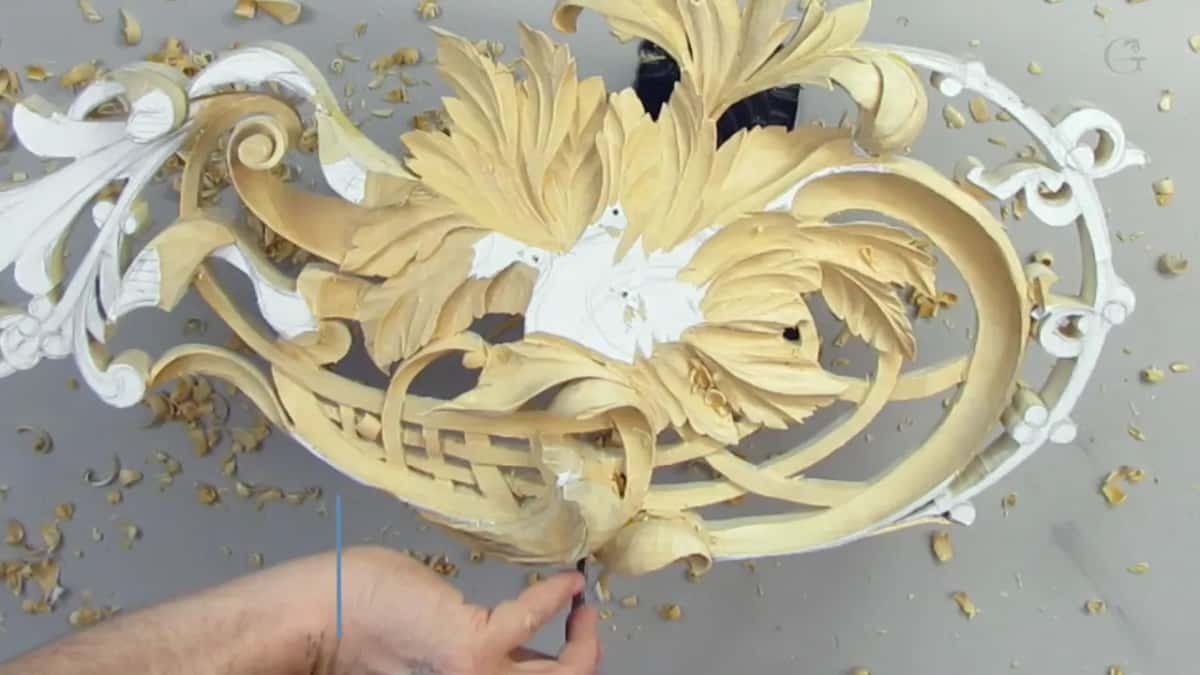
The magnet question got two different answers. Someone in the chat asked whether tools kept on magnets get magnetized and sharpen worse. Bill had read that, said they probably are, and added that it doesn't affect the carving any that he can see. I don't use magnetic strips at all. With more than half a thousand tools I would need a lot of strips, I have no space on my walls, and all of mine live in tool chests. Whether magnets cause trouble, I told the chat I can't answer.
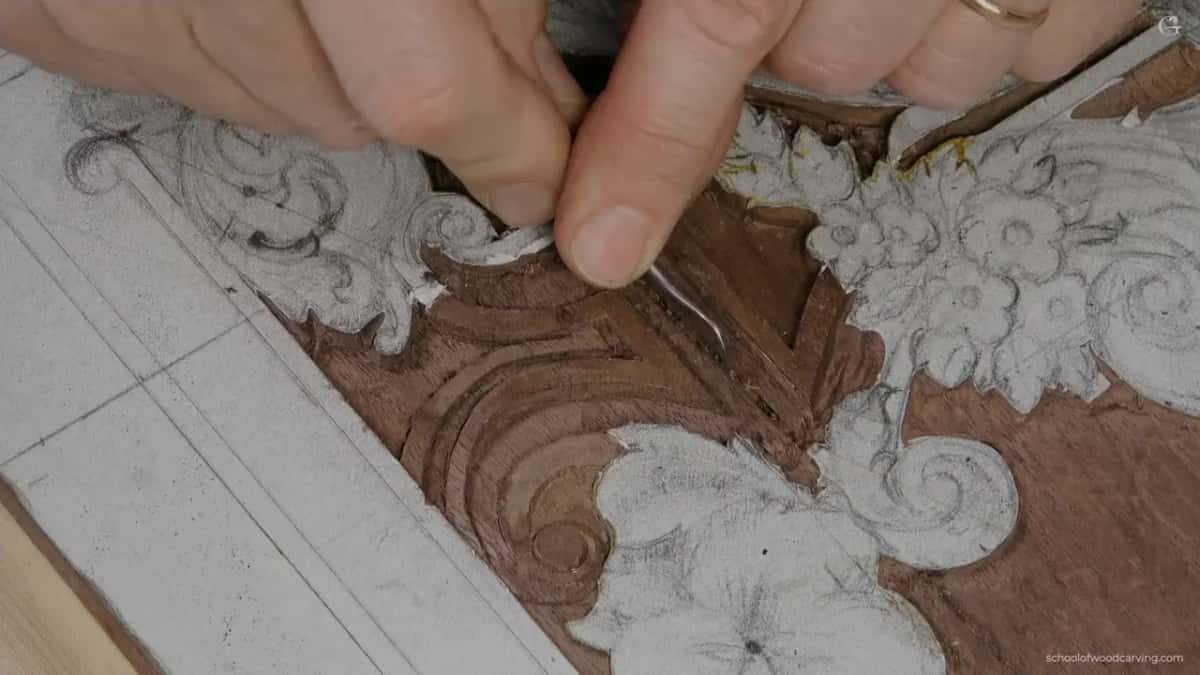
Bill keeps the edges up with wheels he makes himself out of MDF. He shapes them with files, one like a very sharp V tool, one flat, one round, and charges them with his own compound of sheep tallow and chromium oxide. I asked whether it was HDF. Medium density, he said. Mostly he gets by for a really long time just keeping the tools well honed. The paper pattern on dark wood below is from Carving Furniture Panel 38.
Where each piece of the eagle comes from
Here is his order of work as he described it, in one place.
| Stage | Work | Material | Notes |
|---|---|---|---|
| The paper pattern | A photocopy traced onto a clear transparency | Magic marker | He often changes the drawing here |
| Sizing the eagle | Projected lines land on the wood pieces | Wood pieces | Then the lines get traced on |
| Blank and outline | Glue up first, then the band saw | Thick pine | The whole eagle sits in outline |
| Wings and haunches | Extra pieces glued on after the saw | 4/4 boards | Claws come on with the haunches |
| Holding the work | Wood block screwed on behind the carving | His vise | Everything is just big blocks then |
| The eagle's head | Carved separately and attached toward the end | Separate piece | A lot of times, he said |
| Gold on top | Primer, yellow paint, size, then the leaf | Squirrel hair | No top coat, in his words |
If you would rather carve beside me than read about it, the lessons open when you start here.
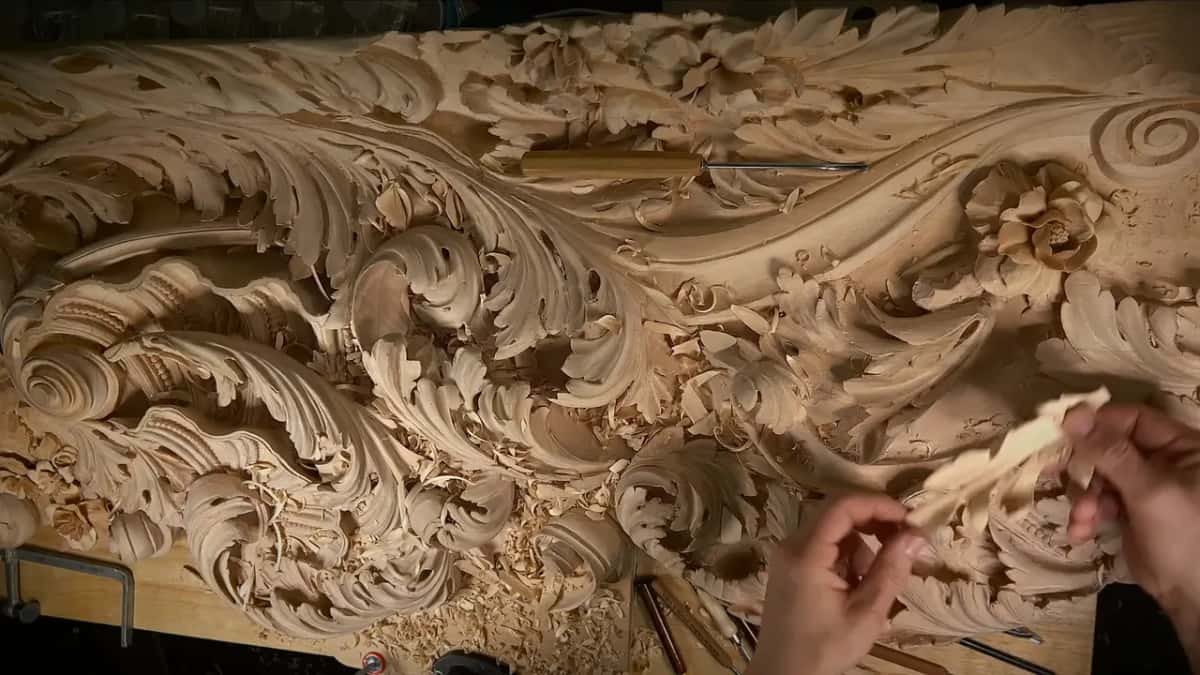
When does the gold leaf go on?
Last. Bill had already put size on one eagle and offered a demonstration, and I said let's do it. Size is the glue for gold leaf, basically a type of varnish in his words, and his was a fast one with a very short window. "The tricky part is the size," he said. "It has to be just the right tack." He thought he might be a little past it already, but we could wing it, he said, and see how it goes.
That eagle had been sanded to about 100 or 150 and given two coats of primer. Lately he puts yellow paint under the gold, because little tiny gaps hide better that way. He rubs a little Vaseline on his hands, rubs the tips of a pure squirrel hair brush on it, and that, he said, is what lets the gold leaf stick when he lays it. Then squares of 23 karat leaf went down onto the tacky size, piece after piece. You can't do it with any motion in the air.
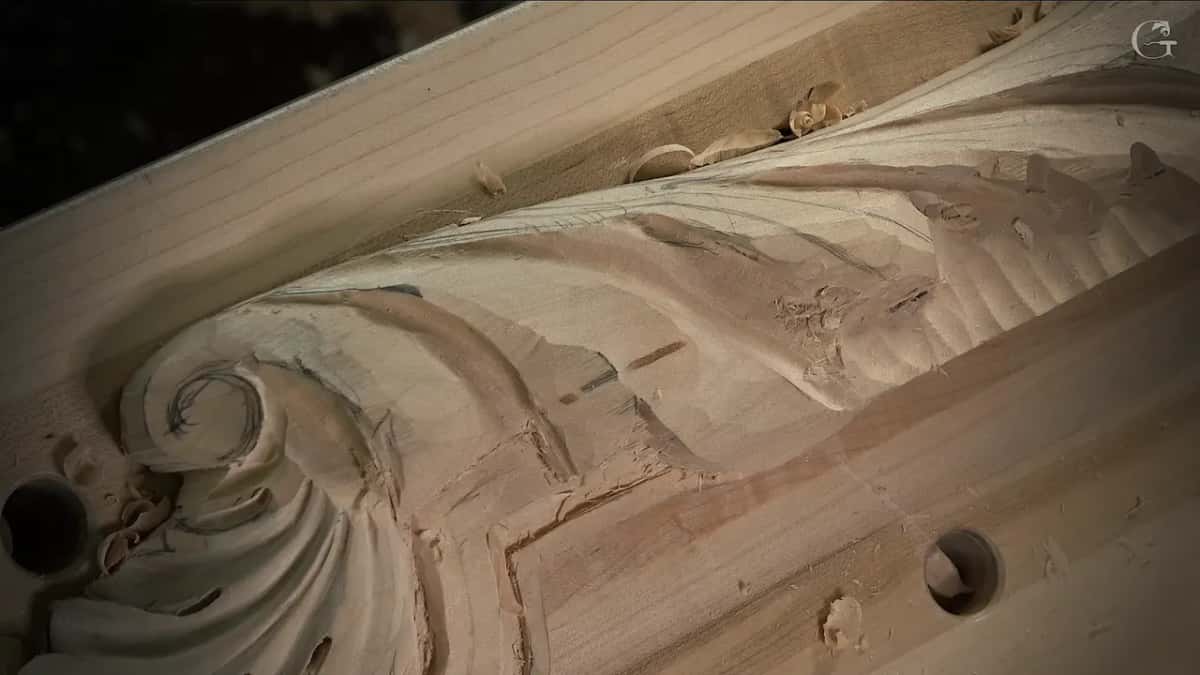
A carved surface eats leaf. Nothing on it is flat, so Bill figures you need about three times as much as on a flat board. He tamps it down gently with a very soft mop brush, and a cosmetic brush works too. Little granules of gold float around on top, and as he keeps brushing they work themselves into the crevices. "There's a mystique about gold," he said. "I didn't go to Paris to learn this."
Gold leaf wears outside in all weather, in his experience, and you don't need a top coat. You really shouldn't. After about three hours he can burnish it with a piece of cotton, though he doesn't always. The bits that fall onto the newspaper go in a cigar box. They are called skewings, and he sprinkles them back on to fill little gaps. How to carve a surface meant for paint or gold is a separate subject, and I covered it in Venice Room workshop 8. Burnishing bare wood is different again, in my burnishing lesson.
What goes on the banners?
Words, flags and one joke. Bill never does one of anything, he told me, so the banners come as a series. One will say Don't Tread on Me, from one of the first American flags. Some carry a place name, and one of those he made for Camden, the town where his school is. Another is for fun. A man in Camden drives around with a Nixon Now sticker on his car. "If anybody here's old enough to remember Nixon," Bill said.
The most popular eagle he has carved, he thinks, is the one he calls the 1812 eagle, and its banner reads liberty or death. A lot of orders have come in for that one. Another very typical Bellamy style eagle of his carries E pluribus unum, the motto of the Great Seal. One of his own designs went to a poet, with some of the man's poetry on its banner, and a second one got arrows in place of the banner. Another eagle is for a dentist office. When folks come over, he tells them he has a dentist practice in the basement.
One pattern Bill had never seen carved. It was printed in a brochure from an exhibit at the Farnsworth Museum in Rockland, Maine, back in the late 1970s, and Bellamy left it in his shop after he died. So Bill decided to make it, and the eagle he has made is the closest he can get to that pattern. On the reversed-wing eagle he is adding laurel leaves at the bottom, a nice green to offset the gold leaf.
Why did a furniture maker start carving eagles?
Furniture is really what he does. His carving goes back about as far as his furniture making, which he put at probably 40 years, and on period pieces he does ball and claws, fans and shell carvings for high end Chippendale furniture. As a young man he bugged an old-time furniture maker in Chester County, Pennsylvania for about four months before the man said they would give it a try. Making a career of it looked like a pretty tough way to make a living. He went to medical school and kept the woodworking on the side.
About six years ago, tired after his day, he was sitting on the couch in front of the TV. He decided to get rid of the TV and put a workbench there instead, and he started carving. He had done a Bellamy eagle a long time before, and after that the eagles took on a life of their own. In his words it is really hard to sell high-end furniture, but the eagles are fairly popular, and when we spoke he had a number of orders and commissions.
He does not carve only eagles, either. I watched him carving a Byzantine acanthus leaf. Bill also runs a school in Camden, Maine, and I had taught a class there the year before this stream. Lessons from my classes in Maine are in the Grinling Gibbons class in Maine.
Why do I invite guests like Bill on air?
Once in a while it is a good idea, as I told the chat in another part of this lesson. I had announced the founder of a furniture school in Austin, then Frank Strazza, then Bill. The week after Bill came Trevor Davis, who makes violins. I even said my guests don't have an accent like I do, so it would be better for you. If you want a live interview with me yourself, a smartphone is enough for me to hook you up.
This lesson and the other live sessions sit in the Livestream events course, and more of these answers live in my techniques course. Full access is on the tuition page. Before we signed off, Bill said he hopes to be doing some of his own teaching as well.
How it's done
- Trace the picture on clear plastic. Bill lays a transparency over a photocopied picture and follows the eagle with a magic marker, reworking the shape there if he wants a different look.
- Shine it on the boards. An overhead projector shines that drawing onto his wood at the size he picked, and the lines go straight on.
- Glue up and saw. Pieces go together into one blank first. The band saw follows with the outline.
- Add the built-up parts. Haunches with claws get glued on, and wing pieces go on behind, sometimes from 4/4 stock.
- Screw a holding block on. A chunk of wood screwed on at the back lets the whole piece go into his vise.
- Make the head apart. Many times he carves it as a separate piece and fixes it on late in the job.
- Prime, paint and gild. Two coats of primer and some yellow paint come first. With the size at the right tack, he lays 23 karat leaf using a squirrel hair brush and tamps it with a soft mop brush.
Frequently asked questions
Where is Bellamy's most famous eagle?
Bill showed me a picture of one with an 18 foot (5.5 m) wingspan and said it is now at the Mariners' Museum in Newport News, Virginia. The Bellamy piece Wikipedia places in that museum is the eagle figurehead he carved for USS Lancaster in 1880.
What wood does William Brown use for his eagles?
Mostly 8/4 pine, about 5 cm (2 in) thick, with thinner 4/4 boards for some of the parts he builds up. A big slab of basswood he called a carving in the rough sat among his offcuts too. For furniture he keeps a separate supply of walnut, maple and cherry.
Does gold leaf on a carving need a top coat?
Bill says no. In his experience real leaf wears outside in all weather, and he told me you really should not put a top coat over it. About three hours after laying it, he sometimes rubs it smooth with cotton.
What to carve next