

Alexander Grabovetskiy, woodcarver, School of Woodcarving · Published 2020
Does a straight gouge last longer than a fishtail gouge?
Quick answer: Straight gouge life is the longer of the two. Its long groove keeps one shape, so I can sharpen that tool for most of my carving life until the groove ends. The fishtail carries its shape only in the tail, and the rest is stem. Still, I use fishtails more often.
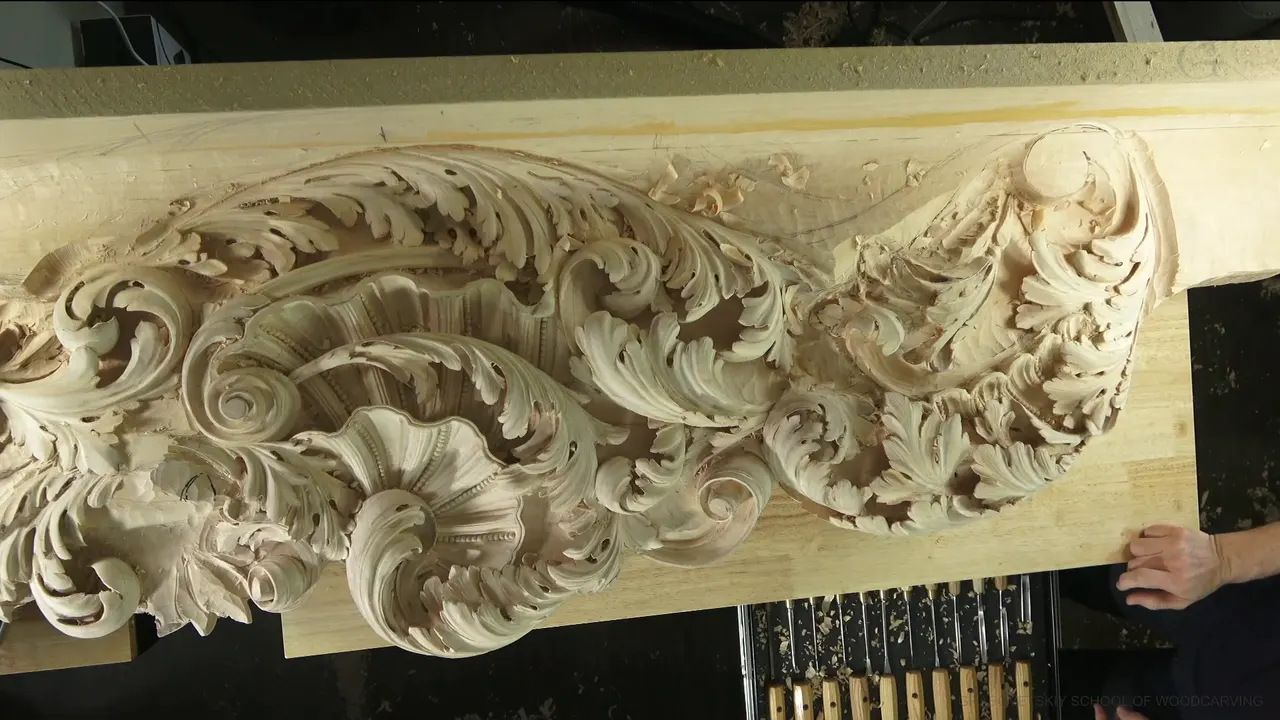
A straight gouge lasts longer than a fishtail gouge in one plain way, because its long groove keeps the same shape far up the steel. That tool I can use pretty much all my life. A fishtail has its shape only in the tail. Behind the tail there is just a stem, and even so I am using fishtails most of the time.
Fishtail gouge vs straight gouge was the question. A member of two weeks asked it on a livestream in April 2020, which went out on several platforms at once, YouTube, Facebook, Twitter and Instagram. I answered with the tools in my hands. That day a real-life project sat on my bench, a long panel of acanthus, and the answer became a short part of my questions and answers lesson. Below it are my own tools, and what all that sharpening did to them.
Have you seen two gouges with the same number on the steel and wondered which one to pick up? Did one of them flare at the end like the tail of a fish? Then you have the question that member had. Both carve the same sweep, and the difference lives in the shank and in the years that follow.
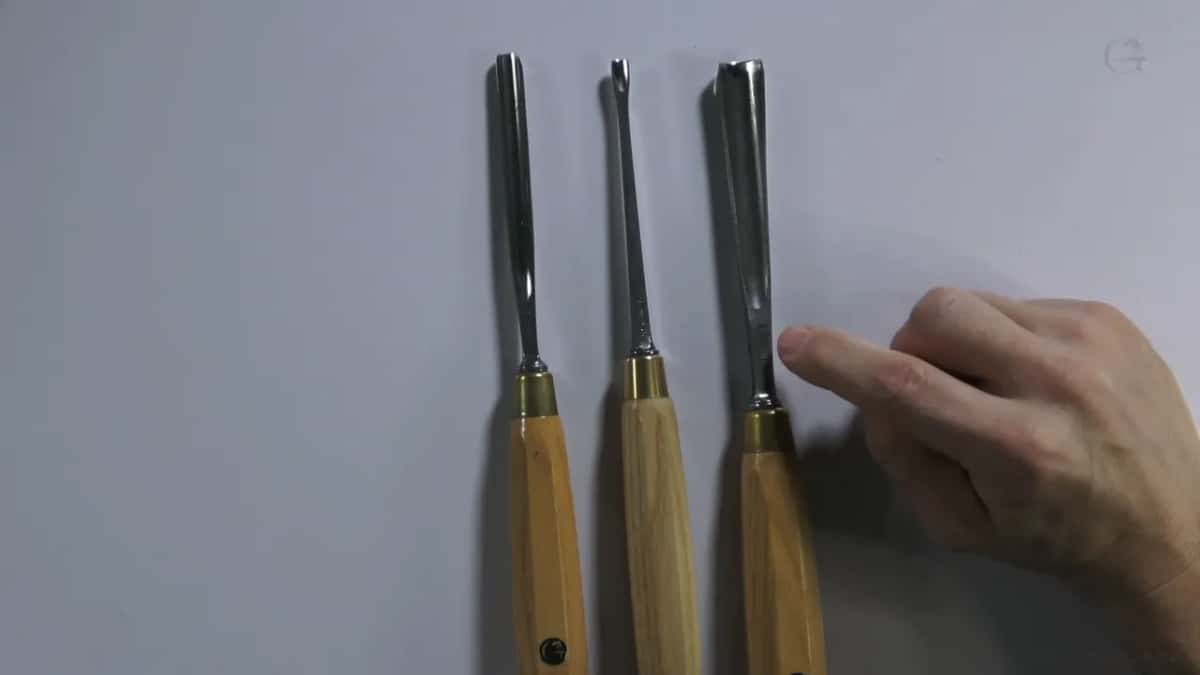
What my own gouges say about the two shapes
- The long groove inside a straight gouge keeps going for most of a working life.
- The fishtail's shape sits in the tail, with a plain stem behind it.
- Two tools of one sweep carve alike on open wood.
- Only the fishtail turns once it is in a hole.
- Regrinding changes how wide a tool comes out, and fishtails are what I use most.
- My old Marples fishtail has an eaten corner, and it still works for me.
What did two number 9 gouges show?
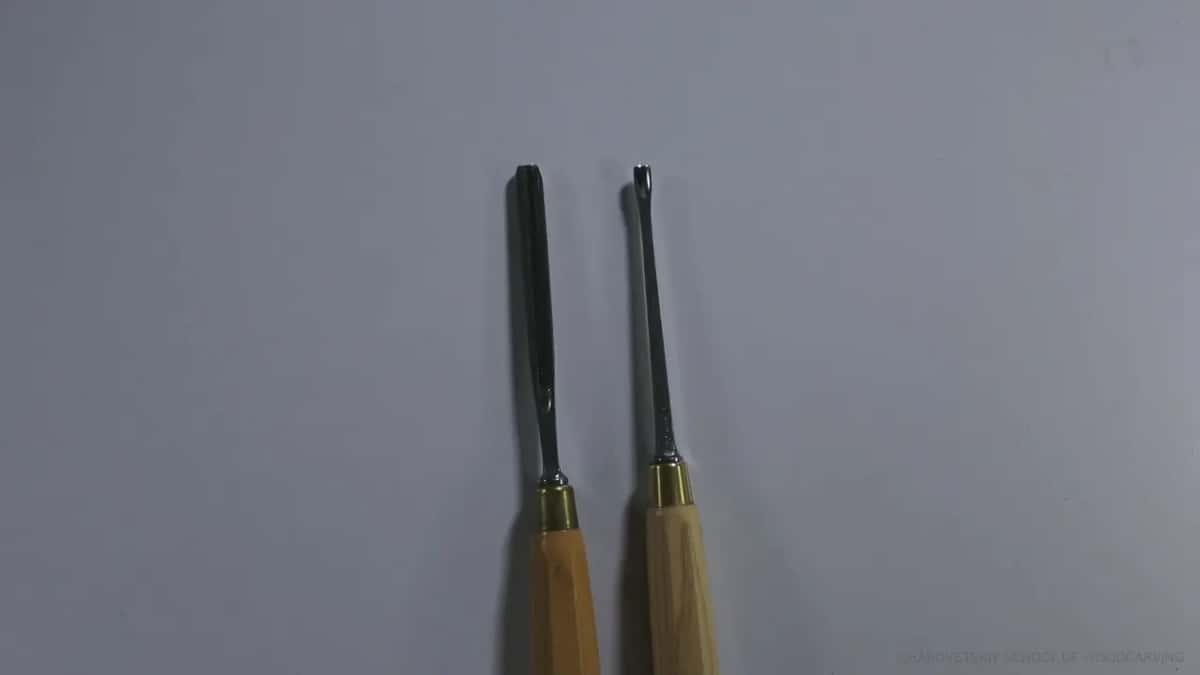
That the stamp is only a start. I took a number nine for the example, two of them, both approximately a quarter inch, and laid them side by side where the camera could see them. One says six millimeters on the steel. So does the other. Supposedly they are both six, and you can still see one is a little wider, even though the same number is marked on both.
Unfortunately I couldn't get any closer to the camera than that. The real difference is on the inside. My straight one has a long groove running up the inside of the steel, and the fishtail has only something like the tail of a fish, with the rest of it just the stem.
A dining table apron is where I put that shape in plain words. It's called a fishtail, and it looks like a fish tail. It's wider at the edge and just narrows down, and you can easily get to the corners with it, and I was using a lot of Ashley Iles on that carving. Later in the same workshop I picked up a Swiss made fishtail three at 20 millimeters, about 3/4 of an inch.

How long does a straight gouge last?
A whole carving life, nearly. I can use that long groove pretty much all my life, until the groove ends somewhere up the steel, and even then the tool is still going to be usable.
In my straight gouge sharpening lesson I held a fishtail beside a straight tool for anyone who does not know what a fishtail is. One has the same property all the way up, I said, and the other has a fishtail end. With the fishtail you can get to the tiniest corners and dig really into the smallest part.

What do years of sharpening do to a fishtail?
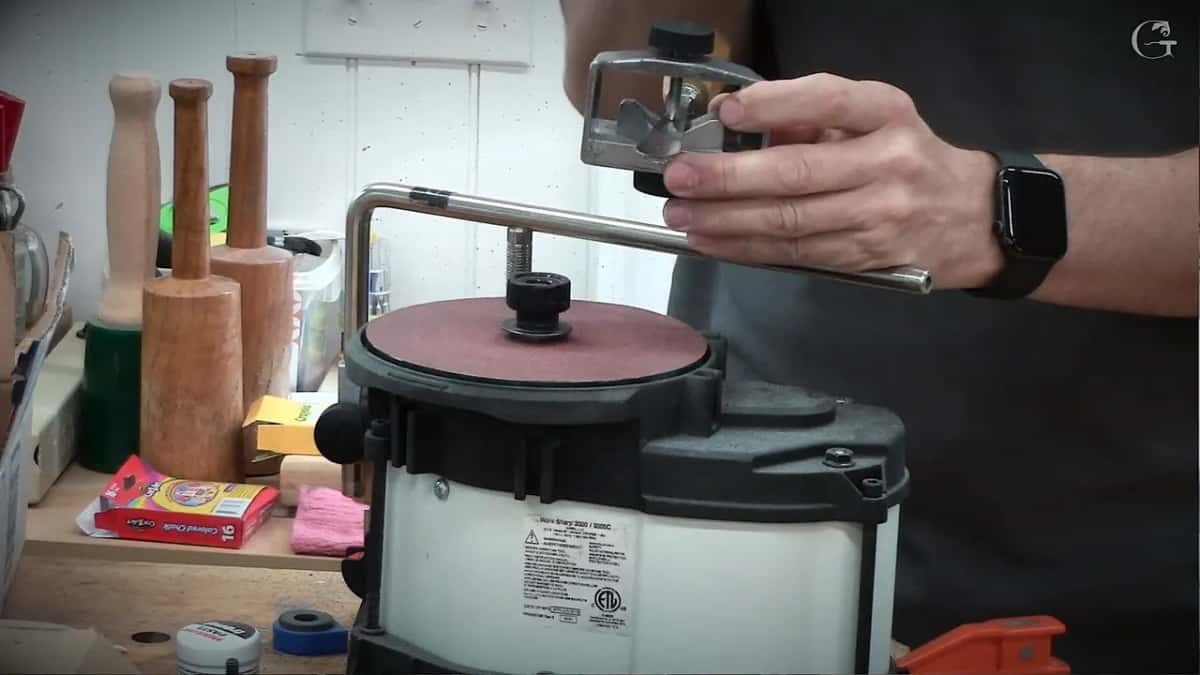
They change it, and I keep using it. That same lesson was about grinding on the Work Sharp, which for me is a workhorse, and about steel that turns blue. If your metal is blue, you killed your tool and you wasted your money.
Then comes the better news. You can resharpen and eat some of that, and it's not the end of the world. Regrind the edge and take out all the blue, but how wide the tool comes out after that depends on what you are using. And I'm using fishtails most of the time, I said in the next breath.
One of them is a short fishtail by Auriou with a small neck, and I don't think any other brand makes one quite like it. Maybe Henry Taylor does, somewhat short but a little longer. Beside another one on a Venice Room panel, I said mine is much shorter if you compare. That other one has the same idea, a really short carving end and a really narrow neck, but it is slightly bent, and even with it I could go in and start some excavation. Just because I sharpened that one so much, it is already shorter than the tool you would buy. I use that tool a lot. It lets me go really deep and work in areas people can't even get into with other tools, and on that panel I needed that shadow.
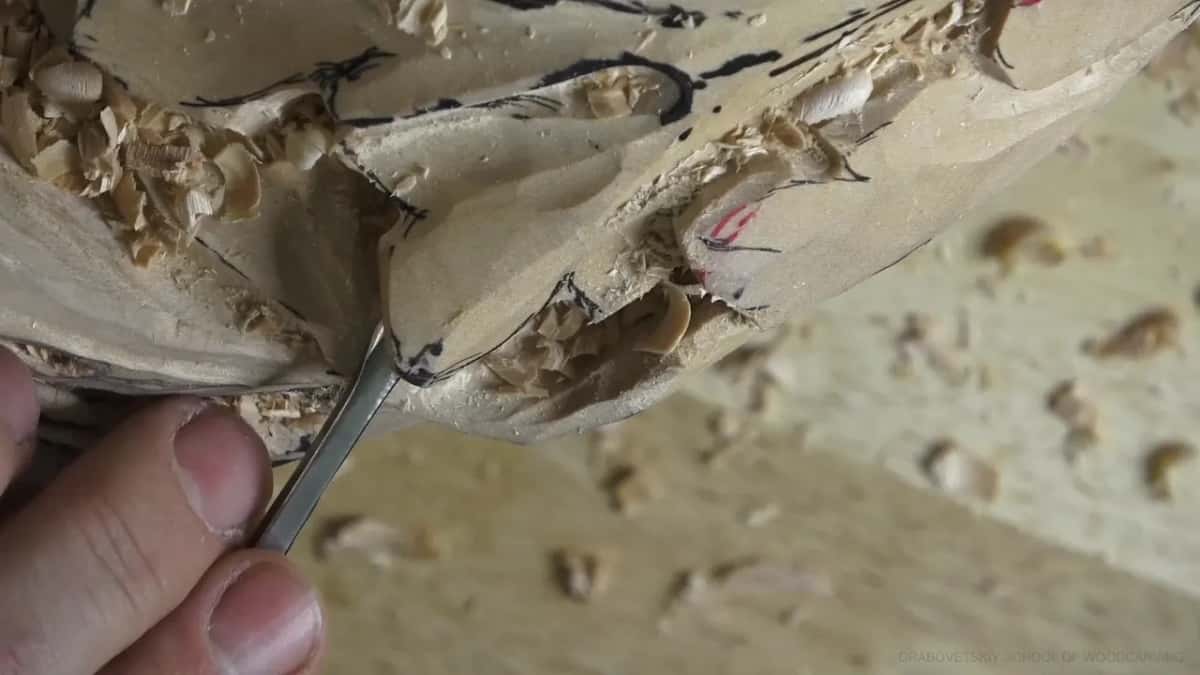
Another fishtail of mine is an old Marples and Sons, an antique Marples from when they had just started. I really like the quality of the tools they made. This one came to me already used, and one of its corners is eaten.
I did not want to sacrifice the tool, and since it is a fishtail I did not want to just straighten it. That's okay, I said on camera. It still works for me. That was on an acanthus over a molding, where I also said I am not a fan of just one brand. Some makers specialize in certain tools and make them better, and I still find unique tools that other brands do not make.

Fishtail gouge vs straight gouge on the same sweep
On open wood they carve alike. To make that plain I pulled a couple of number sevens, both 14 millimeters, half an inch, one a fishtail and the other a longy. Sweep wise, I said, they are the same tool. They do exactly the same operation.
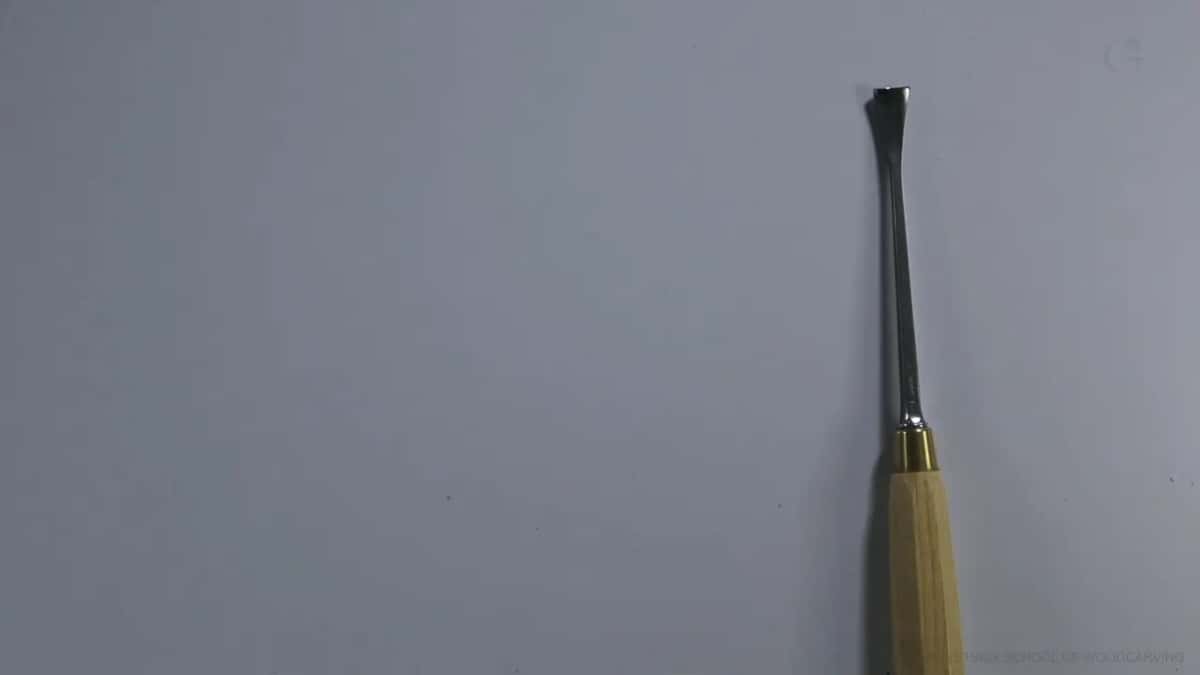
For the beads on a Roman acanthus leaf I picked two small sevens to start their outside form, one an Auriou, a French brand, and the other a Swiss made Pfeil. I called them six and four millimeters. Then I looked again and said about five, and this one is really four, which is about 3/16 and 5/32 of an inch. Almost no difference, and either will do. The Auriou just has a tail at the end while the Pfeil is straight, and they are going to work the same.
Near the end of that part I switched to the 4 mm Pfeil to prove the point. Same operation, different tool. Over that same molding my fishtail was about an eight and a half, around five millimeters, and I said a number nine is going to give you the same result. Because mine is a fishtail, though, I can use just the side of it.
| Pair of gouges | What I said about each pair while I filmed | Where you can watch |
|---|---|---|
| Two number nines | Both marked six millimeters, one still a little wider | This answer, April 2020 |
| Fourteen millimeter sevens | Fishtail and longy that do exactly the same operation | The same livestream answer |
| Auriou and Pfeil | Small sevens, one fishtail, one straight, working exactly alike | Roman acanthus, lesson sixteen |
| A fishtail eight | A nine would give me the same result here | Acanthus over moldings, seven |
| Short Auriou nine | One favorite nine, though any number nine will work | Venice Room, lesson 40 |
| Narrow necked seven | Normal sevens work too, but I like this neck | Venice Room, lesson 56 |
What a fishtail does in the tight corners of a whole flower panel is its own page, Hashemi flowers 32.

Where does the shank decide the carving?
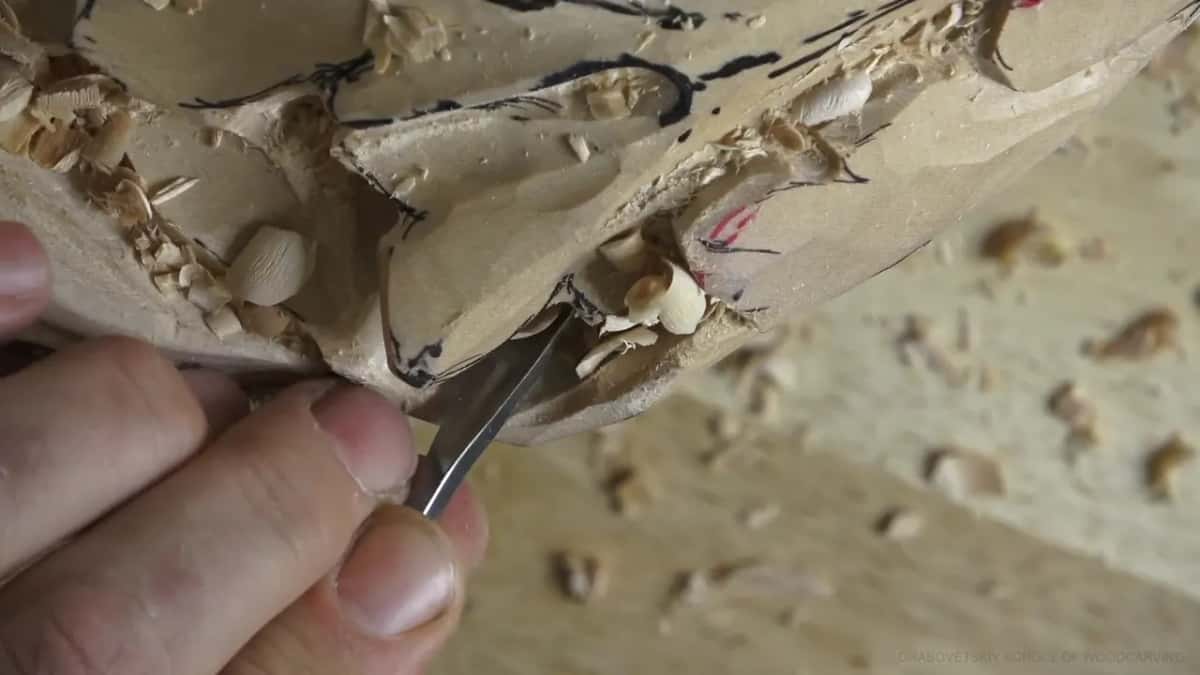
Inside a hole first, and then in the tiniest spots a corner can reach. I showed it right on the carving. With a fishtail I go into the hole, rotate, and carve right on the inside, which is a lot easier for me. The other tool gets into the hole the same way, but I cannot rotate it, so I can't really carve on the inside.
The first time was a little too far from the camera. So I said sorry and showed it again. With a longy and a straight tool you can get inside, but you cannot rotate the tool and you cannot carve all around, while a fishtail carves all around. That's how I do my deep excavations.
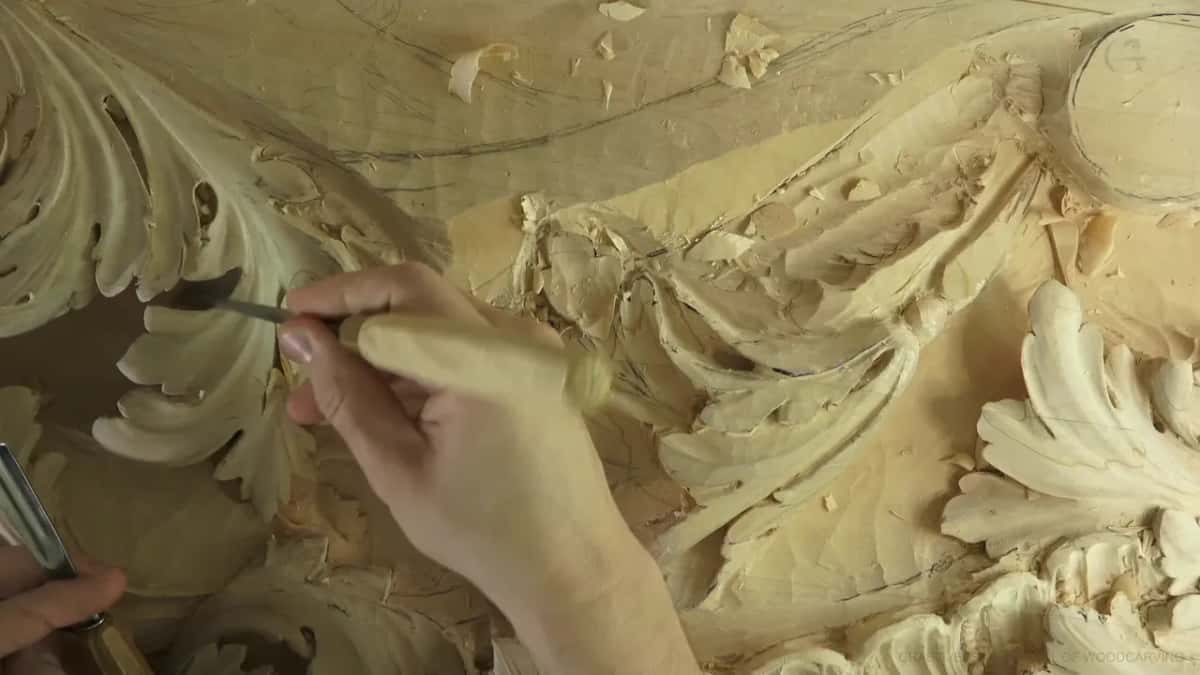
Its second advantage is the corner. Some tiny spots I can reach with just the corner, where I can't get with a straight tool. Working that acanthus over a molding, I took one corner right underneath and grabbed about half a millimeter right away, just to remove some of that stuff. In the Venice Room the small neck of that short Auriou let me go directly underneath, where a full size tool without that small part would not allow it. Inside, I could make a full rotation without touching the space around it.
Another time, in workshop 40 of the Venice Room, I wanted to get really deep, but not too deep, because that piece was going to be visible from the bottom. My short headed nine went in there for plug cuts.
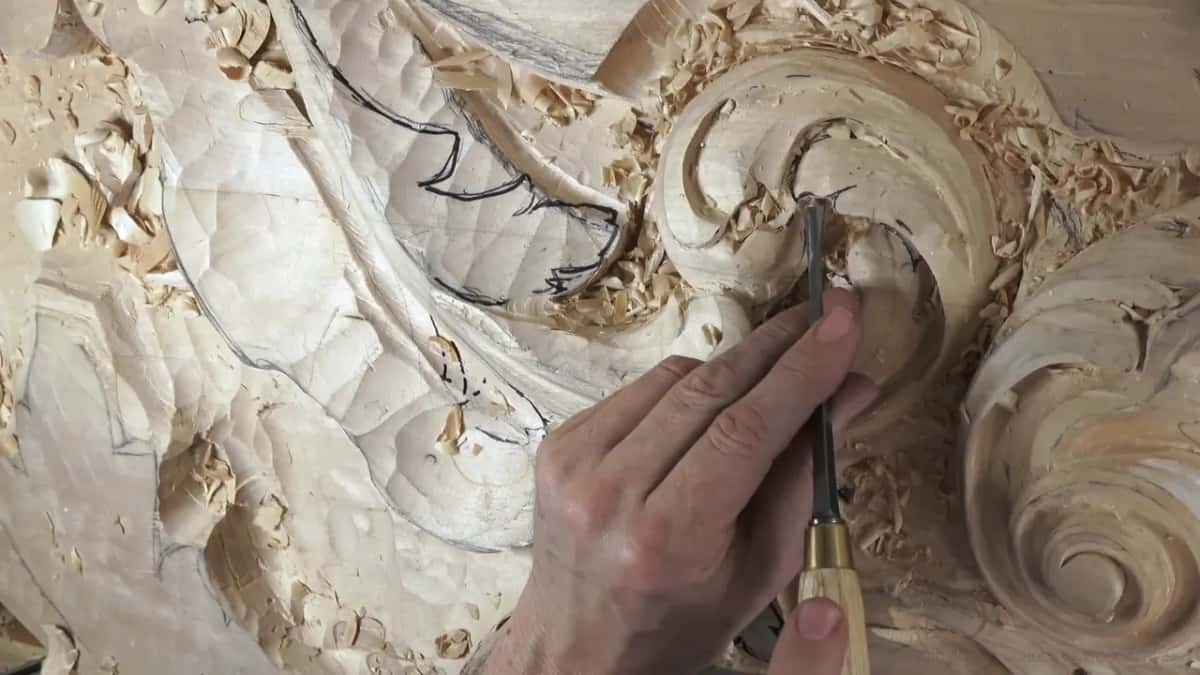
A straight gouge can still go deep. On one Venice Room section I got really deep with just a straight gouge, and then I still had to clean up all that mess without breaking a fragile part, so for that I took the fishtail number nine. Somewhere else I outlined with a 12 mm (1/2 in) fishtail three, then tried the straight tool to clean one side a little. Looks like not much, I said, but yes.
What is a longy gouge?
A gouge that just tapers along the steel. Longy is my own name for it. One of mine is a number nine at 14 millimeters, half an inch, and next to a fishtail it gets into a hole just as well but will not turn there. When a jig question came up in my sharpening class in Maine, I called the tool in it a longy. It's not a straight one, I said, and the flute does not go all the way.
On the grape onlay I took a number three that is somewhat fish style, elongated like a longy. I liked it better than the Pfeil there, which is just a straight tool, and it still gets me closer to the corners.
Fishtail gouges have a separate name. I still call one a straight gouge, because it is not bent, neither a front bend nor a back bend. When a bent tool would help, I say that too, and on a Corinthian acanthus leaf, with a Pfeil fishtail five in my hand, I said a back bend would be an excellent tool there as well. Some are not much of a fishtail anyway, and on the Hashemi flowers I said so about a quarter inch eight.

Which fishtails do I reach for most?
Number nines, and a 14 mm seven. Number nine is the sweep I like to use most, and with a fishtail nine I can get inside the smallest areas and carve there. My short headed Auriou nine at six millimeters is one of my favorite number nines. Why, I don't know. Any number nine will work, but this one feels really special.
On a floral panel with a molding I said a number eight is still going to work, then took a quarter inch fishtail nine, six millimeters, and said I really like this one. Earlier on that panel a quarter inch fishtail five did the undercutting, held upside down and still slicing. During a livestream in October 2020, a fishtail seven of 14 millimeters was one of my favorite tools right now, and I can do a lot of work with that one.

I keep fishtail threes for lowering, too. For the Hashemi flowers I named a 20 mm one, about 3/4 of an inch, to start lowering gradually, and a 12 mm Pfeil three lowered part of a Greek acroterion. A 14 mm Pfeil fishtail seven took out the excess on a grape onlay. I had to be careful not to create too much force there. Then I said maybe this one is too big, and I could probably use a little smaller, but it was all right and I kept going.

So which one should stay on your bench?
Both of mine do. The straight one is the tool for a long life of sharpening, and the fishtail is the one that turns inside a hole and reaches the tiny spots. Every lesson I named here sits inside the school, and the rest of my techniques course answers more questions like this one.
The old Marples with the eaten corner is one I still carve with.
How it's done
- Take two gouges of one number. Pick two tools with the same sweep and about the same width. I used two number nines near a quarter inch.
- Read the stamp, then look. Both of mine said six millimeters on the steel, and one was still a little wider than the other.
- Look along the inside. Down the inside of the straight one runs a long groove. On the fishtail, only the tail carries the shape.
- Take each one into an opening. Go in and rotate. The fishtail turns and does the excavation inside, while a straight tool or a longy gets in but cannot turn.
- Try only the corner. Work a tiny spot with just one corner of the fishtail, a place a straight tool cannot get into.
Frequently asked questions
What's the difference between a gouge and a chisel?
A gouge has a curvature across its edge, and the right word for it is the sweep. In most countries the gouge numbers start from 3, which is almost flat but still has some sweep. Number 1 is always a chisel, not a gouge, with no curvature at all.
Does regrinding change how wide a gouge is?
Grinding away blue steel can do it. Take out all the blue and the width you end up with depends on the tool you are using, and most of mine are fishtails. One short Auriou fishtail of mine is now even shorter than the one you would buy.
Can you still use a fishtail with one corner worn away?
Mine still does the work. An old Marples and Sons fishtail came to me already used, with one corner eaten, and straightening it would have sacrificed the tool. That was okay with me, and I kept carving with it.
What to carve next