

Alexander Grabovetskiy, woodcarver, School of Woodcarving · Published 2020
What does a wood carving pattern not tell you?
Quick answer: A carving pattern is one flat view of the lines from above. It never says how deep a line drops, where a shape rolls downhill, or which wood behind a flower goes to waste. I make those calls as the wood comes off, and sometimes I move a line on the spot.
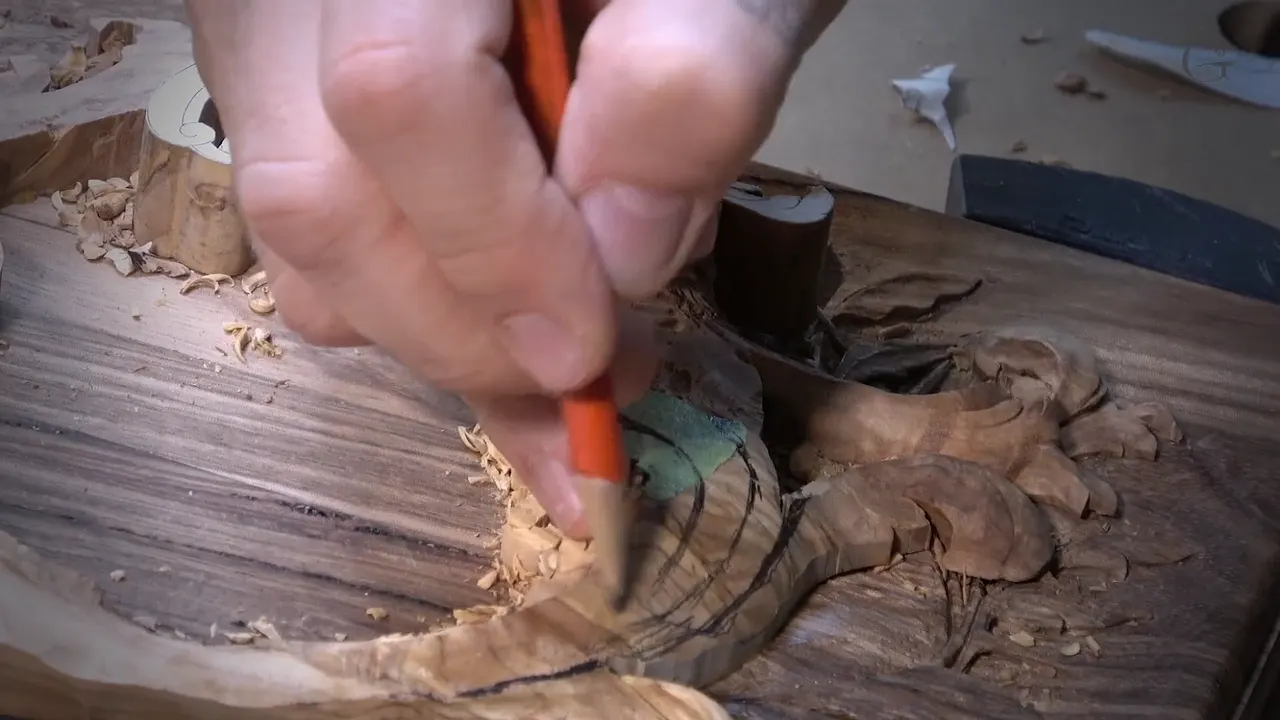
A wood carving pattern is a flat picture of lines seen from straight above, and that is where it stops. How deep each line drops, where a shape rolls downhill and how wide a petal has to stay are things I decide at the bench, with the wood in front of me. Wood carving patterns are usually drawn flat, in two dimensions, and the wood never is.
Did you ever trace a pattern onto a board and then stand there with a gouge, not sure where to go down? Did the lines look right on paper and wrong in the wood? The paper did its part. Every call on this page happened on a real piece in one of my lessons or livestreams, and I name the lesson each time, so you can find the moment yourself.

What did I mean by seeing what two dimensional people don't see?
One question in my questions and answers lesson was whether wood carving is just digging in the wood. My answer was that carving adds a lot more than digging inside the wood. It is the ability to think in a three dimensional world, the ability to see what two dimensional people don't see.
Don't get me wrong. Every human being is able to develop that, because we have the same brains. The rest of that answer, about who comes to my classes in Florida and what I believe the work does for the mind, is in the lesson itself.
On a livestream in October 2020 I put it another way. To dig wood or poke a gouge into the fibers is easy, and you can learn to carve really quickly. The design part is much harder, because you are designing for 3D, and that is really hard. Looking at the piece I showed that day, you saw the whole thing, and yet it was twisted, with two surfaces, one turned 90 degrees to the other, and a leaf that wraps around both sides.

What the paper leaves for you to decide
- How deep a line drops, and whether it rolls downhill on the way.
- Lines that flow on paper can leave a ridge.
- Waste behind a small flower is close to impossible to draw from one view.
- Lines move on the spot, once by about 3 mm (1/8 in).
- Two matching panels leave less room.
- Hard woods take another design.
Why can't you carve straight from wood carving patterns?
A pattern only holds what one view from above can show. In lesson 5 of my lily box, working on the lid, I said it out loud. Sometimes you really can't tell from a 2D drawing what exactly is going on.
Some people would love to get patterns. Once they get them, they have no idea what to do with them, because the pattern is usually in a two dimensional world, and you really have to think in three dimensions. Right before that I had taken a number 7 of about 3/4 of an inch (19 mm) for one clean pass, and I called the shape a three dimensional movement. Then I took that part downhill, and it started to make sense.

Technical drawing handles the same gap by setting several flat views of one object side by side, up to six of them, and calls it multiview projection. A pattern usually gives you that one view from above.
What does a carved line have to do that a drawn one doesn't?
It has to flow downhill as well as across. Back in lesson 4 of the lily box I looked at my paper and told you it is different there, because you look at a two dimensional world. In 3D you have a lot more space.

So when you redraw those lines on the wood, make sure they flow nicely there too. I took a pencil, because that way I can always redraw. Flowing lines, or tangent lines, have to work in the wood as well as on paper. I turned it to show you on camera how the curve carried on all the way round.
A little later in that lesson I could feel a ridge where one shape went into the next, and I did not like it. Same rule, I said. The flow line has to continue in 3D.

My furniture panel, in lesson 21, got the same rule for an acanthus movement. The curve can be a really beautiful, flowing movement, and it also has to go downhill nicely, gradually, and it cannot be choppy. Looking from above will not always show you that. For the lily box lid I looked from the side, because sometimes a slope is impossible to see from above, and set my lines again with the same tool.

How do you know which wood turns into waste?
Mostly from the wood itself, as it comes off. Carving the small filler flowers in lesson 12 of the lily box, I took wood off the back side, careful not to take too much, and all of it was going to be waste. When I drew those flowers, that waste was not really visible on flat paper.
Not everything is possible to draw in two dimensions. It can be done if you make several drawings from different angles, and I am not saying it is impossible. With just the one look from above, though, it is almost impossible to create those little things, and I like to put a waviness even into tiny flowers like those.

Depth also gets felt out in small steps. Back on the second layer of that lid I liked how the shape was flowing in three dimensions, and then I took a 1 mm (about 1/32 in) number 11 and started digging underneath a little. That was not the real undercutting yet, just an indication for me on a relief carved in layers, and later on the lily flower I undercut both sides.
In the design part of the furniture panel course I compared carving with other work. Photos, films, drawings, oil or acrylic on a canvas all stay flat. Carving works in three, and it depends how deep your chisel travels, how you create the shadow and how the light is going to hit. Some people call that panel style Chippendale, though hundreds of carvers used that shallow carving technique, so it is not necessarily true Chippendale.

Can you move a line that is on the pattern?
Once in a while I have to, and I did it on the lily itself. In lesson 10 one line was supposed to sit right here, and I moved it slightly. I moved another one in from the edge a little, because I wanted that flower to keep enough width. That is sometimes the decision I have to make on the fly.
Drawing a lily on a piece of paper is one thing, and working it in three dimensions is another.

In workshop 75 of the Venice Room I placed an eye with a number 11, 5 mm (3/16 in), and said I could have made it a little bigger. I looked at it, and it did not make too much sense, so I changed it. Overall movement stayed the same, and only minor details changed. On paper something sometimes looks one way, and in real life it just does not look too good.
Back in workshop 3 I said that when I want a change, I do a little bit, and there I just moved a line about an eighth of an inch, about 3 mm. Carving the floral and molding panel, I checked the piece I had carved before, saw that it rolls a little differently, and started my movement farther over so it would look more organic. I was not sure, and I said so on camera.
| Pattern | Bench | Lesson |
|---|---|---|
| Lily lines from above | One line moved so the flower kept enough width | Lily box, lesson 10 |
| Filler flowers drawn flat | Back side carved away, waste the drawing never showed | Lily box, lesson 12 |
| An eye position marked | Minor details changed and the overall movement stayed put | Venice Room, workshop 75 |
| Main movements already in | That movement got exaggerated because it felt too flat | Venice Room, workshop 72 |
| Curve drawn nicely flowing | Brought downhill gradually so the movement is not choppy | Furniture panel, lesson 21 |

When should you stay with the drawing?
When two pieces have to match each other. Working on the background of the furniture panel, I said it is okay to change a design on one panel like that. Two panels that are supposed to be symmetrical to each other are a different story, and there you can only change it to a certain degree.
At my Grinling Gibbons class in Maine I said I like to work on original pieces more than on a replica. A replica has to be super accurate. An original gives you some flexibility.
Sometimes your tools decide it for you, and for my furniture panel I took a number 8 of about half an inch, 14 mm, and told you it does not have to be 14 mm, because your panel may come out slightly different. Go ahead and alter your design if you need to, to fit the tools you have.

Why does a carving look flat when it follows the pattern?
Main shapes in the right places are not enough on their own. In workshop 72 of the Venice Room I had my main movements, main concaves and main convexes, and it still did not feel three dimensional. It was just a little too flat for my taste, so I decided to exaggerate that movement, and part of another one.
Pretty much, carving is an art of exaggeration, I told you in workshop 61. I did not worry about losing the middle part, because it was not the final, and it was going to get a lot more exaggeration. I said see how much it gives the dimension, and then added, not dementia, dimension.

The lily flower had its overall shape already, and then it was all about how much detail to add. One spot had too much flatness, so I gave it some roundness with a number 1 that has a double bevel and a really low bevel.
Does the kind of wood change the design?
It does, and somebody asked me exactly that on a livestream in April 2020. I have to understand the property of the wood I am carving.
Working with lime wood is not the same as working with basswood, and harder woods like oak, walnut and mahogany are different again. Even birch is a little different, and it is not that hard. With basswood I can do pretty much anything, and that is why I like it.
The lily box is Mediterranean acacia, and on the lily flower there were spots I could not even get through sometimes. Really, really dense.

Why keep the details rough until the form is right?
A change is cheap early on. In my Maine class I told students there are two approaches. Some carvers work the details first, area by area, and clean each one up completely. If you then want a different design, you have wasted so much time, and it is going to get to you.
I take the second approach. I create the main form first and then work the details, so if I need to change something, I did not waste too much time. Teaching the modern acanthus, I said don't overdo it, because when you look at it with a fresh eye, you want to change something.
Even on the lily box lid I left one flip undrawn for a while. I did not need to draw it yet, because the overall movement had to be there first.
How do you learn to see past the paper?
By carving, and even a nearly flat beginner piece helps. On the curly kitchen cutting board in my beginner course, the carving is more like 2D, and you are still training your hand to feel how deep your knife has to travel. You control the pressure, and it really trains you.
I said that kind of carving is actually the best practice for the three dimensional world. For a really low pass I hold the knife from higher up, because a hand lying on the wood will not let me lower it any more.

Psychologists have a name for turning flat and solid figures around in your head, visuospatial ability. I have carved since I was six years old, and in my case that ability just came naturally with the carving. And every human being can develop it.
Getting the lines onto the board is a separate job. I draw mine on an iPad and scale them in SketchUp. Carrying measured points off a flat print with calipers is how I worked a corbel in workshop 86 of the Venice Room.
Do you want to watch me make these calls on real wood? Every lesson here sits inside the school, and the tuition page shows the plans.
How it's done
- Redraw your lines in pencil. Once the first wood is off, redraw on the carving itself, in pencil so you can always redraw. Make sure those lines are flowing nicely in the wood too.
- Check the slope side on. Turn the piece and look at it from the side, since a slope can be impossible to see from above. Set the line again with the same tool.
- Bring up the whole form first. Carve the main form before any detail, and don't overdo one area. A fresh look later may change your mind, and then you have lost very little time.
- Fit the design to your tools. If your gouge is a different size from mine, go ahead and change the design. Whatever fits is fine.
Frequently asked questions
Why do patterns confuse beginners?
Usually they show lines from one view and nothing more. People would love to get a pattern, and once they have one they often don't know what to do with it, because it is drawn in two dimensions. You have to think in three dimensions on top of the paper.
Can a carving pattern show depth?
Not much of it. Drawings, photos and paintings on canvas all stay flat, while carving depends on how far down the chisel travels, how you create the shadow and how the light is going to hit it, and you settle all of that in the wood itself.
Is changing a carving pattern a mistake?
Not on an original piece. On paper a detail can look one way and in real life just not look good, so once in a while I change minor details and keep the overall movement. A pair of panels that must be symmetrical gives you much less room.
What to carve next